Startup Idea Generator
AI-Powered • Market Analysis • Feasibility Assessment
Advanced Startup Idea Formula
Generate IdeasAdvanced Formula = [Market Gap] + [Technology Trend] + [User Pain Point] + [Business Model] + [Scalability Factor] + [Competitive Advantage]
Components:
- Market Gap: Underserved segment or unmet need
- Technology Trend: Emerging tech opportunity
- User Pain Point: Specific problem to solve
- Business Model: Revenue generation strategy
- Scalability Factor: Growth potential assessment
- Competitive Advantage: Unique value proposition
Example: "Generate 10 profitable startup ideas in the AI-powered productivity tools industry targeting remote workers who struggle with time management. Focus on SaaS models with network effects and recurring revenue potential. Consider current trends in automation, personalization, and workplace collaboration."
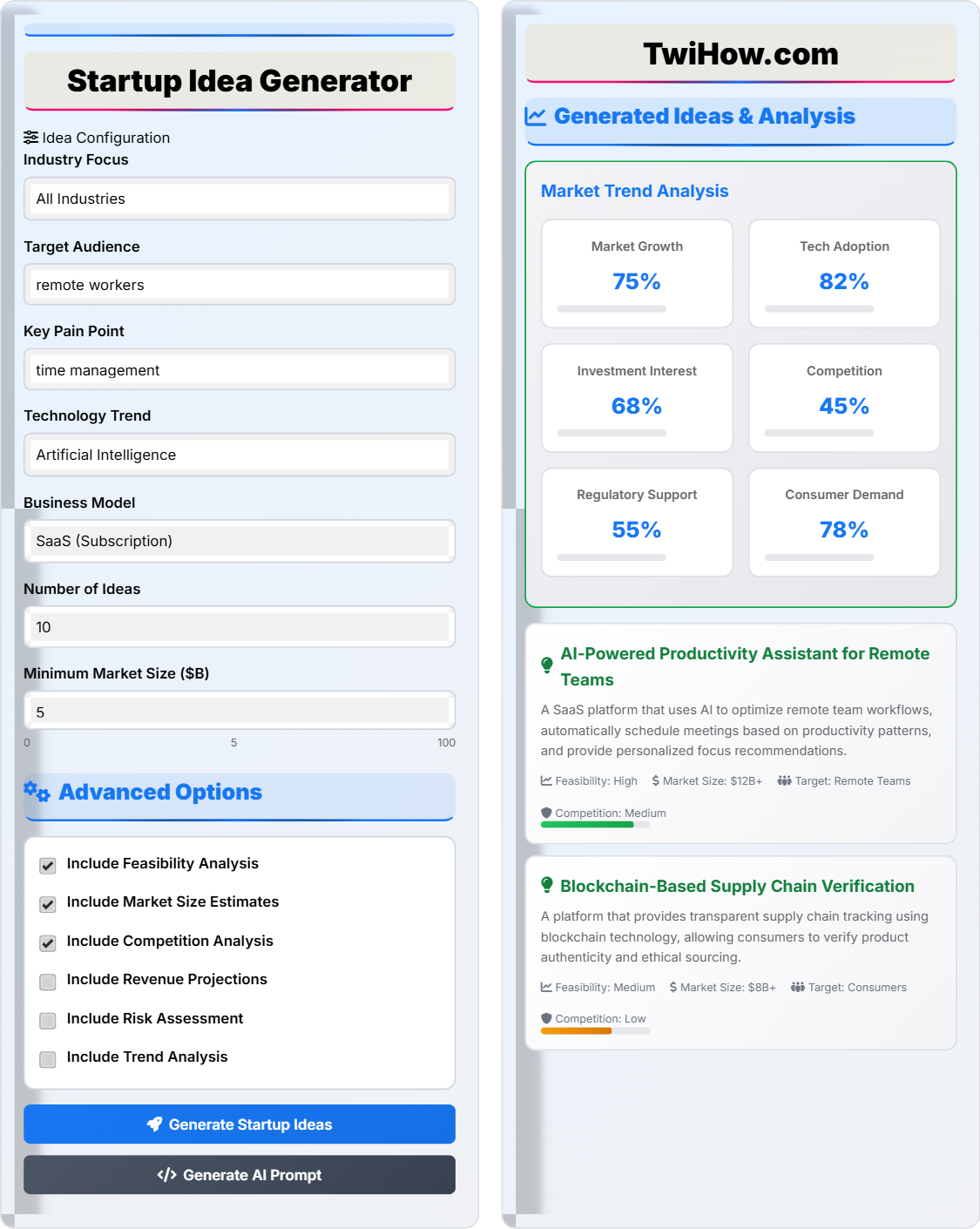
Idea Configuration
Advanced Options
Generated Ideas & Analysis
Market Opportunity Analysis
Total Addressable Market (TAM)
$45B+ across selected industries
Growth Rate
15-25% annually
Competition Level
Moderate with gaps in niche segments
Investment Readiness
High investor interest in selected areas
Comprehensive Startup Idea Generation Process
Market Research & Trend Analysis
Begin by identifying emerging market trends, consumer behaviors, and technological shifts. Analyze market size, growth projections, and competitive landscape to find underserved niches.
Pain Point Identification
Identify specific problems that your target audience faces. These could be inefficiencies, unmet needs, or frustrations with existing solutions. Focus on problems that cause significant impact or cost.
Technology Integration
Consider how emerging technologies can solve identified problems. Look for synergies between market needs and technological capabilities. Evaluate feasibility and implementation costs.
Business Model Validation
Define your revenue model and validate its sustainability. Consider subscription, marketplace, freemium, or other models. Ensure the solution creates enough value to justify pricing.
Competitive Analysis
Research existing competitors and identify your unique value proposition. Determine how your solution differs from current offerings and why customers would choose yours.
Feasibility Assessment
Evaluate the technical, financial, and regulatory feasibility of your idea. Consider development timeline, required resources, and potential barriers to entry.
Real-World Startup Idea Examples
Expert Q&A Session
Validating your startup idea is crucial before committing resources. Here's a systematic approach:
- Problem Validation: Conduct surveys and interviews with potential customers to confirm the problem exists and is painful enough to pay for a solution.
- Solution Validation: Create a simple prototype or MVP to test if your solution actually addresses the problem effectively.
- Market Validation: Analyze competitors and market size to ensure sufficient demand and differentiation opportunities.
- Business Model Validation: Test pricing assumptions with potential customers to ensure willingness to pay.
- Financial Validation: Calculate customer acquisition costs and lifetime value to ensure profitability.
Remember, the goal is to falsify your assumptions quickly and cheaply. If your idea doesn't pass initial validation, pivot early rather than invest heavily in a flawed concept.
True innovation creates new markets or dramatically transforms existing ones, while incremental improvements enhance current solutions. Key characteristics of truly innovative ideas:
- Paradigm Shift: Changes how people think about solving the problem, not just the solution itself.
- Network Effects: Value increases as more users join, creating defensible moats.
- Platform Potential: Enables other businesses or services to build upon it.
- Defensible Position: Creates barriers to entry through patents, data, or switching costs.
- Scalability: Can grow exponentially without proportional cost increases.
For example, Uber didn't just create a better taxi booking app—it transformed urban transportation by leveraging underutilized assets (private cars) and creating a new economic model (gig economy). This represents true innovation versus incremental improvements to existing taxi services.
Timing is often the most critical factor in startup success, sometimes more important than the idea itself. Here's why:
- Market Readiness: Even the best idea will fail if the market isn't ready. Consider when Netflix tried DVD-by-mail in 1997 vs. streaming in 2007.
- Technology Maturity: Some innovations require supporting infrastructure to mature first (e.g., electric vehicles needed battery technology).
- Regulatory Environment: Changes in regulations can create or eliminate entire market opportunities.
- Competitive Landscape: Being first has advantages, but being too early can mean educating the market alone.
- Economic Conditions: Funding availability and consumer spending patterns vary with economic cycles.
The most successful startups often emerge when multiple favorable conditions align—market need, technology readiness, and favorable business environment. Pay attention to macro trends and adapt your launch timing accordingly.
About Startup Idea Generator
Innovation Research Team
This startup idea generator combines market intelligence, trend analysis, and business model expertise to help entrepreneurs discover viable business opportunities. Our algorithm analyzes thousands of data points including market size, growth trends, competitive landscapes, and technological feasibility.
The system incorporates insights from successful startups, investor preferences, and emerging technology trends to generate ideas with higher probability of success. Each suggestion includes market analysis, feasibility assessment, and strategic recommendations.
Used by 50,000+ entrepreneurs and startup accelerators worldwide
Updated: April 2026 • Version 3.2.1