Avogadro's Law Calculator
Complete chemistry guide • Gas law simulations
Avogadro's Law::
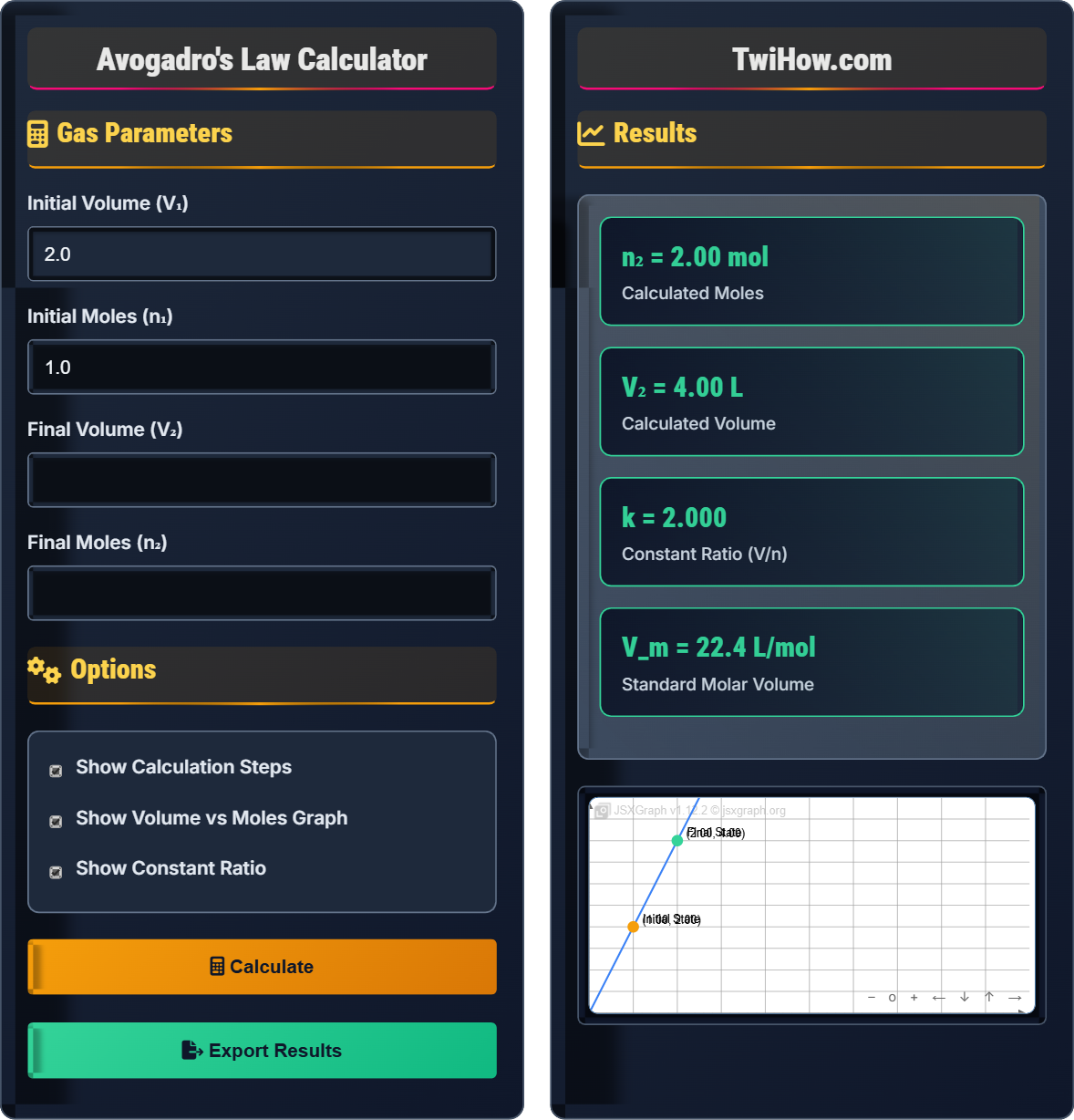
Show the calculator /Simulator\( \frac{V_1}{n_1} = \frac{V_2}{n_2} \)
This law states that equal volumes of gases, at the same temperature and pressure, contain an equal number of molecules (or moles). The relationship shows that volume (V) is directly proportional to the number of moles (n) when temperature and pressure are held constant.
Key relationships:
- If the number of moles increases, volume increases proportionally
- If the number of moles decreases, volume decreases proportionally
- The ratio V/n remains constant for a given gas at constant T and P
Use this law when comparing the volumes of gases at the same conditions of temperature and pressure, or when calculating how changes in the amount of gas affect its volume. It's fundamental in stoichiometry of gaseous reactions and in understanding molar volume relationships.
Gas Parameters
Options
Results
| Parameter | Initial | Final | Change |
|---|
Enter parameters to see calculation steps.
Avogadro's Law Explained
Avogadro's Law, formulated by Amedeo Avogadro in 1811, states that equal volumes of gases, at the same temperature and pressure, contain an equal number of molecules (or moles). This fundamental gas law establishes a direct proportional relationship between the volume of a gas and the number of moles of gas particles present. The law is particularly important in stoichiometry and helps explain why gas volumes combine in simple whole-number ratios in chemical reactions.
Avogadro's Law can be expressed mathematically as:
Or equivalently: V = kn (where k is a constant)
Where:
- V₁ = Initial volume of the gas
- n₁ = Initial number of moles of gas
- V₂ = Final volume of the gas
- n₂ = Final number of moles of gas
Key applications of Avogadro's Law include:
- Stoichiometry: Calculating volumes of gases in chemical reactions
- Gas Mixtures: Understanding partial pressures and mole fractions
- Standard Conditions: Establishing molar volume relationships
- Industrial Processes: Calculating gas requirements and yields
- Ideal Gas Behavior: Avogadro's Law applies perfectly to ideal gases
- Real Gas Deviations: At high pressures or low temperatures, real gases deviate from ideal behavior
- Non-Ideal Conditions: Corrections may be needed for precise measurements
- Atomic vs Molecular: Applies to atoms as well as molecules
Avogadro's Law Fundamentals
Equal volumes of gases at the same T and P contain equal number of molecules.
\( \frac{V_1}{n_1} = \frac{V_2}{n_2} \)
Where V = volume, n = moles.
- T and P must remain constant
- V and n are directly proportional
- Applies to all gases
Applications
Volume ratios equal mole ratios for gases at same T and P.
- Chemical reaction calculations
- Industrial gas processes
- Atmospheric science
- Medical gas applications
- Only applies at constant T and P
- Ideal gas approximation
- STP: 22.4 L per mole
- Deviations at extreme conditions
Avogadro's Law Learning Quiz
If 2.0 moles of a gas occupy 44.8 L at STP, how many moles would occupy 67.2 L at the same conditions?
Using Avogadro's Law: V₁/n₁ = V₂/n₂
Given: V₁ = 44.8 L, n₁ = 2.0 mol, V₂ = 67.2 L, n₂ = ?
Rearranging: n₂ = (V₂ × n₁) / V₁
n₂ = (67.2 × 2.0) / 44.8 = 134.4 / 44.8 = 3.0 mol
The answer is B) 3.0 moles.
Avogadro's Law shows the direct relationship between volume and moles of gas at constant temperature and pressure. When we set up the proportion V₁/n₁ = V₂/n₂, we're establishing that the ratio of volume to moles remains constant. Solving for the unknown involves cross-multiplication and algebraic manipulation. Notice that as volume increased by 50% (from 44.8L to 67.2L), the number of moles also increased by 50% (from 2.0 mol to 3.0 mol), demonstrating the direct proportionality.
Avogadro's Law: Volume is directly proportional to number of moles at constant T and P
STP: Standard Temperature and Pressure (0°C, 1 atm)
Mole: Amount of substance containing 6.022×10²³ particles
• V/n = constant when T and P are constant
• Direct proportionality: V₁/n₁ = V₂/n₂
• Applies to all ideal gases regardless of identity
• Always keep T and P constant when applying this law
• Cross multiply to solve for unknown quantities
• Remember: doubling moles doubles volume
• Forgetting to keep temperature and pressure constant
• Mixing up direct and inverse relationships
• Incorrectly setting up the proportion
A sample of oxygen gas contains 0.5 moles and occupies 11.2 L at STP. If 0.3 more moles of oxygen are added while keeping temperature and pressure constant, what will be the new volume of the gas?
Step 1: Identify initial conditions: n₁ = 0.5 mol, V₁ = 11.2 L
Step 2: Calculate final moles: n₂ = n₁ + added moles = 0.5 + 0.3 = 0.8 mol
Step 3: Apply Avogadro's Law: V₁/n₁ = V₂/n₂
Step 4: Solve for V₂: V₂ = (V₁ × n₂) / n₁
Step 5: V₂ = (11.2 × 0.8) / 0.5 = 8.96 / 0.5 = 17.92 L
Therefore, the new volume will be 17.92 L.
This problem requires multiple steps but follows the same principle of Avogadro's Law. First, we identify what we know and what we need to find. Then, we calculate the final number of moles after adding more gas. Finally, we apply the law to find the new volume. The key insight is that adding more gas particles (moles) at constant temperature and pressure necessarily increases the volume proportionally. This demonstrates how Avogadro's Law predicts the physical behavior of gases.
Gas Expansion: Increase in volume due to increase in number of gas particles
Addition of Gas: Increasing the amount of substance in a container
Proportional Change: Volume changes in direct proportion to mole changes
• Always calculate total moles for final state
• Keep temperature and pressure constant
• Volume increases with addition of gas
• Always calculate the total final amount before applying the law
• Check that your answer makes physical sense (more gas = more volume)
• Verify that temperature and pressure remain constant
• Forgetting to add the additional moles to get total moles
• Assuming the volume stays the same after adding gas
• Incorrectly applying the proportion
In the reaction 2H₂(g) + O₂(g) → 2H₂O(g), if 4.0 L of hydrogen gas reacts completely with excess oxygen at constant temperature and pressure, what volume of water vapor will be produced? (Assume all substances are gases at the reaction conditions.)
Step 1: Identify the stoichiometric ratio from the balanced equation: 2H₂ : 1O₂ : 2H₂O
Step 2: According to Avogadro's Law, volume ratios equal mole ratios for gases at same T and P
Step 3: 2 volumes H₂ produce 2 volumes H₂O
Step 4: Therefore, 4.0 L H₂ will produce 4.0 L H₂O
Alternatively: 4.0 L H₂ × (2 L H₂O / 2 L H₂) = 4.0 L H₂O
Therefore, 4.0 L of water vapor will be produced.
This problem combines Avogadro's Law with stoichiometry. The key insight is that at the same temperature and pressure, the volume ratio of gases equals their mole ratio. So, 2 moles of H₂ producing 2 moles of H₂O means 2 liters of H₂ produces 2 liters of H₂O. This demonstrates how Avogadro's Law connects macroscopic measurements (volumes) with microscopic reality (stoichiometric ratios). This principle is fundamental in gas-phase reaction calculations.
Gas-Phase Stoichiometry: Using volume ratios instead of mole ratios for gases
Chemical Equilibrium: Balance of reactants and products in a reaction
Excess Reagent: Reactant present in greater quantity than needed
• Volume ratios equal mole ratios for gases at same T and P
• Balanced equation provides stoichiometric ratios
• Apply Avogadro's Law to connect volume and moles
• For gases at same T and P, use volumes directly in stoichiometry
• Same coefficients mean same volume ratios
• Always verify that all substances are gases
• Not checking that all substances are gases
• Using mass ratios instead of volume ratios
• Forgetting that volume ratios equal mole ratios
At STP, 1 mole of any gas occupies 22.4 L. If a balloon contains 0.25 moles of helium gas at STP, what is the volume of the balloon? If the balloon is heated to double the temperature (while keeping pressure constant), how many moles of helium would be needed to maintain the same volume?
Part 1: Using Avogadro's Law at STP
1 mol of gas = 22.4 L, so 0.25 mol = 0.25 × 22.4 = 5.6 L
Part 2: When temperature doubles, the gas law changes from Avogadro's Law to Charles's Law (V/T = constant) because pressure is constant but temperature changes.
However, if we want to maintain the same volume at higher temperature, we would need to decrease the number of moles to compensate for the temperature increase.
But if we want to maintain the same volume with the same temperature effect, we would need fewer moles. Actually, if temperature doubles and we want to maintain the same volume, we would need half the moles if pressure remains constant.
Wait, let's reconsider: If temperature doubles and we want to maintain the same volume while pressure remains constant, we would need to reduce the moles to maintain the same volume according to the combined gas law.
Actually, if we want to maintain the same volume at the new temperature, we need to consider: if T doubles and P is constant, then according to PV=nRT, if V is to remain constant, n must be halved to compensate for the doubled T.
So we would need 0.25/2 = 0.125 moles of helium.
This problem requires understanding the limitations of Avogadro's Law. Avogadro's Law only applies when temperature and pressure are constant. When temperature changes, we need to consider other gas laws. However, if we want to maintain the same volume at a higher temperature, we need to reduce the amount of gas (moles) to compensate for the temperature increase, since PV=nRT. This demonstrates how gas laws are interconnected and how changing conditions affect the applicability of each law.
STP: Standard Temperature (0°C) and Pressure (1 atm)
Combined Gas Law: Relationship combining Boyle's, Charles's, and Avogadro's laws
Molar Volume: Volume occupied by one mole of gas at specific conditions
• Avogadro's Law applies only when T and P are constant
• At STP: 1 mol of any gas = 22.4 L
• Different gas laws apply under different conditions
• Always check which conditions are constant before applying a gas law
• Remember that gas laws are interconnected
• STP molar volume (22.4 L/mol) is a useful reference
• Applying Avogadro's Law when temperature or pressure changes
• Forgetting that gas laws have specific conditions of applicability
• Not considering the relationship between different gas laws
Which of the following statements about Avogadro's Law is FALSE?
Let's examine each option:
A) TRUE - This is the core principle of Avogadro's Law
B) TRUE - V ∝ n, which is the mathematical representation
C) TRUE - The law applies universally to all ideal gases
D) FALSE - Avogadro's Law assumes ideal gas behavior, which breaks down at extreme temperatures and pressures. Real gases deviate from ideal behavior under these conditions.
The answer is D) The law is valid at all temperatures and pressures.
This question tests conceptual understanding of the limitations of Avogadro's Law. While the law is generally accurate for ideal gases, real gases deviate from ideal behavior at high pressures or low temperatures due to intermolecular forces and the finite volume of gas molecules. Understanding these limitations is crucial for accurate scientific applications, especially in industrial settings where extreme conditions might be encountered.
Ideal Gas: Hypothetical gas that follows gas laws perfectly under all conditions
Real Gas: Actual gas that deviates from ideal behavior under certain conditions
Limiting Conditions: Extreme temperatures or pressures where gas laws break down
• Avogadro's Law assumes ideal gas behavior
• Real gases deviate at extreme conditions
• Law is most accurate at moderate conditions
• Remember that all gas laws assume ideal behavior
• Know the conditions where deviations occur
• Understand the difference between ideal and real gases
• Assuming gas laws apply under all conditions
• Forgetting that real gases deviate from ideal behavior
• Not considering the limitations of theoretical models
FAQ
Q: Why does Avogadro's Law state that equal volumes of different gases contain equal numbers of molecules?
A: Avogadro's Law is based on the observation that gas particles are much smaller than the distances between them, and their intermolecular forces are negligible compared to their kinetic energy. This means that the volume occupied by the gas particles themselves is insignificant compared to the total volume they occupy. Under these conditions, the total volume is determined primarily by the number of particles present, not by their size or identity.
At the same temperature and pressure, gas particles have the same average kinetic energy regardless of their identity. Since they're moving randomly and colliding with the container walls equally, the same number of particles will exert the same pressure in the same volume. This principle allows us to treat all gases similarly in terms of their volumetric properties.
Q: When is it appropriate to use Avogadro's Law instead of other gas laws?
A: Avogadro's Law is specifically applicable when you need to relate the volume of a gas to the number of moles of gas particles, under conditions where temperature and pressure remain constant. You should use Avogadro's Law when:
- You're comparing volumes of different amounts of gas at the same T and P
- You're dealing with stoichiometric calculations involving gaseous reactants and products
- You want to determine how changing the amount of gas affects its volume
- You're working with molar volume relationships at STP
Use other gas laws when other variables (temperature, pressure) are changing: Charles's Law (V-T relationship at constant P), Boyle's Law (P-V relationship at constant T), or the Ideal Gas Law when multiple variables change simultaneously.