Nernst Equation Calculator
Complete physical chemistry guide • Electrochemistry simulator
Nernst Equation::
Show the calculator /Simulator\( E = E^\\circ - \\frac{RT}{nF} \\ln Q \)
The Nernst equation calculates the electrode potential of an electrochemical cell under non-standard conditions. It relates the standard electrode potential (E°) to the actual potential (E) based on temperature, number of electrons transferred, and the reaction quotient (Q). This equation is fundamental in electrochemistry for predicting cell voltages under various conditions.
Key relationships:
- E > E°: Cell potential increases with concentration of products
- E < E°: Cell potential decreases with concentration of reactants
- At equilibrium: E = 0 and Q = K (equilibrium constant)
- Temperature affects the correction term
Use this equation when determining actual cell voltages, calculating concentrations from measured potentials, or understanding how concentration gradients affect electrochemical cells.
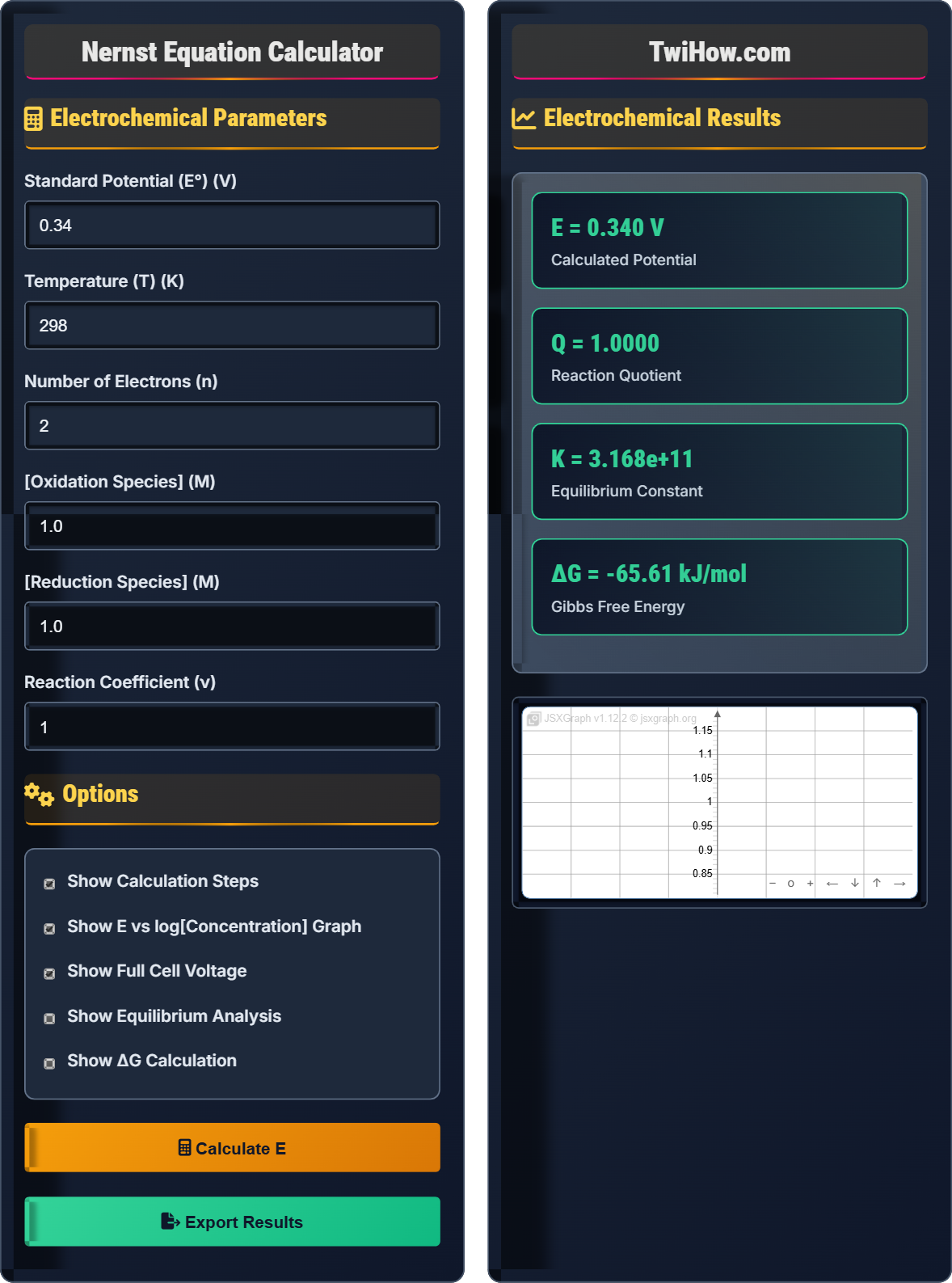
Electrochemical Parameters
Options
Electrochemical Results
| Parameter | Value | Unit | Significance |
|---|
Enter electrochemical parameters to see calculation steps.
Nernst Equation Explained
The Nernst equation is a fundamental relationship in electrochemistry that describes how the electrode potential of an electrochemical cell varies with temperature and reactant/product concentrations. It connects the standard electrode potential (measured under standard conditions) to the actual electrode potential under non-standard conditions. This equation is essential for understanding how concentration gradients drive electrical current in batteries, fuel cells, and biological systems.
The Nernst equation in its common forms:
Or at 298K:
Where:
- E = Actual electrode potential (V)
- E° = Standard electrode potential (V)
- R = Gas constant (8.314 J/K·mol)
- T = Absolute temperature (K)
- n = Number of electrons transferred
- F = Faraday's constant (96485 C/mol)
- Q = Reaction quotient
Key applications of the Nernst equation include:
- Battery Design: Predicting voltage under different conditions
- Corrosion Studies: Understanding metal oxidation
- Biological Systems: Modeling nerve impulses and ion channels
- Industrial Electrolysis: Optimizing process conditions
- Membrane Potentials: Calculating resting potentials in neurons
- Ion Channels: Understanding selective permeability
- Active Transport: Modeling ion pumps
- pH Sensors: Glass electrode operation
Nernst Equation Fundamentals
Relationship between electrode potential and reactant concentrations.
\( E = E^\\circ - \\frac{RT}{nF} \\ln Q \)
Where E = actual potential.
- Q = [products]/[reactants]
- At equilibrium: E = 0
- Higher [products] → Lower E
Applications
Changes in reactant/product concentrations directly affect cell potential.
- Battery voltage prediction
- Corrosion prevention
- Biosensor development
- Electroplating control
- Only valid for dilute solutions
- Temperature must be in Kelvin
- Activity coefficients ignored
- Assumes ideal behavior
Nernst Equation Learning Quiz
For the reaction Cu²⁺(aq) + Zn(s) → Cu(s) + Zn²⁺(aq), with E° = +1.10 V, if [Cu²⁺] = 0.1 M and [Zn²⁺] = 0.01 M at 298 K, what is the calculated cell potential?
Given: E° = +1.10 V, [Cu²⁺] = 0.1 M, [Zn²⁺] = 0.01 M, T = 298 K
Step 1: Write the reaction quotient
Q = [Zn²⁺]/[Cu²⁺] (solid concentrations are 1)
Step 2: Calculate Q
Q = 0.01/0.1 = 0.1
Step 3: Apply the Nernst equation
At 298 K: E = E° - (0.0592/n) log(Q)
For this reaction, n = 2 (2 electrons transferred)
Step 4: Calculate
E = 1.10 - (0.0592/2) log(0.1)
E = 1.10 - (0.0296) × (-1)
E = 1.10 + 0.0296 = 1.1296 ≈ 1.13 V
The answer is B) 1.13 V.
This problem demonstrates how concentration affects cell potential. With [Zn²⁺] < [Cu²⁺], the reaction quotient Q < 1, making log(Q) negative. The negative sign in the Nernst equation means we're subtracting a negative number, which increases the potential above the standard value. This makes sense thermodynamically: lower product concentration drives the reaction forward more strongly, increasing the voltage.
Reaction Quotient (Q): Ratio of product to reactant activities
Standard Potential (E°): Potential under standard conditions
Electrons Transferred (n): Number of electrons in balanced equation
• Q = [products]/[reactants]
• Solid phases have activity = 1
• Use 0.0592/n at 298 K
• Remember to exclude solid phases from Q
• At 298 K, use simplified form with 0.0592
• More concentrated reactants increase voltage
• Including solid phases in reaction quotient
• Using wrong value for n (number of electrons)
• Sign errors in logarithmic calculations
Calculate the potential for the hydrogen electrode at pH = 4 at 298 K. The standard potential for the hydrogen electrode is 0.00 V. The reaction is: 2H⁺(aq) + 2e⁻ → H₂(g).
Step 1: Determine the conditions
pH = 4, so [H⁺] = 10⁻⁴ M
We'll assume [H₂] = 1 bar (standard pressure)
Step 2: Write the reaction quotient
Q = P(H₂)/[H⁺]² = 1/(10⁻⁴)² = 1/10⁻⁸ = 10⁸
Step 3: Apply the Nernst equation
E = E° - (0.0592/n) log(Q)
Step 4: Substitute values
E = 0.00 - (0.0592/2) log(10⁸)
E = 0.00 - (0.0296) × 8
E = 0.00 - 0.2368 = -0.237 V
Therefore, the potential is -0.237 V.
This problem shows how pH significantly affects electrode potentials. At low pH (high [H⁺]), the potential is more positive than the standard value. At high pH (low [H⁺]), the potential becomes negative. This is why pH meters work - they measure the potential difference between a reference electrode and a glass electrode sensitive to H⁺ concentration. The logarithmic relationship means small changes in pH cause significant potential changes.
Hydrogen Electrode: Reference electrode with E° = 0.00 V
pH Scale: pH = -log[H⁺]
Gas Pressure: Include in reaction quotient as P/P°
• pH = -log[H⁺]
• Include gas pressures in Q
• Standard H₂ pressure = 1 bar
• Convert pH to [H⁺] using 10⁻ᵖᴴ
• Remember gas pressures in reaction quotients
• Log(10ⁿ) = n
• Forgetting to include gas pressure in Q
• Wrong sign in logarithmic calculation
• Using [H⁺] instead of pH in calculation
A zinc-copper battery starts with [Zn²⁺] = 0.01 M and [Cu²⁺] = 1.0 M. As the battery discharges, [Zn²⁺] increases to 0.5 M and [Cu²⁺] decreases to 0.05 M. Calculate the change in cell potential from start to finish. E° for the cell is +1.10 V.
Step 1: Calculate initial potential
Initial Q = [Zn²⁺]/[Cu²⁺] = 0.01/1.0 = 0.01
E_initial = 1.10 - (0.0592/2) log(0.01)
E_initial = 1.10 - (0.0296) × (-2) = 1.10 + 0.0592 = 1.159 V
Step 2: Calculate final potential
Final Q = [Zn²⁺]/[Cu²⁺] = 0.5/0.05 = 10
E_final = 1.10 - (0.0592/2) log(10)
E_final = 1.10 - (0.0296) × 1 = 1.10 - 0.0296 = 1.070 V
Step 3: Calculate change in potential
ΔE = E_final - E_initial = 1.070 - 1.159 = -0.089 V
The potential decreased by 0.089 V during discharge.
This problem demonstrates the practical implications of the Nernst equation for battery performance. As a battery discharges, product concentrations increase and reactant concentrations decrease, reducing the driving force for the reaction. This causes the voltage to decrease over time, which is why batteries "die" gradually rather than failing suddenly. The relationship is logarithmic, so voltage drops off more slowly when the battery is nearly depleted.
Battery Discharge: Process of converting chemical energy to electrical energy
Driving Force: Thermodynamic tendency for reaction to proceed
Voltage Drop: Reduction in electrical potential over time
• Q increases as battery discharges
• Voltage decreases during discharge
• Logarithmic relationship moderates changes
• Calculate both initial and final states separately
• Remember that discharge moves toward equilibrium
• At equilibrium, voltage drops to zero
• Calculating only one state instead of both
• Forgetting the sign convention for potential change
• Not accounting for concentration changes properly
For the reaction Fe³⁺(aq) + e⁻ → Fe²⁺(aq), E° = +0.771 V. Calculate the potential at 350 K if [Fe³⁺] = 0.05 M and [Fe²⁺] = 0.2 M. Assume n = 1 and that the standard potential is temperature-independent.
Step 1: Calculate the reaction quotient
Q = [Fe²⁺]/[Fe³⁺] = 0.2/0.05 = 4
Step 2: Use the full Nernst equation since T ≠ 298 K
E = E° - (RT/nF) ln(Q)
Step 3: Substitute values
R = 8.314 J/K·mol, T = 350 K, n = 1, F = 96485 C/mol
(RT/nF) = (8.314 × 350)/(1 × 96485) = 2909.9/96485 = 0.03016 V
Step 4: Calculate potential
E = 0.771 - (0.03016) ln(4)
E = 0.771 - (0.03016) × 1.386
E = 0.771 - 0.0418 = 0.729 V
This problem demonstrates the temperature dependence of the Nernst equation. At higher temperatures, the correction term (RT/nF) becomes larger, making concentration effects more pronounced. The logarithmic term remains the same, but it's multiplied by a larger coefficient. This means that at elevated temperatures, small changes in concentration have larger effects on the electrode potential. This is important in high-temperature electrochemical processes.
Full Nernst Equation: Includes explicit temperature dependence
Temperature Coefficient: RT/nF term in equation
Thermal Effects: Changes due to temperature variation
• Use full equation when T ≠ 298 K
• Temperature increases correction term
• Concentration effects become stronger at higher T
• Remember to use full equation for non-standard temperatures
• Calculate RT/nF first for clarity
• Convert temperatures to Kelvin
• Using simplified 0.0592/n form at non-standard temperatures
• Forgetting to convert temperature to Kelvin
• Arithmetic errors in RT/nF calculation
Which of the following statements about the Nernst equation is FALSE?
Let's examine each option:
A) TRUE - The Nernst equation explicitly relates potential to concentration through the reaction quotient Q
B) FALSE - At equilibrium, E = 0 (not equal to E°). Also, at equilibrium, Q = K and the equation becomes 0 = E° - (RT/nF)ln(K), leading to E° = (RT/nF)ln(K)
C) TRUE - The RT/nF term shows that temperature directly affects the magnitude of concentration corrections
D) TRUE - The n in the denominator means more electrons transferred reduces the sensitivity to concentration changes
The answer is B) At equilibrium, the cell potential equals the standard potential.
This question highlights a common misconception about equilibrium conditions. At equilibrium, there is no net driving force for the reaction, so the cell potential is zero. The standard potential represents the potential under standard conditions (all concentrations = 1 M), not at equilibrium. At equilibrium, the reaction quotient equals the equilibrium constant, and the Nernst equation relates the standard potential to the equilibrium constant. This is a critical distinction in electrochemistry.
Equilibrium: State where forward and reverse rates are equal
Standard Conditions: All species at 1 M concentration
Equilibrium Constant (K): Q value at equilibrium
• At equilibrium: E = 0
• At equilibrium: Q = K
• Standard conditions: all concentrations = 1 M
• Remember: equilibrium ≠ standard conditions
• At equilibrium, no net current flows
• Standard potential is a reference value
• Confusing equilibrium with standard conditions
• Thinking E = E° at equilibrium
• Forgetting that E = 0 at equilibrium
FAQ
Q: Why does the Nernst equation use a logarithmic relationship?
A: The logarithmic relationship in the Nernst equation stems from the fundamental thermodynamic relationship between free energy and the reaction quotient. The equation ΔG = ΔG° + RT ln(Q) connects the Gibbs free energy change to the reaction quotient. Since electrode potential is related to free energy by ΔG = -nFE, substituting gives the Nernst equation. The logarithm arises naturally from the statistical mechanical treatment of chemical equilibrium, where the probability of molecular arrangements follows logarithmic relationships. This logarithmic dependence means that concentration changes have a proportional effect on potential, which is why small changes in pH (which is logarithmic) cause significant changes in electrode potential.
Q: How is the Nernst equation used in practical applications like pH meters?
A: A pH meter consists of a glass electrode sensitive to H⁺ concentration and a reference electrode. The glass electrode contains a thin membrane that selectively responds to H⁺ ions. The potential across this membrane follows the Nernst equation: E = E° - (RT/F)ln[H⁺]. Since pH = -log[H⁺], we can write E = E° + (RT/F)ln(10) × pH. The meter is calibrated with buffer solutions of known pH, establishing the relationship between measured potential and pH. The logarithmic relationship means that for every 10-fold change in [H⁺] (change of 1 pH unit), the potential changes by approximately 59.2 mV at 298 K. This sensitivity makes pH meters highly accurate for measuring acidity.