Time-Speed-Distance Formula Calculator
Complete travel & navigation guide • Step-by-step solutions
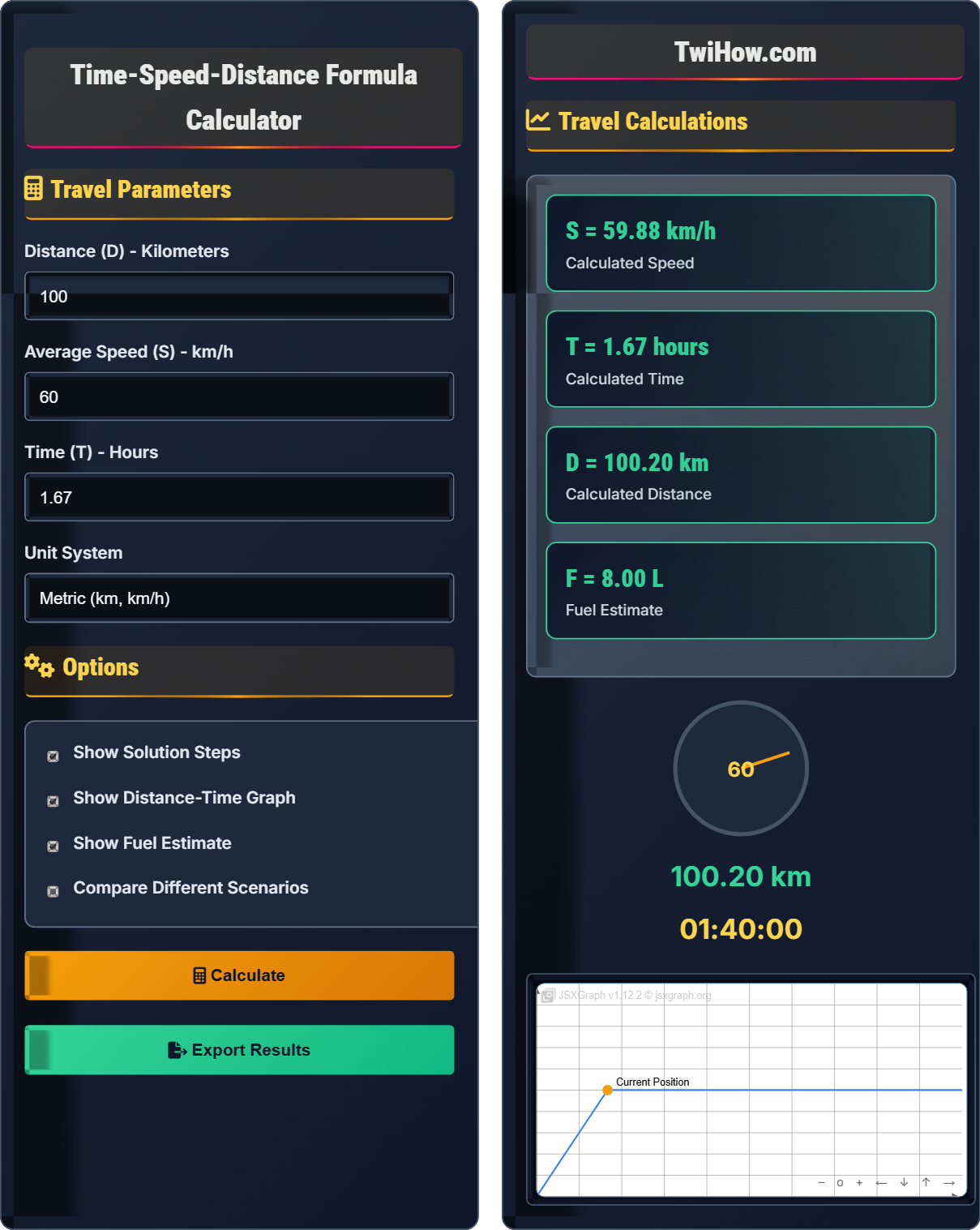
Time-Speed-Distance Formula:
Show the calculator /Simulator\( \text{Speed} = \frac{\text{Distance}}{\text{Time}} \) or \( S = \frac{D}{T} \)
The time-speed-distance formula is a fundamental relationship in kinematics that connects three essential parameters of motion: distance traveled, time elapsed, and average speed. This versatile formula can be rearranged to solve for any unknown parameter: Distance = Speed × Time (D = S×T) or Time = Distance ÷ Speed (T = D/S). It applies to uniform motion where speed remains constant, forming the basis for navigation, travel planning, and physics calculations.
Key relationships in the formula:
- Direct Proportionality: Distance increases with speed or time
- Inverse Proportionality: Time increases with distance, decreases with speed
- Units Consistency: Distance and time units must match speed units
- Average Speed: Total distance divided by total time
Use this formula to calculate travel times, plan routes, determine fuel consumption, estimate arrival times, and solve physics problems involving motion. It's essential for transportation, logistics, sports timing, and any scenario involving movement from one location to another.
Travel Parameters
Options
Travel Calculations
| Parameter | Value | Unit | Significance |
|---|
Enter travel parameters to see solution steps.
Time-Speed-Distance Formula Explained
The time-speed-distance relationship describes how these three quantities are interconnected in uniform motion. The fundamental formula states that distance equals speed multiplied by time (D = S×T). This relationship is fundamental to kinematics and has applications in everyday travel, navigation, physics, and engineering. Understanding how to manipulate this formula allows for solving for any of the three variables when the other two are known.
Three equivalent formulations of the relationship:
Where:
- \(S\) = Average speed (km/h, mph, m/s)
- \(D\) = Distance traveled (km, miles, meters)
- \(T\) = Time elapsed (hours, minutes, seconds)
Key applications of the time-speed-distance formula:
- Travel Planning: Estimating arrival times and fuel requirements
- Navigation: Route planning and GPS calculations
- Transportation: Logistics and delivery scheduling
- Sports: Timing and performance analysis
- Identify Knowns: Determine which two variables are given
- Select Formula: Choose the appropriate rearrangement
- Check Units: Ensure compatibility between measurements
- Verify Result: Check if answer is reasonable
Formula Fundamentals
S = D/T, D = S×T, T = D/S, where S = speed, D = distance, T = time.
1 km/h = 0.278 m/s, 1 mph = 1.609 km/h, 1 mile = 1.609 km.
Always convert to consistent units before calculating.
- Distance ∝ Speed × Time
- Time ∝ Distance / Speed
- Speed ∝ Distance / Time
- Units must be compatible
Real-World Applications
Use the formula to estimate travel times and plan departure schedules.
- Car trip duration estimates
- Fuel consumption calculations
- Airline flight time predictions
- Sports performance tracking
- Delivery route optimization
- Formula assumes constant speed
- Real travel includes stops and variations
- Weather affects actual speeds
- Traffic conditions impact travel time
Time-Speed-Distance Formula Learning Quiz
A car travels 120 kilometers at an average speed of 60 km/h. How long does the journey take?
Using the formula: Time = Distance ÷ Speed
T = 120 km ÷ 60 km/h = 2 hours
The answer is B) 2 hours.
This problem uses the time calculation form of the formula: T = D/S. It's important to identify which formula to use based on the known variables. Here, we know distance (120 km) and speed (60 km/h), so we divide distance by speed to find time. Always check that units are consistent.
Average Speed: Total distance divided by total time
Uniform Motion: Motion at constant speed
Time: Duration of the journey
• T = D/S when distance and speed are known
• Units must be compatible (km with km/h gives hours)
• Always verify the result makes sense
• Identify known variables first
• Select the correct formula arrangement
• Check units are consistent
• Using the wrong formula arrangement
• Inconsistent units (mixing km and miles)
• Arithmetic errors in division
A cyclist travels 15 miles in 45 minutes. What is their average speed in km/h? (Note: 1 mile = 1.609 km)
Step 1: Convert distance to kilometers
15 miles × 1.609 km/mile = 24.135 km
Step 2: Convert time to hours
45 minutes = 45/60 = 0.75 hours
Step 3: Calculate speed using S = D/T
S = 24.135 km ÷ 0.75 h = 32.18 km/h
The cyclist's average speed is 32.18 km/h.
This problem requires unit conversions before applying the formula. It's crucial to convert all measurements to compatible units. The problem also demonstrates how to convert between different measurement systems (miles to kilometers) and time units (minutes to hours). Always perform conversions before calculations.
Unit Conversion: Changing measurement units while preserving value
Compatible Units: Units that work together in a formula
Average Speed: Total distance over total time
• Convert all units to be compatible before calculating
• 1 mile = 1.609 km
• Convert minutes to hours by dividing by 60
• Convert to the unit required in the answer
• Use conversion factors as fractions
• Double-check conversion calculations
• Forgetting to convert units
• Using incorrect conversion factors
• Mixing imperial and metric units
Two cars start from the same point. Car A travels east at 70 km/h and Car B travels west at 50 km/h. How far apart will they be after 2.5 hours?
Step 1: Calculate distance traveled by Car A
Distance_A = Speed_A × Time = 70 km/h × 2.5 h = 175 km
Step 2: Calculate distance traveled by Car B
Distance_B = Speed_B × Time = 50 km/h × 2.5 h = 125 km
Step 3: Calculate total separation distance
Since they're traveling in opposite directions, distances add up
Total distance = 175 km + 125 km = 300 km
The cars will be 300 km apart after 2.5 hours.
This problem involves two objects moving in opposite directions. When objects move in opposite directions from the same starting point, their separation distance is the sum of the distances each has traveled. We calculate each distance separately using D = S×T, then add them together. This type of problem is common in meeting/journey scenarios.
Opposite Directions: Movement in directly opposite paths
Separation Distance: Total distance between two moving objects
Relative Motion: Motion of objects relative to each other
• Objects moving in opposite directions: distances add
• Objects moving in same direction: subtract distances
• Always consider direction in relative motion problems
• Draw a diagram to visualize the situation
• Consider direction when adding/subtracting distances
• Calculate each object's distance separately first
• Forgetting to account for direction
• Subtracting instead of adding distances
• Using incorrect time values
A truck needs to travel 300 km. It averages 80 km/h on highways and 40 km/h in cities. If 200 km of the journey is on highways and 100 km in cities, how long will the entire trip take? Also, if the truck consumes 8 liters per 100 km, how much fuel will be needed?
Step 1: Calculate highway time
Time_highway = 200 km ÷ 80 km/h = 2.5 hours
Step 2: Calculate city time
Time_city = 100 km ÷ 40 km/h = 2.5 hours
Step 3: Calculate total time
Total time = 2.5 + 2.5 = 5 hours
Step 4: Calculate fuel consumption
Fuel = (300 km ÷ 100 km) × 8 liters = 3 × 8 = 24 liters
The trip will take 5 hours and require 24 liters of fuel.
This problem involves different speeds for different segments of a journey. It requires calculating time for each segment separately, then summing them. This approach is essential for real-world travel planning where conditions vary. The fuel calculation uses a rate of consumption per distance, demonstrating how the time-speed-distance formula integrates with other practical calculations.
Segmented Journey: Trip with different conditions for parts
Fuel Consumption Rate: Fuel used per unit distance
Variable Conditions: Different speeds in different environments
• Calculate each segment separately
• Sum individual times for total time
• Fuel consumption is proportional to distance
• Break complex journeys into segments
• Calculate time for each segment separately
• Consider additional factors like fuel consumption
• Using average speed for the entire journey
• Forgetting to account for different speeds
• Incorrect fuel calculation
Two trains are traveling toward each other on parallel tracks. Train A travels at 90 km/h and Train B at 70 km/h. What is their relative speed of approach?
When two objects move toward each other, their relative speed is the sum of their individual speeds.
Relative speed = 90 km/h + 70 km/h = 160 km/h
The answer is D) 160 km/h.
Relative speed problems involve how fast objects approach or separate from each other. When objects move toward each other, their relative speed is the sum of individual speeds. When moving in the same direction, it's the difference. This concept is crucial for collision avoidance, meeting time calculations, and understanding motion from different reference frames.
Relative Speed: Speed of one object relative to another
Approach Speed: Rate at which objects get closer
Reference Frame: Perspective from which motion is observed
• Objects approaching: add speeds
• Objects receding: subtract speeds
• Same direction: subtract speeds
• Consider direction of motion
• Visualize the scenario
• Think about how fast distance changes
• Using only one object's speed
• Subtracting instead of adding for approach
• Confusing relative and absolute speeds
FAQ
Q: How does the time-speed-distance formula account for stops during a journey?
A: The basic time-speed-distance formula (D = S×T) calculates travel time at constant speed, excluding stops. To account for stops, you must add the stop time to the calculated travel time. For example, if a 300 km journey at 60 km/h takes 5 hours according to the formula, but includes 1 hour of stops, the total journey time is 6 hours. For more accurate planning, you can calculate an effective speed that includes stops: Effective Speed = Total Distance ÷ Total Time (including stops).
Q: Is the time-speed-distance formula applicable to accelerating objects?
A: The basic formula S = D/T applies to uniform motion (constant speed). For accelerating objects, the formula still applies but uses average speed over the time interval. Average speed is total distance divided by total time. For uniformly accelerated motion, you would use kinematic equations like d = v₀t + ½at². However, the fundamental relationship between distance, time, and speed remains valid as long as you use the appropriate form of speed (instantaneous, average, or initial/final velocities).