Work Rate Formula Calculator
Complete time & work guide • Step-by-step solutions
Work Rate Formula:
Show the calculator /Simulator\( \text{Work Rate} = \frac{\text{Work Done}}{\text{Time Taken}} \)
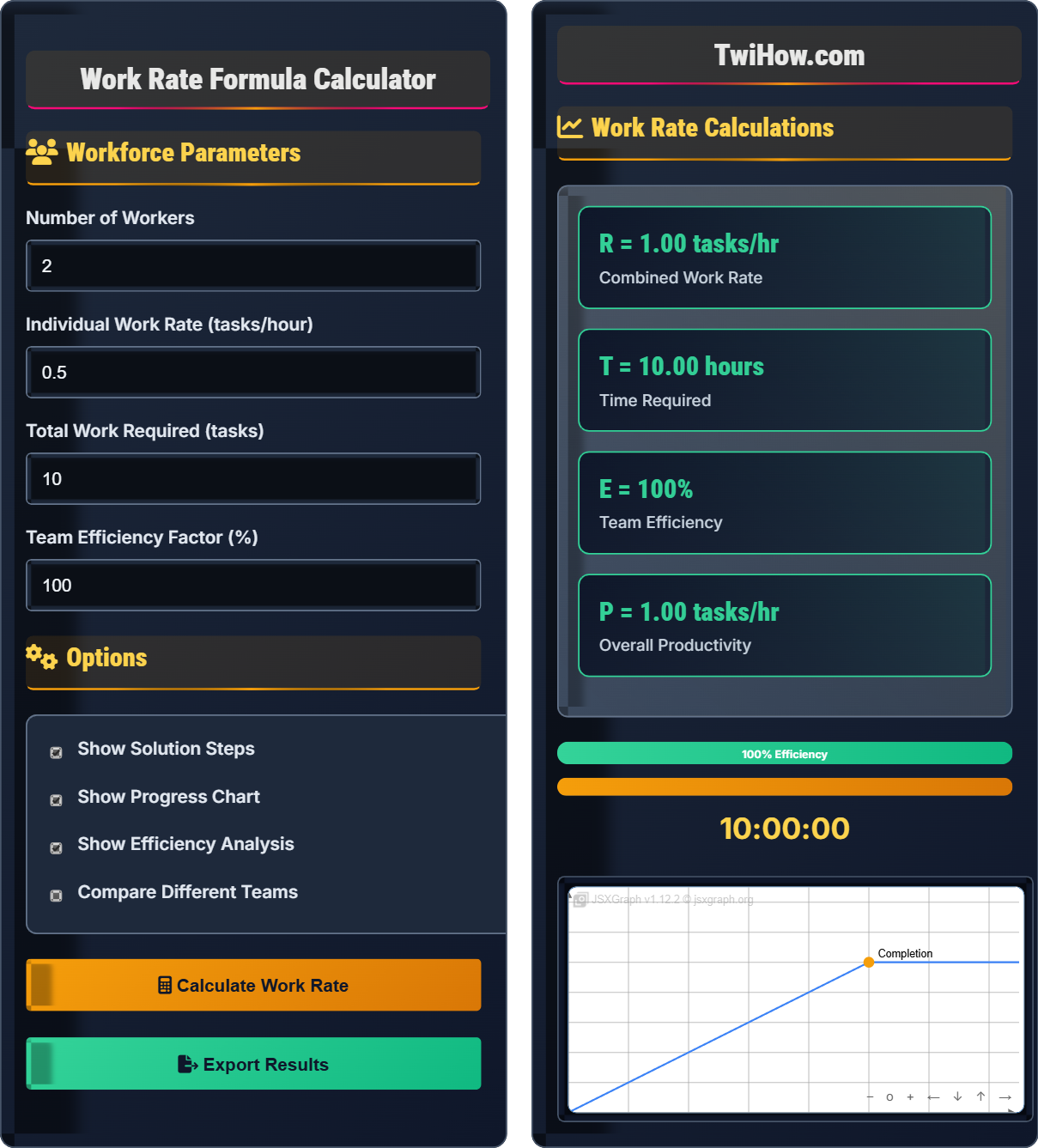
The work rate formula calculates the efficiency of completing a task, where work rate is typically measured in units of work per unit time (e.g., tasks/hour, pages/hour, jobs/day). For multiple workers, the combined work rate is the sum of individual rates: R_total = R₁ + R₂ + ... + Rₙ. This fundamental concept in time and work problems helps determine how long it takes for individuals or teams to complete projects, considering their respective efficiencies.
Key relationships in work rate problems:
- Individual Rate: R = W/T (work per unit time)
- Combined Rate: R_total = Σ(individual rates)
- Time for Combined Work: T = W/R_total
- Inverse Relationship: More workers = Less time
Use this formula to optimize team productivity, plan project timelines, calculate efficiency improvements, and solve complex work allocation problems. It applies to construction, manufacturing, software development, and any collaborative effort where time management is crucial.
Workforce Parameters
Options
Work Rate Calculations
| Parameter | Value | Unit | Impact |
|---|
Enter workforce parameters to see solution steps.
Work Rate Formula Explained
Work rate is the amount of work completed per unit time. It quantifies productivity and efficiency in completing tasks. The basic work rate formula is: Rate = Work Done / Time Taken. In time and work problems, understanding individual and combined work rates is crucial for project planning and resource allocation. Work rate is typically expressed in units like tasks per hour, pages per minute, or jobs per day.
For individual work rate:
For combined work rate of n workers:
Time to complete work with multiple workers:
Where:
- \(R\) = Work rate (work per unit time)
- \(W\) = Total work to be done
- \(T\) = Time required
Key applications of work rate concepts:
- Project Management: Estimating completion times for teams
- Manufacturing: Optimizing production schedules
- Construction: Planning labor requirements
- Software Development: Sprint planning and resource allocation
- Standard Approach: Calculate individual rates, sum them, find time
- Work Units: Convert everything to work units for easier calculations
- Efficiency Factors: Adjust for real-world productivity variations
- Partial Work: Calculate remaining work after partial completion
Work Rate Fundamentals
R = W/T, where R = rate, W = work, T = time.
R_total = R₁ + R₂ + ... + Rₙ
T = W / R_total
- Rates add when working together
- More workers reduce completion time
- Efficiency affects actual performance
- Time is inversely proportional to rate
Real-World Applications
Use work rate to estimate deadlines and allocate resources efficiently.
- Construction scheduling
- Software development sprints
- Manufacturing production planning
- Household chore distribution
- Academic assignment management
- Individual productivity varies
- Coordination overhead exists
- Diminishing returns may occur
- Skills and experience matter
Work Rate Formula Learning Quiz
If worker A can complete a job in 6 hours and worker B can complete the same job in 12 hours, what fraction of the job can they complete together in 2 hours?
Worker A's rate = 1/6 job per hour
Worker B's rate = 1/12 job per hour
Combined rate = 1/6 + 1/12 = 2/12 + 1/12 = 3/12 = 1/4 job per hour
Work completed in 2 hours = (1/4) × 2 = 1/2 of the job
The answer is A) 1/2 of the job.
This problem demonstrates how to find individual work rates by taking the reciprocal of time. Worker A completes 1 job in 6 hours, so their rate is 1/6 job per hour. Adding rates when working together is fundamental to solving work rate problems. The result shows that collaboration allows faster completion than either worker alone.
Work Rate: Amount of work completed per unit time
Individual Rate: Work rate of a single person
Combined Rate: Sum of individual rates when working together
• Individual rate = 1 / time to complete job alone
• Combined rate = sum of individual rates
• Work done = rate × time
• Always convert time to rates (reciprocal)
• Add rates when people work together
• Multiply rate by time to get work done
• Adding times instead of rates
• Forgetting to find common denominators
• Confusing work done with work rate
A project can be completed by worker A in 8 hours and by worker B in 12 hours. If A works alone for 2 hours, then both A and B work together to finish the remainder, how long does the entire project take?
Step 1: Find individual rates
A's rate = 1/8 job per hour
B's rate = 1/12 job per hour
Step 2: Calculate work done by A alone in 2 hours
Work completed = (1/8) × 2 = 1/4 of the job
Remaining work = 1 - 1/4 = 3/4 of the job
Step 3: Calculate combined rate when both work
Combined rate = 1/8 + 1/12 = 3/24 + 2/24 = 5/24 job per hour
Step 4: Calculate time to complete remaining work
Time = (3/4) ÷ (5/24) = (3/4) × (24/5) = 18/5 = 3.6 hours
Total time = 2 + 3.6 = 5.6 hours
This problem involves sequential work scenarios. First, calculate how much work is completed by one person, then determine the remaining work. When both work together, use their combined rate to finish the project. This type of problem often appears in project management scenarios where tasks are started by one person and finished collaboratively.
Sequential Work: Work completed in phases by different workers
Remaining Work: Work left after partial completion
Collaborative Completion: Finishing work with multiple workers
• Calculate work done in each phase separately
• Subtract completed work from total to find remainder
• Use combined rates for collaborative phases
• Break complex problems into smaller phases
• Keep track of work completed vs. remaining
• Verify that total work adds up to 1
• Forgetting to calculate remaining work
• Applying combined rate to the entire job
• Arithmetic errors with fractions
Three workers can individually complete a task in 6, 8, and 12 hours respectively. However, due to coordination challenges, their combined efficiency is only 80% of their theoretical combined rate. How long will it take them to complete the task working together?
Step 1: Calculate individual rates
Worker 1: 1/6 job per hour
Worker 2: 1/8 job per hour
Worker 3: 1/12 job per hour
Step 2: Calculate theoretical combined rate
Find LCD of 6, 8, 12 = 24
Combined rate = 4/24 + 3/24 + 2/24 = 9/24 = 3/8 job per hour
Step 3: Apply efficiency factor
Actual rate = (3/8) × 0.80 = 3/10 job per hour
Step 4: Calculate time to complete
Time = 1 ÷ (3/10) = 10/3 = 3⅓ hours = 3 hours 20 minutes
This problem introduces the concept of efficiency factors, which account for real-world limitations in teamwork. Coordination challenges, communication overhead, and resource conflicts often reduce the theoretical combined productivity. The efficiency factor multiplies the theoretical rate to give the actual rate of progress.
Theoretical Rate: Combined rate without efficiency losses
Actual Rate: Rate after applying efficiency factor
Efficiency Factor: Percentage of theoretical productivity achieved
• Actual rate = Theoretical rate × Efficiency factor
• Efficiency factor is usually less than 100%
• Always apply efficiency to combined rates
• Calculate theoretical rate first
• Convert efficiency percentage to decimal
• Apply factor to combined rate, not individual rates
• Forgetting to apply efficiency factor
• Applying efficiency to individual rates instead of combined
• Confusing efficiency as addition instead of multiplication
A company needs to complete 100 units of work. Worker X can complete 5 units per hour but costs $20/hour. Worker Y can complete 3 units per hour but costs $12/hour. If the company wants to minimize cost while completing the work in 15 hours or less, how should they allocate workers?
Step 1: Calculate cost per unit for each worker
Worker X: $20/hour ÷ 5 units/hour = $4/unit
Worker Y: $12/hour ÷ 3 units/hour = $4/unit
Both workers have equal cost efficiency!
Step 2: Determine combined rate needed
Required rate = 100 units ÷ 15 hours = 6.67 units/hour
Step 3: Find optimal combination
Let x = hours for worker X, y = hours for worker Y
We need: 5x + 3y ≥ 100 and x ≤ 15, y ≤ 15
One optimal solution: X works 15 hours (75 units), Y works 8.33 hours (25 units)
Total time: 15 hours (limited by X), Total cost: $300 + $100 = $400
This problem combines work rate with cost optimization. Surprisingly, both workers have the same cost per unit ($4/unit), so cost isn't the deciding factor. The constraint is time (15 hours max). The solution shows how to balance different work rates to meet time constraints while optimizing resources. This type of problem is common in operations research and project management.
Cost Efficiency: Cost per unit of work produced
Resource Allocation: Distributing work among available resources
Optimization: Finding best solution under constraints
• Calculate cost per unit to compare efficiency
• Identify binding constraints (time, resources)
• Balance multiple objectives (cost, time, quality)
• Compare cost per unit, not just hourly rates
• Identify the limiting factor first
• Consider all constraints simultaneously
• Focusing only on hourly rates instead of productivity
• Ignoring time constraints
• Not considering combined work scenarios
Which scenario best illustrates diminishing returns in work rate problems?
Diminishing returns occurs when adding more workers results in less than proportional increases in productivity. This happens due to coordination challenges, limited workspace, resource competition, and communication overhead. In reality, the combined work rate doesn't scale linearly with the number of workers. The answer is C) Additional workers contribute less to the combined rate than expected.
While the basic work rate formula assumes linear scaling (rates simply add), real-world scenarios often exhibit diminishing returns. As more workers are added to a task, coordination complexity increases, potentially reducing overall efficiency. This concept is important for realistic project planning and resource allocation.
Diminishing Returns: Decreasing marginal productivity as more resources are added
Linear Scaling: Proportional relationship between inputs and outputs
Productivity Loss: Reduction in efficiency due to coordination challenges
• Basic formula assumes ideal conditions
• Real-world applications require efficiency adjustments
• More workers doesn't always mean faster completion
• Consider coordination overhead in team problems
• Apply efficiency factors for realistic estimates
• Recognize that theoretical models have limitations
• Assuming perfect linear scaling in all scenarios
• Ignoring practical limitations of teamwork
• Not accounting for efficiency losses in large teams
FAQ
Q: How does the work rate formula help in project planning when team members have different skill levels?
A: The work rate formula allows for individual rate calculations based on each person's capacity. If Person A completes a task in 4 hours and Person B in 6 hours, their rates are 1/4 and 1/6 of the task per hour respectively. When combined, their rate becomes 1/4 + 1/6 = 5/12 of the task per hour. This approach enables accurate project timeline estimation by accounting for each team member's contribution. The formula can be extended to include efficiency factors that adjust for skill level differences, experience, and specialization.
Q: Why do work rate problems assume that rates simply add together when people work together?
A: The assumption that work rates add linearly is a simplification for educational purposes and basic calculations. In the ideal scenario, if Person A completes 1/4 of a job per hour and Person B completes 1/6 of the job per hour, together they would complete 1/4 + 1/6 = 5/12 of the job per hour. This assumes no coordination overhead, unlimited resources, and that the work can be perfectly parallelized. In reality, factors like communication overhead, resource contention, and coordination challenges might reduce the combined efficiency, requiring adjustment factors to the theoretical combined rate.