Binomial Theorem Calculator
Complete algebra guide • Step-by-step solutions
Binomial Theorem:
Show the calculator / Simulator\( (a + b)^n = \sum_{k=0}^{n} \binom{n}{k} a^{n-k} b^k \)
This theorem provides the exact expansion for any binomial raised to a power. The binomial coefficient \(\binom{n}{k}\) is calculated as \(\frac{n!}{k!(n-k)!}\). The expansion contains exactly n+1 terms, with exponents of 'a' decreasing from n to 0 and exponents of 'b' increasing from 0 to n.
Key properties:
- The sum of exponents in each term equals n
- Coefficients follow Pascal's triangle pattern
- Symmetry: \(\binom{n}{k} = \binom{n}{n-k}\)
- Sum of coefficients in row n equals 2^n
Use this theorem for expanding expressions like (x + y)⁵, calculating probabilities, combinatorial problems, and finding specific terms in binomial expansions without multiplying out each term manually.
Binomial Parameters
Options
Expansion Results
| Term # | Expression | Coefficient | Verification |
|---|
Enter parameters to see solution steps.
Enter parameters to see coefficients.
Binomial Theorem Explained
The binomial theorem describes the algebraic expansion of powers of a binomial. For any positive integer n, the expansion of (a + b)ⁿ contains exactly n + 1 terms. The general form is: (a + b)ⁿ = Σ(k=0 to n) [C(n,k) × a^(n-k) × b^k], where C(n,k) = n!/[k!(n-k)!] represents the binomial coefficient.
The binomial theorem provides the exact expansion for any binomial raised to a power:
Where:
- \(a, b\) = the terms in the binomial
- \(n\) = the exponent (non-negative integer)
- \(\binom{n}{k}\) = binomial coefficient = n!/[k!(n-k)!]
- \(k\) = index of the term (0 to n)
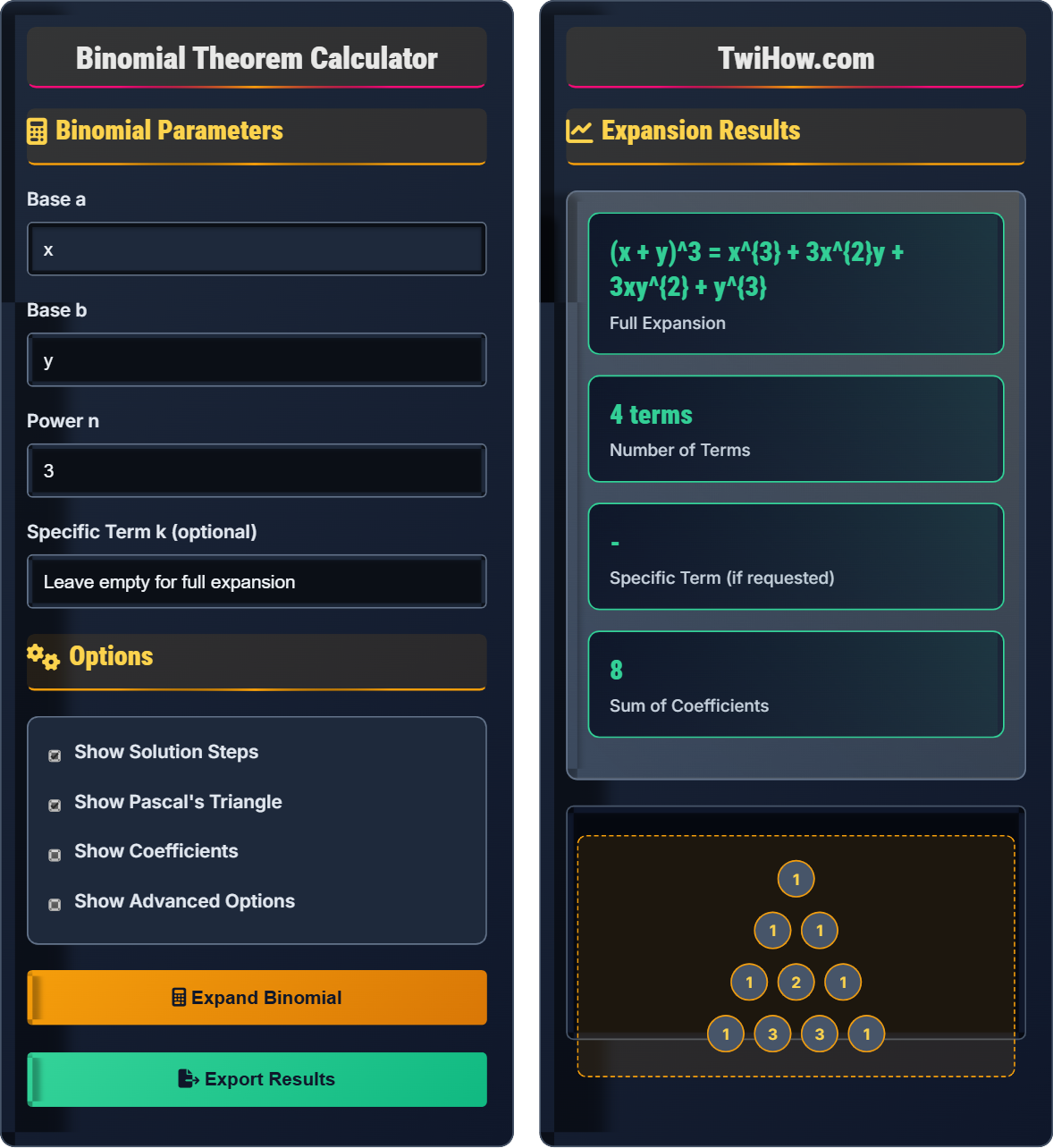
Pascal's triangle arranges binomial coefficients in a triangular array:
Each number is the sum of the two numbers above it. Row n contains the coefficients for (a + b)ⁿ.
- Algebra: Expanding binomial expressions
- Probability: Calculating binomial distributions
- Combinatorics: Counting arrangements and combinations
- Calculus: Series expansions and approximations
Binomial Theorem Learning Quiz
What is the coefficient of x²y³ in the expansion of (x + y)⁵?
In the expansion of (x + y)⁵, the general term is C(5,k) × x^(5-k) × y^k. For x²y³, we need 5-k = 2 and k = 3. This gives k = 3. The coefficient is C(5,3) = 5!/(3!×2!) = 120/(6×2) = 10. The answer is C) 10.
To find a specific term in a binomial expansion, identify the powers of each variable and match them to the general term formula. The binomial coefficient C(n,k) determines how many ways we can choose k items from n total items, which corresponds to the number of ways we can arrange the terms in the expansion.
Binomial Coefficient: C(n,k) = n!/[k!(n-k)!] represents combinations
General Term: The k-th term in (a+b)ⁿ expansion
Factorial: n! = n×(n-1)×...×2×1
• General term: C(n,k) × a^(n-k) × b^k
• Sum of exponents in each term = n
• Number of terms = n + 1
• Remember: C(n,k) = C(n,n-k) due to symmetry
• Use Pascal's triangle for small values
• Always check that exponents sum to n
• Forgetting to calculate the binomial coefficient
• Mixing up the positions of a and b in the term
• Not verifying that exponents sum to n
Find the 4th row of Pascal's triangle and explain how it relates to the expansion of (a + b)³.
The 4th row of Pascal's triangle (starting from row 0) is: 1, 3, 3, 1. These are the binomial coefficients C(3,0), C(3,1), C(3,2), and C(3,3). The expansion of (a + b)³ is: 1×a³ + 3×a²b + 3×ab² + 1×b³ = a³ + 3a²b + 3ab² + b³. Each coefficient in the expansion matches the corresponding number in Pascal's triangle.
Pascal's triangle provides a visual representation of binomial coefficients. Each row corresponds to the coefficients of a binomial expansion. The relationship between adjacent rows follows Pascal's rule: each number is the sum of the two numbers above it. This creates the pattern that matches binomial coefficients.
Pascal's Triangle: Triangular array of binomial coefficients
Row Numbering: Row 0 is the top row (just 1)
Adjacent Relationship: Each number is sum of two above it
• Row n contains coefficients for (a + b)ⁿ
• First and last numbers in each row are 1
• Rows are symmetric
• Use Pascal's triangle for quick calculations
• Remember rows start from 0
• Symmetry can reduce calculation work
• Miscounting row numbers (start from 0)
• Forgetting that first/last entries are always 1
• Not recognizing the symmetry property
A fair coin is flipped 5 times. What is the probability of getting exactly 3 heads? Use the binomial theorem concept to solve.
This is a binomial probability problem with n=5 trials, k=3 successes (heads), and p=0.5 probability of success. The number of ways to get exactly 3 heads is C(5,3) = 5!/(3!×2!) = 10. The probability is C(5,3) × (0.5)³ × (0.5)² = 10 × (0.125) × (0.25) = 0.3125 or 31.25%.
Binomial probability uses the same mathematical structure as binomial expansion. The binomial coefficient C(n,k) counts the number of ways to achieve k successes in n trials. This connects discrete probability with algebraic expansion, showing how binomial theorem applies beyond pure algebra.
Binomial Probability: P(X=k) = C(n,k) × p^k × (1-p)^(n-k)
Success/Failure: Binary outcomes in trials
Independent Trials: Outcomes don't affect each other
• Probability of exactly k successes: C(n,k) × p^k × (1-p)^(n-k)
• Sum of all probabilities equals 1
• Binomial coefficient counts favorable outcomes
• Recognize binomial situations: fixed trials, binary outcomes
• Use symmetry when p = 0.5
• Verify that probabilities sum to 1
• Forgetting the binomial coefficient in probability
• Misidentifying success probability
• Not accounting for all possible arrangements
Find the 4th term in the expansion of (2x - 3)⁶. Which method is most efficient for this problem?
The 4th term corresponds to k=3 in the general term formula: C(6,3) × (2x)^(6-3) × (-3)³ = C(6,3) × (2x)³ × (-27). C(6,3) = 20, so the term is 20 × 8x³ × (-27) = -4320x³. The binomial theorem is most efficient here since it directly gives the term without expanding all terms.
When finding a specific term in a binomial expansion, using the general term formula is far more efficient than expanding the entire expression. The k-th term in (a + b)ⁿ is given by C(n,k-1) × a^(n-k+1) × b^(k-1). Pay attention to signs when dealing with negative terms.
General Term: Formula for the k-th term in expansion
Position Index: k-th term corresponds to index k-1 in formula
Sign Handling: Negative bases alternate signs
• k-th term uses index k-1 in general formula
• Signs alternate when base is negative
• Exponents sum to original power
• Always use general term formula for specific terms
• Track signs carefully with negative bases
• Verify that exponents sum to original power
• Confusing term position with formula index
• Forgetting to handle negative signs properly
• Not verifying exponent sums
Which of the following statements about the binomial theorem is FALSE?
Let's examine each option: A) TRUE - setting a=b=1 in (a+b)ⁿ gives 2ⁿ. B) TRUE - C(n,k) = C(n,n-k). C) FALSE - each row sums to 2ⁿ, not n!. For example, row 3 (1,3,3,1) sums to 8 = 2³, not 3! = 6. D) TRUE - terms go from k=0 to k=n, giving n+1 terms. The answer is C) Each row in Pascal's triangle sums to n!.
Understanding the properties of binomial coefficients is crucial for recognizing patterns and avoiding computational errors. The sum of row n in Pascal's triangle is always 2ⁿ, which can be verified by substituting a=b=1 in the binomial theorem: (1+1)ⁿ = 2ⁿ = ΣC(n,k).
Row Sum Property: Sum of row n equals 2ⁿ
Symmetry Property: C(n,k) = C(n,n-k)
Counting Property: n+1 terms in expansion
• Σ(k=0 to n) C(n,k) = 2ⁿ
• C(n,k) = C(n,n-k)
• Total terms = n + 1
• Use substitution (a=b=1) to find sum of coefficients
• Remember row sums are powers of 2, not factorials
• Symmetry can simplify calculations
• Confusing row sum with factorial
• Forgetting the correct formula for counting terms
• Misapplying symmetry property
Binomial Fundamentals
(a + b)ⁿ = Σ(k=0 to n) [C(n,k) × a^(n-k) × b^k], where C(n,k) = n!/[k!(n-k)!].
\(\binom{n}{k} = \frac{n!}{k!(n-k)!}\)
Where n,k are non-negative integers with k ≤ n.
- n must be non-negative
- k ranges from 0 to n
- n+1 terms in expansion
- Exponents sum to n in each term
Applications
Row n contains coefficients for (a + b)ⁿ, each number is sum of two above it.
- Probability calculations
- Combinatorial problems
- Algebraic expansions
- Statistical analysis
- Works for any real numbers a,b
- n must be non-negative integer
- Sum of coefficients is 2ⁿ
- Symmetric coefficient pattern
FAQ
Q: Why does the binomial theorem work?
A: The binomial theorem works because of combinatorial principles. When expanding (a + b)ⁿ, we're essentially multiplying n factors of (a + b). To form a term like a^(n-k)b^k, we need to choose k of the n factors to contribute a 'b', while the remaining (n-k) factors contribute an 'a'. The number of ways to choose k items from n total items is the binomial coefficient C(n,k). This explains why each term in the expansion has the form C(n,k)a^(n-k)b^k. The theorem captures all possible ways of selecting terms from the n factors, ensuring no combination is missed or counted twice.
Q: Can the binomial theorem be extended to non-integer exponents?
A: Yes, the binomial theorem can be generalized to non-integer exponents through the binomial series: (1 + x)ᵝ = Σ(k=0 to ∞) [Γ(β+1)/(Γ(k+1)Γ(β-k+1))] x^k, where Γ is the gamma function (generalization of factorial). This converges for |x| < 1 and β ∈ ℝ. When β is a positive integer, this reduces to the standard binomial theorem with finite terms. The generalized version is particularly useful in calculus for approximating functions and solving differential equations.