Difference of Squares Calculator
Complete algebra guide • Step-by-step solutions
Difference of Squares:
Show the calculator / Simulator\( a^2 - b^2 = (a + b)(a - b) \)
The difference of squares formula allows us to factor expressions of the form a² - b² into the product of two binomials. This pattern occurs when we have two perfect squares separated by subtraction. The formula shows that the difference of two squares equals the product of their sum and their difference.
Key requirements:
- Both terms must be perfect squares
- The operation must be subtraction
- Can be applied to variables, constants, or expressions
- Works for higher powers when they can be rewritten as squares
Use this formula for factoring polynomials, simplifying expressions, solving equations, and recognizing special product patterns. It's one of the fundamental factoring techniques in algebra.
Difference of Squares Input
Options
Factoring Results
| Component | Expression | Identification | Status |
|---|
Enter expression to see solution steps.
Factorization verification will appear here.
Difference of Squares Explained
The difference of squares is a special factoring pattern that applies to expressions of the form a² - b². This pattern occurs when we subtract one perfect square from another. The general formula is: a² - b² = (a + b)(a - b). This identity holds for any real numbers, variables, or algebraic expressions that can be written as perfect squares.
The difference of squares formula provides the exact factorization for any expression that fits the pattern:
Where:
- \(a, b\) = expressions that can be squared
- \(a^2\) = the first perfect square term
- \(b^2\) = the second perfect square term
- \(a + b\) = the sum of the square roots
- \(a - b\) = the difference of the square roots
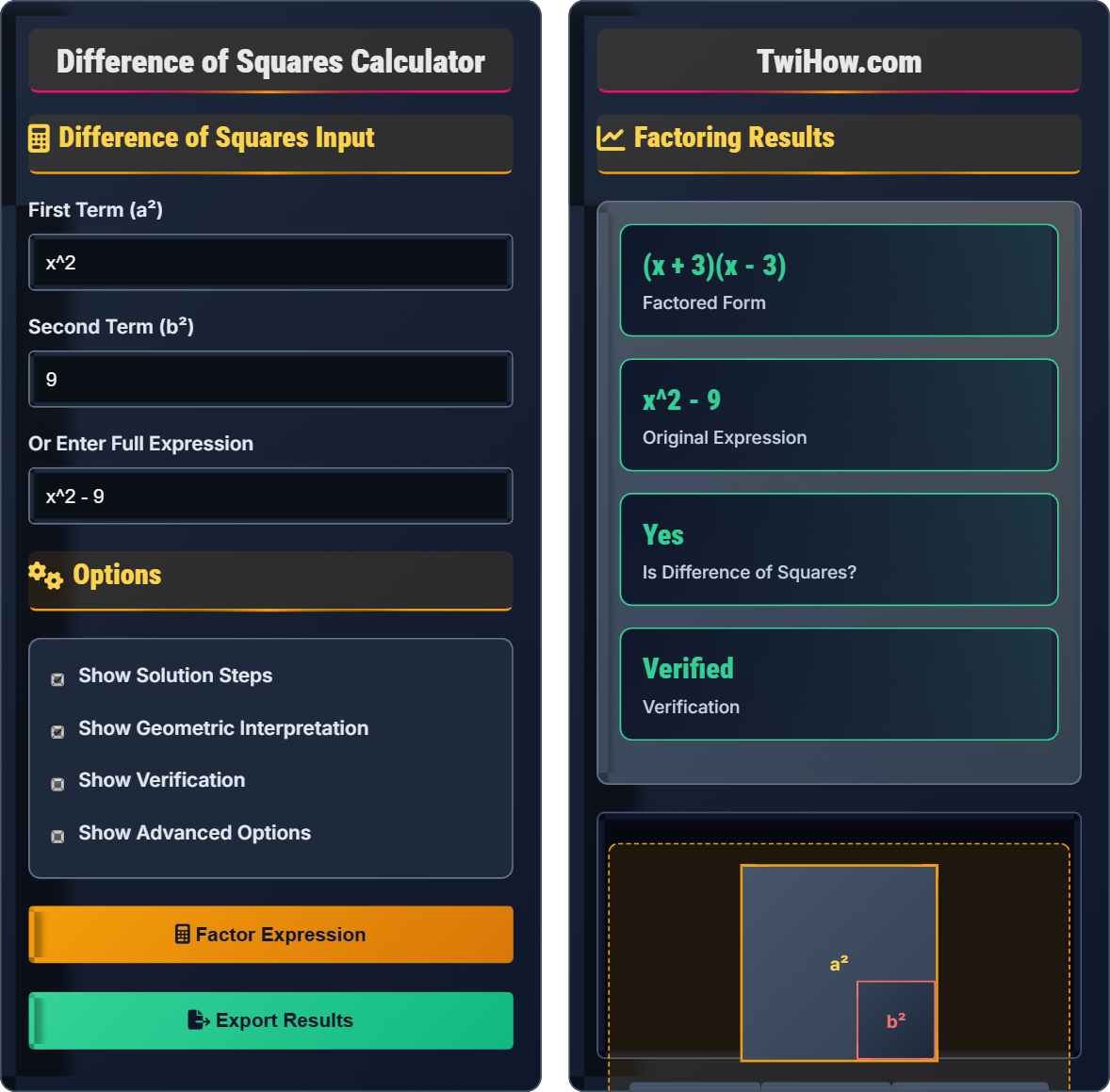
The difference of squares has a beautiful geometric interpretation. Imagine a large square with side length 'a' and area a². Inside this square, remove a smaller square with side length 'b' and area b². The remaining shaded region has area a² - b². This region can be rearranged into a rectangle with dimensions (a + b) and (a - b), demonstrating that a² - b² = (a + b)(a - b).
- Factoring: Simplifying polynomial expressions
- Solving Equations: Setting factored form equal to zero
- Simplification: Reducing complex fractions
- Calculus: Limit evaluations and derivatives
Difference of Squares Learning Quiz
Which of the following expressions CAN be factored using the difference of squares formula?
The difference of squares requires two perfect squares separated by subtraction. Option C, x² - 4, has x² (square of x) minus 4 (square of 2), so it fits the pattern a² - b² where a = x and b = 2. The factorization is x² - 4 = (x + 2)(x - 2). The answer is C) x² - 4.
To recognize a difference of squares, look for the specific pattern: perfect square - perfect square. Both terms must be squares of some expression, and they must be separated by subtraction. Addition (option A) doesn't work. Having a middle term (option B) means it's not a difference of squares. Option D isn't in the right form unless factored first.
Difference of Squares: Expression of form a² - b²
Perfect Square: Expression that equals something squared
Factorization: Writing as a product of expressions
• Must have subtraction between terms
• Both terms must be perfect squares
• Formula: a² - b² = (a + b)(a - b)
• Look for the minus sign first
• Check if both terms are squares
• Remember: sum of squares cannot be factored
• Trying to factor sum of squares
Factor completely: 16x² - 25y². Show your work and explain each step.
Step 1: Identify if this fits the difference of squares pattern. 16x² = (4x)² and 25y² = (5y)². So we have (4x)² - (5y)².
Step 2: Apply the formula a² - b² = (a + b)(a - b) where a = 4x and b = 5y.
Step 3: 16x² - 25y² = (4x)² - (5y)² = (4x + 5y)(4x - 5y).
The complete factorization is (4x + 5y)(4x - 5y).
When factoring differences of squares with multiple variables, treat each variable separately. Identify the square root of each term, then apply the formula. In this case, 16x² is the square of 4x, and 25y² is the square of 5y. The process remains the same regardless of the number of variables.
Complete Factorization: Breaking down until no further factoring is possible
Multiple Variables: Expressions containing more than one variable
Square Root: Value that multiplies by itself to give the original
• Factor out GCF first if present
• Always check for GCF first
• Verify by expanding your answer
• Work with coefficients and variables separately
• Forgetting to factor out GCF
A rectangular garden has an area of (x² - 36) square meters. If the length is (x + 6) meters, find the width. Then verify your answer by showing that length × width = area.
Step 1: Factor the area expression using difference of squares: x² - 36 = x² - 6² = (x + 6)(x - 6).
Step 2: Since Area = Length × Width, and we know Area = (x + 6)(x - 6) and Length = (x + 6), we can find Width by dividing: Width = [(x + 6)(x - 6)] / (x + 6) = (x - 6).
Step 3: Verification: Length × Width = (x + 6)(x - 6) = x² - 6² = x² - 36 ✓
The width is (x - 6) meters.
This problem connects factoring to a geometric concept. When we know the area and one dimension of a rectangle, we can find the other dimension by dividing the area by the known dimension. The factored form makes this division straightforward, and the difference of squares pattern naturally appears in such problems.
Rectangle Area: Length × Width
Dimension Division: Finding unknown dimension by division
Algebraic Geometry: Connecting algebraic expressions to geometric figures
• Area = Length × Width
• Factor first, then divide
• Look for common factors in division
• Always verify by multiplication
• Forgetting to factor the area expression
Factor completely: x⁴ - 16. Explain how this relates to the difference of squares pattern and why your factorization is complete.
Step 1: Recognize that x⁴ - 16 can be written as (x²)² - 4², which is a difference of squares.
Step 2: Apply difference of squares: x⁴ - 16 = (x²)² - 4² = (x² + 4)(x² - 4).
Step 3: Notice that (x² - 4) is also a difference of squares: x² - 4 = (x + 2)(x - 2).
Step 4: Final factorization: x⁴ - 16 = (x² + 4)(x + 2)(x - 2).
Note that (x² + 4) cannot be factored further over the real numbers since it's a sum of squares.
Higher powers can sometimes be rewritten as squares, allowing us to apply the difference of squares pattern. Here, x⁴ = (x²)² and 16 = 4². After the first application, we found another difference of squares to factor. Complete factorization means we continue factoring until no factor can be broken down further.
Higher Powers: Exponents greater than 2
Complete Factorization: Factoring until no further factoring is possible
Sum of Squares: Cannot be factored over real numbers
• Rewrite higher powers as squares when possible
• Look for hidden difference of squares patterns
• Factor repeatedly until complete
• Know when to stop factoring
• Stopping after first factorization
Which of the following statements about the difference of squares is TRUE?
Let's evaluate each option: A) FALSE - difference of squares requires subtraction, not addition. B) FALSE - the factors are (a + b) and (a - b), not both (a + b). C) TRUE - sin²x - cos²x fits the pattern a² - b² where a = sin x and b = cos x, so it factors as (sin x + cos x)(sin x - cos x). D) FALSE - it works with any real coefficients. The answer is C) It can be applied to expressions like sin²x - cos²x.
The difference of squares pattern is quite general - it applies to any expressions that can be written as perfect squares, regardless of whether they contain variables, trigonometric functions, logarithms, or other mathematical expressions. The key is recognizing the pattern a² - b² where a and b can be any mathematical expressions.
Trigonometric Functions: sin, cos, tan, etc.
General Pattern: Applies to any expressions that fit a² - b²
Mathematical Expressions: Any combination of numbers and operations
• Requires subtraction (not addition)
• Look for the pattern regardless of expression type
• Remember: subtraction, not addition
• Factors have sum and difference forms
• Confusing with sum of squares
Difference of Squares Fundamentals
a² - b² = (a + b)(a - b), where a and b are any expressions that can be squared.
1. Identify if expression has form a² - b²
2. Find square roots of each term
3. Apply formula: (sum of roots)(difference of roots)
4. Verify by expanding
- Must have subtraction between terms
- Both terms must be perfect squares
- Factors are always a sum and a difference
- Works for variables, constants, and expressions
Applications
Represents the area of a square with side 'a' minus the area of a square with side 'b'.
- Polynomial factoring
- Solving quadratic equations
- Simplifying algebraic fractions
- Trigonometric identities
- Only works with subtraction
- Cannot factor sum of squares over reals
- May need to factor multiple times
- Always verify factorization
FAQ
Q: Why can't we factor a sum of squares like a² + b²?
A: The sum of squares a² + b² cannot be factored over the real numbers because there are no real numbers whose product is positive and whose sum is zero. If we tried to factor a² + b² as (a + ?)(a + ?), we'd need the inner and outer products to cancel out while keeping the squares. This is impossible with real numbers. However, over the complex numbers, a² + b² = (a + bi)(a - bi), where i is the imaginary unit. For real numbers, the sum of squares is considered prime (irreducible).
Q: How does the difference of squares relate to the conjugate method?
A: The difference of squares formula a² - b² = (a + b)(a - b) is closely related to the concept of conjugates. The pair (a + b) and (a - b) are called conjugates because they differ only in the sign between the terms. When you multiply conjugates, you always get a difference of squares: (a + b)(a - b) = a² - b². This relationship is useful in rationalizing denominators, simplifying complex numbers, and in calculus for limit evaluations.