Sum of Cubes Calculator
Complete algebra guide • Step-by-step solutions
Sum of Cubes:
Show the calculator / Simulator\( a^3 + b^3 = (a + b)(a^2 - ab + b^2) \)
The sum of cubes formula allows us to factor expressions of the form a³ + b³ into the product of a binomial and a trinomial. This pattern occurs when we have two perfect cubes separated by addition. The formula shows that the sum of two cubes equals the product of their sum and a specific trinomial.
Key requirements:
- Both terms must be perfect cubes
- The operation must be addition
- Can be applied to variables, constants, or expressions
- Works for higher powers when they can be rewritten as cubes
Use this formula for factoring polynomials, simplifying expressions, solving equations, and recognizing special product patterns. It's one of the fundamental factoring techniques in algebra alongside difference of cubes and difference of squares.
Sum of Cubes Input
Options
Factoring Results
| Component | Expression | Identification | Status |
|---|
Enter expression to see solution steps.
Factorization verification will appear here.
Sum of Cubes Explained
The sum of cubes is a special factoring pattern that applies to expressions of the form a³ + b³. This pattern occurs when we add one perfect cube to another. The general formula is: a³ + b³ = (a + b)(a² - ab + b²). This identity holds for any real numbers, variables, or algebraic expressions that can be written as perfect cubes.
The sum of cubes formula provides the exact factorization for any expression that fits the pattern:
Where:
- \(a, b\) = expressions that can be cubed
- \(a^3\) = the first perfect cube term
- \(b^3\) = the second perfect cube term
- \(a + b\) = the sum of the cube roots
- \(a^2 - ab + b^2\) = the quadratic factor
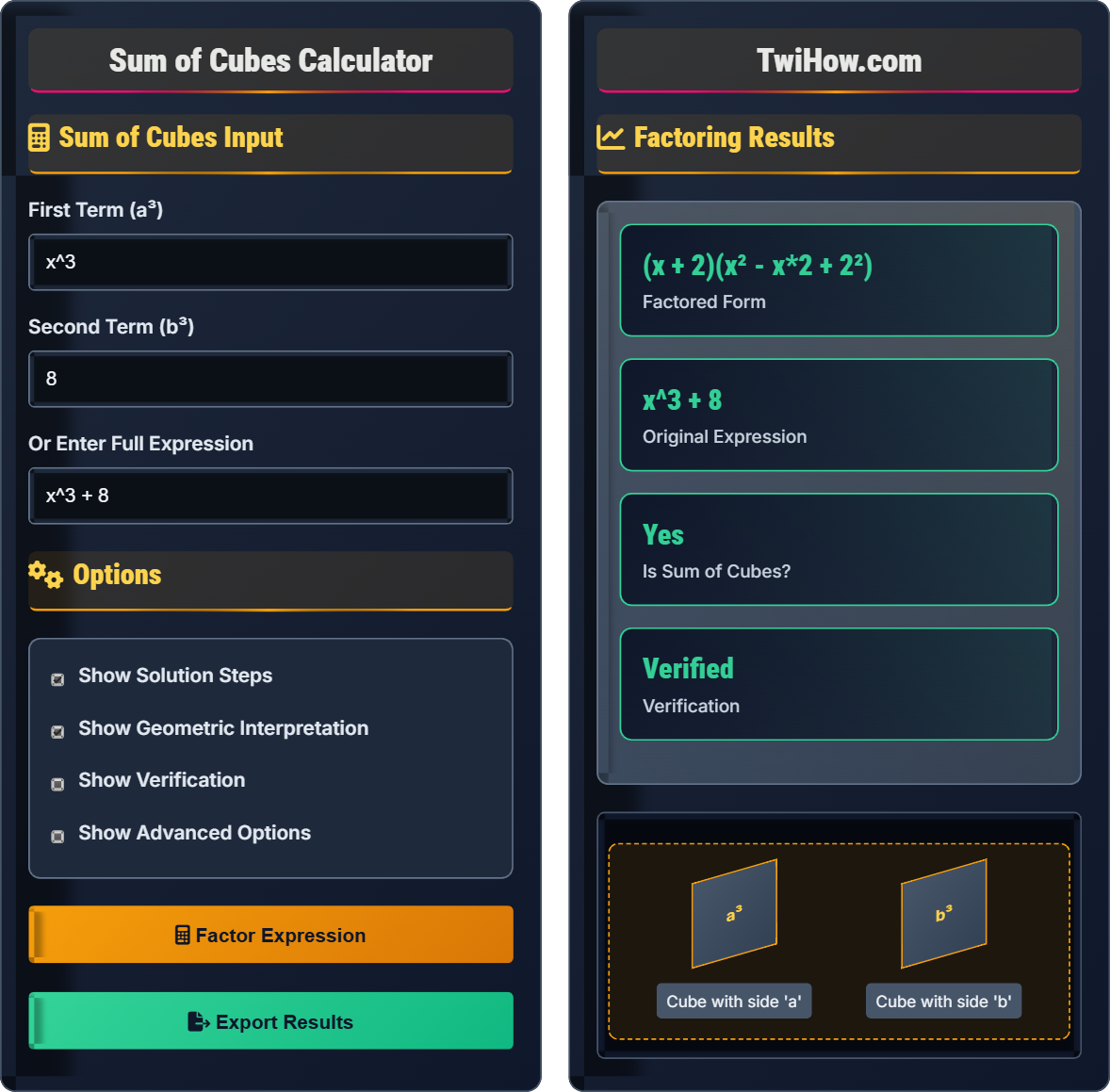
The sum of cubes has a geometric interpretation involving volumes of cubes. If we have two cubes with side lengths 'a' and 'b', their volumes are a³ and b³ respectively. The sum of cubes formula shows how these volumes can be represented as the product of (a + b) and (a² - ab + b²). Unlike the difference of squares, this doesn't have a simple visual rearrangement but represents a fundamental algebraic relationship.
- Factoring: Simplifying polynomial expressions
- Solving Equations: Setting factored form equal to zero
- Simplification: Reducing complex fractions
- Calculus: Limit evaluations and derivatives
Sum of Cubes Learning Quiz
Which of the following expressions CAN be factored using the sum of cubes formula?
The sum of cubes requires two perfect cubes separated by addition. Option C, x³ + 8, has x³ (cube of x) plus 8 (cube of 2), so it fits the pattern a³ + b³ where a = x and b = 2. The factorization is x³ + 8 = (x + 2)(x² - 2x + 4). The answer is C) x³ + 8.
To recognize a sum of cubes, look for the specific pattern: perfect cube + perfect cube. Both terms must be cubes of some expression, and they must be separated by addition. Option A is difference of cubes. Option B has a square term, not a cube. Option D needs to be factored differently first.
Sum of Cubes: Expression of form a³ + b³
Perfect Cube: Expression that equals something cubed
Factorization: Writing as a product of expressions
• Must have addition between terms
• Both terms must be perfect cubes
• Formula: a³ + b³ = (a + b)(a² - ab + b²)
• Look for the plus sign first
• Check if both terms are cubes
• Remember: difference of cubes is different
• Confusing with difference of cubes
• Misidentifying non-perfect cubes
• Forgetting the correct trinomial pattern
Factor completely: 27x³ + 64y³. Show your work and explain each step.
Step 1: Identify if this fits the sum of cubes pattern. 27x³ = (3x)³ and 64y³ = (4y)³. So we have (3x)³ + (4y)³.
Step 2: Apply the formula a³ + b³ = (a + b)(a² - ab + b²) where a = 3x and b = 4y.
Step 3: a² = (3x)² = 9x², ab = (3x)(4y) = 12xy, b² = (4y)² = 16y²
Step 4: 27x³ + 64y³ = (3x + 4y)(9x² - 12xy + 16y²)
The complete factorization is (3x + 4y)(9x² - 12xy + 16y²).
When factoring sums of cubes with multiple variables, treat each variable separately. Identify the cube root of each term, then apply the formula. The trinomial factor always follows the pattern a² - ab + b². In this case, we have (3x)³ and (4y)³, so the trinomial becomes (3x)² - (3x)(4y) + (4y)².
Complete Factorization: Breaking down until no further factoring is possible
Multiple Variables: Expressions containing more than one variable
Cube Root: Value that multiplies by itself three times to give the original
• Factor out GCF first if present
• Apply sum of cubes pattern
• Check if factors can be factored further
• Always check for GCF first
• Verify by expanding your answer
• Work with coefficients and variables separately
• Forgetting to factor out GCF
• Incorrectly identifying cube roots
• Not remembering the trinomial pattern
A company produces two types of cubic containers with volumes of x³ and 8 cubic meters respectively. Write an expression for the combined volume and factor it completely. Then explain how this factored form could help in designing packaging for both containers together.
Step 1: Combined volume is x³ + 8.
Step 2: Factor using sum of cubes: x³ + 8 = x³ + 2³ = (x + 2)(x² - 2x + 4).
The factored form (x + 2)(x² - 2x + 4) shows that the combined volume can be thought of as the product of two factors. This might be useful in packaging design because it suggests that the containers could potentially be arranged in a way that reflects these dimensions. For example, if x represents a dimension in meters, then (x + 2) could represent a combined linear dimension, and the quadratic factor represents the remaining area/volume relationship.
This problem connects factoring to a practical scenario. The factored form of a sum of cubes can provide insights into dimensional relationships that might be useful in design applications. While the geometric interpretation isn't as straightforward as with areas, the algebraic relationship still holds practical significance.
Volume: Space occupied by a 3D object
Cubic Container: Box with equal length, width, and height
Dimensional Relationship: How measurements relate to each other
• Volume of cube = side³
• Combined volume = sum of individual volumes
• Apply sum of cubes formula
• Think about what the factors might represent geometrically
• Consider how factored forms relate to dimensions
• Always verify your factorization
• Misidentifying the cube terms
• Forgetting the trinomial pattern
• Not verifying the final answer
Factor completely: x⁶ + 64. Explain how this relates to both sum of cubes and difference of squares patterns and why your factorization is complete.
Step 1: Recognize that x⁶ + 64 can be written as (x²)³ + 4³, which is a sum of cubes.
Step 2: Apply sum of cubes: x⁶ + 64 = (x²)³ + 4³ = (x² + 4)((x²)² - (x²)(4) + 4²) = (x² + 4)(x⁴ - 4x² + 16).
Step 3: Check if further factoring is possible. The factor (x² + 4) cannot be factored further over real numbers since it's a sum of squares. The factor (x⁴ - 4x² + 16) is not a difference of squares but can be checked for other patterns.
Step 4: Final factorization: x⁶ + 64 = (x² + 4)(x⁴ - 4x² + 16).
Over real numbers, this is completely factored.
Higher powers can sometimes be rewritten as cubes, allowing us to apply the sum of cubes pattern. Here, x⁶ = (x²)³ and 64 = 4³. After applying the sum of cubes, we check if any resulting factors can be factored further. In this case, x² + 4 is prime over real numbers, and the quartic factor doesn't follow a standard pattern.
Higher Powers: Exponents greater than 3
Complete Factorization: Factoring until no further factoring is possible
Prime Polynomial: Cannot be factored further over given domain
• Rewrite higher powers as cubes when possible
• Continue factoring until complete
• Sum of squares cannot be factored over reals
• Look for hidden sum of cubes patterns
• Factor repeatedly until complete
• Know when to stop factoring
• Stopping after first factorization
• Trying to factor sum of squares
• Missing additional factoring opportunities
Which of the following statements about the sum of cubes is TRUE?
Let's evaluate each option: A) FALSE - sum of cubes requires addition, not subtraction (that's difference of cubes). B) FALSE - the quadratic factor is a² - ab + b², not a² + ab + b². C) TRUE - sin³x + cos³x fits the pattern a³ + b³ where a = sin x and b = cos x, so it factors as (sin x + cos x)(sin²x - sin x cos x + cos²x). D) FALSE - the linear factor is (a + b), not (a - b). The answer is C) It can be applied to expressions like sin³x + cos³x.
The sum of cubes pattern is quite general - it applies to any expressions that can be written as perfect cubes, regardless of whether they contain variables, trigonometric functions, logarithms, or other mathematical expressions. The key is recognizing the pattern a³ + b³ where a and b can be any mathematical expressions.
Trigonometric Functions: sin, cos, tan, etc.
General Pattern: Applies to any expressions that fit a³ + b³
Mathematical Expressions: Any combination of numbers and operations
• Requires addition (not subtraction)
• Linear factor is (a + b)
• Quadratic factor is a² - ab + b²
• Look for the pattern regardless of expression type
• Remember: addition, not subtraction
• Quadratic factor has minus sign in middle
• Confusing with difference of cubes
• Using incorrect quadratic factor
• Thinking it only applies to simple polynomials
Sum of Cubes Fundamentals
a³ + b³ = (a + b)(a² - ab + b²), where a and b are any expressions that can be cubed.
1. Identify if expression has form a³ + b³
2. Find cube roots of each term
3. Apply formula: (sum of roots)(quadratic factor)
4. Verify by expanding
- Must have addition between terms
- Both terms must be perfect cubes
- Linear factor is always (a + b)
- Quadratic factor is always a² - ab + b²
Applications
Represents the sum of volumes of two cubes with sides 'a' and 'b' respectively.
- Polynomial factoring
- Solving cubic equations
- Simplifying algebraic fractions
- Trigonometric identities
- Only works with addition
- Cannot factor sum of squares over reals
- May need to factor multiple times
- Always verify factorization
FAQ
Q: Why does the quadratic factor in sum of cubes have a minus sign in the middle?
A: When we expand (a + b)(a² - ab + b²), the middle terms combine as follows: a(a² - ab + b²) + b(a² - ab + b²) = a³ - a²b + ab² + a²b - ab² + b³. The -a²b and +a²b terms cancel, as do the +ab² and -ab² terms, leaving only a³ + b³. The minus sign in the middle of the quadratic factor is essential for this cancellation to occur, ensuring that only the cubic terms remain.
Q: How does sum of cubes relate to complex numbers?
A: The sum of cubes formula connects to complex numbers through the cube roots of unity. When factoring a³ + b³, the quadratic factor a² - ab + b² can be factored further using complex numbers as (a - ωb)(a - ω²b), where ω = (-1 + i√3)/2 is a primitive cube root of unity. This gives the complete factorization: a³ + b³ = (a + b)(a - ωb)(a - ω²b), showing how algebraic formulas connect to deeper mathematical structures.