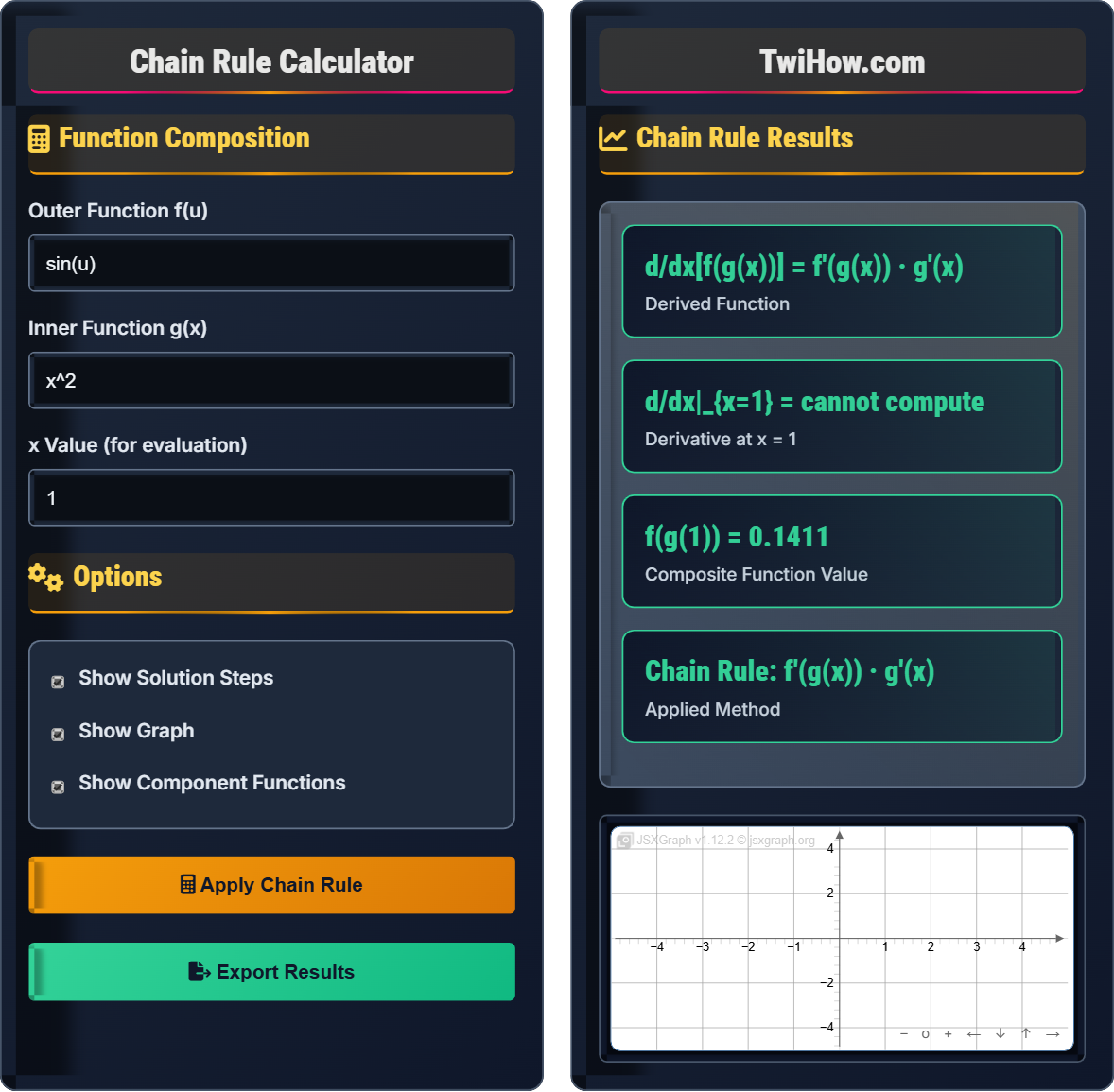
Chain Rule Calculator
Complete calculus guide • Step-by-step solutions
Chain Rule:
Show the calculator /Simulator\( \frac{d}{dx}[f(g(x))] = f'(g(x)) \cdot g'(x) \)
The Chain Rule is a fundamental technique in calculus for differentiating composite functions. It states that the derivative of a composite function f(g(x)) is the derivative of the outer function evaluated at the inner function, multiplied by the derivative of the inner function. This rule is essential when we have a function of a function, such as sin(x²), e^(2x), or (3x+1)⁵. The Chain Rule allows us to break down complex functions into simpler parts and differentiate them step by step.
Key applications include:
- Differentiating composite functions
- Trigonometric functions of functions
- Exponential and logarithmic compositions
- Parametric equations
The Chain Rule is one of the most important differentiation techniques and is used extensively in calculus, physics, engineering, and other sciences. It's often combined with other rules like the Product Rule and Quotient Rule for complex functions.
Function Composition
Options
Chain Rule Results
| Component | Function | Derivative | Value at x=1 |
|---|
Enter functions to see solution steps.
Chain Rule Explained
The Chain Rule is a fundamental differentiation technique used to find the derivative of composite functions. A composite function is formed when one function is applied to the result of another function, written as f(g(x)). The Chain Rule states that the derivative of f(g(x)) is the derivative of the outer function evaluated at the inner function, multiplied by the derivative of the inner function. This is expressed mathematically as: d/dx[f(g(x))] = f'(g(x)) · g'(x). The Chain Rule is essential for differentiating complex functions that cannot be handled with basic differentiation rules alone.
The formal statement of the Chain Rule is:
This rule can also be expressed using Leibniz notation as:
- dy/dx = (dy/du) · (du/dx) where y = f(u) and u = g(x)
- This notation emphasizes the "chain" of differentiation
Key characteristics of the Chain Rule:
- Order Matters: Differentiate outer function first, then multiply by derivative of inner
- Iterative Use: Can be applied multiple times for complex compositions
- Essential Rule: Foundation for implicit differentiation
- Physics Applications: Critical for related rates problems
- Identify Components: Recognize outer and inner functions
- Differentiate Outer: Find derivative of f(u) with respect to u
- Differentiate Inner: Find derivative of g(x) with respect to x
- Multiply Results: Apply the Chain Rule formula
Chain Rule Fundamentals
d/dx[f(g(x))] = f'(g(x)) · g'(x), where f and g are differentiable functions.
\( \frac{d}{dx}[f(g(x))] = f'(g(x)) \cdot g'(x) \)
Where f is the outer function and g is the inner function.
- Derivative of outside function evaluated at inside function
- Multiply by derivative of inside function
- Can be applied recursively for multiple compositions
Applications
Used for composite functions, parametric equations, and implicit differentiation.
- Physics rate problems
- Engineering design optimization
- Chemical reaction kinetics
- Economic growth models
- Both functions must be differentiable
- Check for domain restrictions
- Apply rule systematically
- Watch for multiple compositions
Chain Rule Learning Quiz
Find the derivative of f(x) = sin(x²) using the Chain Rule.
Using the Chain Rule: d/dx[f(g(x))] = f'(g(x)) · g'(x)
Step 1: Identify the outer function f(u) = sin(u) and inner function g(x) = x²
Step 2: Find the derivative of the outer function: f'(u) = cos(u)
Step 3: Evaluate f'(g(x)) = cos(x²)
Step 4: Find the derivative of the inner function: g'(x) = 2x
Step 5: Apply the Chain Rule: d/dx[sin(x²)] = cos(x²) · 2x
The answer is B) cos(x²) · 2x.
The Chain Rule requires identifying the "outer" and "inner" functions. In sin(x²), the outer function is sine and the inner function is x². We first differentiate the outer function (keeping the inner function intact) to get cos(x²), then multiply by the derivative of the inner function (2x). This two-step process is the essence of the Chain Rule: differentiate the outside function first, then multiply by the derivative of the inside function.
Composite Function: A function of a function [f(g(x))]
Outer Function: The function applied last (sin in sin(x²))
Inner Function: The function applied first (x² in sin(x²))
• d/dx[f(g(x))] = f'(g(x)) · g'(x) (chain rule)
• d/dx[sin(u)] = cos(u) · du/dx
• d/dx[x²] = 2x (power rule)
• Identify the outer and inner functions before applying the rule
• Differentiate the outer function first, keeping the inner function unchanged
• Always multiply by the derivative of the inner function
• Forgetting to multiply by the derivative of the inner function
Find the derivative of f(x) = e^(3x+2) using the Chain Rule. Show your work.
Step 1: Identify components: outer function f(u) = eᵘ, inner function g(x) = 3x + 2
Step 2: Derivative of outer function: f'(u) = eᵘ
Step 3: Evaluate at inner function: f'(g(x)) = e^(3x+2)
Step 4: Derivative of inner function: g'(x) = 3
Step 5: Apply Chain Rule: d/dx[e^(3x+2)] = e^(3x+2) · 3 = 3e^(3x+2)
Therefore, f'(x) = 3e^(3x+2).
This example shows the Chain Rule applied to an exponential function. The derivative of eᵘ with respect to u is eᵘ itself, which remains unchanged when we evaluate it at the inner function. Then we multiply by the derivative of the inner function (3x + 2), which is simply 3. The result is 3e^(3x+2). This demonstrates that the Chain Rule preserves the original function's form while scaling by the derivative of the inner function.
Exponential Function: Function of the form aˣ where a > 0
Natural Exponential: Function eˣ where e ≈ 2.718
Linear Function: Function of the form ax + b
• d/dx[eᵘ] = eᵘ · du/dx (exponential rule)
• d/dx[ax + b] = a (linear function rule)
• The exponential function is its own derivative
• Remember that the derivative of eˣ is eˣ
• For linear inner functions, the derivative is just the coefficient
• The result always includes the original exponential function
• Forgetting that d/dx[eᵘ] = eᵘ · u' (not just eᵘ)
• Not recognizing that the derivative of 3x+2 is 3
• Confusing exponential functions with polynomial functions
The position of a particle moving along a line is given by s(t) = sin(2t + π/4), where s is in meters and t is in seconds. Find the velocity of the particle at t = π/8 seconds using the Chain Rule.
Step 1: Velocity is the derivative of position: v(t) = ds/dt = d/dt[sin(2t + π/4)]
Step 2: Identify components: outer function f(u) = sin(u), inner function g(t) = 2t + π/4
Step 3: Derivative of outer function: f'(u) = cos(u)
Step 4: Evaluate at inner function: f'(g(t)) = cos(2t + π/4)
Step 5: Derivative of inner function: g'(t) = 2
Step 6: Apply Chain Rule: v(t) = cos(2t + π/4) · 2 = 2cos(2t + π/4)
Step 7: At t = π/8: v(π/8) = 2cos(2·π/8 + π/4) = 2cos(π/4 + π/4) = 2cos(π/2) = 2·0 = 0
The velocity at t = π/8 seconds is 0 m/s.
This problem demonstrates the Chain Rule in a physics context. The position function is a composite function with an outer sine function and an inner linear function. The velocity is the derivative of position, so we apply the Chain Rule: the derivative of sin(u) is cos(u) times the derivative of u. This example also shows how calculus connects to physics - the derivative of position gives velocity, and when velocity is zero, the particle is momentarily at rest.
Position Function: Describes location at time t
Velocity: Rate of change of position (v = ds/dt)
Harmonic Motion: Periodic motion described by trigonometric functions
• Velocity = derivative of position function
• d/dt[sin(at + b)] = a·cos(at + b)
• cos(π/2) = 0
• Remember that derivatives of position give velocity and acceleration
• Common angles like π/4 and π/2 have known trig values
• The Chain Rule is essential for periodic motion problems
• Forgetting to multiply by the derivative of the inner function
• Incorrectly calculating the derivative of 2t + π/4
• Not recognizing when the velocity equals zero
Find the derivative of f(x) = sin²(3x) using the Chain Rule. Hint: This is a composition of three functions: square, sine, and linear.
Step 1: Rewrite as f(x) = [sin(3x)]² to see the composition
Step 2: Identify the functions from outside to inside: u², sin(v), 3x
Step 3: Apply the Chain Rule iteratively: d/dx[u²] = 2u · du/dx
Step 4: Here u = sin(3x), so du/dx = cos(3x) · 3 (applying Chain Rule again)
Step 5: f'(x) = 2·sin(3x) · cos(3x) · 3
Step 6: f'(x) = 6sin(3x)cos(3x)
Step 7: Using the double angle identity: f'(x) = 3sin(6x)
Therefore, f'(x) = 6sin(3x)cos(3x) or 3sin(6x).
This problem shows how to apply the Chain Rule multiple times for functions with more than two layers. We can think of sin²(3x) as [sin(3x)]². The outermost function is the squaring function, the middle function is sine, and the innermost function is 3x. We apply the Chain Rule step by step from the outside in: first differentiate the square function, then the sine function, then the linear function. This demonstrates the iterative nature of the Chain Rule for complex compositions.
Triple Composition: Function of the form f(g(h(x)))
Iterative Application: Applying the rule multiple times
Double Angle Identity: sin(2θ) = 2sin(θ)cos(θ)
• For f(g(h(x))): (f∘g∘h)' = f'(g(h(x))) · g'(h(x)) · h'(x)
• sin(2θ) = 2sin(θ)cos(θ) (double angle identity)
• Apply the Chain Rule from outside to inside
• Break down complex functions into smaller parts
• Apply the Chain Rule step by step
• Use trigonometric identities to simplify results when possible
• Not recognizing that sin²(3x) = [sin(3x)]²
• Forgetting to apply the Chain Rule to each layer
• Arithmetic errors when multiplying multiple derivatives
What is the derivative of f(x) = ln(2x² + 3x + 1) using the Chain Rule?
Using the Chain Rule: d/dx[ln(u)] = (1/u) · du/dx
Step 1: Identify u = 2x² + 3x + 1
Step 2: Find du/dx = 4x + 3
Step 3: Apply the formula: d/dx[ln(2x² + 3x + 1)] = (1/(2x² + 3x + 1)) · (4x + 3)
Step 4: f'(x) = (4x + 3)/(2x² + 3x + 1)
The answer is B) (4x + 3)/(2x² + 3x + 1).
The derivative of ln(u) is particularly straightforward with the Chain Rule: it's simply (1/u) times the derivative of u. In this case, we have ln(2x² + 3x + 1), so the derivative is 1 divided by the original function, multiplied by the derivative of the inside function (2x² + 3x + 1), which is 4x + 3. This gives us (4x + 3)/(2x² + 3x + 1). This pattern is consistent for all logarithmic functions: the derivative of ln(f(x)) is f'(x)/f(x).
Natural Logarithm: Logarithm with base e
Logarithmic Derivative: Derivative of ln(f(x)) is f'(x)/f(x)Rational Function: Function expressed as a ratio of polynomials
• d/dx[ln(u)] = (1/u) · du/dx (logarithmic rule)
• d/dx[2x² + 3x + 1] = 4x + 3 (polynomial rule)
• The result is always a rational function
• The derivative of ln(f(x)) is always f'(x)/f(x)
• Remember to multiply by the derivative of the inside function
• Check that the denominator is never zero in the domain
• Forgetting to multiply by the derivative of the inside function
• Thinking the derivative of ln(u) is just 1/u
• Not simplifying the final rational expression
FAQ
Q: How do I recognize when to use the Chain Rule?
A: The Chain Rule is used when you have a composite function - a function of a function. Look for expressions like:
• Trigonometric functions of other functions: sin(x²), cos(3x+1), tan(√x)
• Exponential functions with non-trivial exponents: e^(x²), 2^(3x)
• Logarithmic functions of other functions: ln(x²+1), log₃(2x-5)
• Functions raised to powers: (2x+1)⁵, (x²-3x+2)¹⁰
• Radicals of functions: √(x³+2x), ∛(sin(x))
Ask yourself: "Is this function applied to another function?" If yes, use the Chain Rule.
Q: How is the Chain Rule used in engineering applications?
A: The Chain Rule is fundamental in engineering:
Mechanical Engineering: Differentiating position functions that depend on time-dependent parameters.
Electrical Engineering: Analyzing signals that are functions of other time-varying signals.
Chemical Engineering: Reaction rate calculations where concentrations depend on time-varying factors.
Civil Engineering: Stress analysis in materials with time-varying loads.
Systems Engineering: Control systems where output depends on functions of state variables.
Any time a quantity depends on another quantity that itself changes with time, the Chain Rule is essential.