Derivative Definition Calculator
Complete calculus guide • Step-by-step solutions
Derivative Definition:
Show the calculator /Simulator\( f'(x) = \lim_{h \to 0} \frac{f(x+h) - f(x)}{h} \)
The derivative of a function represents the instantaneous rate of change of the function at any point. It measures how quickly the output of the function changes as the input changes. The limit definition of the derivative is the foundational concept that gives rise to all differentiation rules. This definition captures the idea of finding the slope of the tangent line to a curve at a specific point by taking the limit of the slopes of secant lines as the distance between points approaches zero.
Key applications include:
- Finding rates of change in physics and engineering
- Determining instantaneous velocity and acceleration
- Optimization problems in business and economics
- Curve sketching and analysis
The derivative definition is fundamental to calculus and provides the theoretical basis for all differentiation techniques. Understanding this definition is crucial for grasping the deeper concepts of calculus.
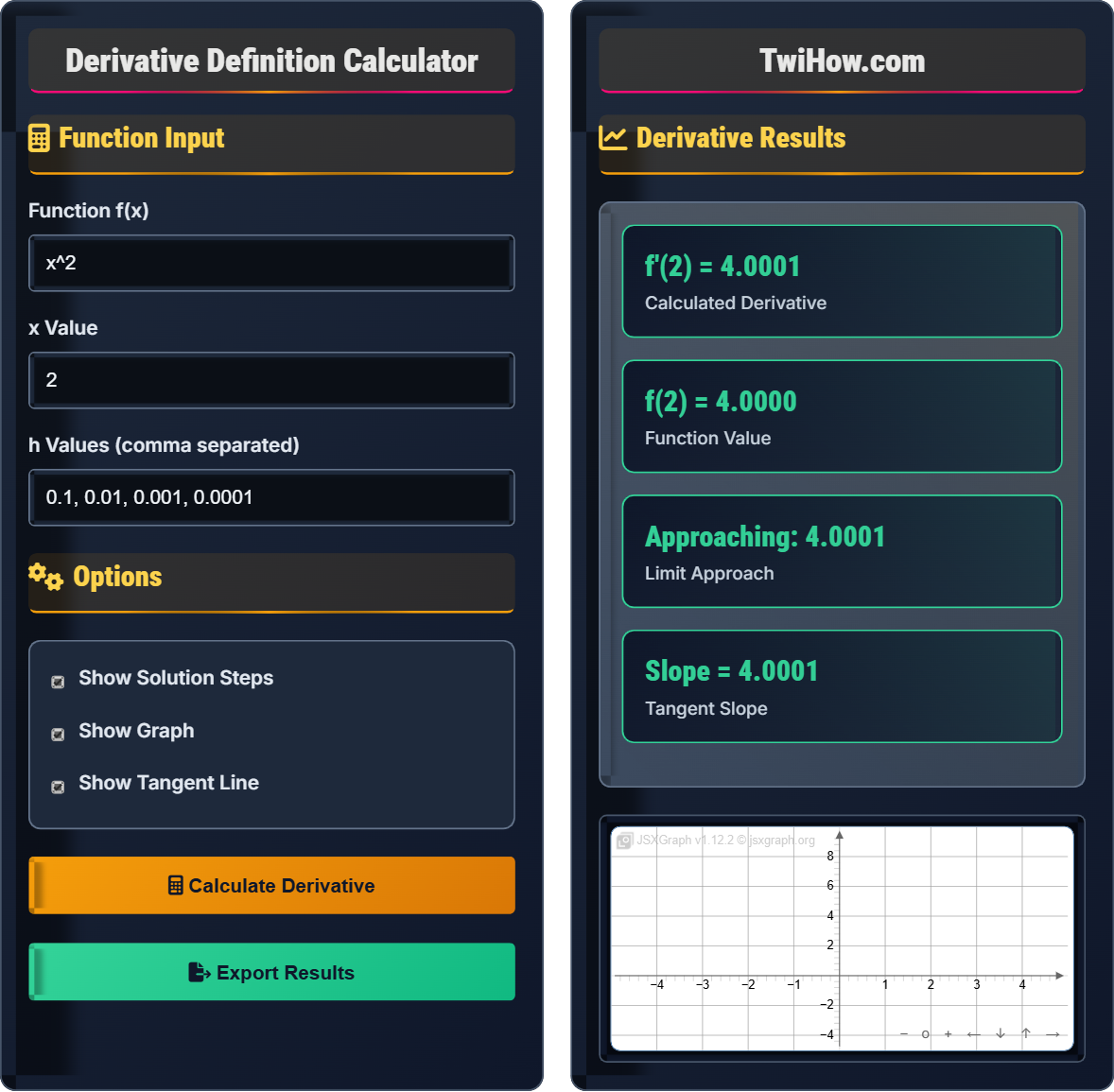
Function Input
Options
Derivative Results
| h Value | f(x+h) | f(x) | f(x+h) - f(x) | [f(x+h) - f(x)]/h |
|---|
Enter function and x value to see solution steps.
Derivative Definition Explained
The derivative of a function f(x) at a point x is defined as the limit of the difference quotient as h approaches zero: f'(x) = lim[h→0] [f(x+h) - f(x)]/h. This definition captures the instantaneous rate of change of the function at that point. It represents the slope of the tangent line to the curve at that specific point, which is the limit of the slopes of secant lines connecting nearby points on the curve.
The formal definition of the derivative is:
Alternatively, it can be expressed as:
- \( f'(a) = \lim_{x \to a} \frac{f(x) - f(a)}{x - a} \)
Key characteristics of the derivative definition:
- Instantaneous Rate: Measures rate of change at a single point
- Limit Process: Requires the limit to exist for the derivative to exist
- Geometric Interpretation: Represents the slope of the tangent line
- Physical Interpretation: Represents instantaneous velocity when f(x) is position
- Direct Substitution: Substitute the function into the definition
- Algebraic Simplification: Simplify the difference quotient
- Cancel Common Factors: Cancel h in numerator and denominator
- Evaluation: Take the limit as h approaches 0
Derivative Definition Fundamentals
f'(x) = lim[h→0] [f(x+h) - f(x)]/h, where h represents a small change in x.
\( f'(x) = \lim_{h \to 0} \frac{f(x+h) - f(x)}{h} \)
Where f(x) = original function, h = small change in x.
- Limit must exist for derivative to exist
- Function must be continuous at the point
- h must cancel out in the difference quotient
Applications
Used for rates of change, tangent lines, optimization, and curve analysis.
- Velocity and acceleration
- Marginal cost/profit
- Population growth
- Chemical reaction rates
- Function must be differentiable at the point
- Check for continuity first
- Verify the limit exists
- Consider domain restrictions
Derivative Definition Learning Quiz
Using the definition of the derivative, find f'(x) for f(x) = 3x + 2.
Using the definition: f'(x) = lim[h→0] [f(x+h) - f(x)]/h
Step 1: Find f(x+h) = 3(x+h) + 2 = 3x + 3h + 2
Step 2: Calculate f(x+h) - f(x) = (3x + 3h + 2) - (3x + 2) = 3h
Step 3: Form the difference quotient: [f(x+h) - f(x)]/h = 3h/h = 3
Step 4: Take the limit: f'(x) = lim[h→0] 3 = 3
The answer is B) 3.
This problem demonstrates the systematic approach to finding derivatives using the definition. The key insight is that for a linear function f(x) = mx + b, the derivative is always m, representing the constant slope. The constant term disappears because it doesn't affect the rate of change. Notice how the h in the numerator cancels with the h in the denominator, leaving a constant that doesn't depend on h, so the limit as h approaches 0 is just that constant.
Derivative Definition: f'(x) = lim[h→0] [f(x+h) - f(x)]/h
Difference Quotient: The expression [f(x+h) - f(x)]/h
Linear Function: Function of the form f(x) = mx + b
• f'(x) = lim[h→0] [f(x+h) - f(x)]/h (definition)
• For linear functions f(x) = mx + b, f'(x) = m
• Constants disappear when taking derivatives
• Always expand f(x+h) first
• Cancel h from numerator and denominator when possible
• The result should not contain h after taking the limit
• Forgetting to expand f(x+h) properly
• Not canceling h correctly
• Leaving h in the final answer
Using the definition of the derivative, find f'(x) for f(x) = x². Show your work.
Using the definition: f'(x) = lim[h→0] [f(x+h) - f(x)]/h
Step 1: Find f(x+h) = (x+h)² = x² + 2xh + h²
Step 2: Calculate f(x+h) - f(x) = (x² + 2xh + h²) - x² = 2xh + h²
Step 3: Factor out h: f(x+h) - f(x) = h(2x + h)
Step 4: Form the difference quotient: [f(x+h) - f(x)]/h = h(2x + h)/h = 2x + h
Step 5: Take the limit: f'(x) = lim[h→0] (2x + h) = 2x + 0 = 2x
Therefore, f'(x) = 2x.
This is the classic example of finding the derivative of a quadratic function using the definition. The key step is factoring out h from the numerator in Step 3, which allows us to cancel h from the numerator and denominator in Step 4. This cancellation is crucial because it eliminates the h from the denominator, allowing us to evaluate the limit as h approaches 0. The result f'(x) = 2x shows that the slope of the tangent line to the parabola y = x² varies linearly with x.
Quadratic Function: Function of the form f(x) = ax² + bx + c
Difference Quotient: [f(x+h) - f(x)]/h
Binomial Expansion: (x+h)² = x² + 2xh + h²
• f'(x²) = 2x (special case)
• Always factor out h before canceling
• The limit must exist for the derivative to exist
• Expand (x+h)² carefully: x² + 2xh + h²
• Factor out h to facilitate cancellation
• The final result should not contain h
• Expanding (x+h)² incorrectly as x² + h²
• Not factoring out h before canceling
• Leaving h in the final answer
The position of a particle moving along a line is given by s(t) = 4t² + 3t + 1, where s is measured in meters and t in seconds. Find the velocity of the particle at t = 2 seconds using the definition of the derivative. What is the physical meaning of this value?
Velocity is the derivative of position, so v(t) = s'(t).
Using the definition: s'(t) = lim[h→0] [s(t+h) - s(t)]/h
Step 1: Find s(t+h) = 4(t+h)² + 3(t+h) + 1 = 4(t² + 2th + h²) + 3t + 3h + 1 = 4t² + 8th + 4h² + 3t + 3h + 1
Step 2: Calculate s(t+h) - s(t) = (4t² + 8th + 4h² + 3t + 3h + 1) - (4t² + 3t + 1) = 8th + 4h² + 3h
Step 3: Factor out h: s(t+h) - s(t) = h(8t + 4h + 3)
Step 4: Form the difference quotient: [s(t+h) - s(t)]/h = h(8t + 4h + 3)/h = 8t + 4h + 3
Step 5: Take the limit: s'(t) = lim[h→0] (8t + 4h + 3) = 8t + 3
Step 6: At t = 2: v(2) = s'(2) = 8(2) + 3 = 19 m/s
The velocity at t = 2 seconds is 19 m/s, meaning the particle is moving forward at 19 meters per second.
This problem demonstrates a fundamental application of derivatives in physics. Position, velocity, and acceleration are connected through derivatives: velocity is the derivative of position, and acceleration is the derivative of velocity. The derivative definition shows us the instantaneous rate of change of position, which is exactly what velocity measures. This connects the abstract mathematical concept to a concrete physical interpretation.
Position Function: s(t) describes location at time t
Velocity: Rate of change of position (v = ds/dt)
Acceleration: Rate of change of velocity (a = dv/dt)
• Velocity = derivative of position
• Acceleration = derivative of velocity
• Derivatives measure instantaneous rates of change
• Apply the derivative definition systematically
• Physical quantities often represent rates of change
• Always include units in your final answer
• Not expanding (t+h)² correctly
• Arithmetic errors in the algebra
• Forgetting to substitute the specific time value
Find the equation of the tangent line to the curve f(x) = x² + 2x at the point where x = 1. Use the definition of the derivative to find the slope.
Step 1: Find the point on the curve: f(1) = 1² + 2(1) = 3, so the point is (1, 3)
Step 2: Find the derivative using the definition: f'(x) = lim[h→0] [f(x+h) - f(x)]/h
Step 3: f(x+h) = (x+h)² + 2(x+h) = x² + 2xh + h² + 2x + 2h
Step 4: f(x+h) - f(x) = (x² + 2xh + h² + 2x + 2h) - (x² + 2x) = 2xh + h² + 2h = h(2x + h + 2)
Step 5: [f(x+h) - f(x)]/h = h(2x + h + 2)/h = 2x + h + 2
Step 6: f'(x) = lim[h→0] (2x + h + 2) = 2x + 2
Step 7: At x = 1: f'(1) = 2(1) + 2 = 4 (this is the slope)
Step 8: Using point-slope form: y - 3 = 4(x - 1), so y = 4x - 1
The equation of the tangent line is y = 4x - 1.
This problem combines the derivative definition with the geometric interpretation of derivatives. The derivative at a point gives the slope of the tangent line at that point. Once we have the slope and a point on the line, we can use the point-slope form to write the equation of the tangent line. This demonstrates the connection between the analytical concept of the derivative and its geometric interpretation.
Tangent Line: Line that touches a curve at exactly one point
Point-Slope Form: y - y₁ = m(x - x₁)
Derivative as Slope: f'(a) is the slope of tangent line at x = a
• f'(a) = slope of tangent line at x = a
• Point-slope form: y - y₁ = m(x - x₁)
• Tangent line passes through (a, f(a))
• Find the point first, then the slope
• Use the derivative definition systematically
• Check that the tangent line passes through the correct point
• Confusing the point with the slope
• Errors in expanding (x+h)²
• Using the wrong x-value for the derivative
Why is it important that h approaches 0 (but never equals 0) in the definition of the derivative?
In the derivative definition f'(x) = lim[h→0] [f(x+h) - f(x)]/h, when h = 0, the denominator becomes 0, making the expression undefined. The numerator f(x+h) - f(x) becomes f(x) - f(x) = 0, giving us 0/0, which is indeterminate. The limit process allows us to approach the value that the difference quotient gets arbitrarily close to as h gets arbitrarily close to 0, without ever actually reaching h = 0.
The answer is D) Both B and C are correct.
This question addresses a fundamental concept in calculus: the distinction between the value of a function at a point and the limit of a function as it approaches that point. The derivative definition involves a limit because directly substituting h = 0 would result in division by zero. The limit allows us to find the value that the difference quotient approaches as h gets arbitrarily close to 0, without actually equaling 0. This is what makes the derivative represent the instantaneous rate of change.
Limit: The value a function approaches as input approaches a value
Indeterminate Form: 0/0 or ∞/∞ which require further analysis
Division by Zero: Undefined mathematical operation
• Division by zero is undefined
• Limits allow us to approach values without reaching them
• 0/0 is an indeterminate form requiring limit analysis
• Always factor out h to cancel it from denominator
• The limit process avoids division by zero
• Limits describe behavior near a point, not at the point
• Directly substituting h = 0 into the difference quotient
• Not understanding why limits are necessary
• Confusing function value with limit value
FAQ
Q: Why do we need the limit in the definition of the derivative?
A: The limit is essential because the derivative represents the instantaneous rate of change, which is the slope of the tangent line at a single point. If we tried to calculate this directly using the slope formula, we would need two points that are exactly the same (since we want the rate at one point), which would give us (f(x) - f(x))/(x - x) = 0/0, which is undefined.
Instead, we use the limit of the difference quotient [f(x+h) - f(x)]/h as h approaches 0. This allows us to consider the slope of secant lines connecting points that get arbitrarily close to each other, approaching the slope of the tangent line at the point of interest. The limit process enables us to define the derivative without encountering division by zero.
Q: How is the derivative definition used in engineering applications?
A: The derivative definition is fundamental in engineering:
Mechanical Engineering: Calculating velocities and accelerations from position functions.
Electrical Engineering: Determining rates of change in current and voltage.
Chemical Engineering: Analyzing reaction rates and heat transfer.
Civil Engineering: Calculating stress and strain rates in materials.
Systems Engineering: Analyzing system response rates and stability.
While engineers typically use derivative rules in practice, understanding the definition is crucial for developing mathematical models of physical systems and for situations where standard rules don't apply.