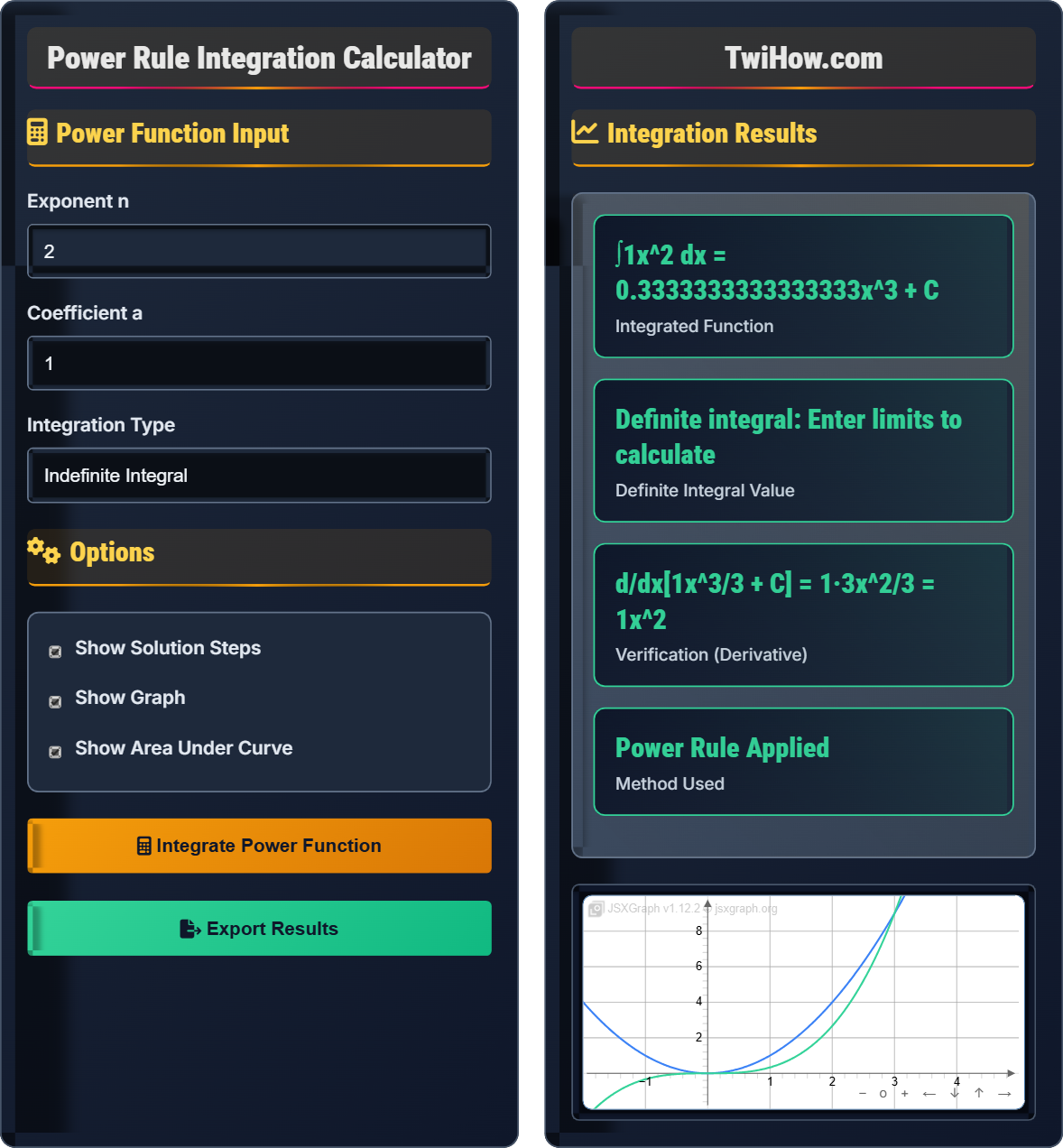
Power Rule Integration Calculator
Complete calculus guide • Step-by-step solutions
Power Rule Integration:
Show the calculator /Simulator\( \int x^n \, dx = \frac{x^{n+1}}{n+1} + C \quad (n \neq -1) \)
The Power Rule for Integration is the fundamental technique for integrating power functions. It states that to integrate x^n, you add 1 to the exponent and divide by the new exponent, plus an arbitrary constant C. This rule is the reverse of the Power Rule for differentiation and is one of the most basic integration techniques. The restriction n ≠ -1 is crucial because it would lead to division by zero, and the integral of x⁻¹ is ln|x| + C, which requires a different approach.
Key applications include:
- Integrating polynomial functions
- Finding areas under power function curves
- Solving differential equations
- Physics applications in kinematics
This rule forms the foundation for more complex integration techniques and is essential for solving any integral involving polynomial terms. The constant of integration C represents the family of antiderivatives that differ by a constant value.
Power Function Input
Options
Integration Results
| Parameter | Value | Formula | Result |
|---|
Enter exponent to see solution steps.
Power Rule Integration Explained
The Power Rule for Integration is a fundamental technique that reverses the Power Rule for differentiation. It states that the integral of x^n is (x^(n+1))/(n+1) + C, where C is the constant of integration. This rule works for any real number n except n = -1, which requires the natural logarithm. The Power Rule is essential for integrating polynomial functions and forms the basis for more complex integration techniques. The "+ C" represents the family of antiderivatives, acknowledging that the derivative of any constant is zero.
The formal statement of the Power Rule for Integration is:
For definite integrals:
- \( \int_a^b x^n \, dx = \frac{x^{n+1}}{n+1} \Big|_a^b = \frac{b^{n+1} - a^{n+1}}{n+1} \)
Key characteristics of power rule integration:
- Reversibility: The derivative of the result returns the original function
- Constant of Integration: Always include +C for indefinite integrals
- Special Case: ∫x⁻¹ dx = ln|x| + C
- Polynomial Integration: Applies to each term independently
- Identify Exponent: Recognize the power n in x^n
- Add One: Increase the exponent by 1
- Divide: Divide by the new exponent
- Add Constant: Include +C for indefinite integrals
Power Integration Fundamentals
∫x^n dx = (x^(n+1))/(n+1) + C, where n ≠ -1 and C is the constant of integration.
\( \int x^n \, dx = \frac{x^{n+1}}{n+1} + C \)
Where n = exponent of x, C = constant of integration.
- n ≠ -1 (special case for reciprocal)
- Add 1 to exponent
- Divide by new exponent
Applications
Used for polynomial integration, area under curves, and solving differential equations.
- Physics motion problems
- Engineering design calculations
- Economics optimization
- Geometry area/volume
- Check for n = -1 special case
- Include constant of integration
- Consider domain restrictions
- Verify with differentiation
Power Rule Integration Learning Quiz
What is the integral of x⁴ dx using the Power Rule?
Using the Power Rule: ∫x^n dx = (x^(n+1))/(n+1) + C
For ∫x⁴ dx, we have n = 4
Step 1: Add 1 to the exponent: 4 + 1 = 5
Step 2: Divide by the new exponent: 1/5
Step 3: Apply the rule: ∫x⁴ dx = (x⁵)/5 + C
The answer is A) (1/5)x⁵ + C.
The Power Rule for Integration is the reverse of the Power Rule for differentiation. For integration, we add 1 to the exponent and divide by the new exponent. This is the opposite of differentiation where we multiply by the exponent and subtract 1. The key is to remember that we're "undoing" the differentiation process. When we differentiate (x⁵)/5, we get 5·(x⁴)/5 = x⁴, which confirms our integration was correct.
Power Rule Integration: ∫x^n dx = (x^(n+1))/(n+1) + C
Constant of Integration: Arbitrary constant C added to indefinite integrals
Antiderivative: Function whose derivative is the original function
• ∫x^n dx = (x^(n+1))/(n+1) + C (for n ≠ -1)
• Always add the constant C for indefinite integrals
• Add 1 to exponent, divide by new exponent
• Remember: integration is differentiation in reverse
• Always verify by differentiating your result
• Don't forget the constant of integration
• Forgetting to add 1 to the exponent
• Not dividing by the new exponent
• Omitting the constant of integration
Find the integral of √x dx. Express your answer with a positive exponent.
First, rewrite √x as x^(1/2)
Using the Power Rule: ∫x^n dx = (x^(n+1))/(n+1) + C
Here, n = 1/2
Step 1: Add 1 to exponent: 1/2 + 1 = 1/2 + 2/2 = 3/2
Step 2: Divide by new exponent: 1/(3/2) = 2/3
Step 3: Apply rule: ∫x^(1/2) dx = (2/3)x^(3/2) + C
Step 4: Convert back to radical form: (2/3)x^(3/2) = (2/3)√(x³) = (2/3)x√x
Therefore, ∫√x dx = (2/3)x^(3/2) + C.
This problem demonstrates how to handle fractional exponents with the Power Rule. The key insight is recognizing that √x = x^(1/2). Once rewritten in exponential form, we can apply the Power Rule directly. When n = 1/2, n+1 = 3/2, and 1/(n+1) = 1/(3/2) = 2/3. The result (2/3)x^(3/2) can be converted back to radical form as (2/3)√(x³) or (2/3)x√x. This shows the connection between fractional exponents and radicals.
Fractional Exponent: x^(m/n) = nth root of x^m
Rational Exponent: Exponent that is a fraction
Radical Form: Expression using root symbols
• √x = x^(1/2)
• ∛x = x^(1/3)
• x^(m/n) = √(nth root of x^m)
• Convert radicals to fractional exponents first
• The Power Rule works for any real number exponent
• Remember to add 1 to the fractional exponent
• Not converting radicals to fractional exponents
• Arithmetic errors when adding fractions
• Forgetting to divide by the new exponent
The velocity of a particle is given by v(t) = 3t² + 2t + 1 m/s. Find the position function s(t) if the particle starts at position s(0) = 5 meters. Use integration to solve.
Since velocity is the derivative of position, we integrate: s(t) = ∫v(t) dt = ∫(3t² + 2t + 1) dt
Step 1: Integrate each term separately using the Power Rule
Step 2: ∫3t² dt = 3 · (t³)/3 = t³
Step 3: ∫2t dt = 2 · (t²)/2 = t²
Step 4: ∫1 dt = t
Step 5: s(t) = t³ + t² + t + C
Step 6: Use initial condition s(0) = 5: 5 = 0³ + 0² + 0 + C, so C = 5
Therefore, s(t) = t³ + t² + t + 5 meters.
This problem demonstrates a fundamental application of integration in physics: finding position from velocity. Since velocity is the derivative of position (v = ds/dt), position is the integral of velocity (s = ∫v dt). We apply the Power Rule to each term in the polynomial separately. The constant of integration C is determined by the initial condition. This shows how calculus connects physical quantities: position, velocity, and acceleration are related through differentiation and integration.
Velocity: Rate of change of position (v = ds/dt)
Position: Location of object at time t
Initial Condition: Known value at specific time
• Position = ∫velocity dt
• ∫(a·f(x)) dx = a·∫f(x) dx (constant multiple rule)
• ∫(f(x) + g(x)) dx = ∫f(x) dx + ∫g(x) dx (sum rule)
• Integrate each term of polynomial separately
• Use initial conditions to find constants
• Always check by differentiating your result
• Forgetting to integrate each term separately
• Not applying the Power Rule correctly to each term
• Forgetting to use initial conditions to find C
Find the area under the curve y = x³ from x = 1 to x = 2 using definite integration. Show your work and verify using the Fundamental Theorem of Calculus.
Area = ∫₁² x³ dx
Step 1: Find the antiderivative: ∫x³ dx = (x⁴)/4 + C
Step 2: Apply the Fundamental Theorem of Calculus: ∫₁² x³ dx = [(x⁴)/4]₁²
Step 3: Evaluate at bounds: [(2⁴)/4] - [(1⁴)/4] = [16/4] - [1/4] = 4 - 0.25 = 3.75
Step 4: Verification: d/dx[(x⁴)/4] = (4x³)/4 = x³ ✓
The area under the curve from x = 1 to x = 2 is 3.75 square units.
This problem demonstrates the connection between definite integration and area calculation. The Fundamental Theorem of Calculus states that ∫ₐᵇ f(x) dx = F(b) - F(a), where F is the antiderivative of f. First, we find the antiderivative using the Power Rule, then we evaluate it at the upper and lower bounds and subtract. This is much more efficient than trying to calculate the area geometrically. The verification step confirms that our antiderivative is correct by differentiating it.
Definite Integral: Integral with specified bounds
Antiderivative: Function whose derivative is the integrand
Fundamental Theorem: Connects differentiation and integration
• ∫ₐᵇ f(x) dx = F(b) - F(a) (Fundamental Theorem)
• ∫x^n dx = (x^(n+1))/(n+1) + C
• Area under curve = definite integral
• Always find the antiderivative first
• Substitute upper bound first, then lower bound
• Subtract: Upper value - Lower value
• Forgetting to subtract the lower bound value
• Substituting bounds in wrong order
• Arithmetic errors when evaluating powers
What is the integral of x⁻³ dx? Note: n ≠ -1 in this case.
Using the Power Rule: ∫x^n dx = (x^(n+1))/(n+1) + C
For ∫x⁻³ dx, we have n = -3
Step 1: Add 1 to exponent: -3 + 1 = -2
Step 2: Divide by new exponent: 1/(-2) = -1/2
Step 3: Apply rule: ∫x⁻³ dx = (x⁻²)/(-2) + C = (-1/2)x⁻² + C
Step 4: Can also be written as: -1/(2x²) + C
The answer is B) (-1/2)x⁻² + C.
This problem shows how the Power Rule works with negative exponents. When n = -3, we still add 1 to get n+1 = -2, and divide by this new exponent: 1/(-2) = -1/2. The result (-1/2)x⁻² can be written as -1/(2x²), showing that integration can produce rational functions from negative power functions. Note that this is different from the special case of n = -1, which gives ln|x| + C.
Negative Exponent: x⁻ⁿ = 1/xⁿ
Rational Function: Function expressed as a ratio of polynomials
Special Case: ∫x⁻¹ dx = ln|x| + C
• ∫x^n dx = (x^(n+1))/(n+1) + C (for n ≠ -1)
• n = -1 is the exception: ∫x⁻¹ dx = ln|x| + C
• The rule works for all other real values of n
• The Power Rule works for any real number n except -1
• Negative exponents produce positive coefficients when integrated
• Remember that x⁻² = 1/x²
• Confusing the special case of n = -1
• Arithmetic errors with negative numbers
• Forgetting to change the sign when dividing by a negative number
FAQ
Q: Why can't we use the Power Rule for n = -1?
A: The Power Rule ∫x^n dx = (x^(n+1))/(n+1) + C fails when n = -1 because it would require division by zero:
∫x⁻¹ dx = (x⁻¹⁺¹)/(-1+1) + C = x⁰/0 + C = 1/0 + C
Division by zero is undefined in mathematics. Instead, the integral of x⁻¹ (or 1/x) is ln|x| + C. This is because d/dx[ln|x|] = 1/x, making ln|x| the antiderivative of 1/x. The natural logarithm function is specifically designed to handle this case where the Power Rule breaks down.
Q: How is power rule integration used in engineering applications?
A: Power rule integration is fundamental in engineering:
Mechanical Engineering: Calculating work done by variable forces, center of mass calculations.
Electrical Engineering: Computing energy stored in capacitors and inductors.
Civil Engineering: Determining volumes of revolution, structural analysis.
Chemical Engineering: Reaction rate integration, heat transfer calculations.
Systems Engineering: Modeling cumulative processes over time.
Power rule integration is essential for any engineering calculation involving polynomial relationships.