Product Rule Calculator
Complete calculus guide • Step-by-step solutions
Product Rule:
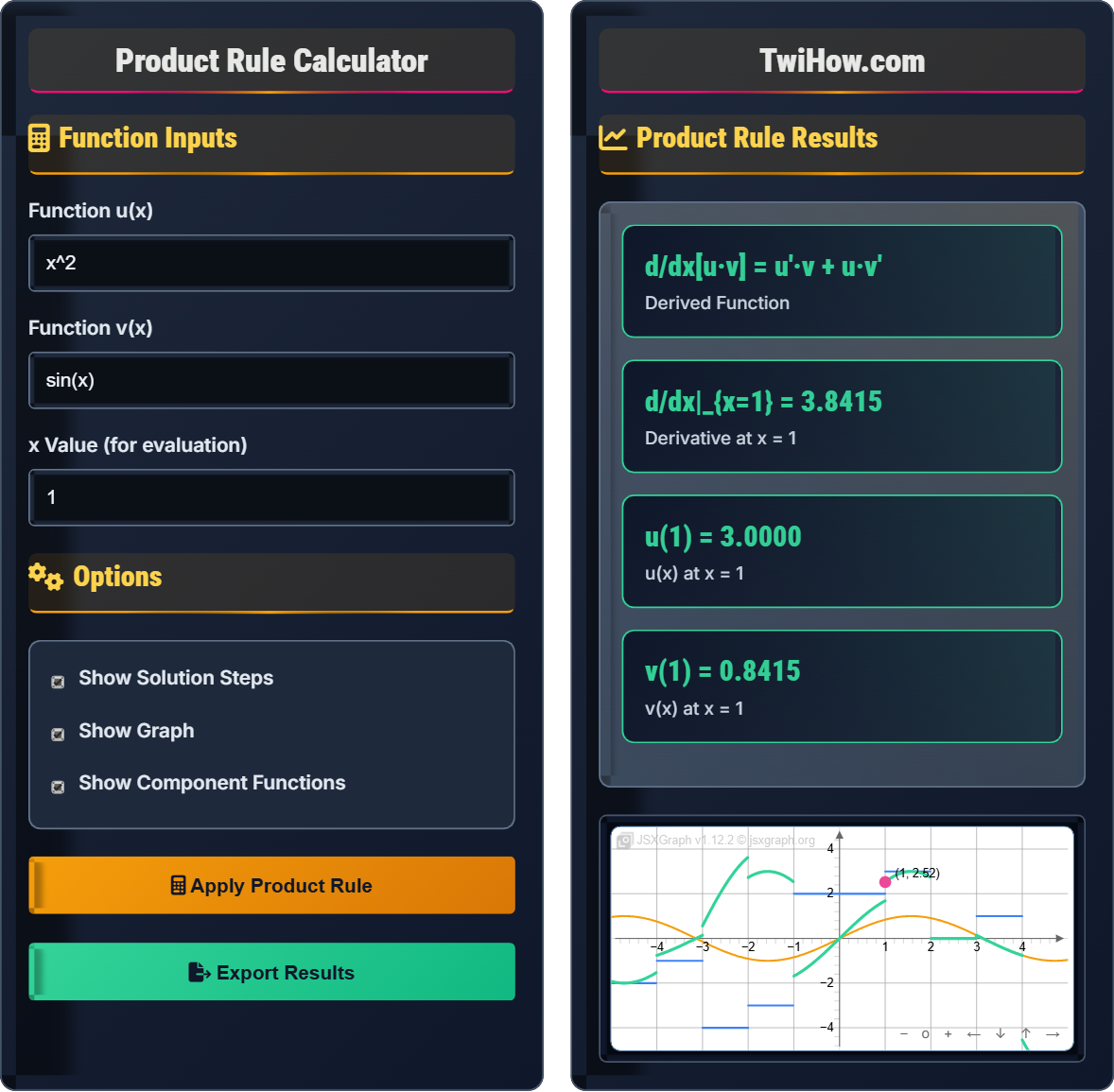
Show the calculator /Simulator\( \frac{d}{dx}[u(x)v(x)] = u'(x)v(x) + u(x)v'(x) \)
The Product Rule is a fundamental differentiation technique used to find the derivative of the product of two functions. It states that the derivative of a product of two functions is the derivative of the first function times the second function plus the first function times the derivative of the second function. This rule is essential for differentiating expressions that cannot be simplified algebraically before differentiation, such as x·sin(x), eˣ·cos(x), or polynomial multiplied by trigonometric functions.
Key applications include:
- Differentiating products of functions
- Calculus applications in physics and engineering
- Probability theory and statistics
- Optimization problems with constraint functions
The Product Rule is derived from the definition of the derivative and is one of the core differentiation techniques alongside the Chain Rule and Quotient Rule.
Function Inputs
Options
Product Rule Results
| Component | Function | Derivative | Value at x=1 |
|---|
Enter functions to see solution steps.
Product Rule Explained
The Product Rule is a fundamental differentiation technique used to find the derivative of the product of two functions. It states that the derivative of the product of two functions u(x) and v(x) is the derivative of the first function times the second function plus the first function times the derivative of the second function. This is expressed mathematically as: d/dx[u(x)v(x)] = u'(x)v(x) + u(x)v'(x). The Product Rule is essential when we cannot simplify the product algebraically before differentiation.
The formal statement of the Product Rule is:
This rule can also be written as:
- (uv)' = u'v + uv'
- For three functions: (uvw)' = u'vw + uv'w + uvw'
Key properties of the Product Rule:
- Commutative Property: The order of terms doesn't matter: u'v + uv' = vu' + uv'
- Chain Rule Connection: Used in combination with other rules
- Generalization: Extends to products of more than two functions
- Integration: Related to integration by parts formula
- Identify Functions: Recognize u(x) and v(x) in the product
- Find Derivatives: Compute u'(x) and v'(x) separately
- Apply Formula: Substitute into the Product Rule formula
- Simplify: Combine like terms if possible
Product Rule Fundamentals
d/dx[u(x)v(x)] = u'(x)v(x) + u(x)v'(x), where u and v are differentiable functions.
\( \frac{d}{dx}[u(x)v(x)] = u'(x)v(x) + u(x)v'(x) \)
Where u(x) and v(x) are differentiable functions of x.
- Derivative of first times second plus first times derivative of second
- Order matters for computation but not for result
- Can be extended to multiple functions
Applications
Used for products of functions, physics applications, and probability theory.
- Physics motion equations
- Probability density functions
- Engineering design problems
- Biological growth models
- Both functions must be differentiable
- Functions must be defined at the point
- Check for domain restrictions
- Consider continuity requirements
Product Rule Learning Quiz
Find the derivative of f(x) = x²·sin(x) using the Product Rule.
Using the Product Rule: d/dx[u·v] = u'·v + u·v'
Let u = x² and v = sin(x)
Step 1: Find u' = d/dx[x²] = 2x
Step 2: Find v' = d/dx[sin(x)] = cos(x)
Step 3: Apply Product Rule: d/dx[x²·sin(x)] = (2x)·sin(x) + x²·cos(x)
Step 4: f'(x) = 2x·sin(x) + x²·cos(x)
The answer is A) 2x·sin(x) + x²·cos(x).
The Product Rule requires identifying the two functions being multiplied. Here, u = x² and v = sin(x). We differentiate each function separately: u' = 2x (by the Power Rule) and v' = cos(x) (derivative of sine). Then we apply the formula u'·v + u·v' = (2x)·sin(x) + x²·cos(x). The key is to remember that we take the derivative of one function at a time while keeping the other function unchanged.
Product Rule: d/dx[u·v] = u'·v + u·v'
Component Functions: The two functions being multiplied
Derivative: The rate of change of a function
• d/dx[u·v] = u'·v + u·v' (product rule)
• d/dx[x²] = 2x (power rule)
• d/dx[sin(x)] = cos(x) (trigonometric derivative)
• Identify u and v clearly before applying the rule
• Differentiate each function separately first
• Remember the pattern: derivative of first times second plus first times derivative of second
• Forgetting to apply the product rule and differentiating as a single function
• Using the wrong derivatives for component functions
• Confusing the order of terms in the formula
Find the derivative of f(x) = eˣ·cos(x) using the Product Rule. Show your work.
Using the Product Rule: d/dx[u·v] = u'·v + u·v'
Let u = eˣ and v = cos(x)
Step 1: Find u' = d/dx[eˣ] = eˣ (exponential derivative)
Step 2: Find v' = d/dx[cos(x)] = -sin(x) (trigonometric derivative)
Step 3: Apply Product Rule: d/dx[eˣ·cos(x)] = (eˣ)·cos(x) + eˣ·(-sin(x))
Step 4: Simplify: f'(x) = eˣ·cos(x) - eˣ·sin(x)
Step 5: Factor: f'(x) = eˣ(cos(x) - sin(x))
Therefore, f'(x) = eˣ(cos(x) - sin(x)).
This problem combines exponential and trigonometric functions. The key is to remember that the derivative of eˣ is eˣ (itself), and the derivative of cos(x) is -sin(x). Applying the Product Rule: (eˣ)'·cos(x) + eˣ·(cos(x))' = eˣ·cos(x) + eˣ·(-sin(x)). We can factor out eˣ to get eˣ(cos(x) - sin(x)). This demonstrates how the Product Rule allows us to differentiate complex functions that are products of simpler functions.
Exponential Function: Function of the form eˣ
Trigonometric Function: Functions like sin(x), cos(x)
Factoring: Extracting common factors from expressions
• d/dx[eˣ] = eˣ (exponential rule)
• d/dx[cos(x)] = -sin(x) (trigonometric rule)
• d/dx[u·v] = u'·v + u·v' (product rule)
• Remember that eˣ is its own derivative
• The derivative of cos(x) is -sin(x)
• Factor common terms when possible to simplify the result
• Forgetting that the derivative of cos(x) is negative
• Thinking the derivative of eˣ is xeˣ⁻¹
• Not factoring out common terms for simplification
The position of a damped oscillator is given by s(t) = e⁻ᵗ·cos(t), where s is displacement in meters and t is time in seconds. Find the velocity of the oscillator at t = π/4 seconds using the Product Rule. What is the physical meaning of this value?
Velocity is the derivative of position: v(t) = ds/dt = d/dt[e⁻ᵗ·cos(t)]
Using the Product Rule: d/dx[u·v] = u'·v + u·v'
Let u = e⁻ᵗ and v = cos(t)
Step 1: Find u' = d/dt[e⁻ᵗ] = -e⁻ᵗ (chain rule)
Step 2: Find v' = d/dt[cos(t)] = -sin(t)
Step 3: Apply Product Rule: v(t) = (-e⁻ᵗ)·cos(t) + e⁻ᵗ·(-sin(t))
Step 4: Simplify: v(t) = -e⁻ᵗ·cos(t) - e⁻ᵗ·sin(t) = -e⁻ᵗ(cos(t) + sin(t))
Step 5: At t = π/4: v(π/4) = -e^(-π/4)(cos(π/4) + sin(π/4))
Step 6: Since cos(π/4) = sin(π/4) = √2/2: v(π/4) = -e^(-π/4)(√2/2 + √2/2) = -e^(-π/4)·√2
Step 7: v(π/4) ≈ -0.303·1.414 ≈ -0.428 m/s
The velocity at t = π/4 is approximately -0.428 m/s, meaning the oscillator is moving in the negative direction.
This problem demonstrates a real-world application of the Product Rule in physics. The damped oscillator model combines exponential decay (e⁻ᵗ) with oscillatory motion (cos(t)). To find velocity, we differentiate the position function using the Product Rule. The result shows that the velocity is negative, indicating the oscillator is moving in the negative direction at t = π/4. This connects the abstract mathematical concept to a concrete physical situation.
Damped Oscillator: System with exponentially decreasing oscillations
Position Function: s(t) describes location at time t
Velocity: Rate of change of position (v = ds/dt)
• Velocity = derivative of position
• d/dt[e⁻ᵗ] = -e⁻ᵗ (chain rule)
• d/dt[cos(t)] = -sin(t)
• Apply the product rule systematically
• Don't forget the chain rule when differentiating e⁻ᵗ
• Use exact values for common angles when possible
• Forgetting the chain rule when differentiating e⁻ᵗ
• Not applying the product rule correctly
• Arithmetic errors when substituting specific values
Find the derivative of f(x) = x·sin(x)·cos(x) using the Product Rule. Hint: You can group the functions as (x·sin(x))·cos(x) or x·(sin(x)·cos(x)). Which grouping is more efficient?
Let's use the grouping f(x) = x·(sin(x)·cos(x)) and apply the Product Rule twice.
First, find the derivative of sin(x)·cos(x) using the Product Rule:
Let u = sin(x), v = cos(x)
Then d/dx[sin(x)·cos(x)] = cos(x)·cos(x) + sin(x)·(-sin(x)) = cos²(x) - sin²(x)
Now apply the Product Rule to f(x) = x·(sin(x)·cos(x)):
Let U = x, V = sin(x)·cos(x)
Step 1: U' = 1, V' = cos²(x) - sin²(x)
Step 2: f'(x) = U'·V + U·V' = 1·sin(x)·cos(x) + x·(cos²(x) - sin²(x))
Step 3: f'(x) = sin(x)·cos(x) + x·cos²(x) - x·sin²(x)
Step 4: f'(x) = sin(x)cos(x) + x(cos²(x) - sin²(x))
Alternative approach using triple product rule: f'(x) = sin(x)cos(x) + x·cos²(x) - x·sin²(x)
Grouping as (x·sin(x))·cos(x) is more efficient as it requires fewer operations.
This problem shows how to extend the Product Rule to three functions. The most efficient approach is to group two functions together and apply the Product Rule twice. We chose to group sin(x)·cos(x) first, which simplifies to cos²(x) - sin²(x) using the Product Rule. Then we apply the Product Rule again with x and the grouped result. This demonstrates that the Product Rule can be applied iteratively to products of any number of functions.
Triple Product Rule: Extension of product rule to three functions
Grouping Strategy: Combining functions to simplify differentiation
Efficiency: Minimizing computational steps
• d/dx[uvw] = u'vw + uv'w + uvw' (triple product rule)
• cos²(x) - sin²(x) = cos(2x) (double angle identity)
• Product rule can be applied iteratively
• Group functions strategically to minimize work
• Use trigonometric identities to simplify results
• Apply the product rule systematically to each pair
• Attempting to apply the product rule to three functions simultaneously
• Forgetting to apply the rule to intermediate results
• Not recognizing opportunities for simplification
What is the derivative of f(x) = x·ln(x) using the Product Rule?
Using the Product Rule: d/dx[u·v] = u'·v + u·v'
Let u = x and v = ln(x)
Step 1: Find u' = d/dx[x] = 1
Step 2: Find v' = d/dx[ln(x)] = 1/x
Step 3: Apply Product Rule: d/dx[x·ln(x)] = (1)·ln(x) + x·(1/x)
Step 4: Simplify: f'(x) = ln(x) + 1
Both A) ln(x) + 1 and B) 1 + ln(x) are mathematically equivalent.
The answer is A) ln(x) + 1.
This problem combines polynomial and logarithmic functions. The key is remembering that the derivative of ln(x) is 1/x. When applying the Product Rule: (x)'·ln(x) + x·(ln(x))' = 1·ln(x) + x·(1/x) = ln(x) + 1. This result is important in calculus as it appears in integration by parts problems and is used to find the integral of ln(x). The commutative property of addition means both A and B are correct.
Logarithmic Function: Function of the form ln(x)
Derivative of ln(x): d/dx[ln(x)] = 1/x
Commutative Property: Addition order doesn't matter
• d/dx[ln(x)] = 1/x (logarithmic derivative)
• d/dx[x] = 1 (power rule)
• d/dx[u·v] = u'·v + u·v' (product rule)
• Remember that the derivative of ln(x) is 1/x
• x·(1/x) simplifies to 1
• The result ln(x) + 1 is significant in calculus
• Forgetting that the derivative of ln(x) is 1/x
• Thinking the derivative of ln(x) is 1
• Not simplifying x·(1/x) to 1
FAQ
Q: Why can't I just multiply the derivatives of each function?
A: The derivative of a product is NOT the product of the derivatives. That is, d/dx[u·v] ≠ u'·v'. This is a common misconception. The Product Rule exists because of how limits work in the definition of the derivative. When we compute the derivative of u(x)·v(x), we get:
lim[h→0] [u(x+h)v(x+h) - u(x)v(x)]/h
Adding and subtracting u(x+h)v(x) in the numerator, this becomes:
lim[h→0] [u(x+h)v(x+h) - u(x+h)v(x) + u(x+h)v(x) - u(x)v(x)]/h
Which separates into u'(x)v(x) + u(x)v'(x). This is why the Product Rule has its specific form.
Q: How is the Product Rule used in engineering applications?
A: The Product Rule is fundamental in engineering:
Electrical Engineering: Differentiating current-voltage relationships where both vary with time.
Mechanical Engineering: Analyzing systems with time-varying mass or damping coefficients.
Chemical Engineering: Rate calculations involving concentration and temperature-dependent factors.
Civil Engineering: Stress analysis in materials with varying properties.
Systems Engineering: Modeling systems where multiple time-varying parameters interact.
Engineers regularly encounter products of functions in dynamic system models.