Quotient Rule Calculator
Complete calculus guide • Step-by-step solutions
Quotient Rule:
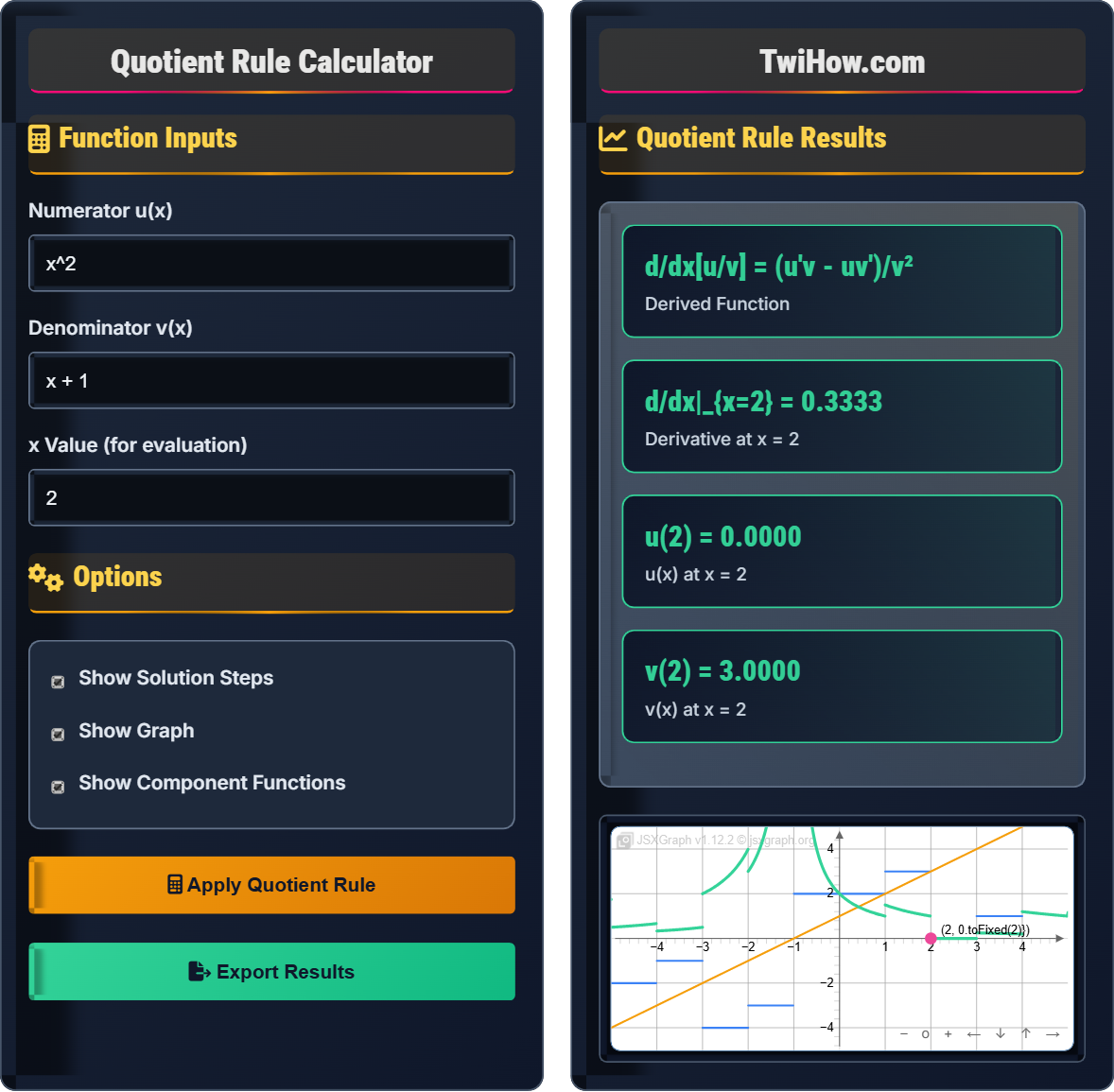
Show the calculator /Simulator\( \frac{d}{dx}\left[\frac{u(x)}{v(x)}\right] = \frac{u'(x)v(x) - u(x)v'(x)}{[v(x)]^2} \)
The Quotient Rule is a fundamental differentiation technique used to find the derivative of the quotient of two functions. It states that the derivative of a quotient is the derivative of the numerator times the denominator minus the numerator times the derivative of the denominator, all divided by the square of the denominator. This rule is essential for differentiating rational functions, trigonometric functions like tan(x) = sin(x)/cos(x), and other complex quotients that cannot be simplified algebraically before differentiation.
Key applications include:
- Differentiating rational functions
- Calculus applications in physics and engineering
- Trigonometric function differentiation
- Optimization problems with constraint functions
The Quotient Rule is closely related to the Product Rule and can be derived from it. It's essential that the denominator function is never zero in the domain of interest.
Function Inputs
Options
Quotient Rule Results
| Component | Function | Derivative | Value at x=2 |
|---|
Enter functions to see solution steps.
Quotient Rule Explained
The Quotient Rule is a fundamental differentiation technique used to find the derivative of the quotient of two functions. It states that the derivative of u(x)/v(x) is [u'(x)v(x) - u(x)v'(x)]/[v(x)]². This rule is essential when we cannot simplify the quotient algebraically before differentiation. The Quotient Rule can be remembered with the mnemonic "low d-high minus high d-low over low squared," where "low" refers to the denominator, "high" refers to the numerator, and "d" represents the derivative.
The formal statement of the Quotient Rule is:
This rule can also be written as:
- (u/v)' = (u'v - uv')/v²
- It's important that v(x) ≠ 0 in the domain of interest
Key properties of the Quotient Rule:
- Denominator Squared: The denominator of the result is [v(x)]², ensuring it's positive
- Subtraction Pattern: The numerator follows the pattern u'v - uv' (not u'v + uv')
- Domain Restrictions: v(x) must not equal zero in the domain
- Relation to Product Rule: Can be derived from the Product Rule and Chain Rule
- Identify Functions: Recognize u(x) (numerator) and v(x) (denominator)
- Find Derivatives: Compute u'(x) and v'(x) separately
- Apply Formula: Substitute into the Quotient Rule formula
- Simplify: Combine like terms and reduce if possible
Quotient Rule Fundamentals
d/dx[u(x)/v(x)] = [u'(x)v(x) - u(x)v'(x)]/[v(x)]², where u and v are differentiable functions and v(x) ≠ 0.
\( \frac{d}{dx}\left[\frac{u(x)}{v(x)}\right] = \frac{u'(x)v(x) - u(x)v'(x)}{[v(x)]^2} \)
Where u(x) is the numerator and v(x) is the denominator function.
- Top times derivative of bottom minus bottom times derivative of top
- Divided by bottom squared
- Denominator must be non-zero
Applications
Used for quotients of functions, trigonometric ratios, and rational functions.
- Physics rate problems
- Chemical reaction rates
- Engineering design ratios
- Biological growth models
- Both functions must be differentiable
- Denominator function must not equal zero
- Check for domain restrictions
- Consider continuity requirements
Quotient Rule Learning Quiz
Find the derivative of f(x) = x²/(x+1) using the Quotient Rule.
Using the Quotient Rule: d/dx[u/v] = (u'v - uv')/v²
Let u = x² and v = x+1
Step 1: Find u' = d/dx[x²] = 2x
Step 2: Find v' = d/dx[x+1] = 1
Step 3: Apply Quotient Rule: d/dx[x²/(x+1)] = (2x·(x+1) - x²·1)/(x+1)²
Step 4: f'(x) = (2x(x+1) - x²)/(x+1)²
Step 5: Simplify: f'(x) = (2x² + 2x - x²)/(x+1)² = (x² + 2x)/(x+1)²
The answer is A) (2x(x+1) - x²)/(x+1)².
The Quotient Rule requires identifying the numerator (top) and denominator (bottom) functions. Here, u = x² (numerator) and v = x+1 (denominator). We differentiate each function separately: u' = 2x (by the Power Rule) and v' = 1 (constant rule). Then we apply the formula (u'v - uv')/v² = ((2x)·(x+1) - x²·(1))/(x+1)². The key is to remember that we subtract uv' from u'v, not add them, and the denominator gets squared.
Quotient Rule: d/dx[u/v] = (u'v - uv')/v²
Numerator: The top function in the quotient
Denominator: The bottom function in the quotient
• d/dx[u/v] = (u'v - uv')/v² (quotient rule)
• d/dx[x²] = 2x (power rule)
• d/dx[x+1] = 1 (constant rule)
• Remember: "low d-high minus high d-low over low squared"
• Identify u (numerator) and v (denominator) clearly before applying the rule
• The subtraction order is crucial: u'v - uv' not uv' - u'v
• Forgetting to square the denominator
• Reversing the subtraction order (writing uv' - u'v instead of u'v - uv')
• Not simplifying the final expression when possible
Find the derivative of f(x) = tan(x) = sin(x)/cos(x) using the Quotient Rule. Show your work.
Using the Quotient Rule: d/dx[u/v] = (u'v - uv')/v²
Let u = sin(x) and v = cos(x)
Step 1: Find u' = d/dx[sin(x)] = cos(x)
Step 2: Find v' = d/dx[cos(x)] = -sin(x)
Step 3: Apply Quotient Rule: d/dx[sin(x)/cos(x)] = (cos(x)·cos(x) - sin(x)·(-sin(x)))/(cos(x))²
Step 4: Simplify numerator: cos²(x) - sin(x)·(-sin(x)) = cos²(x) + sin²(x)
Step 5: Apply Pythagorean identity: cos²(x) + sin²(x) = 1
Step 6: f'(x) = 1/cos²(x) = sec²(x)
Therefore, d/dx[tan(x)] = sec²(x).
This famous application of the Quotient Rule proves that the derivative of tan(x) is sec²(x). The key insight is recognizing that sin(x)/cos(x) is a quotient of functions. When we apply the Quotient Rule: (sin(x))'/cos(x) - sin(x)·(cos(x))'/cos²(x) = (cos(x)·cos(x) - sin(x)·(-sin(x)))/cos²(x). This simplifies to (cos²(x) + sin²(x))/cos²(x), and using the Pythagorean identity cos²(x) + sin²(x) = 1, we get 1/cos²(x) = sec²(x).
Tangent Function: tan(x) = sin(x)/cos(x)
Secant Function: sec(x) = 1/cos(x)
Pythagorean Identity: cos²(x) + sin²(x) = 1
• d/dx[sin(x)] = cos(x) (trigonometric derivative)
• d/dx[cos(x)] = -sin(x) (trigonometric derivative)
• cos²(x) + sin²(x) = 1 (Pythagorean identity)
• Remember that the derivative of tan(x) is sec²(x)
• Use Pythagorean identities to simplify expressions
• The quotient rule is the fundamental proof for this derivative
• Forgetting the negative sign when differentiating cos(x)
• Not recognizing the Pythagorean identity opportunity
• Confusing the sign in the numerator of the quotient rule
The efficiency of a machine is given by E(t) = (t² + 1)/(2t + 3), where E is efficiency and t is time in hours. Find the rate of change of efficiency at t = 1 hour using the Quotient Rule. What does this value represent physically?
Rate of change of efficiency is the derivative: dE/dt = d/dt[(t² + 1)/(2t + 3)]
Using the Quotient Rule: d/dx[u/v] = (u'v - uv')/v²
Let u = t² + 1 and v = 2t + 3
Step 1: Find u' = d/dt[t² + 1] = 2t
Step 2: Find v' = d/dt[2t + 3] = 2
Step 3: Apply Quotient Rule: dE/dt = [(2t)(2t + 3) - (t² + 1)(2)]/(2t + 3)²
Step 4: Expand numerator: 4t² + 6t - 2t² - 2 = 2t² + 6t - 2
Step 5: dE/dt = (2t² + 6t - 2)/(2t + 3)²
Step 6: At t = 1: dE/dt|_{t=1} = (2(1)² + 6(1) - 2)/(2(1) + 3)² = (2 + 6 - 2)/(5)² = 6/25 = 0.24
The rate of change of efficiency at t = 1 hour is 0.24 units per hour, meaning efficiency is increasing at that rate.
This problem demonstrates a real-world application of the Quotient Rule in engineering. The efficiency function is a rational function, making the Quotient Rule the appropriate technique. The result dE/dt = 0.24 at t = 1 means that at that moment, the efficiency is increasing by 0.24 units per hour. This connects the abstract mathematical concept to a concrete physical situation where we need to understand how a system parameter changes over time.
Efficiency Function: E(t) describes performance over time
Rate of Change: Derivative of the function with respect to time
Units per Hour: Rate of change of efficiency
• Rate of change = derivative of function
• d/dt[t² + 1] = 2t (power rule)
• d/dt[2t + 3] = 2 (constant rule)
• Apply the quotient rule systematically
• Carefully expand products in the numerator
• Include units in your final answer when applicable
• Forgetting to square the denominator
• Arithmetic errors when expanding the numerator
• Not substituting the specific time value correctly
Find the derivative of f(x) = 1/g(x) using the Quotient Rule, where g(x) is a differentiable function. How does this relate to the Chain Rule?
Write f(x) = 1/g(x) as a quotient where u = 1 and v = g(x)
Using the Quotient Rule: d/dx[u/v] = (u'v - uv')/v²
Step 1: u = 1, so u' = 0
Step 2: v = g(x), so v' = g'(x)
Step 3: Apply Quotient Rule: d/dx[1/g(x)] = (0·g(x) - 1·g'(x))/[g(x)]²
Step 4: Simplify: d/dx[1/g(x)] = -g'(x)/[g(x)]²
Alternative approach using Chain Rule: d/dx[g(x)]⁻¹ = -[g(x)]⁻² · g'(x) = -g'(x)/[g(x)]²
Both methods yield the same result: -g'(x)/[g(x)]²
This shows that the derivative of 1/g(x) is -g'(x)/[g(x)]².
This problem demonstrates how the Quotient Rule applies to reciprocal functions. When we have 1/g(x), we can think of it as 1 in the numerator and g(x) in the denominator. Since the derivative of 1 is 0, the first term in the numerator (u'v) becomes 0, simplifying the expression significantly. This result can also be obtained using the Chain Rule with the power rule for negative exponents: d/dx[g(x)]⁻¹ = -[g(x)]⁻² · g'(x), which gives the same result. This shows the consistency between different differentiation techniques.
Reciprocal Function: Function of the form 1/g(x)
Chain Rule: Technique for differentiating composite functions
Consistency: Different methods yielding same results
• d/dx[1/g(x)] = -g'(x)/[g(x)]² (reciprocal rule)
• d/dx[c] = 0 for any constant c
• Both quotient and chain rule approaches yield same result
• For 1/g(x), the derivative is -g'(x)/[g(x)]²
• The quotient rule often simplifies for reciprocals
• Different methods should yield consistent results
• Forgetting that the derivative of 1 is 0
• Not squaring the denominator properly
• Confusing the sign in the final result
When applying the Quotient Rule to f(x) = u(x)/v(x), what condition must be satisfied for the derivative to exist?
Looking at the Quotient Rule: d/dx[u/v] = (u'v - uv')/v²
For the derivative to exist, the denominator v² must not equal zero.
Since v² = 0 only when v = 0, the condition is that v(x) ≠ 0.
Additionally, both u(x) and v(x) must be differentiable at the point.
The answer is B) v(x) ≠ 0.
This question addresses an important domain consideration when using the Quotient Rule. Looking at the formula (u'v - uv')/v², we can see that if v(x) = 0, then the denominator v² = 0, making the expression undefined. This makes intuitive sense because if the denominator function equals zero, the original function f(x) = u(x)/v(x) is undefined at that point, so its derivative cannot exist there either. The numerator terms don't affect the existence of the derivative in this context.
Domain Restriction: Values for which a function is defined
Undefined Expression: Mathematical expression with no value
Division by Zero: Mathematical operation that is undefined
• v(x) ≠ 0 for the quotient rule to apply
• Both u(x) and v(x) must be differentiable
• The original function must be defined at the point
• Always check that the denominator is non-zero
• The original function must be defined before its derivative exists
• Look for vertical asymptotes where v(x) = 0
• Forgetting that v(x) ≠ 0 is required for the rule to apply
• Confusing which function must be non-zero
• Not considering domain restrictions when applying the rule
FAQ
Q: Why can't I just divide the derivatives of the numerator and denominator?
A: The derivative of a quotient is NOT the quotient of the derivatives. That is, d/dx[u/v] ≠ u'/v'. This is a common misconception. The Quotient Rule exists because of how limits work in the definition of the derivative. When we compute the derivative of u(x)/v(x), we get:
lim[h→0] [u(x+h)/v(x+h) - u(x)/v(x)]/h
After algebraic manipulation, this becomes (u'v - uv')/v². This is why the Quotient Rule has its specific form with the subtraction pattern and the squared denominator.
Q: How is the Quotient Rule used in engineering applications?
A: The Quotient Rule is fundamental in engineering:
Electrical Engineering: Differentiating transfer functions and impedance ratios.
Mechanical Engineering: Analyzing efficiency ratios and gear ratios in dynamic systems.
Chemical Engineering: Rate calculations involving concentration ratios.
Civil Engineering: Stress-to-strain ratios and material property relationships.
Systems Engineering: Modeling systems where output-to-input ratios change over time.
Engineers frequently encounter rational functions in system models and control theory.