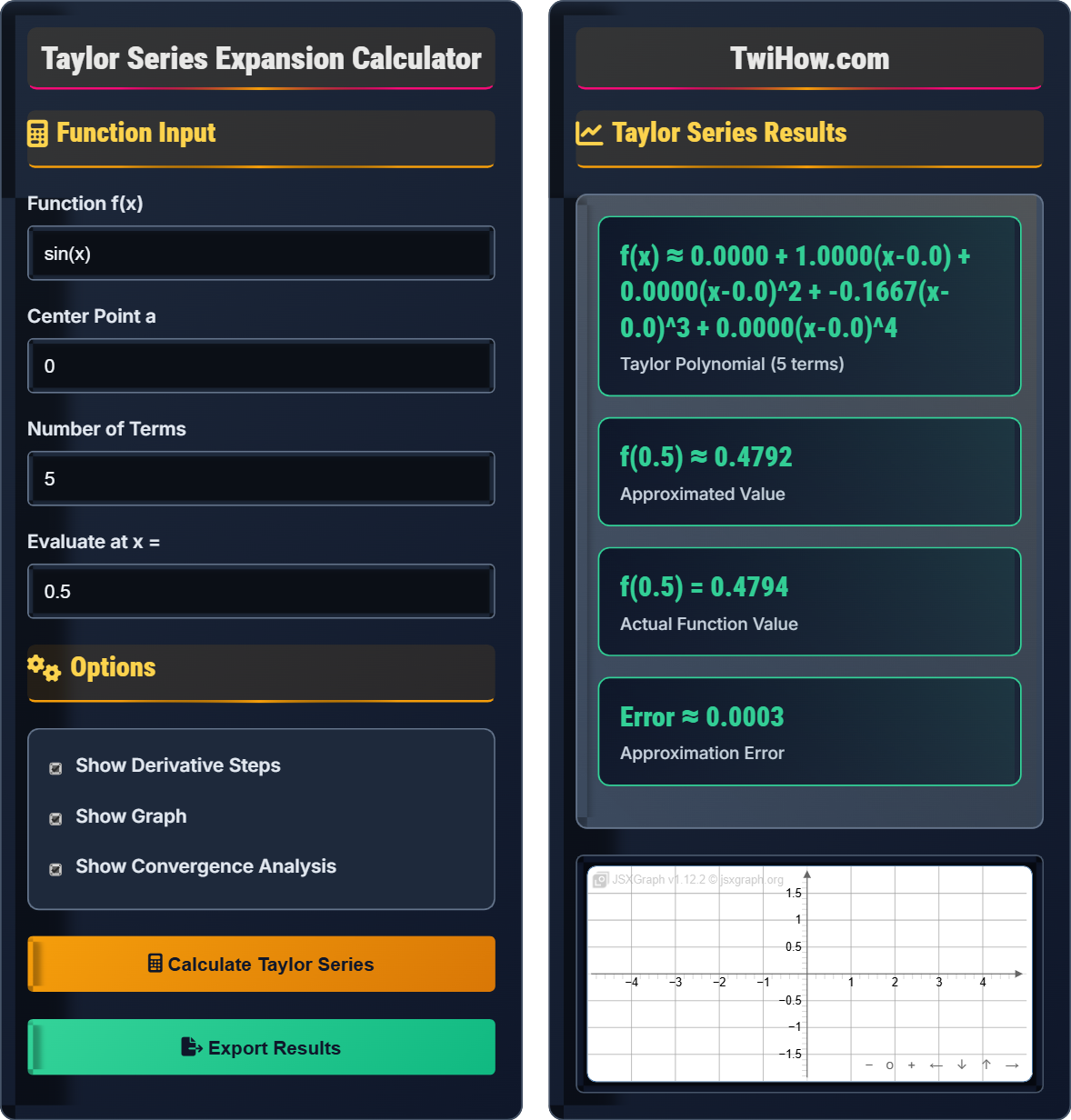
Taylor Series Expansion Calculator
Complete calculus guide • Step-by-step solutions
Taylor Series:
Show the calculator /Simulator\( f(x) = \sum_{n=0}^{\infty} \frac{f^{(n)}(a)}{n!}(x-a)^n = f(a) + f'(a)(x-a) + \frac{f''(a)}{2!}(x-a)^2 + \frac{f'''(a)}{3!}(x-a)^3 + \cdots \)
The Taylor Series is a powerful mathematical tool that represents a function as an infinite sum of terms calculated from the function's derivatives at a single point. This series allows us to approximate complex functions using polynomials, making them easier to compute and analyze. The Maclaurin Series is a special case where the expansion point a = 0. Taylor Series are fundamental in calculus, physics, and engineering for solving differential equations, approximating functions, and analyzing behavior near specific points.
Key applications include:
- Function approximation and interpolation
- Solving differential equations
- Physics and engineering modeling
- Numerical analysis and computation
The series converges within a radius of convergence around the expansion point. Higher-order terms provide more accurate approximations, but the series must converge for the approximation to be valid.
Function Input
Options
Taylor Series Results
| Term n | Derivative f(n)(a) | Coefficient | Term |
|---|
Enter function and parameters to see solution steps.
Taylor Series Explained
A Taylor Series is an infinite series representation of a function as a sum of terms calculated from the function's derivatives at a single point. The series takes the form: f(x) = f(a) + f'(a)(x-a) + f''(a)(x-a)²/2! + f'''(a)(x-a)³/3! + ... This remarkable mathematical tool allows us to approximate complex functions using polynomials, which are much easier to compute and manipulate. The Maclaurin Series is a special case of the Taylor Series where the expansion point a = 0.
The general form of the Taylor Series is:
Expanded form:
- f(x) = f(a) + f'(a)(x-a) + f''(a)(x-a)²/2! + f'''(a)(x-a)³/3! + ...
- When a = 0, this becomes the Maclaurin Series
Important characteristics of Taylor Series:
- Radius of Convergence: Series converges within a specific interval
- Accuracy: More terms provide better approximations
- Convergence: Depends on function's behavior and distance from center
- Uniqueness: Taylor Series is unique for each function
- Compute Derivatives: Calculate f(a), f'(a), f''(a), etc.
- Form Terms: Apply the Taylor formula for each term
- Sum Series: Add terms to desired precision
- Convergence Check: Verify convergence conditions
Taylor Series Fundamentals
f(x) = Σ[n=0 to ∞] f^(n)(a)(x-a)^n/n!, where f^(n)(a) is the nth derivative at x=a.
\( f(x) = \sum_{n=0}^{\infty} \frac{f^{(n)}(a)}{n!}(x-a)^n \)
Where f^(n)(a) = nth derivative of f evaluated at x = a.
- Function must be infinitely differentiable
- Series converges within radius of convergence
- More terms = better approximation
Applications
Used for function approximation, differential equations, and numerical analysis.
- Physics motion equations
- Engineering design calculations
- Computer graphics rendering
- Signal processing algorithms
- Check for function differentiability
- Verify convergence conditions
- Consider domain restrictions
- Account for truncation errors
Taylor Series Learning Quiz
What is the first three terms of the Taylor series for f(x) = eˣ centered at a = 0 (Maclaurin series)?
For f(x) = eˣ, all derivatives equal eˣ, so f^(n)(0) = e⁰ = 1 for all n
Using Taylor formula: f(x) = f(0) + f'(0)x + f''(0)x²/2! + f'''(0)x³/3! + ...
Step 1: f(0) = e⁰ = 1
Step 2: f'(0) = e⁰ = 1
Step 3: f''(0) = e⁰ = 1
Step 4: f'''(0) = e⁰ = 1
Step 5: First three terms: 1 + 1·x + 1·x²/2! + 1·x³/3! = 1 + x + x²/2 + x³/6
For first three terms only: 1 + x + x²/2
The answer is A) 1 + x + x²/2.
This problem demonstrates a key property of the exponential function: it is its own derivative. This means f^(n)(x) = eˣ for all n, and at x = 0, all derivatives equal 1. The Maclaurin series for eˣ is particularly elegant because all coefficients are 1, leading to the beautiful series: eˣ = 1 + x + x²/2! + x³/3! + ... This series converges for all real x, making it globally accurate. The factorial in the denominator causes terms to decrease rapidly, providing excellent approximations with just a few terms.
Taylor Series: f(x) = Σ f^(n)(a)(x-a)ⁿ/n!
Maclaurin Series: Taylor series centered at a = 0
Factorial: n! = n·(n-1)·(n-2)·...·2·1
• d/dx[eˣ] = eˣ (exponential derivative property)
• e⁰ = 1
• n! = n·(n-1)! with 0! = 1
• Remember: eˣ is its own derivative
• Factorials grow very quickly (2! = 2, 3! = 6, 4! = 24)
• The series for eˣ converges for all real x
• Forgetting that all derivatives of eˣ equal eˣ
Find the Taylor series for f(x) = sin(x) centered at a = 0. What is the coefficient of the x⁵ term?
Step 1: Find derivatives of sin(x) and evaluate at x = 0
f(x) = sin(x) → f(0) = 0
f'(x) = cos(x) → f'(0) = 1
f''(x) = -sin(x) → f''(0) = 0
f'''(x) = -cos(x) → f'''(0) = -1
f⁽⁴⁾(x) = sin(x) → f⁽⁴⁾(0) = 0
f⁽⁵⁾(x) = cos(x) → f⁽⁵⁾(0) = 1
Step 2: Apply Taylor formula for x⁵ term: f⁽⁵⁾(0)·x⁵/5!
Step 3: Coefficient = f⁽⁵⁾(0)/5! = 1/5! = 1/120
The coefficient of x⁵ is 1/120.
The derivatives of sin(x) follow a cyclic pattern: sin → cos → -sin → -cos → sin (every 4 derivatives). This creates a pattern where odd derivatives at x = 0 alternate between 1 and -1, while even derivatives are 0. The Maclaurin series for sin(x) is: sin(x) = x - x³/3! + x⁵/5! - x⁷/7! + ... Notice that only odd-powered terms appear with alternating signs. This reflects the odd symmetry of the sine function.
Odd Function: f(-x) = -f(x) (like sin(x))
Cyclic Derivatives: Derivatives repeat after a certain number of steps
Alternating Series: Series with terms that alternate in sign
• sin'(x) = cos(x), cos'(x) = -sin(x)
• sin(0) = 0, cos(0) = 1
• Only odd terms appear in sin(x) Maclaurin series
• Remember the derivative cycle: sin → cos → -sin → -cos
• Odd functions have only odd-powered terms in their series
• Signs alternate starting with positive for the first term
• Not recognizing the cyclic pattern of trigonometric derivatives
• Arithmetic errors with factorials (5! = 120, not 25)
• Forgetting to include the factorial in the denominator
In physics, the relativistic kinetic energy is given by K = mc²(γ - 1) where γ = 1/√(1 - v²/c²). For small velocities (v << c), use the Taylor series to approximate γ and find an expression for kinetic energy. Compare with the classical formula K = ½mv².
Step 1: Rewrite γ = (1 - v²/c²)^(-1/2)
Step 2: Let u = v²/c², then γ = (1 - u)^(-1/2)
Step 3: Find Taylor series for (1 - u)^(-1/2) around u = 0
Step 4: Using binomial series: (1 - u)^(-1/2) = 1 + (1/2)u + (3/8)u² + ...
Step 5: Substitute back: γ ≈ 1 + (1/2)(v²/c²) + (3/8)(v²/c²)² + ...
Step 6: For small v/c: γ ≈ 1 + v²/(2c²)
Step 7: K = mc²(γ - 1) ≈ mc²(1 + v²/(2c²) - 1) = mc² · v²/(2c²) = ½mv²
The relativistic formula reduces to the classical formula for small velocities.
This problem shows how Taylor series connects advanced physics theories to classical approximations. The binomial series (1 + x)^n = 1 + nx + n(n-1)x²/2! + ... is a special case of the Taylor series. When v << c, higher-order terms become negligible, and the relativistic formula approaches the classical Newtonian result. This demonstrates the principle of correspondence: new theories must reduce to established ones in appropriate limits. The Taylor series provides the mathematical tool for making this connection explicit.
Relativistic Kinetic Energy: K = mc²(γ - 1)
Lorentz Factor: γ = 1/√(1 - v²/c²)
Classical Limit: Low velocity approximation of relativistic formula
• (1 - x)^(-1/2) ≈ 1 + x/2 + (3/8)x² for small x
• Classical mechanics is limiting case of relativity
• Taylor series bridges different physical theories
• Use substitution to simplify complex expressions
• Binomial series is useful for expressions like (1 + x)^n
• Physics often uses Taylor series for limiting cases
• Forgetting the negative exponent in the binomial series
• Not properly substituting the variable before applying the series
• Arithmetic errors when calculating coefficients
Find the Taylor series for f(x) = 1/(1-x) centered at a = 0. What is the radius of convergence? Explain why this series cannot be used to approximate f(2).
Step 1: Find derivatives of f(x) = (1-x)^(-1)
f(x) = (1-x)^(-1) → f(0) = 1
f'(x) = (1-x)^(-2) → f'(0) = 1
f''(x) = 2(1-x)^(-3) → f''(0) = 2
f'''(x) = 6(1-x)^(-4) → f'''(0) = 6
In general: f^(n)(x) = n!(1-x)^(-n-1), so f^(n)(0) = n!
Step 2: Apply Taylor formula: f(x) = Σ n!·xⁿ/n! = Σ xⁿ
Step 3: The series is: 1 + x + x² + x³ + ...
Step 4: This is a geometric series with ratio x, converging when |x| < 1
Step 5: Radius of convergence is R = 1
Step 6: f(2) = 1/(1-2) = -1, but the series 1 + 2 + 4 + 8 + ... diverges because |2| > 1
The radius of convergence is 1, so the series cannot approximate f(2).
This problem illustrates the critical concept of convergence in Taylor series. The function f(x) = 1/(1-x) has a Taylor series that is the geometric series Σxⁿ. While the function is defined for all x ≠ 1, the series representation only converges when |x| < 1. This is because the function has a singularity (division by zero) at x = 1, which limits the radius of convergence. The distance from the center (x = 0) to the nearest singularity (x = 1) determines the radius of convergence: R = |1 - 0| = 1.
Radius of Convergence: Distance from center to boundary of convergence
Geometric Series: Series of the form Σarⁿ
Singularity: Point where function is undefined
• Σxⁿ = 1/(1-x) for |x| < 1 (geometric series)
• Radius of convergence limited by nearest singularity
• Taylor series may not represent function everywhere
• Look for singularities to determine convergence radius
• Geometric series is a fundamental Taylor series
• Always check convergence before using series approximation
• Assuming Taylor series always converges everywhere
• Forgetting to check convergence conditions
• Not recognizing geometric series patterns
What is the coefficient of x⁴ in the Maclaurin series for f(x) = cos(x)?
Step 1: Find derivatives of cos(x) and evaluate at x = 0
f(x) = cos(x) → f(0) = 1
f'(x) = -sin(x) → f'(0) = 0
f''(x) = -cos(x) → f''(0) = -1
f'''(x) = sin(x) → f'''(0) = 0
f⁽⁴⁾(x) = cos(x) → f⁽⁴⁾(0) = 1
Step 2: The coefficient of x⁴ is f⁽⁴⁾(0)/4! = 1/4! = 1/24
Wait, let's reconsider the sign pattern for cos(x):
cos(x) = 1 - x²/2! + x⁴/4! - x⁶/6! + ...
The coefficient of x⁴ is indeed 1/4! = 1/24.
The answer is A) 1/24.
The derivatives of cos(x) follow a cyclic pattern: cos → -sin → -cos → sin → cos (every 4 derivatives). This creates a pattern where even derivatives at x = 0 alternate between 1 and -1, while odd derivatives are 0. The Maclaurin series for cos(x) is: cos(x) = 1 - x²/2! + x⁴/4! - x⁶/6! + ... Notice that only even-powered terms appear with alternating signs. This reflects the even symmetry of the cosine function. The coefficient of x⁴ is positive because f⁽⁴⁾(0) = cos(0) = 1, and 4! = 24.
Even Function: f(-x) = f(x) (like cos(x))
Alternating Signs: Terms that alternate between positive and negative
Factorial: n! = product of all positive integers up to n
• cos'(x) = -sin(x), sin'(x) = cos(x)
• cos(0) = 1, sin(0) = 0
• Only even terms appear in cos(x) Maclaurin series
• Remember: cos(x) is an even function (symmetric about y-axis)
• Even functions have only even-powered terms in their series
• Signs alternate starting with positive for the first term
• Confusing the derivative pattern for cos(x) versus sin(x)
• Forgetting that cos(0) = 1 (not 0)
• Arithmetic errors with factorials (4! = 24, not 4)
FAQ
Q: How do I determine the radius of convergence for a Taylor series?
A: The radius of convergence can be determined using the ratio test:
For a series Σ aₙ(x-a)ⁿ, compute: R = lim[n→∞] |aₙ/aₙ₊₁|
Alternatively, the radius is the distance from the center to the nearest singularity (point where the function is undefined). For example:
1/(1-x): Has a singularity at x = 1, so R = |1 - 0| = 1
ln(1+x): Has a singularity at x = -1, so R = |-1 - 0| = 1
tan(x): Has singularities at x = ±π/2, so R = π/2
The series converges absolutely for |x - a| < R and diverges for |x - a| > R.
Q: Where are Taylor series used in engineering applications?
A: Taylor series are essential in engineering:
Mechanical Engineering: Linearizing nonlinear systems near equilibrium points.
Electrical Engineering: Small-signal analysis in amplifier design.
Control Systems: Linear approximations for system modeling.
Signal Processing: Filter design and algorithm development.
Computer Graphics: Efficient computation of trigonometric functions.
Engineers use Taylor series to simplify complex functions for analysis and computation.