Circumference of Circle Calculator
Complete geometry guide • Step-by-step solutions
Circumference of Circle Formula:
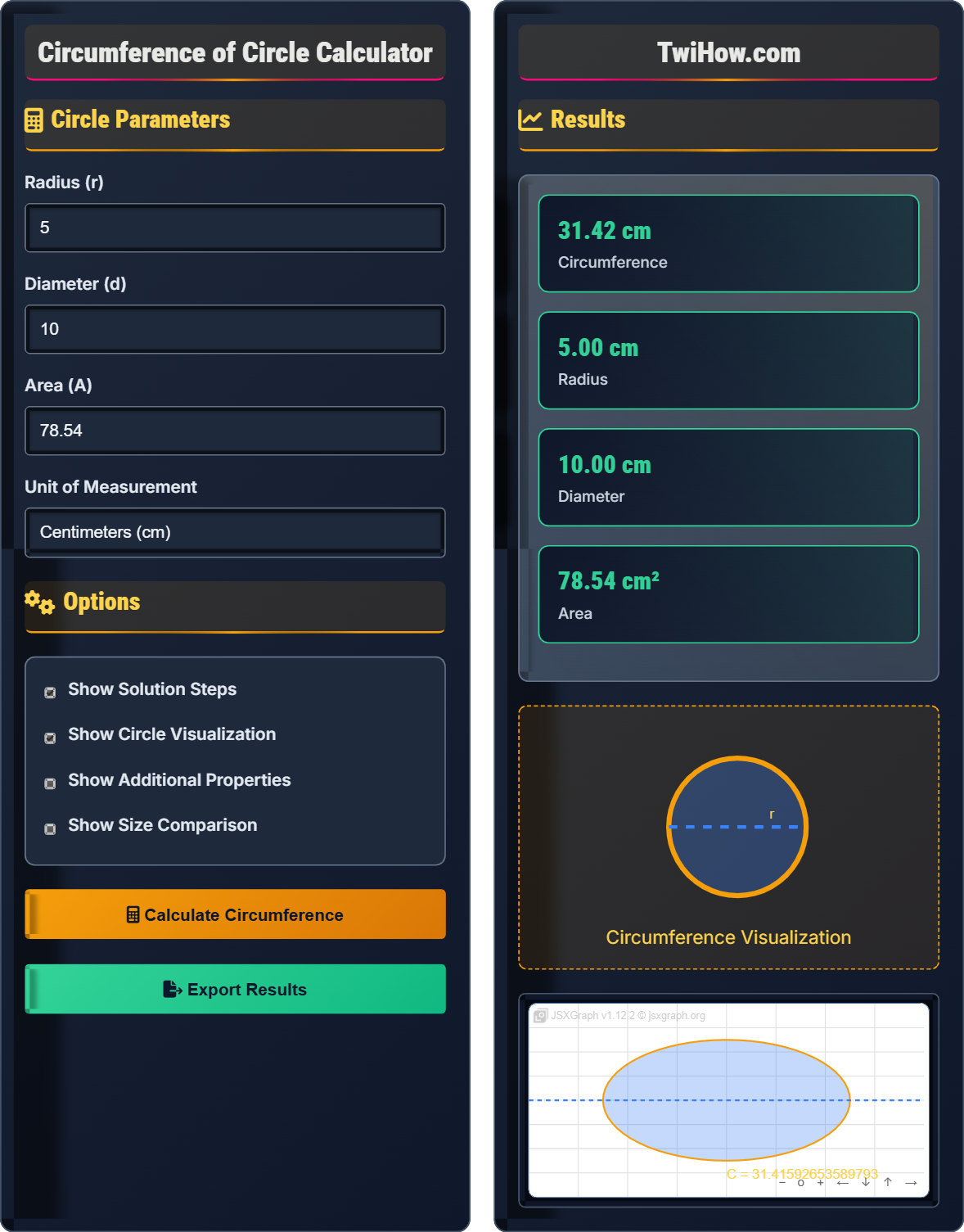
Show the calculator /Simulator\( C = 2\pi r \) or \( C = \pi d \)
This formula calculates the circumference (perimeter) of a circle, where:
- C = circumference of the circle
- π = pi (approximately 3.14159)
- r = radius of the circle
- d = diameter of the circle (d = 2r)
The circumference represents the total distance around the circle's boundary. It's directly proportional to the radius and diameter.
Circle Parameters
Options
Results
| Property | Value | Formula | Calculation |
|---|
Enter parameters to see solution steps.
Circumference of Circle Explained
The circumference of a circle is the total distance around the circle's boundary. It's the perimeter of the circular shape and is calculated using the formula C = 2πr or C = πd, where C is the circumference, π (pi) is approximately 3.14159, r is the radius, and d is the diameter. The circumference is directly proportional to the radius and diameter.
The standard formulas for the circumference of a circle are:
Alternative forms:
- Using area: \(C = 2\sqrt{\pi A}\)
- Using sector: For a sector with central angle θ (in radians), arc length = rθ
Key properties of circles:
- Radius (r): Distance from center to any point on the circle
- Diameter (d): Distance across the circle through the center (d = 2r)
- Circumference (C): Distance around the circle (C = 2πr = πd)
- Area (A): Space enclosed by the circle (A = πr²)
- Transportation: Calculating tire circumferences for vehicle speedometers
- Construction: Measuring circular structures and pipes
- Manufacturing: Creating circular parts and containers
- Science: Calculating orbital paths and wave patterns
Circumference of Circle Learning Quiz
What is the circumference of a circle with radius 7 cm? (Use π ≈ 3.14159)
Using the circumference formula: C = 2πr
Given: r = 7 cm
Step 1: Substitute into the formula
C = 2π × 7
Step 2: Calculate
C = 14π
Step 3: Multiply by π
C = 14 × 3.14159 = 43.98 cm
Therefore, the answer is C) 43.98 cm.
The circumference formula C = 2πr shows that the circumference is directly proportional to the radius. The constant π (pi) represents the ratio of the circumference to the diameter of any circle, and it appears in the circumference formula because of the circular nature of the shape. Notice that the circumference is proportional to the first power of the radius, unlike the area which is proportional to the square of the radius.
Circumference: The distance around a circle
Perimeter: The distance around any closed shape
Pi (π): The ratio of circumference to diameter, approximately 3.14159
• C = 2πr (use radius)
• C = πd (use diameter)
• Units of circumference are linear units (cm, m, etc.)
• Remember: C = 2πr (not πr²)
• If given diameter, use C = πd
• Always include units in your final answer
• Using the area formula instead of circumference
• Forgetting the factor of 2 in C = 2πr
• Omitting units or using incorrect units
Find the circumference of a circle with diameter 12 inches. Show your work and express your answer in terms of π and as a decimal approximation.
Given: diameter d = 12 inches
Step 1: Apply the diameter formula
C = πd = π × 12 = 12π inches
Step 2: Calculate decimal approximation
C = 12π ≈ 12 × 3.14159 ≈ 37.70 inches
Therefore, the circumference is 12π inches or approximately 37.70 inches.
When given the diameter instead of the radius, it's more convenient to use the formula C = πd. This avoids having to divide the diameter by 2 to get the radius. Both formulas (C = 2πr and C = πd) are equivalent since d = 2r, so 2πr = π(2r) = πd.
Diameter: The distance across the circle through the center
Exact Answer: An answer expressed in terms of πApproximate Answer: A decimal representation
• C = 2πr (using radius)
• C = πd (using diameter)
• d = 2r (relationship between diameter and radius)
• Use C = πd when diameter is given
• Use C = 2πr when radius is given
• Give both exact and approximate answers when possible
• Using radius formula when diameter is given
• Forgetting to multiply by π
• Confusing circumference with area
A circular garden has a radius of 8 meters. If fencing costs $12 per meter, how much would it cost to fence the entire perimeter of the garden? Round to the nearest dollar.
This is a two-part problem: find the circumference, then calculate the cost.
Step 1: Find the circumference of the garden
C = 2πr = 2π × 8 = 16π m
C ≈ 16 × 3.14159 ≈ 50.27 m
Step 2: Calculate the cost of fencing
Cost = Circumference × Cost per meter
Cost = 50.27 m × $12/m = $603.24
Step 3: Round to the nearest dollar
Cost ≈ $603
Therefore, it would cost approximately $603 to fence the entire perimeter of the garden.
This problem demonstrates how the circumference formula connects to real-world applications. By finding the circumference of the circular garden, we can determine the length of fencing needed and calculate associated costs. This is a common scenario in construction, landscaping, and many other fields.
Perimeter: The distance around a closed figure
Cost Calculation: Multiplying length by cost per unit length
Real-World Application: Using math to solve practical problems
• Cost = Length × Rate per unit length
• Always check units match (m × $/m = $)
• Round monetary amounts appropriately
• Break complex problems into smaller steps
• Check that units cancel correctly
• Verify that your answer is reasonable
• Forgetting to calculate the circumference before finding cost
• Mismatching units in calculations
• Incorrect rounding of monetary amounts
Circle A has a radius of 4 cm, and Circle B has a radius of 8 cm. How many times larger is the circumference of Circle B compared to Circle A? Explain why the circumference doubles when the radius doubles.
Step 1: Calculate circumference of Circle A
C_A = 2πr = 2π × 4 = 8π cm
Step 2: Calculate circumference of Circle B
C_B = 2πr = 2π × 8 = 16π cm
Step 3: Find the ratio of the circumferences
Ratio = C_B / C_A = 16π / 8π = 2
Step 4: Explain the relationship
When the radius doubles (from 4 to 8), the circumference also doubles. This is because the circumference formula involves r to the first power (C = 2πr). If the radius is multiplied by a factor k, the circumference is also multiplied by k. In this case, k = 2, so the circumference is multiplied by 2.
Therefore, Circle B's circumference is 2 times larger than Circle A's circumference.
This demonstrates a fundamental property of linear relationships. Since the circumference formula contains r to the first power, changes to the radius are directly proportional to changes in the circumference. This is different from the area, which involves r² and creates a quadratic relationship. This concept is important in scaling, similar figures, and many scientific applications.
Linear Relationship: A relationship where variables change proportionally
Scaling Factor: The multiplier applied to dimensions
Similar Figures: Shapes with the same proportions
• If radius × k, then circumference × k
• Circumference scales linearly with radius
• Area scales quadratically with radius
• Circumference relationships are linear
• Area relationships involve squares
• Volume relationships involve cubes
• Assuming circumference scales quadratically like area
• Forgetting that circumference involves linear dimensions
• Confusing linear, area, and volume scaling
If the area of a circle is 100π square units, what is the circumference of the circle?
Given: A = 100π square units
Step 1: Find the radius using the area formula
A = πr²
100π = πr²
100 = r²
r = √100 = 10 units
Step 2: Calculate the circumference
C = 2πr = 2π × 10 = 20π units
Therefore, the answer is B) 20π units.
This problem demonstrates how different circle measurements are interconnected. When you know one measurement (area), you can derive others (circumference) using the fundamental formulas. The key is to first find the radius (since it connects all circle measurements) and then use it to calculate the desired measurement. This approach works for any combination of circle measurements.
Circumference: The distance around the circle
Area: The space inside the circle
Relationship: How measurements relate to each other
• A = πr² (area formula)
• C = 2πr (circumference formula)
• Given one measure, you can find others
• Use radius as the bridge between different measurements
• Always solve for radius first when connecting measurements
• Check your work by verifying relationships
• Trying to connect measurements without finding radius first
• Confusing the formulas for area and circumference
• Making algebraic errors when solving for unknowns
Circumference of Circle Fundamentals
C = 2πr or C = πd, where C is circumference, π is pi, r is radius, and d is diameter.
\(C = 2\pi r\) or \(C = \pi d\) or \(C = 2\sqrt{\pi A}\)
Where d = diameter, A = area.
- Use C = 2πr when radius is given
- Use C = πd when diameter is given
- π ≈ 3.14159265359
Applications
Transportation, construction, manufacturing, engineering, astronomy, and navigation.
- Measuring tire circumferences
- Determining pipe lengths
- Calculating running tracks
- Manufacturing circular parts
- Accuracy of π affects precision
- Measurement errors propagate
- Consider practical constraints
- Verify units throughout calculation
FAQ
Q: Why is the circumference of a circle 2πr and not something else?
A: The formula C = 2πr comes from the fundamental definition of π. Pi (π) is defined as the ratio of the circumference of any circle to its diameter: π = C/d. Since diameter d = 2r, we have π = C/(2r). Solving for C gives us C = 2πr. This relationship is constant for ALL circles, regardless of size, which is why π is a universal constant.
Q: How does the circumference change if I double the radius?
A: If you double the radius, the circumference also doubles. This is because the circumference formula involves the radius to the first power (C = 2πr). If the original radius is r, then the original circumference is 2πr. If the new radius is 2r, the new circumference is 2π(2r) = 4πr = 2(2πr). So the new circumference is 2 times the original circumference. This linear relationship holds for any change in radius: if the radius changes by a factor of k, the circumference changes by the same factor k.