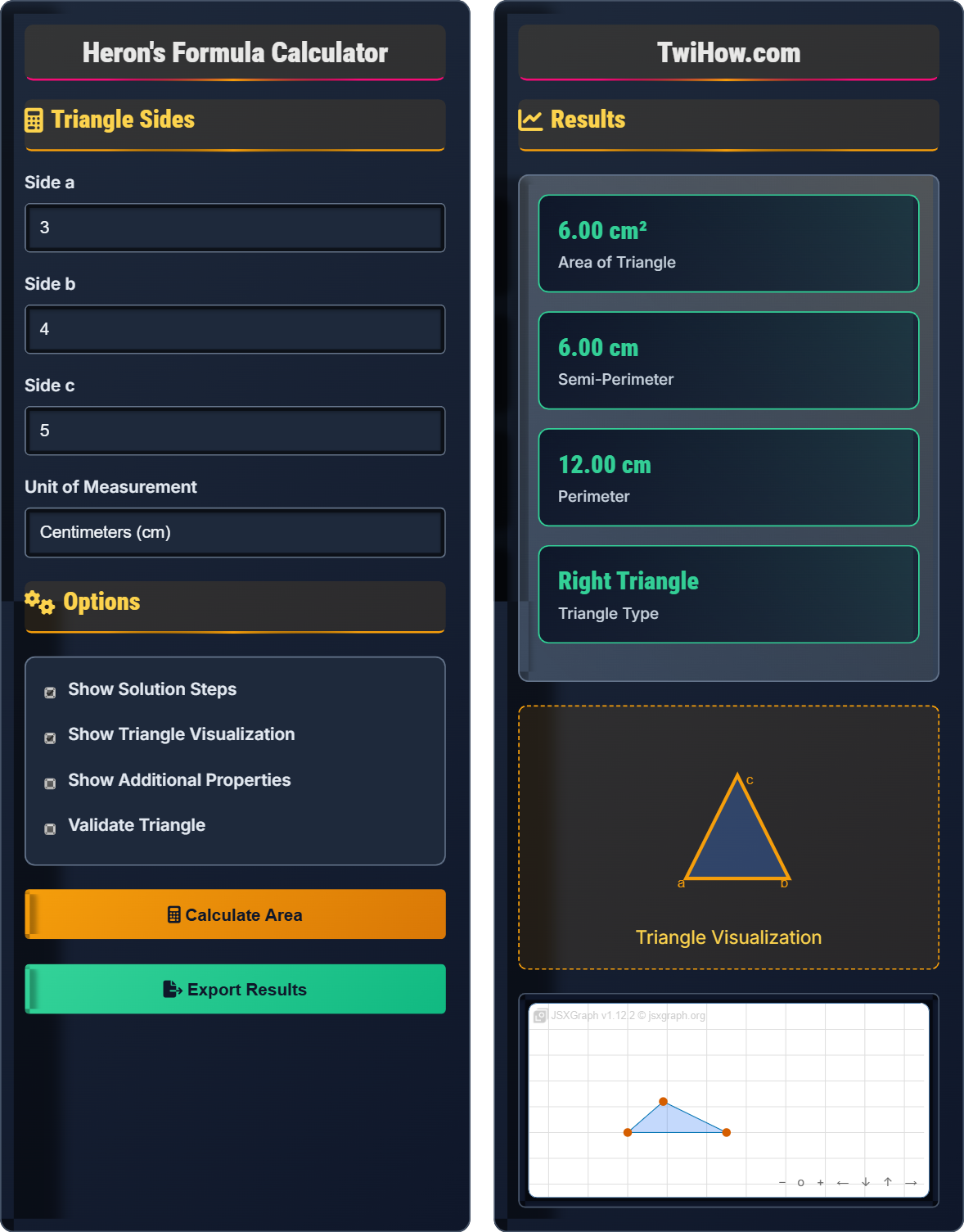
Heron's Formula Calculator
Complete geometry guide • Step-by-step solutions
Heron's Formula:
Show the calculator /Simulator\( A = \sqrt{s(s-a)(s-b)(s-c)} \) where \( s = \frac{a+b+c}{2} \)
This formula calculates the area of a triangle when all three sides are known, where:
- A = area of the triangle
- a, b, c = lengths of the three sides
- s = semi-perimeter of the triangle
Heron's formula is attributed to Hero of Alexandria (1st century CE) and is particularly useful when height is not easily measurable or when only side lengths are known.
Triangle Sides
Options
Results
| Property | Value | Formula | Calculation |
|---|
Enter parameters to see solution steps.
Heron's Formula Explained
Heron's formula is a method to calculate the area of a triangle when only the lengths of all three sides are known. Named after Hero of Alexandria, it's particularly useful when the height of the triangle is not easily measurable. The formula uses the semi-perimeter (half the perimeter) and the differences between the semi-perimeter and each side to calculate the area.
The standard form of Heron's formula is:
Where:
- \(A\) = area of the triangle
- \(s\) = semi-perimeter = \(\frac{a+b+c}{2}\)
- \(a, b, c\) = lengths of the three sides
Key properties related to Heron's formula:
- Semi-perimeter (s): s = (a+b+c)/2
- Validity: Triangle inequality must hold (a+b > c, etc.)
- Non-negativity: All terms under the square root must be non-negative
- Equilateral: For equilateral triangle with side a: A = (√3/4)a²
- Surveying: Calculating land area from measured distances
- Engineering: Structural analysis and design
- Navigation: Calculating distances and areas
- Architecture: Complex geometric calculations
Heron's Formula Learning Quiz
Which of the following is NOT required to use Heron's formula?
Heron's formula requires only the lengths of all three sides of a triangle. The formula is A = √[s(s-a)(s-b)(s-c)] where s is the semi-perimeter and a, b, c are the side lengths.
Unlike the standard area formula A = ½bh, Heron's formula does not require knowledge of the height of the triangle. This is the main advantage of Heron's formula - it allows you to calculate the area when only the side lengths are known.
Therefore, the answer is C) Height of the triangle.
The key insight behind Heron's formula is that the area of a triangle is completely determined by its three side lengths. This is a remarkable result because it means we don't need to measure angles or heights. The formula elegantly combines the side lengths in a way that calculates the area directly. This is particularly useful in practical situations where measuring height is difficult or impossible.
Heron's Formula: A method to calculate triangle area from three sides
Semi-perimeter: Half the perimeter of the triangle
Triangle Inequality: The sum of any two sides must exceed the third
• Requires three side lengths
• Does not require height measurement
• Triangle inequality must be satisfied
• Use when height is unknown or difficult to measure
• Always verify triangle inequality first
• Semi-perimeter is used in the formula
• Assuming height is needed for the formula
• Not checking if sides form a valid triangle
• Forgetting to calculate semi-perimeter first
Find the area of a triangle with sides 6 cm, 8 cm, and 10 cm using Heron's formula. Show your work.
Step 1: Identify the sides
a = 6 cm, b = 8 cm, c = 10 cm
Step 2: Calculate the semi-perimeter
s = (a + b + c)/2 = (6 + 8 + 10)/2 = 24/2 = 12 cm
Step 3: Calculate each factor in the formula
s - a = 12 - 6 = 6 cm
s - b = 12 - 8 = 4 cm
s - c = 12 - 10 = 2 cm
Step 4: Apply Heron's formula
A = √[s(s-a)(s-b)(s-c)]
A = √[12 × 6 × 4 × 2]
A = √[576]
A = 24 cm²
Therefore, the area of the triangle is 24 cm².
This problem demonstrates the systematic approach to using Heron's formula. We first calculate the semi-perimeter, then find the differences between the semi-perimeter and each side, and finally multiply these values together under the square root. This example also shows a right triangle (since 6² + 8² = 10²), which we could verify using the standard area formula A = ½bh = ½(6)(8) = 24 cm².
Semi-perimeter: Half the perimeter of the triangle
Factors: The terms multiplied under the square root
Right Triangle: Triangle with a 90° angle
• s = (a + b + c)/2 (semi-perimeter)
• A = √[s(s-a)(s-b)(s-c)] (Heron's formula)
• All values under square root must be non-negative
• Organize calculations in steps for clarity
• Verify with standard area formula when possible
• Check triangle inequality (6 + 8 > 10, etc.)
• Forgetting to divide by 2 when calculating semi-perimeter
• Arithmetic errors in multiplication
• Not checking if the result under square root is positive
A triangular plot of land has sides measuring 15 meters, 20 meters, and 25 meters. If grass seed costs $2.50 per square meter, how much would it cost to seed the entire plot? Round to the nearest dollar.
Step 1: Calculate the semi-perimeter
s = (a + b + c)/2 = (15 + 20 + 25)/2 = 60/2 = 30 meters
Step 2: Calculate each factor
s - a = 30 - 15 = 15 meters
s - b = 30 - 20 = 10 meters
s - c = 30 - 25 = 5 meters
Step 3: Apply Heron's formula
A = √[s(s-a)(s-b)(s-c)]
A = √[30 × 15 × 10 × 5]
A = √[22,500]
A = 150 square meters
Step 4: Calculate the cost of seeding
Cost = Area × Cost per square meter
Cost = 150 × $2.50 = $375
Therefore, it would cost $375 to seed the entire triangular plot.
This problem demonstrates a practical application of Heron's formula in surveying and landscaping. Notice that this is a right triangle (15² + 20² = 225 + 400 = 625 = 25²), so we could verify using the standard area formula: A = ½(15)(20) = 150 m², which matches our result from Heron's formula.
Surveying: Measuring and mapping land areas
Right Triangle: Triangle with 90° angle (a² + b² = c²)
Practical Application: Using math to solve real problems
• s = (a + b + c)/2 (semi-perimeter)
• A = √[s(s-a)(s-b)(s-c)] (Heron's formula)
• Cost = Area × Rate per unit area
• When sides satisfy a² + b² = c², it's a right triangle
• Use standard formula to verify Heron's result
• Always check units match throughout calculation
• Arithmetic errors with large numbers
• Forgetting to multiply cost by area
• Not checking if the result makes sense
Can a triangle have sides of lengths 2 cm, 3 cm, and 6 cm? Explain your answer using the triangle inequality and discuss what would happen if you tried to apply Heron's formula to these lengths.
Step 1: Check the triangle inequality
For a valid triangle, the sum of any two sides must be greater than the third side:
• 2 + 3 = 5, and 5 < 6
• 2 + 6 = 8, and 8 > 3 ✓
• 3 + 6 = 9, and 9 > 2 ✓
Since 2 + 3 = 5 < 6, the triangle inequality is violated. Therefore, a triangle cannot have sides of 2 cm, 3 cm, and 6 cm.
Step 2: What happens with Heron's formula?
If we attempt to use Heron's formula:
s = (2 + 3 + 6)/2 = 11/2 = 5.5 cm
s - a = 5.5 - 2 = 3.5 cm
s - b = 5.5 - 3 = 2.5 cm
s - c = 5.5 - 6 = -0.5 cm
A = √[5.5 × 3.5 × 2.5 × (-0.5)] = √[-24.0625]
Since we have a negative number under the square root, the formula yields an imaginary result, confirming that no real triangle can exist with these side lengths.
Therefore, no triangle exists with these side lengths.
This problem demonstrates the importance of checking the triangle inequality before attempting to calculate area. Heron's formula will fail (yielding a negative number under the square root) when the sides don't form a valid triangle. This is a useful check to ensure the three given lengths can actually form a triangle before proceeding with calculations.
Triangle Inequality: Sum of any two sides > third side
Invalid Triangle: Sides that don't satisfy triangle inequality
Imaginary Result: Square root of negative number
• Triangle inequality: a + b > c, a + c > b, b + c > a
• Heron's formula fails for invalid triangles
• All terms under square root must be non-negative
• Always check triangle inequality first
• Heron's formula will fail if sides are invalid
• The longest side must be shorter than sum of other two
• Not checking triangle inequality before calculating
• Proceeding with calculations despite invalid sides
• Not understanding why Heron's formula fails for invalid triangles
Which statement about Heron's formula is FALSE?
Let's examine each statement:
Statement A: TRUE. Heron's formula can calculate the area of any triangle when all three sides are known, provided the triangle inequality is satisfied.
Statement B: FALSE. Heron's formula does NOT require knowledge of the height. This is one of its main advantages over the standard area formula A = ½bh.
Statement C: TRUE. The semi-perimeter s = (a+b+c)/2 is a fundamental part of Heron's formula.
Statement D: TRUE. The formula is named after Hero of Alexandria, a Greek mathematician from the 1st century CE.
Therefore, the answer is B) It requires knowledge of the height of the triangle.
This question tests the fundamental understanding of what makes Heron's formula unique. Unlike the standard area formula A = ½bh, which requires knowledge of base and height, Heron's formula only requires the three side lengths. This makes it particularly useful in situations where measuring height is difficult or impossible, such as in surveying or when working with triangles in coordinate geometry.
Hero of Alexandria: Greek mathematician who described the formula
Semi-perimeter: Half the perimeter of the triangle
Height Independence: Formula doesn't require height measurement
• Heron's formula: A = √[s(s-a)(s-b)(s-c)]
• Does not require height measurement
• Requires three side lengths
• Heron's formula is height-independent
• Always verify triangle inequality first
• Semi-perimeter is calculated first
• Confusing with standard area formula that requires height
• Not understanding the advantage of not needing height
• Assuming height is required for area calculation
Heron's Formula Fundamentals
A = √[s(s-a)(s-b)(s-c)], where s = (a+b+c)/2.
\(A = \sqrt{s(s-a)(s-b)(s-c)}\) where \(s = \frac{a+b+c}{2}\)
Where A is area, a, b, c are side lengths, and s is semi-perimeter.
- Triangle inequality must hold (a+b > c, etc.)
- No height measurement required
- All terms under square root must be non-negative
Applications
Surveying, engineering, navigation, architecture, and any field where only side lengths are known.
- Land area measurement
- Structural analysis
- Geometric design
- Coordinate geometry problems
- Accuracy of measurements affects precision
- Measurement errors propagate
- Consider practical constraints
- Verify triangle inequality first
FAQ
Q: Why would I use Heron's formula instead of A = ½bh?
A: Heron's formula is particularly useful when you only know the three side lengths and measuring the height is difficult or impossible. For example, in surveying land plots, architectural design, or coordinate geometry problems. The standard formula A = ½bh requires knowing the base and height, which aren't always readily available. Heron's formula allows you to calculate the area directly from the side lengths without needing to measure or calculate the height.
Q: How do I verify that three lengths can form a triangle before using Heron's formula?
A: You must verify the triangle inequality: the sum of any two sides must be greater than the third side. For sides a, b, and c, check that a + b > c, a + c > b, and b + c > a. If any of these inequalities is false, the three lengths cannot form a triangle, and Heron's formula will fail (yielding a negative number under the square root). This is a crucial first step before applying Heron's formula.