Pythagorean Theorem Calculator
Complete geometry guide • Step-by-step solutions
Pythagorean Theorem:
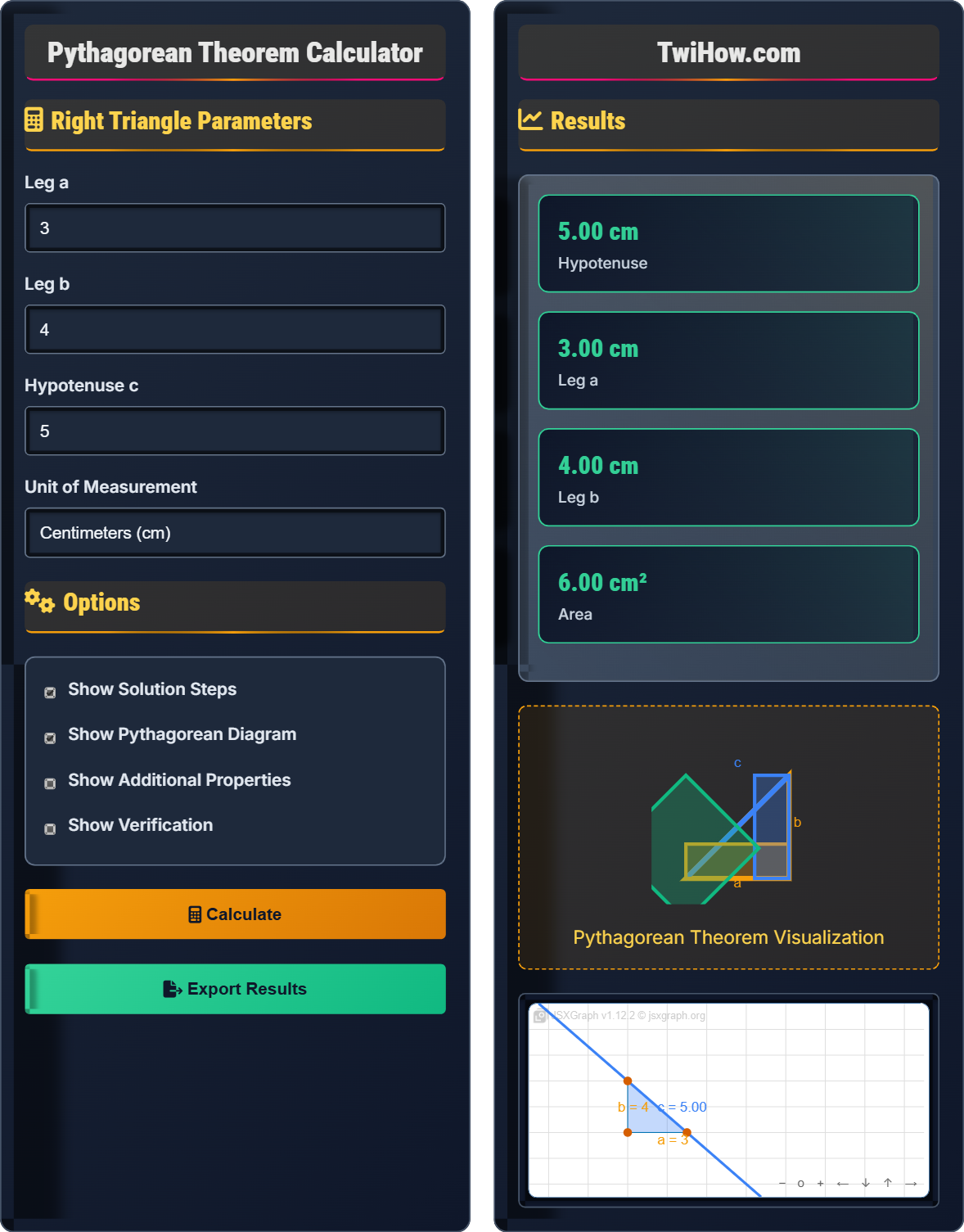
Show the calculator /Simulator\( a^2 + b^2 = c^2 \)
This formula calculates the relationship between the sides of a right triangle, where:
- a, b = lengths of the two legs (sides adjacent to the right angle)
- c = length of the hypotenuse (side opposite the right angle)
The theorem states that in any right triangle, the square of the hypotenuse equals the sum of the squares of the other two sides. This fundamental relationship is essential in geometry, trigonometry, and countless real-world applications.
Right Triangle Parameters
Options
Results
| Property | Value | Formula | Calculation |
|---|
Enter parameters to see solution steps.
Pythagorean Theorem Explained
The Pythagorean theorem is one of the fundamental relations in Euclidean geometry among the three sides of a right triangle. It states that the square of the hypotenuse (the side opposite the right angle) is equal to the sum of the squares of the other two sides. Named after the ancient Greek mathematician Pythagoras, this theorem has been known for thousands of years and has countless applications in mathematics, science, and engineering.
The standard form of the Pythagorean theorem is:
Alternative forms:
- To find leg a: \(a = \sqrt{c^2 - b^2}\)
- To find leg b: \(b = \sqrt{c^2 - a^2}\)
- To find hypotenuse c: \(c = \sqrt{a^2 + b^2}\)
Key properties of right triangles:
- Right Angle: Exactly one 90° angle
- Legs: Two sides forming the right angle (a and b)
- Hypotenuse: Longest side, opposite the right angle (c)
- Pythagorean Relationship: a² + b² = c²
- Area: A = ½ab (half the product of legs)
- Construction: Ensuring corners are square (90°)
- Navigation: Calculating distances between points
- Engineering: Structural analysis and design
- Computer Graphics: Calculating distances and rotations
Pythagorean Theorem Learning Quiz
In a right triangle with legs of length 6 and 8, what is the length of the hypotenuse?
Using the Pythagorean theorem: c² = a² + b²
Given: a = 6, b = 8
Step 1: Substitute values into the formula
c² = 6² + 8²
Step 2: Calculate the squares
c² = 36 + 64 = 100
Step 3: Take the square root
c = √100 = 10
Therefore, the hypotenuse is 10 units long. The answer is A) 10.
This is a classic Pythagorean triple (3, 4, 5) scaled by a factor of 2. The Pythagorean theorem states that in a right triangle, the square of the hypotenuse equals the sum of the squares of the other two sides. This fundamental relationship is essential for understanding right triangles and forms the basis for trigonometry.
Right Triangle: A triangle with one 90° angle
Legs: The two sides that form the right angle
Hypotenuse: The side opposite the right angle (longest side)
• a² + b² = c² (only for right triangles)
• Hypotenuse is always the longest side
• c² = a² + b² (solve for hypotenuse)
• Remember: hypotenuse is always opposite the right angle
• The hypotenuse is always the longest side
• Check: does the result make sense?
• Forgetting to take the square root
• Misidentifying which side is the hypotenuse
• Adding the sides instead of their squares
If the hypotenuse of a right triangle is 13 units and one leg is 5 units, find the length of the other leg. Show your work.
Using the Pythagorean theorem: a² + b² = c²
Given: c = 13 (hypotenuse), a = 5 (one leg), find b (other leg)
Step 1: Rearrange the formula to solve for the unknown leg
b² = c² - a²
Step 2: Substitute known values
b² = 13² - 5²
Step 3: Calculate the squares
b² = 169 - 25 = 144
Step 4: Take the square root
b = √144 = 12
Therefore, the length of the other leg is 12 units.
This problem demonstrates the flexibility of the Pythagorean theorem. When we know the hypotenuse and one leg, we can rearrange the formula to find the missing leg: b² = c² - a². This is still the same relationship, just solved for a different variable. The key is to correctly identify which side is the hypotenuse (always the longest side, opposite the right angle).
Rearranging Equations: Manipulating formulas to solve for different variables
Unknown Variable: The value we need to find
Algebraic Manipulation: Using algebra to solve equations
• c² = a² + b² (solve for hypotenuse)
• a² = c² - b² (solve for leg when hypotenuse known)
• Always verify: sum of legs² = hypotenuse²
• Always identify the hypotenuse first (longest side)
• Subtract when solving for a leg, add when solving for hypotenuse
• Verify by substituting back into original formula
• Misidentifying which side is the hypotenuse
• Forgetting to subtract (trying to add when solving for a leg)
• Arithmetic errors with squares and square roots
A ladder leans against a wall. The base of the ladder is 4 feet from the wall, and the ladder is 10 feet long. How high up the wall does the ladder reach? Round to the nearest tenth of a foot.
This forms a right triangle where: - The ladder is the hypotenuse (c = 10 feet) - The distance from wall is one leg (a = 4 feet) - The height up the wall is the other leg (b = ?)
Step 1: Apply the Pythagorean theorem
a² + b² = c²
4² + b² = 10²
Step 2: Calculate known squares
16 + b² = 100
Step 3: Solve for b²
b² = 100 - 16 = 84
Step 4: Find b
b = √84 ≈ 9.17 feet
Step 5: Round to nearest tenth
b ≈ 9.2 feet
Therefore, the ladder reaches approximately 9.2 feet up the wall.
This problem demonstrates how the Pythagorean theorem applies to real-world scenarios. When a ladder leans against a wall, it forms a right triangle with the ground and the wall. The ladder becomes the hypotenuse, the distance from the wall becomes one leg, and the height up the wall becomes the other leg. Recognizing right triangles in practical situations is a valuable skill.
Right Triangle Formation: When two perpendicular lines meet
Practical Applications: Using math to solve real problems
Problem Modeling: Translating real situations to mathematical forms
• Look for right angles in real-world problems
• The hypotenuse is always the longest side
• Always include units in your answer
• Draw a diagram to visualize the right triangle
• Identify which side is the hypotenuse
• Verify your answer makes practical sense
• Misidentifying which side is the hypotenuse
• Forgetting to take the square root
• Not rounding to the specified precision
Verify that a triangle with sides 5, 12, and 13 is a right triangle using the Pythagorean theorem. Then find the area of this triangle.
Step 1: Identify the longest side (potential hypotenuse)
The longest side is 13, so let's test if c = 13, a = 5, b = 12
Step 2: Apply the Pythagorean theorem
a² + b² = c²
5² + 12² = 13²
Step 3: Calculate each square
25 + 144 = 169
169 = 169 ✓
Step 4: Since the equation is true, this is a right triangle.
Step 5: Calculate the area
For a right triangle: A = ½ × base × height
A = ½ × 5 × 12 = 30 square units
Therefore, this is a right triangle with an area of 30 square units.
This problem shows how to use the Pythagorean theorem to verify if a triangle is right-angled. If a² + b² = c² (where c is the longest side), then the triangle is right-angled. The converse of the Pythagorean theorem is also true: if a² + b² = c², then the triangle is right-angled. This is a classic Pythagorean triple (5, 12, 13).
Pythagorean Triple: Three positive integers that satisfy a² + b² = c²
Converse: The reverse of a theorem
Verification: Proving a statement is true
• Always test the longest side as potential hypotenuse
• Converse: if a² + b² = c², then it's a right triangle
• Area of right triangle = ½ab (legs as base and height)
• Common triples: (3,4,5), (5,12,13), (7,24,25), (8,15,17)
• For right triangles, legs can serve as base and height
• Always verify by substitution
• Testing the wrong side as the hypotenuse
• Arithmetic errors in squaring numbers
• Not verifying the result
Which statement about the Pythagorean theorem is FALSE?
Let's examine each statement:
Statement A: FALSE. The Pythagorean theorem only applies to right triangles. For other triangles, different relationships hold (Law of Cosines generalizes it).
Statement B: TRUE. In a right triangle, the hypotenuse (opposite the right angle) is always the longest side because it's opposite the largest angle (90°).
Statement C: TRUE. If a² + b² = c² for a triangle, then it's a right triangle (converse of the theorem).
Statement D: TRUE. The Pythagorean theorem has one of the highest numbers of known proofs among mathematical theorems.
Therefore, the answer is A) It applies to all triangles.
This question tests the fundamental understanding that the Pythagorean theorem is specific to right triangles. It does not apply to acute or obtuse triangles. For other triangles, we use the Law of Cosines: c² = a² + b² - 2ab cos(C), which reduces to the Pythagorean theorem when C = 90° (since cos(90°) = 0).
Right Triangle: Triangle with one 90° angle
Acute Triangle: All angles less than 90°
Obtuse Triangle: One angle greater than 90°
• Pythagorean theorem: right triangles only
• Law of Cosines: generalization for all triangles
• Hypotenuse: always opposite the right angle
• Always check if triangle is right-angled before using theorem
• Remember: only for right triangles!
• For other triangles, use Law of Cosines or Sines
• Applying to non-right triangles
• Forgetting to verify the triangle is right-angled
• Confusing which relationships apply to which triangles
Pythagorean Theorem Fundamentals
a² + b² = c², where a and b are legs, c is hypotenuse.
\(a^2 + b^2 = c^2\) or \(c = \sqrt{a^2 + b^2}\) or \(a = \sqrt{c^2 - b^2}\)
Where c is hypotenuse, a and b are legs.
- Only applies to right triangles
- Hypotenuse is always the longest side
- Hypotenuse is opposite the right angle
Applications
Construction, navigation, physics, engineering, computer graphics, surveying, and astronomy.
- Ensuring square corners in construction
- Calculating distances between points
- Diagonal measurements of rectangles
- Vector magnitude calculations
- Requires right triangle
- Measurement accuracy matters
- Units must be consistent
- Verify with other methods when possible
FAQ
Q: Does the Pythagorean theorem work for all triangles?
A: No, the Pythagorean theorem a² + b² = c² only works for right triangles. For acute triangles (all angles < 90°), a² + b² > c², and for obtuse triangles (one angle > 90°), a² + b² < c². The Pythagorean theorem is a special case of the Law of Cosines: c² = a² + b² - 2ab cos(C), which applies to all triangles. When C = 90°, cos(90°) = 0, so the Law of Cosines reduces to the Pythagorean theorem.
Q: How is the Pythagorean theorem used in construction?
A: In construction, the Pythagorean theorem is used to ensure corners are square (90°). The 3-4-5 triangle is commonly used: measure 3 units along one side, 4 units along the adjacent side, and if the diagonal measures 5 units, the corner is square. This works because 3² + 4² = 9 + 16 = 25 = 5². This method is applied to foundations, framing, and any situation requiring precise right angles.