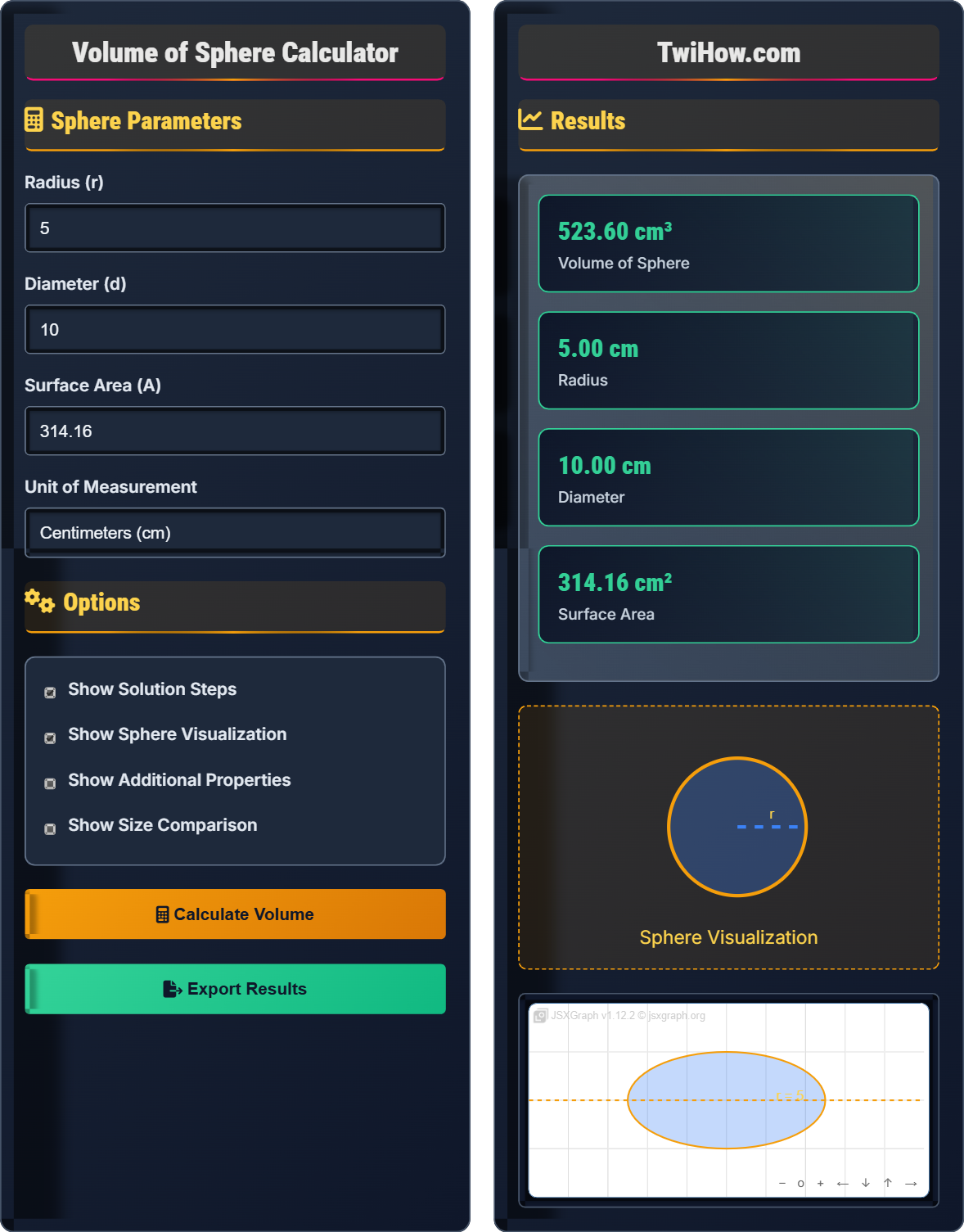
Volume of Sphere Calculator
Complete geometry guide • Step-by-step solutions
Volume of Sphere Formula:
Show the calculator /Simulator\( V = \frac{4}{3}\pi r^3 \)
This formula calculates the volume of a sphere, where:
- V = volume of the sphere
- π = pi (approximately 3.14159)
- r = radius of the sphere
- r³ = radius cubed
Alternatively, if you know the diameter (d), the formula is: V = (1/6)πd³. The volume represents the total space occupied by the sphere in three-dimensional space.
Sphere Parameters
Options
Results
| Property | Value | Formula | Calculation |
|---|
Enter parameters to see solution steps.
Volume of Sphere Explained
The volume of a sphere is the total amount of space enclosed within the sphere's surface. It's calculated using the formula V = (4/3)πr³, where V is the volume and r is the radius of the sphere. This formula was first derived by Archimedes using the method of exhaustion, demonstrating that the volume of a sphere is 2/3 that of the circumscribing cylinder.
The standard formula for the volume of a sphere is:
Alternative forms:
- Using diameter: \(V = \frac{1}{6}\pi d^3\)
- Using surface area: \(V = \frac{A^{3/2}}{6\sqrt{\pi}}\)
Key properties of spheres:
- Radius (r): Distance from center to surface
- Diameter (d): Distance across the sphere through center (d = 2r)
- Surface Area: A = 4πr²
- Volume: V = (4/3)πr³
- Curvature: Constant positive curvature at every point
- Astronomy: Calculating volumes of planets and stars
- Engineering: Designing spherical tanks and vessels
- Physics: Modeling atomic structures and particles
- Medicine: Calculating volumes of cells and organs
Volume of Sphere Learning Quiz
What is the volume of a sphere with radius 3 cm? (Use π ≈ 3.14159)
Using the volume formula: V = (4/3)πr³
Given: r = 3 cm
Step 1: Substitute into the formula
V = (4/3)π × (3)³
Step 2: Calculate the cube
V = (4/3)π × 27
Step 3: Multiply
V = (4 × 27)/3 × π = 108/3 × π = 36π cm³
Therefore, the answer is A) 36π cm³.
The volume formula V = (4/3)πr³ shows that the volume is proportional to the cube of the radius. This means if you double the radius, the volume increases by a factor of eight (2³). The constant (4/3)π represents the geometric relationship for spheres. This cubic relationship is fundamental to understanding how volume scales with size.
Volume: The amount of space inside a three-dimensional shape
Radius: The distance from the center to the surface of the sphere
Pi (π): The ratio of circumference to diameter, approximately 3.14159
• V = (4/3)πr³ (use radius in the formula)
• The radius must be cubed (r³)
• Units of volume are cubic units (cm³, m³, etc.)
• Remember: V = (4/3)πr³ (not πr²)
• Cube the radius, don't square it
• Always include units in your final answer
• Using the area formula instead of volume formula
• Forgetting to cube the radius
• Omitting units or using incorrect units
Find the volume of a sphere with diameter 12 inches. Express your answer in terms of π and as a decimal approximation.
Given: diameter d = 12 inches
Step 1: Find the radius
r = d/2 = 12/2 = 6 inches
Step 2: Apply the volume formula
V = (4/3)πr³ = (4/3)π × (6)³ = (4/3)π × 216 = (4 × 216)/3 × π = 288π cubic inches
Step 3: Calculate decimal approximation
V = 288π ≈ 288 × 3.14159 ≈ 904.78 cubic inches
Therefore, the volume is 288π cubic inches or approximately 904.78 cubic inches.
When given the diameter instead of the radius, you must first calculate the radius by dividing the diameter by 2. This is because the standard volume formula uses the radius. You can also use the alternative formula V = (1/6)πd³, but it's often easier to find the radius first.
Diameter: The distance across the sphere through the center
Exact Answer: An answer expressed in terms of π
Approximate Answer: A decimal representation
• r = d/2 (radius is half the diameter)
• V = (1/6)πd³ (alternative formula using diameter)
• Exact answers contain π, approximations replace π
• Always convert diameter to radius first
• Give both exact and approximate answers when possible
• Keep π in calculations until the final step for accuracy
• Using diameter directly in V = (4/3)πr³
• Cubing the diameter instead of the radius
• Forgetting to divide diameter by 2
A spherical water tank has a radius of 4 meters. If water costs $0.003 per liter, how much would it cost to fill the tank completely? (Note: 1 m³ = 1000 liters)
Step 1: Calculate the volume of the tank
V = (4/3)πr³ = (4/3)π × (4)³ = (4/3)π × 64 = (256π)/3 m³
V ≈ (256 × 3.14159)/3 ≈ 804.25/3 ≈ 268.08 m³
Step 2: Convert cubic meters to liters
Volume in liters = 268.08 m³ × 1000 L/m³ = 268,080 liters
Step 3: Calculate the cost
Cost = Volume × Price per liter
Cost = 268,080 × $0.003 = $804.24
Therefore, it would cost approximately $804.24 to fill the tank completely.
This problem demonstrates how the volume formula connects to real-world applications. By finding the volume of the spherical tank, we can determine the amount of liquid it can hold and calculate associated costs. This is a common scenario in engineering and industrial applications.
Capacity: The maximum amount a container can hold
Real-World Application: Using math to solve practical problemsUnit Conversion: Changing from one measurement unit to another
• 1 m³ = 1000 liters
• Always check units match throughout calculation
• Round monetary amounts appropriately
• Break complex problems into smaller steps
• Check that units cancel correctly
• Verify that your answer is reasonable
• Forgetting to convert units between m³ and liters
• Mismatching units in calculations
• Incorrect rounding of monetary amounts
Sphere A has a radius of 2 cm, and Sphere B has a radius of 6 cm. How many times larger is the volume of Sphere B compared to Sphere A? Explain why the volume doesn't triple when the radius triples.
Step 1: Calculate volume of Sphere A
V_A = (4/3)πr³ = (4/3)π × (2)³ = (4/3)π × 8 = (32π)/3 cm³
Step 2: Calculate volume of Sphere B
V_B = (4/3)πr³ = (4/3)π × (6)³ = (4/3)π × 216 = (864π)/3 cm³
Step 3: Find the ratio of the volumes
Ratio = V_B / V_A = [(864π)/3] / [(32π)/3] = (864π/3) × (3/32π) = 864/32 = 27
Step 4: Explain the relationship
When the radius triples (from 2 to 6), the volume increases by a factor of 27, not 3. This is because the volume formula involves r³. If the radius is multiplied by a factor k, the volume is multiplied by k³. In this case, k = 3, so the volume is multiplied by 3³ = 27.
Therefore, Sphere B's volume is 27 times larger than Sphere A's volume.
This demonstrates a fundamental property of cubic relationships. Since the volume formula contains r³, changes to the radius are cubed in their effect on the volume. This means that even small changes in radius result in large changes in volume. This concept is important in scaling, similar solids, and many scientific applications.
Cubic Relationship: A relationship involving a cubed variable
Scaling Factor: The multiplier applied to dimensions
Similar Solids: Solids with the same shape but different sizes
• If radius × k, then volume × k³
• Volume scales cubically with linear dimensions
• Area scales quadratically with linear dimensions
• Remember: volume relationships involve cubes
• Area relationships involve squares
• This principle applies to all similar shapes
• Assuming volume scales linearly with radius
• Forgetting that volume involves cubed dimensions
• Confusing linear, area, and volume scaling
Which statement about the volume of a sphere is FALSE?
Let's examine each statement:
Statement A: TRUE. V = (4/3)πr³, so V ∝ r³.
Statement B: TRUE. The formula includes π as a constant.
Statement C: FALSE. This depends on the radius. For small radii, volume can be smaller than surface area. For example, if r = 1: V = (4/3)π ≈ 4.19, A = 4π ≈ 12.57. The volume is smaller than the surface area.
Statement D: TRUE. Since A = 4πr², we can find r = √(A/4π), then substitute into the volume formula.
Therefore, the answer is C) The volume is always greater than the surface area.
This question highlights the importance of understanding that volume and surface area have different units (cubic vs. square) and therefore cannot be directly compared in a general sense. The relationship depends on the specific size of the sphere. For small spheres, surface area may be numerically larger than volume, while for large spheres, volume will be significantly larger.
Proportional: Changing at a constant ratio
Dimensional Analysis: Considering units in calculations
Numerical Comparison: Comparing values without considering units
• Volume ∝ r³ (cubic relationship)
• Surface area ∝ r² (quadratic relationship)
• Cannot compare quantities with different units
• Always consider units when comparing quantities
• Volume relationships involve cubes
• Surface area relationships involve squares
• Comparing quantities with different units
• Assuming volume is always larger than surface area
• Not considering dimensional analysis
Volume of Sphere Fundamentals
V = (4/3)πr³, where V is volume and r is radius.
\(V = \frac{4}{3}\pi r^3\) or \(V = \frac{1}{6}\pi d^3\) or \(V = \frac{A^{3/2}}{6\sqrt{\pi}}\)
Where d is diameter and A is surface area.
- Always use radius in V = (4/3)πr³
- Volume units are cubic units (cm³, m³, etc.)
- π ≈ 3.14159265359
Applications
Astronomy, engineering, physics, medicine, manufacturing, and design.
- Planetary volume calculations
- Tank and vessel design
- Atomic and molecular modeling
- Medical imaging and diagnostics
- Accuracy of π affects precision
- Measurement errors propagate
- Consider practical constraints
- Verify units throughout calculation
FAQ
Q: Why is the volume of a sphere (4/3)πr³ and not something else?
A: The (4/3) factor comes from calculus integration. If we consider the sphere as a stack of infinitesimally thin circular disks, each with radius √(r² - x²) at height x, then the volume is the integral ∫₋ᵣʳ π(r² - x²)dx. Evaluating this integral gives V = (4/3)πr³. This relationship was first discovered by Archimedes using the method of exhaustion, which predated calculus by nearly 2000 years.
Q: How does the volume change if I double the radius?
A: If you double the radius, the volume increases by a factor of 8. This is because the volume formula involves r³. If the original radius is r, then the original volume is (4/3)πr³. If the new radius is 2r, the new volume is (4/3)π(2r)³ = (4/3)π(8r³) = 8 × (4/3)πr³. So the new volume is 8 times the original volume. This cubic relationship holds for any change in radius: if the radius changes by a factor of k, the volume changes by a factor of k³.