Probability Formula Calculator
Complete statistics guide • Step-by-step solutions
Probability Formula::
Show the calculator /Simulator\( P(A) = \frac{\text{Number of favorable outcomes}}{\text{Total number of possible outcomes}} \)
Probability measures the likelihood of an event occurring, expressed as a number between 0 and 1 (or 0% to 100%). It quantifies uncertainty and randomness in various phenomena. The classical probability formula assumes all outcomes are equally likely. More complex probability calculations include conditional probability, Bayes' theorem, and compound events.
Where:
- \(P(A)\) = probability of event A
- Favorable outcomes = number of ways A can occur
- Total outcomes = total possible outcomes in sample space
Probability theory forms the foundation for statistical inference, risk assessment, and decision-making under uncertainty. It's essential in fields ranging from finance and insurance to science and medicine.
Event Parameters
Options
Results
| Parameter | Value | Description |
|---|
Enter parameters to see calculation steps.
Additional statistics will appear here.
Probability Formula Explained
Probability is a measure of the likelihood that a particular event will occur. It quantifies uncertainty and randomness, assigning a numerical value between 0 and 1 (or 0% to 100%) to each possible outcome. A probability of 0 indicates impossibility, while a probability of 1 indicates certainty. Probability theory provides the mathematical framework for dealing with uncertain events and forms the foundation for statistical inference and decision-making under uncertainty.
There are several key probability formulas depending on the situation:
Where:
- \(P(A)\) = probability of event A
- \(P(A|B)\) = probability of A given B
- \(P(A \cap B)\) = probability of both A and B
- \(P(A \cup B)\) = probability of A or B
Key characteristics of probability:
- Range: Always between 0 and 1 (inclusive)
- Sum Rule: Probabilities of all outcomes sum to 1
- Complement: P(not A) = 1 - P(A)
- Addition Rule: P(A or B) = P(A) + P(B) - P(A and B)
- Risk Assessment: Evaluating potential outcomes
- Decision Making: Choosing between alternatives
- Statistical Inference: Drawing conclusions from data
- Forecasting: Predicting future events
Probability Fundamentals
Probability measures the likelihood of an event occurring, expressed as a number between 0 and 1.
\( P(A) = \frac{\text{Number of favorable outcomes}}{\text{Total number of possible outcomes}} \)
Where P(A) = probability of event A.
- 0 ≤ P(A) ≤ 1
- P(Sample Space) = 1
- P(Empty Set) = 0
- P(A) + P(not A) = 1
Applications
Foundation for statistics, machine learning, and data science.
- Insurance risk modeling
- Medical diagnosis
- Quality control
- Weather forecasting
- Assumes equally likely outcomes
- Requires complete sample space
- Independent events assumption
- Subjective probability for unique events
Probability Formula Learning Quiz
What is the probability of rolling a 4 on a fair six-sided die?
Step 1: Identify favorable outcomes
Rolling a 4: only 1 favorable outcome
Step 2: Identify total possible outcomes
Die faces: 1, 2, 3, 4, 5, 6 → 6 total outcomes
Step 3: Apply probability formula
P(rolling a 4) = Number of favorable outcomes / Total outcomes = 1/6
The answer is B) 1/6.
The classical probability formula requires identifying two key components: the number of favorable outcomes (ways the event can occur) and the total number of possible outcomes in the sample space. For a fair die, all outcomes are equally likely, making the calculation straightforward. This foundational concept applies to all probability calculations.
Probability: Measure of likelihood of an event
Favorable Outcomes: Ways event can occur
Sample Space: Set of all possible outcomes
• P(A) = favorable outcomes / total outcomes
• All outcomes must be equally likely
• 0 ≤ P(A) ≤ 1
• Always define the sample space first
• Count favorable outcomes carefully
• Verify all outcomes are equally likely
• Miscounting favorable outcomes
• Incorrect sample space identification
• Forgetting equally likely assumption
If the probability of rain tomorrow is 0.35, what is the probability that it will not rain? Explain the relationship between complementary events.
Step 1: Identify the given probability
P(rain) = 0.35
Step 2: Apply the complement rule
P(no rain) = 1 - P(rain) = 1 - 0.35 = 0.65
Step 3: Verify the relationship
P(rain) + P(no rain) = 0.35 + 0.65 = 1.0 ✓
The probability that it will not rain is 0.65 or 65%.
Complementary events are mutually exclusive (cannot occur simultaneously) and collectively exhaustive (cover all possibilities). They always sum to 1, making it easier to calculate the probability of an event not happening when we know the probability of it happening.
The complement rule is fundamental in probability theory. When two events are complementary, they represent opposite outcomes of the same phenomenon. The complement rule states that P(A) + P(not A) = 1, which is derived from the fact that the sum of probabilities of all possible outcomes must equal 1. This rule is particularly useful when calculating the probability of "at least one" or "not all" scenarios.
Complementary Events: Opposite outcomes that cover all possibilities
Mutually Exclusive: Events that cannot occur simultaneously
Collectively Exhaustive: Events that cover all possible outcomes
• P(A) + P(not A) = 1
• P(not A) = 1 - P(A)
• Complementary events are mutually exclusive
• Use complement when direct calculation is difficult
• Verify probabilities sum to 1
• Think in terms of "not" when appropriate
• Forgetting to subtract from 1
• Not identifying complementary events correctly
• Adding instead of subtracting
In a bag containing 5 red marbles, 3 blue marbles, and 2 green marbles, what is the probability of randomly drawing a red marble? What is the probability of drawing a marble that is not blue?
Step 1: Calculate total number of marbles
Total = 5 red + 3 blue + 2 green = 10 marbles
Step 2: Calculate probability of drawing a red marble
P(red) = Number of red marbles / Total marbles = 5/10 = 1/2 = 0.5
Step 3: Calculate probability of drawing a marble that is not blue
Marbles that are not blue = 5 red + 2 green = 7 marbles
P(not blue) = 7/10 = 0.7
Alternatively, using complement: P(not blue) = 1 - P(blue) = 1 - 3/10 = 7/10
The probability of drawing a red marble is 0.5 (50%), and the probability of drawing a marble that is not blue is 0.7 (70%).
This problem demonstrates how to apply probability concepts to real-world scenarios. The key is to identify the sample space (all possible outcomes) and the favorable outcomes for each event. In more complex problems, we can use the complement rule to simplify calculations when dealing with "not" scenarios.
Sample Space: Set of all possible outcomes
Favorable Outcomes: Outcomes that satisfy the event condition
Random Selection: Each outcome equally likely to be chosen
• P(A) = favorable outcomes / total outcomes
• P(not A) = 1 - P(A)
• All outcomes in sample space must be counted
• Always count total outcomes first
• Use complement for "not" problems
• Simplify fractions when possible
• Not counting all possible outcomes
• Misidentifying favorable outcomes
• Forgetting to include all categories
In a class of 30 students, 18 play soccer, 12 play basketball, and 8 play both sports. What is the probability that a student plays basketball given that they play soccer?
Step 1: Identify the given information
Total students = 30
Students who play soccer = 18
Students who play basketball = 12
Students who play both = 8
Step 2: Apply conditional probability formula
P(Basketball | Soccer) = P(Basketball and Soccer) / P(Soccer)
Step 3: Calculate probabilities
P(Basketball and Soccer) = 8/30
P(Soccer) = 18/30
Step 4: Compute conditional probability
P(Basketball | Soccer) = (8/30) / (18/30) = 8/18 = 4/9 ≈ 0.444
The probability that a student plays basketball given that they play soccer is 4/9 or approximately 44.4%.
Conditional probability measures the likelihood of an event occurring given that another event has occurred. The formula P(A|B) = P(A and B) / P(B) adjusts our probability calculation based on new information. This concept is fundamental in statistics, medical testing, and decision-making processes where prior knowledge affects future probabilities.
Conditional Probability: Probability of A given B has occurred
Intersection: Events A and B both occurring
Dependent Events: Events where occurrence affects probability of other
• P(A|B) = P(A and B) / P(B)
• P(A and B) = P(A|B) × P(B)
• Conditional probability adjusts for known information
• Identify what is given and what is sought
• Use intersection for numerator
• Use given event for denominator
• Confusing P(A|B) with P(A and B)
• Using wrong event in denominator
• Forgetting to adjust for given information
Which of the following statements about probability is TRUE?
Let's examine each option:
A) False - Probability cannot be negative as it's a ratio of non-negative counts
B) False - Probability cannot exceed 1 since favorable outcomes cannot exceed total outcomes
C) True - By definition, probability ranges from 0 (impossible) to 1 (certain)
D) False - Probability of impossible event is 0, not 1
The fundamental axiom of probability states that for any event A: 0 ≤ P(A) ≤ 1. This range ensures that probability represents a meaningful measure of likelihood between impossibility (0) and certainty (1).
The answer is C) Probability is always between 0 and 1 inclusive.
The range [0, 1] for probability is a fundamental axiom that stems from the definition of probability as a ratio. Since we're dividing the number of favorable outcomes by the total number of outcomes, and both are non-negative with the numerator never exceeding the denominator, the result must be between 0 and 1. This bounded range makes probability a standardized measure that allows for comparison across different situations.
Axiom: Fundamental truth in probability theory
Impossible Event: Event that cannot occur (P=0)
Certain Event: Event that will definitely occur (P=1)
• 0 ≤ P(A) ≤ 1 for any event A
• P(impossible event) = 0
• P(certain event) = 1
• Always verify probabilities are in [0,1] range
• Use this as a sanity check for calculations
• Remember the boundary meanings
• Calculating probabilities outside [0,1] range
• Confusing impossible and certain events
• Forgetting the fundamental range constraint
FAQ
Q: What's the difference between probability and odds?
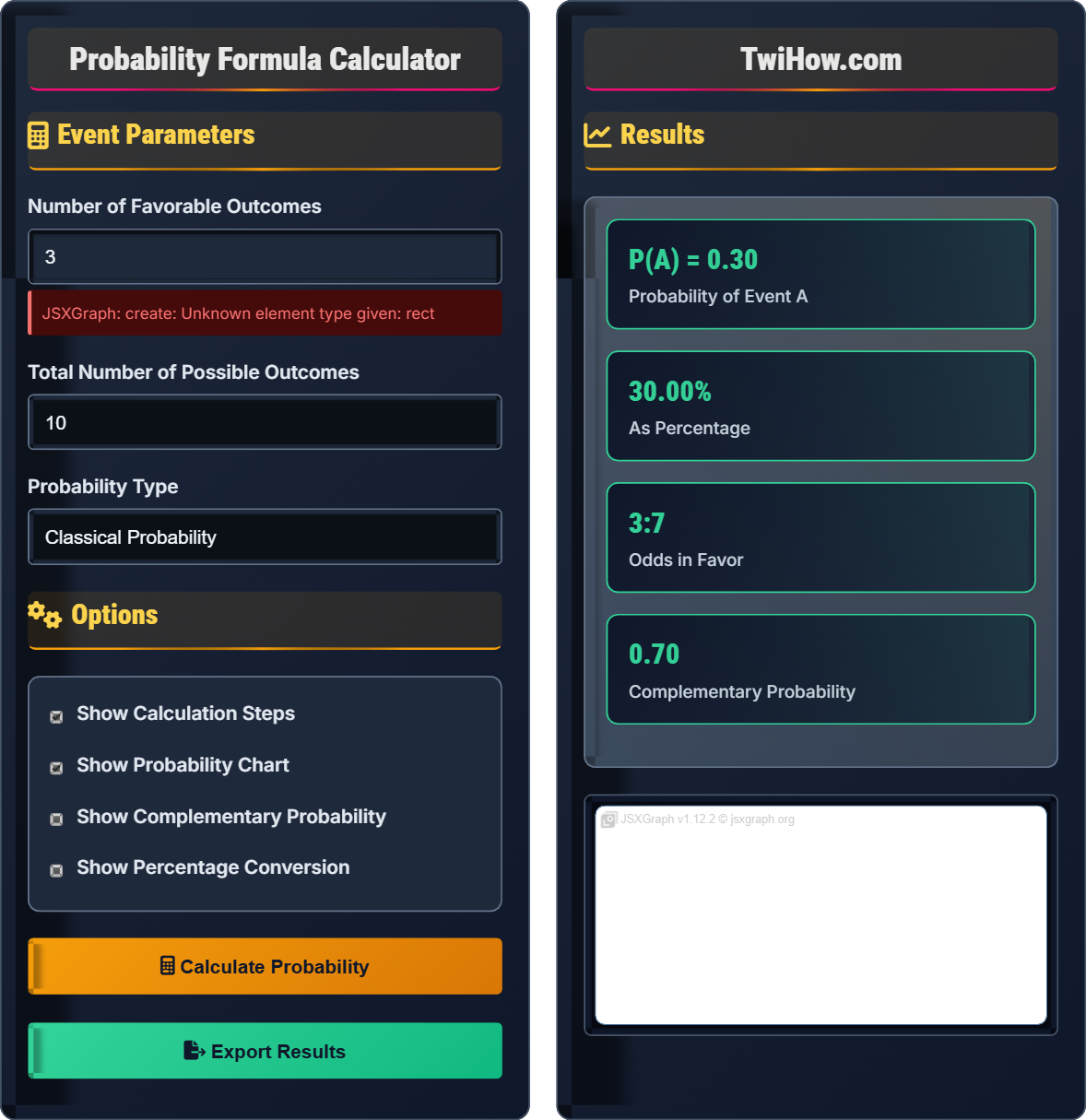
A: Probability and odds are related but different concepts. Probability is the ratio of favorable outcomes to total outcomes, expressed as a decimal between 0 and 1. Odds represent the ratio of favorable to unfavorable outcomes, expressed as a ratio like "3 to 7" or 3:7. For example, if the probability of an event is 0.3 (30%), the odds are 3:7 (3 favorable to 7 unfavorable). To convert: Odds = P/(1-P) and P = Odds/(1+Odds).
Q: How does Bayes' theorem differ from classical probability?
A: Classical probability assumes all outcomes are equally likely and calculates P(A) = favorable/total. Bayes' theorem incorporates prior knowledge and updates probabilities based on new evidence: P(A|B) = [P(B|A) × P(A)] / P(B). While classical probability deals with static scenarios, Bayesian probability allows for dynamic updating as new information becomes available. This makes it particularly valuable in medical diagnosis, machine learning, and decision-making under uncertainty.