Double Angle Formulas Calculator
Complete trigonometry guide • Step-by-step solutions
Double Angle Formulas:
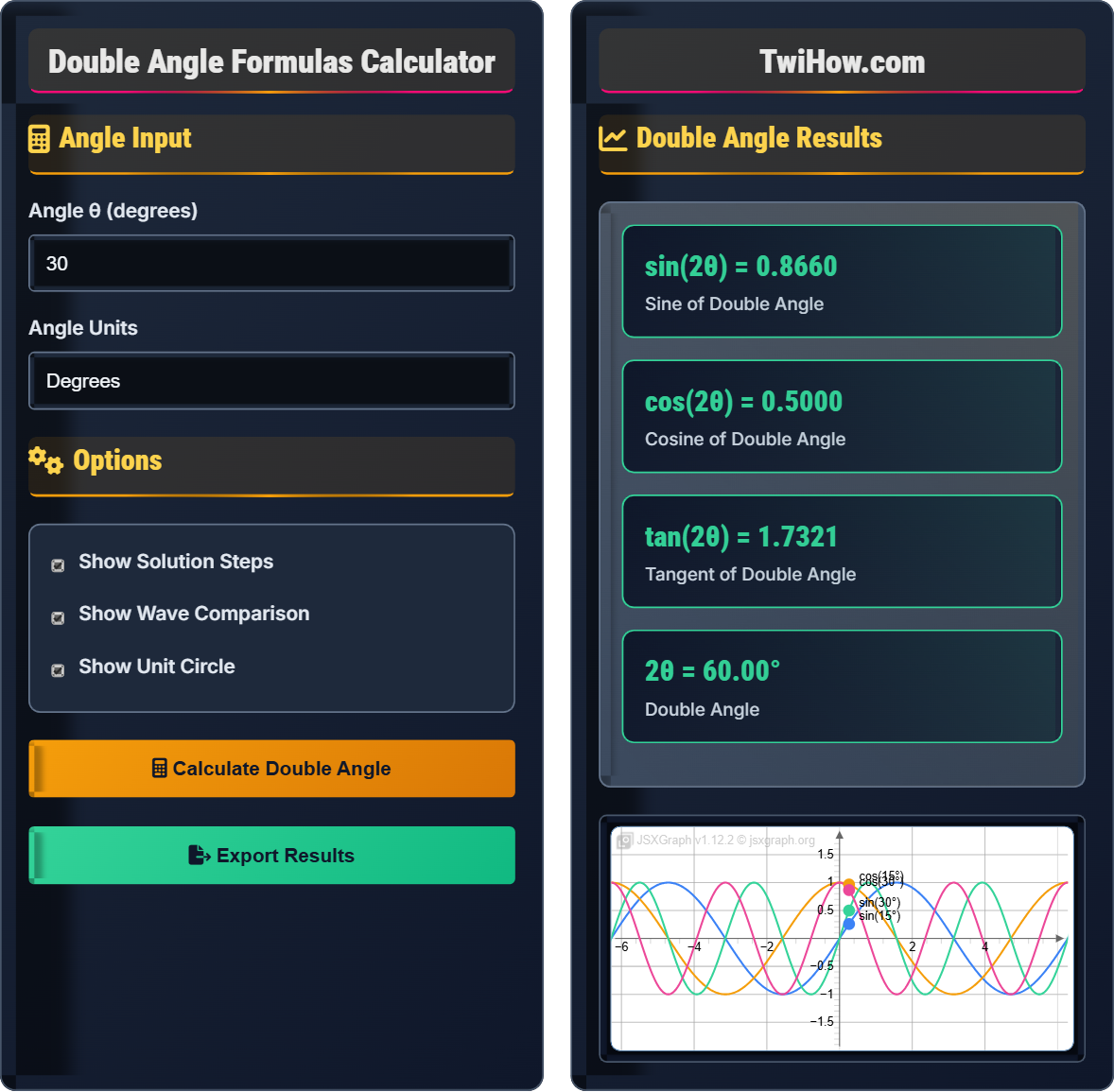
Show the calculator /Simulator\( \sin(2\theta) = 2\sin(\theta)\cos(\theta) \)
\( \cos(2\theta) = \cos^2(\theta) - \sin^2(\theta) = 2\cos^2(\theta) - 1 = 1 - 2\sin^2(\theta) \)
\( \tan(2\theta) = \frac{2\tan(\theta)}{1 - \tan^2(\theta)} \)
Double angle formulas allow you to express trigonometric functions of double angles (2θ) in terms of the original angle (θ). These identities are essential for simplifying expressions, solving equations, and performing integration in calculus. They're particularly useful when working with periodic functions and wave equations.
Key applications include:
- Simplifying trigonometric expressions
- Solving trigonometric equations
- Integration and differentiation
- Fourier series and signal processing
These formulas can be derived from the sum formulas by setting both angles equal: sin(α + β) becomes sin(θ + θ) = sin(2θ). The multiple forms of the cosine double angle formula provide flexibility depending on which function values you know.
Angle Input
Options
Double Angle Results
| Function | Original (θ) | Double (2θ) | Formula Used |
|---|
Enter angle to see solution steps.
Double Angle Formulas Explained
Double angle formulas are trigonometric identities that express the trigonometric functions of twice an angle (2θ) in terms of the functions of the original angle (θ). These formulas are derived from the sum formulas by setting both angles equal: sin(α + β) = sin α cos β + cos α sin β becomes sin(θ + θ) = 2sin θ cos θ. Double angle formulas are essential tools in trigonometry, calculus, and physics for simplifying expressions and solving equations.
The three primary double angle formulas are:
Alternative forms of the cosine double angle formula:
- \( \cos(2\theta) = 2\cos^2(\theta) - 1 \)
- \( \cos(2\theta) = 1 - 2\sin^2(\theta) \)
Key characteristics of double angle formulas:
- Periodicity: sin(2θ) and cos(2θ) have period π (half the original period)
- Amplitude: The amplitude remains the same for sine and cosine
- Derivation: Based on sum formulas with α = β = θ
- Multiple Forms: The cosine formula has three equivalent forms for flexibility
- Direct Substitution: Plug the known angle into the formula
- Alternative Forms: Use the most convenient form based on known values
- Verification: Check results using calculator or unit circle
- Application: Use in integration, differentiation, or equation solving
Double Angle Fundamentals
sin(2θ) = 2sin(θ)cos(θ), cos(2θ) = cos²(θ) - sin²(θ), tan(2θ) = 2tan(θ)/(1 - tan²(θ))
\( \sin(2\theta) = 2\sin(\theta)\cos(\theta) \)
\( \cos(2\theta) = \cos^2(\theta) - \sin^2(\theta) \)
\( \tan(2\theta) = \frac{2\tan(\theta)}{1 - \tan^2(\theta)} \)
- Applicable to any angle θ
- Relate functions of 2θ to functions of θ
- Cosine has three equivalent forms
Applications
Used for simplification, integration, wave analysis, and solving equations.
- Harmonic motion analysis
- Signal processing
- Electrical engineering
- Quantum mechanics
- Check for undefined values (tan when denominator is 0)
- Verify with known special angles
- Choose appropriate cosine formula form
- Consider quadrant for sign determination
Double Angle Formulas Learning Quiz
If sin(θ) = 3/5 and cos(θ) = 4/5, what is sin(2θ)?
Using the double angle formula for sine: sin(2θ) = 2sin(θ)cos(θ)
Given: sin(θ) = 3/5 and cos(θ) = 4/5
Step 1: Substitute values: sin(2θ) = 2 × (3/5) × (4/5)
Step 2: sin(2θ) = 2 × 12/25 = 24/25
The answer is B) 24/25.
The sine double angle formula is straightforward: sin(2θ) = 2sin(θ)cos(θ). It's simply twice the product of the sine and cosine of the original angle. This formula is particularly useful when you already know the values of sin(θ) and cos(θ). Note that this formula doesn't require knowing the angle θ itself, just its sine and cosine values.
Double Angle Formula: Expresses a trig function of 2θ in terms of θ
Sine Function: Ratio of opposite side to hypotenuse in right triangle
Cosine Function: Ratio of adjacent side to hypotenuse in right triangle
• sin(2θ) = 2sin(θ)cos(θ) (product of sine and cosine)
• Always multiply by 2 in the formula
• Result should be between -1 and 1 for sine function
• Remember: sin(2θ) involves both sin(θ) and cos(θ)
• Double check your multiplication when working with fractions
• The result should be dimensionless (no units)
• Forgetting to multiply by 2 in the formula
• Using the wrong formula (cosine instead of sine)
• Arithmetic errors when multiplying fractions
If cos(θ) = 1/3, find cos(2θ) using the appropriate double angle formula. Show your work.
Since we only know cos(θ), we should use the form of the cosine double angle formula that only requires cos(θ): cos(2θ) = 2cos²(θ) - 1
Given: cos(θ) = 1/3
Step 1: Calculate cos²(θ) = (1/3)² = 1/9
Step 2: Apply the formula: cos(2θ) = 2cos²(θ) - 1
Step 3: cos(2θ) = 2(1/9) - 1 = 2/9 - 1 = 2/9 - 9/9 = -7/9
Therefore, cos(2θ) = -7/9.
One of the advantages of the cosine double angle formula is that it comes in three equivalent forms, allowing you to choose the most convenient one based on what information you have. When you only know cos(θ), use cos(2θ) = 2cos²(θ) - 1. When you only know sin(θ), use cos(2θ) = 1 - 2sin²(θ). When you know both sin(θ) and cos(θ), use cos(2θ) = cos²(θ) - sin²(θ). This flexibility makes the cosine double angle formula particularly versatile.
Cosine Double Angle Formula: cos(2θ) = cos²(θ) - sin²(θ) = 2cos²(θ) - 1 = 1 - 2sin²(θ)
Equivalent Forms: Different expressions that yield the same result
Algebraic Manipulation: Rewriting expressions using algebraic rules
• cos(2θ) = cos²(θ) - sin²(θ) (basic form)
• cos(2θ) = 2cos²(θ) - 1 (when cos(θ) is known)
• cos(2θ) = 1 - 2sin²(θ) (when sin(θ) is known)
• Choose the form that uses the information you have available
• Remember that cos(2θ) can be negative even if cos(θ) is positive
• Double check your arithmetic when squaring fractions
• Using the wrong form of the cosine double angle formula
• Forgetting to square the cosine value
• Sign errors when subtracting fractions
In wave interference, the intensity of combined waves can be modeled by I = I₀cos²(φ/2), where φ is the phase difference. If the phase difference is 60°, use the double angle formula to express this as I = I₀(1 + cos(φ))/2. Calculate the intensity ratio I/I₀.
Step 1: We start with I = I₀cos²(φ/2) and want to express it in terms of cos(φ)
Step 2: From the double angle formula: cos(φ) = cos(2 × φ/2) = 2cos²(φ/2) - 1
Step 3: Solving for cos²(φ/2): cos²(φ/2) = (1 + cos(φ))/2
Step 4: Therefore: I = I₀cos²(φ/2) = I₀(1 + cos(φ))/2
Step 5: With φ = 60°, cos(60°) = 0.5
Step 6: I/I₀ = (1 + cos(60°))/2 = (1 + 0.5)/2 = 1.5/2 = 0.75
The intensity ratio I/I₀ is 0.75 or 75%.
This problem demonstrates how double angle formulas appear in physics applications. The identity cos²(θ) = (1 + cos(2θ))/2 is derived from the double angle formula cos(2θ) = 2cos²(θ) - 1. By solving for cos²(θ), we get cos²(θ) = (1 + cos(2θ))/2. In this case, we substitute θ = φ/2 to get cos²(φ/2) = (1 + cos(φ))/2. This identity is particularly important in wave optics and quantum mechanics.
Wave Interference: Phenomenon where waves combine to form a resultant wave
Phase Difference: Difference in phase between two waves
Intensity: Power per unit area carried by a wave
• cos²(θ) = (1 + cos(2θ))/2 (derived from double angle formula)
• cos²(φ/2) = (1 + cos(φ))/2 (substituting θ = φ/2)
• This identity is fundamental in wave theory
• Remember the power-reduction identity: cos²(θ) = (1 + cos(2θ))/2
• This identity is very useful in integration problems
• Understand how double angle formulas connect to physics applications
• Confusing the power-reduction identity with the basic double angle formula
• Forgetting to halve the angle in the argument of the squared function
• Not recognizing when to apply this identity in physics contexts
To integrate sin²(x), we use the identity sin²(x) = (1 - cos(2x))/2. Starting with the cosine double angle formula, derive this identity and explain why it's useful for integration.
Starting with the cosine double angle formula: cos(2x) = cos²(x) - sin²(x)
Using the Pythagorean identity: cos²(x) = 1 - sin²(x)
Substituting: cos(2x) = (1 - sin²(x)) - sin²(x) = 1 - 2sin²(x)
Solving for sin²(x): cos(2x) = 1 - 2sin²(x)
2sin²(x) = 1 - cos(2x)
sin²(x) = (1 - cos(2x))/2
This identity is useful for integration because it converts sin²(x) (which is difficult to integrate directly) into a combination of constants and cos(2x) (which are easier to integrate). The integral becomes: ∫sin²(x)dx = ∫(1 - cos(2x))/2 dx = (1/2)∫(1 - cos(2x))dx = (1/2)[x - (sin(2x)/2)] + C
This derivation shows how the double angle formulas are essential in calculus, particularly for integrating powers of trigonometric functions. The power-reduction identities (like sin²(x) = (1 - cos(2x))/2) transform higher powers of trigonometric functions into sums of functions with different arguments, which are much easier to integrate. This is a fundamental technique in integral calculus and appears frequently in engineering and physics problems.
Power-Reduction Identity: Formula that reduces the power of a trig function
Integration: Finding the antiderivative of a functionPythagorean Identity: sin²(x) + cos²(x) = 1
• sin²(x) = (1 - cos(2x))/2 (from cos(2x) = 1 - 2sin²(x))
• cos²(x) = (1 + cos(2x))/2 (from cos(2x) = 2cos²(x) - 1)
• These identities are crucial for integration of trig powers
• Memorize both power-reduction identities for sin²(x) and cos²(x)
• These identities convert difficult integrals into simple ones
• The resulting integrals often involve linear terms plus sinusoids
• Confusing the signs in the power-reduction identities
• Forgetting the factor of 1/2 in the identities
• Not recognizing when to apply these identities during integration
If tan(θ) = 2, what is tan(2θ)?
Using the tangent double angle formula: tan(2θ) = 2tan(θ)/(1 - tan²(θ))
Given: tan(θ) = 2
Step 1: Calculate tan²(θ) = 2² = 4
Step 2: Substitute into formula: tan(2θ) = 2(2)/(1 - 4)
Step 3: tan(2θ) = 4/(-3) = -4/3
The answer is B) -4/3.
The tangent double angle formula has a specific structure with the denominator being (1 - tan²(θ)). This is different from sine and cosine formulas and is important to remember. Notice that when tan²(θ) > 1, the denominator becomes negative, potentially changing the sign of the result. In this case, since tan²(θ) = 4 > 1, the denominator (1 - 4) = -3 is negative, making tan(2θ) negative even though tan(θ) was positive.
Tangent Function: Ratio of sine to cosine (sin/cos)
Tangent Double Angle Formula: tan(2θ) = 2tan(θ)/(1 - tan²(θ))
Undefined Values: When denominator equals zero (tan²(θ) = 1)
• tan(2θ) = 2tan(θ)/(1 - tan²(θ)) (different from sine/cosine)
• Undefined when tan²(θ) = 1 (i.e., when θ = 45°, 135°, etc.)
• Sign can change based on value of tan²(θ)
• Remember the denominator is (1 - tan²(θ)), not (1 + tan²(θ))
• Check if the result makes sense based on the quadrant of 2θ
• Be careful with signs when the denominator is negative
• Using the wrong denominator (adding instead of subtracting)
• Forgetting that the formula can yield negative results
• Arithmetic errors when squaring tangent values
FAQ
Q: Why does the cosine double angle formula have three different forms?
A: The three forms of the cosine double angle formula are equivalent but offer flexibility depending on what information you have available:
Basic form: cos(2θ) = cos²(θ) - sin²(θ)
When cos(θ) is known: cos(2θ) = 2cos²(θ) - 1 (derived by substituting sin²(θ) = 1 - cos²(θ))
When sin(θ) is known: cos(2θ) = 1 - 2sin²(θ) (derived by substituting cos²(θ) = 1 - sin²(θ))
This versatility makes the cosine double angle formula particularly useful in various mathematical contexts. Choose the form that utilizes the information you already know, eliminating the need to calculate additional trigonometric values.
Q: How are double angle formulas used in engineering applications?
A: Double angle formulas are extensively used in engineering, particularly in:
Signal Processing: Analyzing frequency doubling in electronic circuits and harmonic distortion.
Mechanical Vibrations: Modeling systems where the response contains double frequency components.
Electrical Engineering: AC circuit analysis where voltages and currents can be expressed using double angle relationships.
Structural Analysis: Calculating stresses in materials under oscillating loads.
Control Systems: Designing filters and analyzing system responses with harmonic components.
Additionally, the power-reduction identities (derived from double angle formulas) are essential for integrating periodic functions in engineering calculations.