Law of Sines Calculator
Complete trigonometry guide • Step-by-step solutions
Law of Sines::
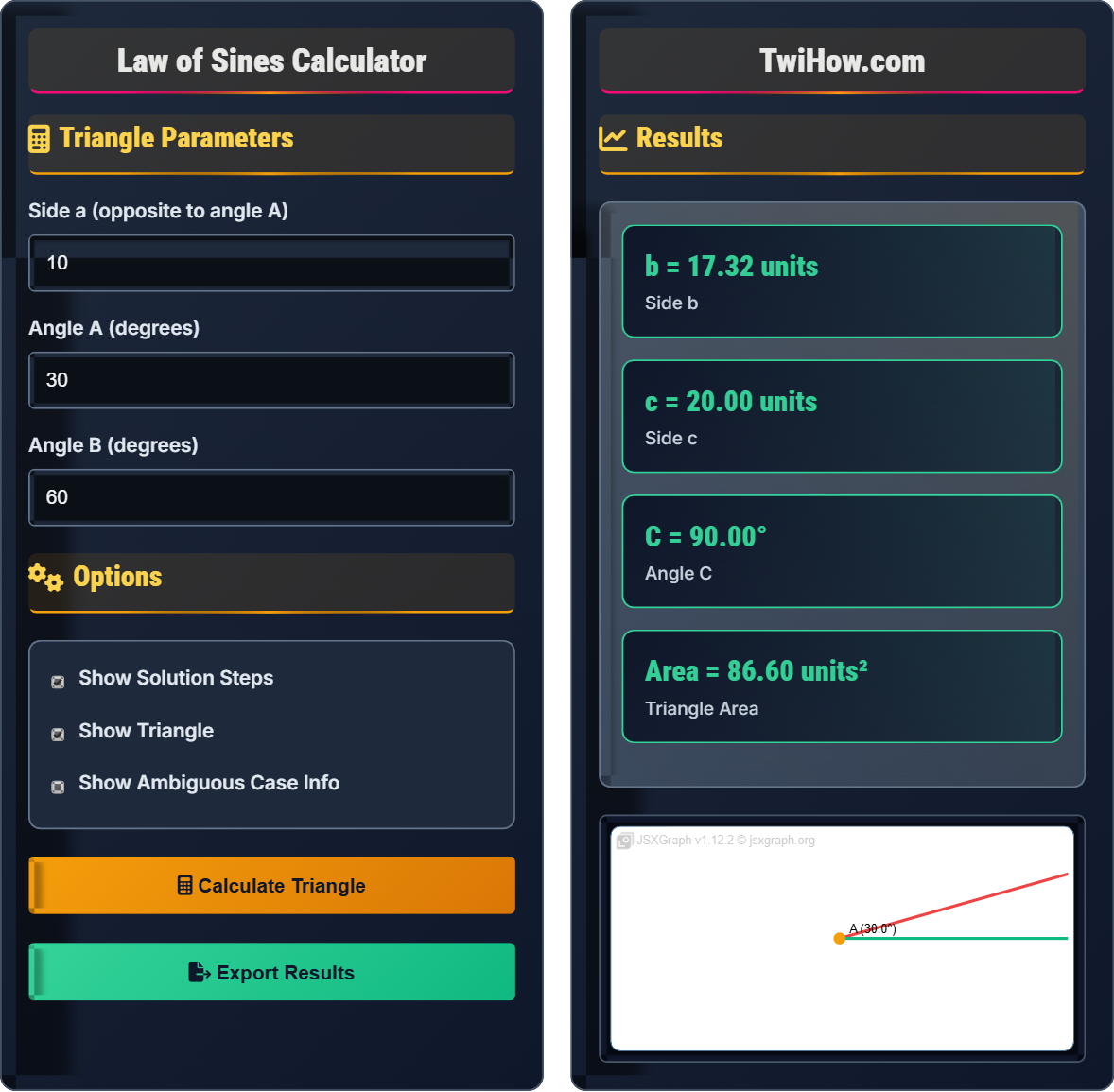
Show the calculator /Simulator\( \frac{a}{\sin(A)} = \frac{b}{\sin(B)} = \frac{c}{\sin(C)} \)
The Law of Sines is a fundamental relationship in trigonometry that connects the lengths of sides of a triangle to the sines of their opposite angles. It states that the ratio of the length of any side to the sine of its opposite angle is constant for all three sides and angles in a triangle. This law is particularly useful for solving triangles when given either two angles and one side (AAS or ASA) or two sides and a non-included angle (SSA).
Where:
- \( a, b, c \) = lengths of the sides of the triangle
- \( A, B, C \) = angles opposite to sides a, b, c respectively
Use this law whenever you need to solve triangles with insufficient information for the Pythagorean theorem or basic trigonometric ratios. It's especially helpful in navigation, surveying, and engineering applications where triangles are not necessarily right-angled.
Triangle Parameters
Options
Results
| Measurement | Value | Units | Description |
|---|
Enter triangle parameters to see calculation steps.
Law of Sines Explained
The Law of Sines is a fundamental relationship in trigonometry that connects the lengths of sides of a triangle to the sines of their opposite angles. It states that the ratio of the length of any side to the sine of its opposite angle is constant for all three sides and angles in a triangle. This law is particularly useful for solving triangles when given either two angles and one side (AAS or ASA) or two sides and a non-included angle (SSA).
For any triangle with sides a, b, c and opposite angles A, B, C respectively:
Alternatively, it can be written as:
Where:
- \( a, b, c \) = lengths of the sides of the triangle
- \( A, B, C \) = angles opposite to sides a, b, c respectively
Important characteristics of the Law of Sines:
- Applicable to all triangles: Works for acute, right, and obtuse triangles
- Constant ratio: The ratio a/sin(A) is the same for all sides
- Relationship to circumcircle: The ratio equals twice the radius of the circumcircle
- Ambiguous case: SSA configuration can have 0, 1, or 2 solutions
- Navigation: Calculating distances between points
- Surveying: Measuring land boundaries
- Engineering: Structural analysis and design
- Astronomy: Calculating distances to celestial bodies
Law of Sines Learning Quiz
In triangle ABC, if A = 30°, B = 45°, and side a = 8 units, what is the length of side b?
Using the Law of Sines: a/sin(A) = b/sin(B)
8/sin(30°) = b/sin(45°)
8/(1/2) = b/(√2/2)
16 = b/(√2/2)
b = 16 × (√2/2) = 8√2 units
The answer is A) 8√2 units.
This problem demonstrates the direct application of the Law of Sines. When given two angles and one side, we can find any other side by setting up the appropriate proportion. The key insight is that the ratio of any side to the sine of its opposite angle remains constant throughout the triangle.
Law of Sines: The relationship between sides and opposite angles in a triangle
Opposite Angle: The angle across from a given side
Proportion: An equation stating that two ratios are equal
• a/sin(A) = b/sin(B) = c/sin(C)
• Always match side with its opposite angle
• Use exact values when possible
• Draw the triangle to visualize the problem
• Always pair a side with its opposite angle
• Use exact values for special angles
• Matching a side with a non-opposite angle
• Forgetting to cross multiply correctly
• Using the wrong trigonometric value
In triangle DEF, if d = 10, e = 15, and E = 40°, find angle D. Round to the nearest degree.
Using the Law of Sines: d/sin(D) = e/sin(E)
10/sin(D) = 15/sin(40°)
10/sin(D) = 15/0.6428
10/sin(D) = 23.34
sin(D) = 10/23.34 = 0.4284
D = arcsin(0.4284) ≈ 25.4° ≈ 25°
Therefore, angle D is approximately 25°.
This problem shows how to find an angle when given two sides and one angle. We rearrange the Law of Sines to solve for the sine of the unknown angle, then use the inverse sine function to find the angle itself. Note that we must consider the ambiguous case possibility, but in this instance, only one solution is valid.
Inverse Sine: Function that returns the angle given the sine value
SSA Configuration: Two sides and a non-included angle
Valid Solution: An angle that makes sense in the context of the triangle
• Use the Law of Sines: a/sin(A) = b/sin(B)
• When solving for angles, use arcsin function
• Check that the solution is geometrically possible
• Always verify that the sum of angles is less than 180°
• Use the largest side to find the largest angle first
• Round only the final answer
• Forgetting to consider the ambiguous case
• Not checking if the solution is geometrically possible
• Using the wrong inverse function
A surveyor needs to find the distance across a river. She sights a tree on the opposite bank and measures the angle to be 60° from her position. She then walks 100 meters along the bank and measures the angle to the same tree as 45°. How wide is the river? Round to the nearest meter.
Step 1: Set up the triangle. Let A be the first position, B be the second position, and T be the tree.
At A: angle to tree = 60°
At B: angle to tree = 45°
Distance AB = 100m
Step 2: Find angle ATB (at the tree):
Angle ATB = 180° - 60° - 45° = 75°
Step 3: Use the Law of Sines to find AT:
AB/sin(ATB) = AT/sin(ABT)
100/sin(75°) = AT/sin(45°)
AT = (100 × sin(45°))/sin(75°) = (100 × 0.7071)/0.9659 ≈ 73.2m
Step 4: The river width is AT × sin(60°) = 73.2 × 0.866 ≈ 63.4m ≈ 63m
The river is approximately 63 meters wide.
This problem demonstrates a practical application of the Law of Sines in surveying. The surveyor creates a triangle with her two positions and the tree. By knowing one side (the distance she walked) and two angles, we can solve for the other sides using the Law of Sines. This is a fundamental technique in land surveying and navigation.
Surveying: The practice of measuring distances and angles
Baseline: The known distance between two points
Triangulation: Using triangles to determine distances
• Always draw a diagram first
• Find the third angle using the 180° rule
• Match sides with their opposite angles
• Draw the situation to scale
• Label all known quantities
• Use the Law of Sines when you have AAS or ASA
• Not correctly identifying the angles in the triangle
• Forgetting that triangle angles sum to 180°
• Misapplying the Law of Sines
In triangle XYZ, x = 12, z = 8, and Z = 30°. Determine if this is an ambiguous case and find all possible solutions for angle X and side y.
Step 1: Use the Law of Sines to find sin(X):
x/sin(X) = z/sin(Z)
12/sin(X) = 8/sin(30°)
12/sin(X) = 8/0.5 = 16
sin(X) = 12/16 = 0.75
Step 2: Find possible angles for X:
X₁ = arcsin(0.75) ≈ 48.6°
X₂ = 180° - 48.6° = 131.4°
Step 3: Check if both solutions are valid:
For X₁ = 48.6°: Y = 180° - 48.6° - 30° = 101.4° ✓
For X₂ = 131.4°: Y = 180° - 131.4° - 30° = 18.6° ✓
Step 4: Find side y for each solution:
For solution 1: y/sin(101.4°) = 8/sin(30°)
y = (8 × sin(101.4°))/0.5 = 16 × 0.981 ≈ 15.7 units
For solution 2: y/sin(18.6°) = 8/sin(30°)
y = (8 × sin(18.6°))/0.5 = 16 × 0.319 ≈ 5.1 units
This is an ambiguous case with two solutions:
Solution 1: X ≈ 48.6°, y ≈ 15.7 units
Solution 2: X ≈ 131.4°, y ≈ 5.1 units
This problem demonstrates the ambiguous case (SSA configuration) where two solutions are possible. When given two sides and a non-included angle, the Law of Sines can yield two possible angles (since sin(θ) = sin(180° - θ)). Both solutions must be checked to ensure they form valid triangles where all angles are positive and sum to 180°.
Ambiguous Case: When SSA configuration yields 0, 1, or 2 solutions
SSA Configuration: Given two sides and a non-included angleSupplementary Angles: Angles that sum to 180°
• In SSA, sin(A) = sin(180° - A), so two angles are possible
• Check if both solutions form valid triangles
• Verify that all angles are positive and sum to 180°
• Always check for the ambiguous case in SSA problems
• Both supplementary angles may be valid solutions
• Verify each solution geometrically
• Forgetting to consider both possible angles in ambiguous case
• Not verifying that solutions form valid triangles
• Assuming there is always only one solution
Which statement about the Law of Sines is TRUE?
Let's analyze each option:
A) TRUE: The Law of Sines applies to all triangles - acute, right, and obtuse. This is one of its key advantages over basic trigonometric ratios which only work for right triangles.
B) FALSE: The Law of Sines is typically used when not all three sides are known. It's most useful for AAS, ASA, and SSA configurations.
C) FALSE: The ratio a/sin(A) equals 2R, where R is the radius of the circumcircle, not the area of the triangle.
D) FALSE: The Law of Sines works for all types of triangles, including obtuse triangles.
The answer is A) It applies to all triangles, not just right triangles.
The Law of Sines is a powerful tool because it extends trigonometric relationships beyond right triangles. Unlike the basic sine, cosine, and tangent ratios which require right triangles, the Law of Sines works for any triangle. This makes it invaluable for solving real-world problems where triangles are rarely right-angled.
Law of Sines: Relationship between sides and opposite angles
Acute Triangle: All angles less than 90°
Obtuse Triangle: One angle greater than 90°
• Law of Sines works for all triangles
• Ratio equals 2R (circumcircle radius)
• Most useful for AAS, ASA, SSA configurations
• Use when dealing with non-right triangles
• Remember it complements the Law of Cosines
• Know when to use each law based on given information
• Thinking it only works for right triangles
• Confusing it with basic trigonometric ratios
• Not recognizing when to use it vs. Law of Cosines
Law of Sines Fundamentals
Sides (a, b, c), opposite angles (A, B, C), constant ratio.
\( \frac{a}{\sin(A)} = \frac{b}{\sin(B)} = \frac{c}{\sin(C)} \)
Where a, b, c = sides, A, B, C = opposite angles.
- Applies to all triangles
- Matches sides with opposite angles
- Constant ratio throughout triangle
Applications
Surveying, navigation, engineering, astronomy, and geodesy.
- Distance measurements
- Land surveying
- Structural analysis
- Angle calculations
- Works for all triangle types
- Be aware of ambiguous case
- Match sides with opposite angles
- Verify geometric validity
FAQ
Q: Why does the Law of Sines work for all triangles?
A: The Law of Sines works for all triangles because it's based on the fundamental relationship between sides and angles in any triangle. The proof involves dropping an altitude from any vertex to create two right triangles, then applying the definition of sine to both. This creates the proportional relationship that holds regardless of the triangle's shape. The constant ratio a/sin(A) = b/sin(B) = c/sin(C) is equal to 2R, where R is the radius of the triangle's circumcircle. This geometric property is universal to all triangles, which is why the Law of Sines is so broadly applicable.
Q: How does the Law of Sines relate to the Law of Cosines?
A: The Law of Sines and Law of Cosines are complementary tools for solving triangles. The Law of Sines is most effective when you have angle-side pairs (AAS, ASA, SSA), while the Law of Cosines is best when you have two sides and the included angle (SAS) or all three sides (SSS). Together, they provide complete coverage for all triangle-solving scenarios. The Law of Cosines is more complex (involving squares and cosines) but avoids the ambiguous case issue that can occur with the Law of Sines in SSA situations. Both laws are derived from the same geometric principles but emphasize different relationships within triangles.