Impulse Formula Calculator
Complete mechanics guide • Step-by-step solutions
Impulse Formula::
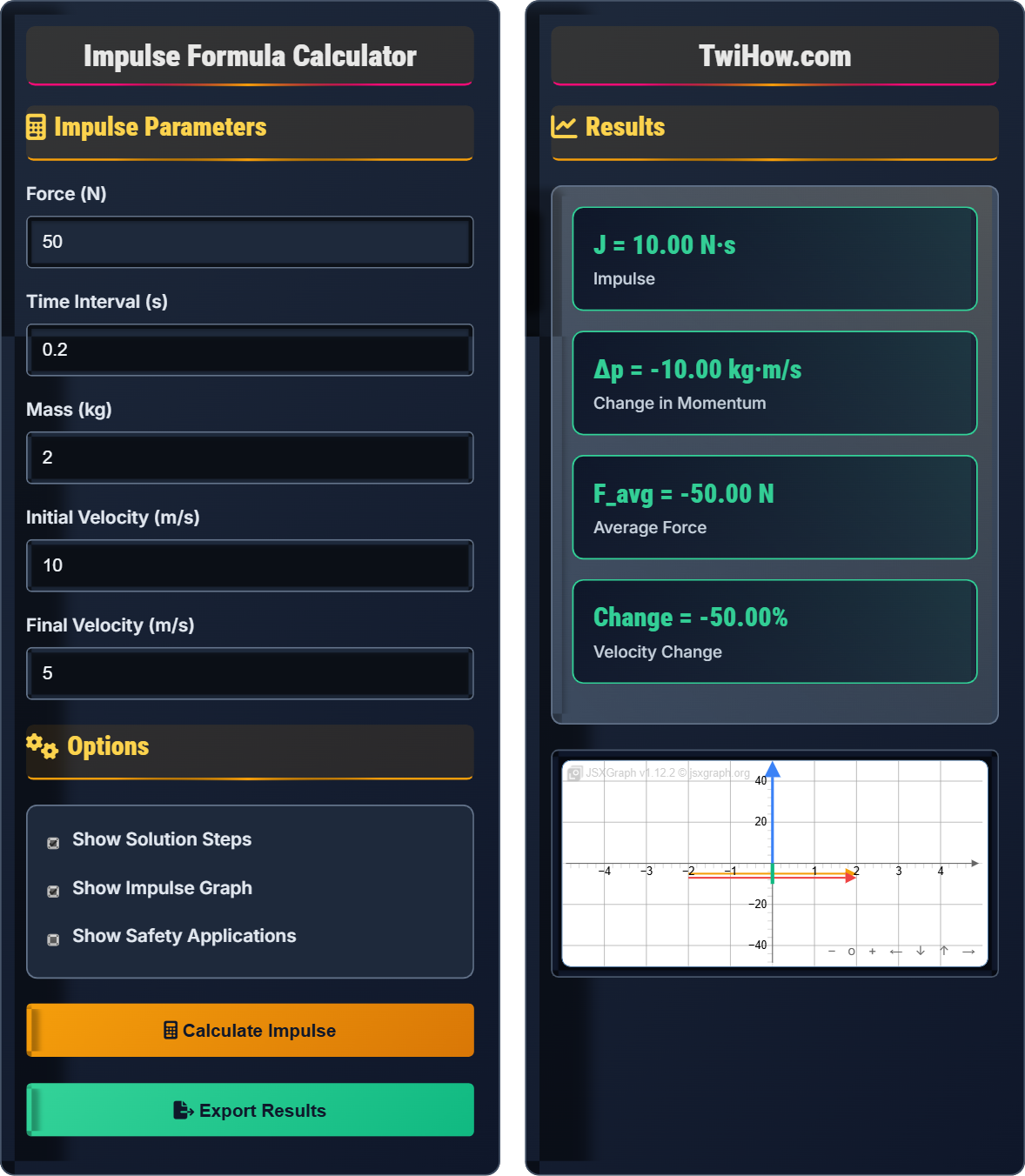
Show the calculator /Simulator\( J = F\Delta t = \Delta p = m(v_f - v_i) \)
Impulse is a fundamental concept in physics that describes the effect of a force acting over a time interval. It is defined as the product of the average force applied to an object and the time interval over which it acts. Impulse equals the change in momentum of the object, connecting force, time, and motion. The SI unit of impulse is Newton-seconds (N·s).
Key properties of impulse:
- Impulse equals change in momentum (impulse-momentum theorem)
- Greater force or longer time interval results in greater impulse
- Impulse is a vector quantity with direction matching the force
- Used to analyze collisions and safety systems
Use this formula whenever analyzing collisions, impacts, or any situation where a force acts over time. It's essential for understanding how objects change their motion and for designing safety systems like airbags, crumple zones, and padded surfaces.
Impulse Parameters
Options
Results
| Property | Value | Unit | Description |
|---|
Enter parameters to see solution steps.
Impulse Formula Explained
Impulse is a measurement that combines the effect of a force applied over a time interval. It quantifies how much the force changes the momentum of an object. The impulse formula J = FΔt shows that impulse is the product of the average force (F) and the time interval (Δt) over which it acts. This fundamental concept connects force, time, and motion, and is central to understanding collisions and safety systems.
The basic impulse formula is:
Additionally, the impulse-momentum theorem states:
Where:
- \(J\) = impulse (N·s)
- \(F\) = average force (N)
- \(\Delta t\) = time interval (s)
- \(\Delta p\) = change in momentum (kg·m/s)
- \(m\) = mass (kg)
- \(v_f\) = final velocity (m/s)
- \(v_i\) = initial velocity (m/s)
Key characteristics of impulse:
- Vector Quantity: Has both magnitude and direction
- Related to Momentum: Equals change in momentum
- Time Dependent: Longer intervals reduce peak force
- Directional: Follows the direction of the applied force
- Car Crumple Zones: Extend collision time to reduce force
- Airbags: Increase contact time during impact
- Padded Surfaces: Reduce impact forces in falls
- Seat Belts: Spread impact over longer time period
Impulse Fundamentals
J = FΔt, where J is impulse, F is force, Δt is time interval.
J = Δp = m(v_f - v_i)
Where J = impulse, Δp = change in momentum.
- Impulse equals change in momentum
- Greater force or time increases impulse
- Impulse is a vector quantity
Safety Applications
For constant impulse, F ∝ 1/Δt (force inversely proportional to time).
- Extend impact time (reduce force)
- Distribute force over larger area
- Absorb energy during impact
- Impulse remains constant in given scenario
- Increasing time reduces peak force
- Safety systems maximize Δt
- Force reduction is proportional to time extension
Impulse Formula Learning Quiz
A constant force of 100 N acts on an object for 0.5 seconds. What is the impulse delivered to the object?
Using the impulse formula J = FΔt, where F = 100 N and Δt = 0.5 s:
J = 100 × 0.5 = 50 N·s
The answer is A) 50 N·s.
Impulse is calculated as the product of force and time interval. This fundamental relationship shows that impulse increases linearly with both force and time. Understanding this basic calculation is crucial because it forms the foundation for analyzing impacts, collisions, and safety systems.
Impulse: The product of force and time interval (J = FΔt)
Vector Quantity: Has both magnitude and direction
SI Unit: Newton seconds (N·s)
• Impulse = force × time interval
• Direction of impulse matches force direction
• Greater force or time results in greater impulse
• Remember: J = FΔt (simple multiplication)
• Units: N·s (force in N, time in s)
• Impulse is directional - consider signs for direction
• Forgetting to convert units properly
• Confusing impulse with force or momentum separately
• Ignoring the vector nature of impulse
An object of mass 5 kg changes its velocity from 10 m/s to 4 m/s due to an impulse. Calculate the magnitude of the impulse and explain the relationship between impulse and change in momentum.
Step 1: Calculate initial momentum
p_initial = mv_initial = 5 kg × 10 m/s = 50 kg·m/s
Step 2: Calculate final momentum
p_final = mv_final = 5 kg × 4 m/s = 20 kg·m/s
Step 3: Calculate change in momentum
Δp = p_final - p_initial = 20 - 50 = -30 kg·m/s
Step 4: Apply impulse-momentum theorem
J = Δp = -30 kg·m/s
The magnitude of the impulse is 30 N·s. The impulse equals the change in momentum, which is the fundamental relationship described by the impulse-momentum theorem.
The impulse-momentum theorem states that impulse equals the change in momentum. This relationship is fundamental in analyzing forces acting over time intervals. When a force acts on an object for a duration, it changes the object's momentum by an amount equal to the impulse. This principle is particularly useful in collision problems and safety engineering.
Impulse: Product of force and time interval (J = FΔt)
Impulse-Momentum Theorem: J = Δp = m(v_f - v_i)
Change in Momentum: Difference between final and initial momentum
• J = FΔt (impulse equals force times time)
• J = Δp (impulse equals change in momentum)
• Impulse is vector quantity in direction of force
• Impulse always equals change in momentum
• Use this theorem for force-time problems
• Remember direction matters for vectors
• Confusing impulse with momentum
• Forgetting that impulse is vector quantity
• Not considering direction in vector calculations
A 75 kg person traveling at 20 m/s in a car experiences a collision that brings them to rest. Without a seatbelt, the person stops in 0.01 seconds. With a seatbelt, the stopping time extends to 0.5 seconds. Calculate the average force exerted on the person in both scenarios and explain why seatbelts are safer.
Step 1: Calculate the change in momentum
Δp = m(v_f - v_i) = 75 kg × (0 - 20) m/s = -1500 kg·m/s
Step 2: Calculate force without seatbelt (Δt = 0.01 s)
F = Δp/Δt = -1500 kg·m/s ÷ 0.01 s = -150,000 N
Step 3: Calculate force with seatbelt (Δt = 0.5 s)
F = Δp/Δt = -1500 kg·m/s ÷ 0.5 s = -3,000 N
Without seatbelt: 150,000 N; With seatbelt: 3,000 N
Seatbelts are safer because they extend the stopping time, reducing the force by a factor of 50. The impulse remains the same, but spreading it over a longer time dramatically reduces the force.
This problem demonstrates the practical application of the impulse-momentum theorem in safety engineering. Since the change in momentum is fixed by the initial conditions, increasing the time interval reduces the average force proportionally. This is why safety systems focus on extending the duration of impacts rather than reducing the impulse itself.
Impulse-Momentum Theorem: J = FΔt = Δp
Safety Engineering: Designing systems to minimize injury
Force Reduction: Extending time to reduce peak force
• For constant impulse, F ∝ 1/Δt
• Longer time intervals reduce peak forces
• Impulse remains constant in given scenario
• Safety systems maximize Δt to minimize F
• Same change in momentum can result in different forces
• Force reduction is proportional to time extension
• Forgetting that impulse remains constant
• Thinking safety systems reduce impulse
• Not understanding inverse relationship between F and Δt
A 0.45 kg soccer ball approaches a player at 25 m/s. The player heads the ball, changing its direction by 180° without changing its speed. If the contact time is 0.02 seconds, calculate the impulse delivered to the ball and the average force exerted by the player.
Step 1: Define initial and final velocities (taking direction into account)
Let the initial direction be positive: v_i = +25 m/s
After being headed, v_f = -25 m/s (opposite direction)
Step 2: Calculate change in momentum
Δp = m(v_f - v_i) = 0.45 kg × (-25 - 25) m/s = 0.45 × (-50) = -22.5 kg·m/s
Step 3: Calculate impulse
J = Δp = -22.5 N·s
Step 4: Calculate average force
F_avg = J/Δt = -22.5 N·s ÷ 0.02 s = -1,125 N
The impulse delivered is 22.5 N·s in the direction opposite to the initial motion, and the average force is 1,125 N.
This problem highlights the importance of considering direction in vector calculations. When an object reverses direction, the change in momentum is actually twice the original momentum magnitude. The negative signs indicate direction, showing that the impulse and force oppose the original motion to reverse it.
Vector Direction: Sign indicates direction of motion
Reversal of Motion: Change in momentum is doubledContact Time: Duration of force application
• Always consider direction in momentum calculations
• Reversing direction doubles the momentum change
• Impulse equals change in momentum regardless of direction
• Assign consistent positive/negative directions
• For 180° reversals, Δp = 2mv (magnitude)
• Average force = impulse/time
• Ignoring direction in vector calculations
• Treating reversal as simple subtraction
• Confusing average force with instantaneous force
Which of the following statements about impulse in collisions is correct?
The impulse-momentum theorem states that impulse equals the change in momentum in all cases, regardless of the type of collision (elastic, inelastic, or perfectly inelastic). This is a fundamental principle of physics. The units of impulse (N·s) are equivalent to the units of momentum (kg·m/s).
The answer is B) Impulse equals the change in momentum in all collisions.
The impulse-momentum theorem is one of the fundamental laws of physics. It applies universally to all situations where a force acts on an object for a time interval. Unlike conservation of kinetic energy (which only applies to elastic collisions), the impulse-momentum theorem applies to all types of collisions and interactions.
Impulse-Momentum Theorem: Fundamental relationship J = Δp
Universal Principle: Applies in all physical situations
Dimensional Analysis: N·s = kg·m/s
• J = Δp in all collisions
• Applies to elastic and inelastic collisions
• Units: N·s (equivalent to kg·m/s)
• This theorem is always valid
• More general than energy conservation
• Connects force-time to motion change
• Thinking it only applies to certain collision types
• Confusing with energy conservation
• Mixing up units (confusing with energy units)
FAQ
Q: How does impulse relate to safety systems like airbags?
A: Airbags and other safety systems operate on the principle that impulse (J = FΔt) remains constant for a given change in momentum. Since impulse equals the change in momentum, and the change in momentum is determined by the person's mass and velocity before impact, the impulse cannot be changed. However, by extending the time interval (Δt) over which the person's momentum changes, the average force (F) experienced is reduced according to F = J/Δt.
For example, if a person's momentum needs to change by 1000 kg·m/s during a crash:
- Without an airbag (Δt = 0.01 s): F = 1000/0.01 = 100,000 N
- With an airbag (Δt = 0.1 s): F = 1000/0.1 = 10,000 N
The force is reduced by a factor of 10, significantly decreasing injury risk.
Q: Is impulse the same as momentum, and how are they related?
A: Impulse and momentum are related but distinct concepts. Momentum (p = mv) is a property of a moving object at a given moment, representing the quantity of motion it possesses. Impulse (J = FΔt) is the effect of a force acting over a time interval.
The connection between them is established by the impulse-momentum theorem: J = Δp, which means impulse equals the change in momentum. While momentum describes the state of motion, impulse describes how that state of motion changes due to external forces. Both have the same units (kg·m/s or N·s), but they represent different physical concepts.