Kinematic Equations Calculator
Complete mechanics guide • Step-by-step solutions
Kinematic Equations::
Show the calculator /Simulator\( v = u + at \) (Velocity-Time)
\( s = ut + \frac{1}{2}at^2 \) (Displacement-Time)
\( v^2 = u^2 + 2as \) (Velocity-Displacement)
\( s = \frac{(u+v)t}{2} \) (Displacement-Average Velocity)
The kinematic equations describe motion with constant acceleration. They relate five kinematic variables: displacement (s), initial velocity (u), final velocity (v), acceleration (a), and time (t). These equations are fundamental to mechanics and apply to any motion where acceleration remains constant. They allow us to predict motion parameters when we know three of the five variables.
Where:
- \(s\) = displacement (m)
- \(u\) = initial velocity (m/s)
- \(v\) = final velocity (m/s)
- \(a\) = acceleration (m/s²)
- \(t\) = time (s)
These equations are essential for analyzing projectile motion, vehicle motion, free fall, and any other motion with constant acceleration. They form the foundation for understanding more complex motion in physics and engineering applications.
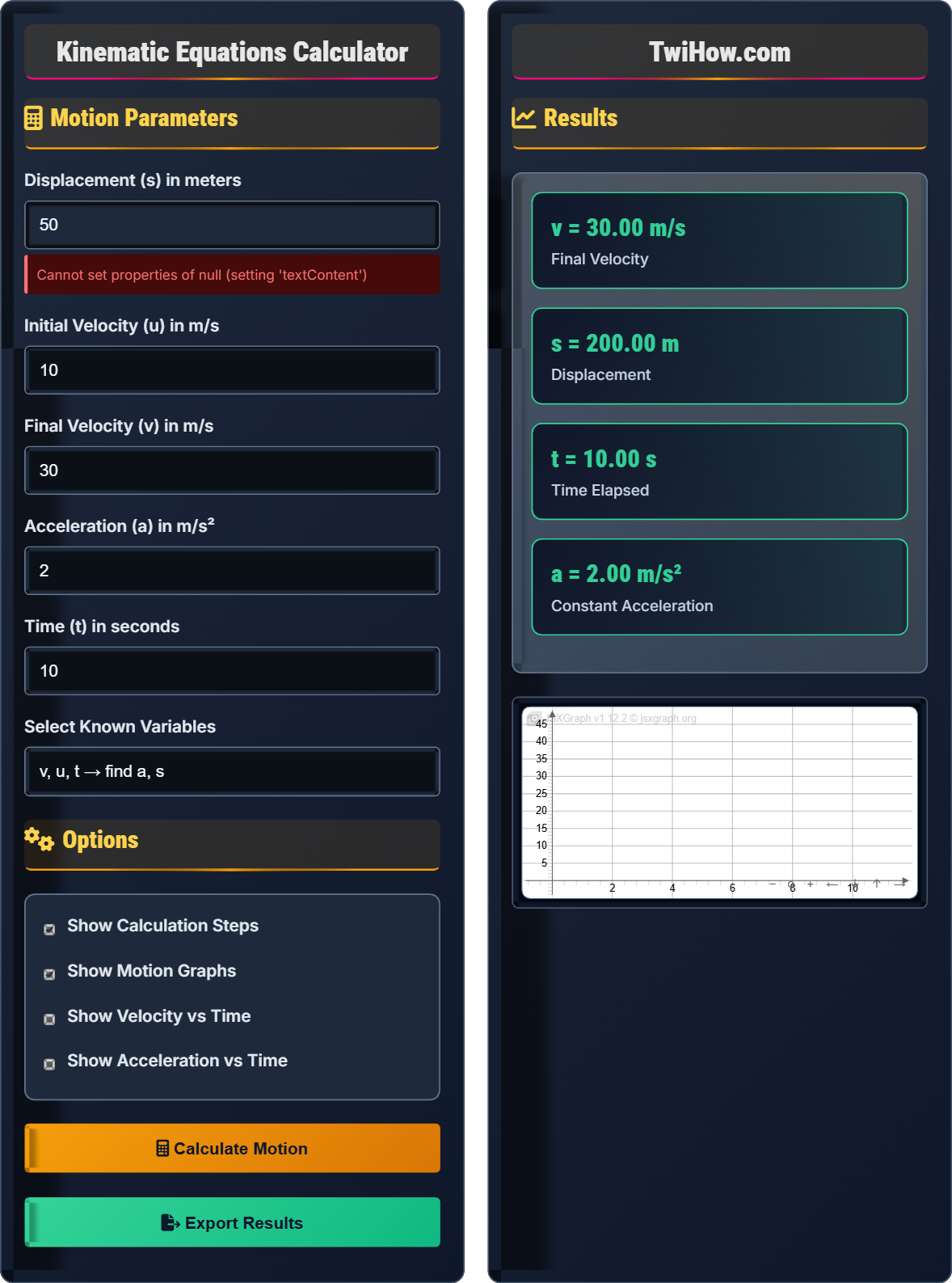
Motion Parameters
Options
Results
| Variable | Value | Unit | Symbol |
|---|
Enter parameters to see calculation steps.
Interactive motion graphs will appear here.
Kinematic Equations Explained
Kinematic equations are fundamental relationships that describe motion with constant acceleration. They connect five kinematic variables: displacement (s), initial velocity (u), final velocity (v), acceleration (a), and time (t). These equations are derived from the basic definitions of velocity and acceleration and are essential for analyzing motion in physics. They apply to any motion where acceleration remains constant, such as free fall, vehicle motion, or projectile motion.
The four fundamental kinematic equations are:
Where:
- \(v\) = final velocity
- \(u\) = initial velocity
- \(s\) = displacement
- \(a\) = acceleration
- \(t\) = time
Key characteristics of motion described by kinematic equations:
- Constant Acceleration: Acceleration must remain unchanged
- Vector Nature: All quantities have direction as well as magnitude
- Independent Axes: Motion in perpendicular directions is independent
- Applicability: Only valid for constant acceleration scenarios
- Free Fall: Motion under gravity (a = 9.8 m/s²)
- Vehicle Motion: Acceleration/deceleration on straight roads
- Projectile Motion: Horizontal and vertical components
- Any Motion: With constant acceleration
Motion Fundamentals
Kinematic equations describe motion with constant acceleration, relating displacement, velocity, acceleration, and time.
\( v = u + at \)
\( s = ut + \frac{1}{2}at^2 \)
\( v^2 = u^2 + 2as \)
\( s = \frac{(u+v)t}{2} \)
Where s = displacement, u = initial velocity, v = final velocity, a = acceleration, t = time.
- Acceleration must be constant
- Choose appropriate equation based on known variables
- Sign convention matters for direction
- Applies to each axis independently
Applications
Foundation for dynamics, kinematics, and motion analysis.
- Vehicle crash analysis
- Sports performance evaluation
- Ballistic trajectory calculations
- Engineering design and testing
- Only valid for constant acceleration
- Requires inertial reference frame
- Relativistic effects ignored
- Quantum mechanics requires different approach
Kinematic Equations Learning Quiz
A car starts from rest and accelerates uniformly at 3 m/s² for 8 seconds. What is its final velocity?
Given information:
Initial velocity (u) = 0 m/s (starts from rest)
Acceleration (a) = 3 m/s²
Time (t) = 8 s
Unknown: Final velocity (v)
Step 1: Select appropriate equation
We know u, a, and t, and need to find v. Use: v = u + at
Step 2: Substitute values
v = 0 + 3 × 8 = 0 + 24 = 24 m/s
The final velocity is 24 m/s.
The answer is B) 24 m/s.
This problem demonstrates the simplest kinematic equation: v = u + at. When starting from rest (u = 0), the final velocity is simply the product of acceleration and time. This linear relationship shows that under constant acceleration, velocity increases uniformly with time. The equation directly connects the rate of change of velocity (acceleration) with the time period over which it acts.
Uniform Acceleration: Constant rate of change of velocity
Initial Velocity: Velocity at the start of the motion period
Final Velocity: Velocity at the end of the motion period
• v = u + at (use when displacement is unknown)
• All kinematic equations require constant acceleration
• Units must be consistent throughout calculation
• Always identify known and unknown variables first
• Choose equation with one unknown variable
• Check units before substituting values
• Forgetting that "from rest" means u = 0
• Using wrong kinematic equation
• Not maintaining consistent units
A ball is dropped from a height of 45 meters. How long does it take to reach the ground? (Neglect air resistance, g = 9.8 m/s²)
Step 1: Identify known variables
Initial velocity (u) = 0 m/s (dropped, not thrown)
Displacement (s) = 45 m (distance fallen)
Acceleration (a) = 9.8 m/s² (due to gravity)
Unknown: Time (t)
Step 2: Select appropriate equation
We know u, s, and a, and need to find t. Use: s = ut + ½at²
Step 3: Substitute known values
45 = 0×t + ½×9.8×t²
45 = 0 + 4.9t²
45 = 4.9t²
Step 4: Solve for t
t² = 45/4.9 = 9.18
t = √9.18 = 3.03 seconds
The ball takes approximately 3.03 seconds to reach the ground.
This free fall problem demonstrates how to handle vertical motion under gravity. The key insight is that "dropped" means the initial velocity is zero. We use the displacement-time equation because we know the displacement, initial velocity, and acceleration. Notice how the displacement is positive when moving in the direction of acceleration (downward).
Free Fall: Motion under gravity alone, neglecting air resistance
Acceleration Due to Gravity: g = 9.8 m/s² on Earth
Displacement: Change in position from initial to final location
• g = 9.8 m/s² on Earth's surface
• All objects fall at same rate in vacuum
• Direction affects sign of acceleration
• Always define positive direction consistently
• "Dropped" means u = 0
• Use kinematic equations for constant acceleration only
• Forgetting that initial velocity is zero when dropped
• Using wrong sign for acceleration
• Forgetting to take square root of t²
A car traveling at 25 m/s applies brakes and comes to a stop in 5 seconds. What distance does it travel while braking?
Step 1: Identify known variables
Initial velocity (u) = 25 m/s
Final velocity (v) = 0 m/s (comes to stop)
Time (t) = 5 s
Unknown: Displacement (s)
Step 2: Select appropriate equation
We know u, v, and t, and need to find s. Use: s = (u+v)t/2
Step 3: Substitute values
s = (25 + 0) × 5 / 2 = 25 × 5 / 2 = 125 / 2 = 62.5 m
Step 4: Verify with alternative equation
First find acceleration: v = u + at → 0 = 25 + a×5 → a = -5 m/s²
Then: s = ut + ½at² = 25×5 + ½×(-5)×25 = 125 - 62.5 = 62.5 m ✓
The car travels 62.5 meters while braking.
This deceleration problem shows how to handle negative acceleration (deceleration). The displacement-average velocity equation is particularly useful here because it doesn't require calculating acceleration first. The result shows that even with rapid deceleration, the car covers a significant distance before stopping, which has important implications for traffic safety.
Deceleration: Negative acceleration, slowing down
Braking Distance: Distance traveled while stoppingUniform Deceleration: Constant rate of slowing down
• Deceleration is negative acceleration
• Use same kinematic equations
• Sign convention is crucial for direction
• Always verify results using different equations
• Pay attention to signs of acceleration
• Consider physical meaning of results
• Not recognizing that "stop" means v = 0
• Forgetting that deceleration is negative
• Using incorrect kinematic equation
A stone is thrown vertically upward with an initial velocity of 20 m/s. What is its maximum height? (g = 9.8 m/s²)
Step 1: Identify conditions at maximum height
At maximum height, final velocity (v) = 0 m/s (stone momentarily stops)
Initial velocity (u) = 20 m/s (upward)
Acceleration (a) = -9.8 m/s² (gravity acts downward)
Unknown: Displacement (s) = maximum height
Step 2: Select appropriate equation
We know u, v, and a, and need to find s. Use: v² = u² + 2as
Step 3: Substitute values
0² = 20² + 2×(-9.8)×s
0 = 400 - 19.6s
19.6s = 400
s = 400/19.6 = 20.41 m
The stone reaches a maximum height of approximately 20.41 meters.
This vertical projectile problem demonstrates a key concept: at maximum height, the velocity is zero. The acceleration due to gravity is constant and always directed downward (negative if upward is positive). The velocity-displacement equation is ideal here because it directly relates velocity, displacement, and acceleration without needing time.
Projectile Motion: Motion under gravity with initial velocity
Maximum Height: Highest point in trajectory where v = 0
Vertical Motion: Motion along a straight up-down line
• At max height, v = 0
• g is constant (9.8 m/s² on Earth)
• Upward positive, g negative (or vice versa)
• Define positive direction consistently
• Remember v = 0 at maximum height
• Use v² = u² + 2as for height without time
• Forgetting that v = 0 at maximum height
• Using wrong sign for acceleration
• Not defining direction convention
Which of the following statements about kinematic equations is TRUE?
Let's examine each option:
A) False - Kinematic equations only apply to motion with constant acceleration
B) True - This is a fundamental requirement for using kinematic equations
C) False - They work for any velocity (positive, negative, or zero)
D) False - Direction is crucial; velocity and acceleration are vector quantities
The kinematic equations are derived under the assumption of constant acceleration. If acceleration varies, different mathematical approaches (calculus) are required. The equations work for any direction of motion as long as the sign convention is maintained consistently.
The answer is B) They require constant acceleration.
The requirement for constant acceleration is the fundamental limitation of kinematic equations. This restriction arises from the derivation process, which assumes acceleration doesn't change over time. When acceleration varies, we must use calculus to integrate acceleration over time to find velocity, and integrate velocity to find displacement. This is why kinematic equations are so useful—they simplify motion analysis under constant acceleration conditions.
Constant Acceleration: Acceleration that doesn't change with time
Vector Quantity: Has both magnitude and direction
Scalar Quantity: Has only magnitude
• Valid only for constant acceleration
• Velocity and acceleration are vectors
• Direction affects signs in equations
• Check if acceleration is constant before applying
• Maintain consistent sign convention
• Verify that motion is one-dimensional (or components separately)
• Applying to motion with variable acceleration
• Ignoring vector nature of quantities
• Inconsistent sign conventions
FAQ
Q: What's the difference between speed and velocity in kinematic equations?
A: Speed is a scalar quantity that only has magnitude (how fast something is moving), while velocity is a vector quantity that has both magnitude and direction (how fast something is moving in a specific direction). In kinematic equations, we use velocity because direction matters for acceleration and displacement. For example, a car traveling north at 60 km/h has a different velocity than a car traveling south at 60 km/h, even though their speeds are the same.
Q: How do kinematic equations apply to projectile motion?
A: Projectile motion can be analyzed by treating horizontal and vertical motions independently. Horizontally, acceleration is zero (constant velocity), so x = x₀ + vₓt. Vertically, acceleration is constant (gravity), so we use the standard kinematic equations with a = -g. The horizontal and vertical motions are connected through time, allowing us to analyze the complete trajectory. This separation works because acceleration due to gravity only acts vertically.