Kinetic Energy Formula Calculator
Complete mechanics guide • Step-by-step solutions
Kinetic Energy Formula::
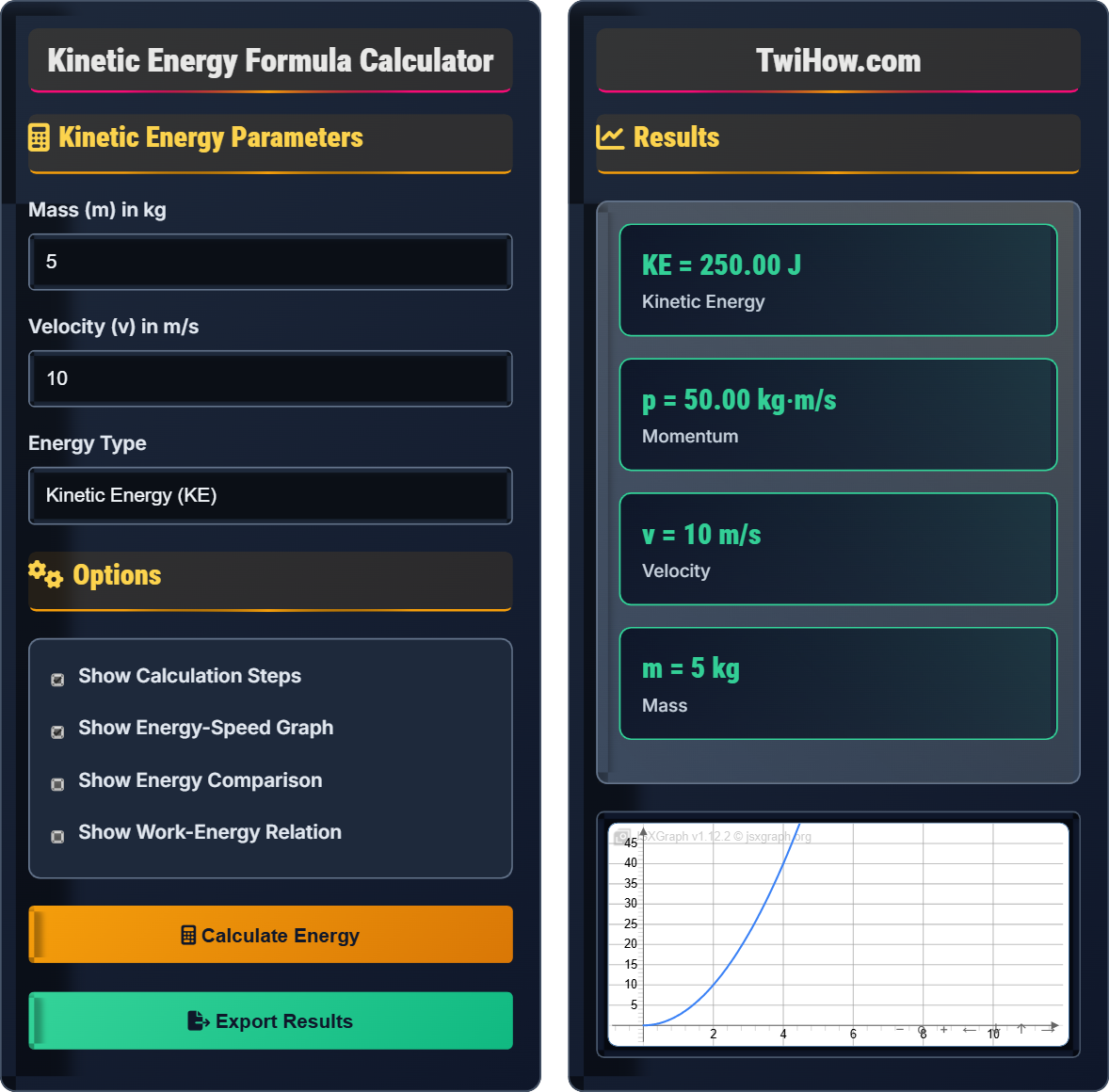
Show the calculator /Simulator\( KE = \frac{1}{2}mv^2 \)
Kinetic energy is the energy an object possesses due to its motion. It's directly proportional to the mass of the object and the square of its velocity. The kinetic energy formula shows that velocity has a quadratic effect on energy - doubling the velocity quadruples the kinetic energy. This fundamental relationship is central to understanding motion, collisions, and energy conservation in physics.
Where:
- \(KE\) = kinetic energy (Joules)
- \(m\) = mass of the object (kg)
- \(v\) = velocity of the object (m/s)
The kinetic energy formula is fundamental in mechanics, thermodynamics, and quantum physics. It's used in analyzing collisions, calculating work done by forces, understanding molecular motion, and many engineering applications. The quadratic relationship with velocity makes kinetic energy particularly sensitive to changes in speed.
Kinetic Energy Parameters
Options
Results
| Quantity | Value | Unit | Formula |
|---|
Enter parameters to see calculation steps.
Additional physics relationships will appear here.
Kinetic Energy Explained
Kinetic energy is the energy an object possesses due to its motion. It's a scalar quantity that depends on both the mass and velocity of the object. The faster an object moves or the more massive it is, the greater its kinetic energy. This energy can be converted to other forms (like potential energy) or transferred between objects during collisions. Understanding kinetic energy is fundamental to analyzing motion, work, and energy conservation in physics.
The classical kinetic energy formula is:
Relativistic kinetic energy (for high velocities):
Where:
- \(KE\) = kinetic energy (Joules)
- \(m\) = mass of the object (kilograms)
- \(v\) = velocity of the object (meters per second)
- \(\gamma\) = Lorentz factor = \( \frac{1}{\sqrt{1-v^2/c^2}} \)
- \(c\) = speed of light (≈ 3×10⁸ m/s)
Key characteristics of kinetic energy:
- Always Positive: Since v² is always non-negative
- Quadratic Relationship: KE ∝ v² (velocity squared)
- Scalar Quantity: Has magnitude but no direction
- Reference Frame Dependent: Value depends on observer's frame
- Collision Analysis: Understanding impact effects
- Energy Conservation: Mechanical energy problems
- Work Calculations: Work-energy theorem applications
- Thermodynamics: Molecular kinetic energy
Kinetic Energy Fundamentals
Kinetic energy is the energy associated with the motion of an object, calculated as one-half the product of mass and velocity squared.
\( KE = \frac{1}{2}mv^2 \)
Where KE = kinetic energy, m = mass, v = velocity.
- KE is always ≥ 0
- Quadratic dependence on velocity
- Linear dependence on mass
- Measured in Joules (J)
Applications
Foundation for work-energy theorem, conservation of energy, and momentum.
- Vehicle safety and collision analysis
- Ballistics and projectile motion
- Thermal energy and temperature
- Electrical generation from kinetic energy
- Formula is valid for classical mechanics
- Relativistic effects at high speeds
- Depends on reference frame
- Applies to translational motion
Kinetic Energy Formula Learning Quiz
What is the kinetic energy of a 2 kg object moving at 3 m/s?
Step 1: Identify parameters
Mass (m) = 2 kg
Velocity (v) = 3 m/s
Step 2: Apply kinetic energy formula
KE = ½mv²
KE = ½ × 2 × (3)²
KE = ½ × 2 × 9
KE = 9 J
The kinetic energy of the object is 9 Joules.
The answer is B) 9 J.
This problem demonstrates the basic kinetic energy calculation. Notice how the velocity is squared in the formula, meaning that small changes in velocity can have a large impact on kinetic energy. For example, if the velocity doubled from 3 m/s to 6 m/s, the kinetic energy would increase from 9 J to 36 J (a factor of 4).
Kinetic Energy: Energy due to motion
Joule: Unit of energy (kg⋅m²/s²)
Mass: Amount of matter in an object
• KE = ½mv² (quadratic in velocity)
• Always positive value
• Proportional to mass
• Always square the velocity
• Remember the ½ factor
• Use consistent units (kg, m/s)
• Forgetting to square the velocity
• Omitting the ½ factor
• Using inconsistent units
If the velocity of an object is doubled, by what factor does its kinetic energy change? Explain the relationship between velocity and kinetic energy.
Step 1: Write the initial kinetic energy
KE₁ = ½mv₁²
Step 2: Write the kinetic energy after velocity is doubled
KE₂ = ½m(2v₁)²
KE₂ = ½m(4v₁²)
KE₂ = 4 × ½mv₁²
KE₂ = 4 × KE₁
Step 3: Calculate the factor of change
Factor = KE₂ / KE₁ = 4
When the velocity is doubled, the kinetic energy increases by a factor of 4.
This demonstrates the quadratic relationship between velocity and kinetic energy. Since KE ∝ v², any change in velocity is squared in its effect on kinetic energy. This is why small increases in speed result in significant increases in energy.
This problem illustrates the fundamental quadratic relationship in the kinetic energy formula. The squared dependence on velocity means that kinetic energy increases rapidly as speed increases. This has important practical implications, such as the exponential increase in fuel consumption at higher speeds and the significantly greater damage in high-speed collisions compared to low-speed impacts.
Quadratic Relationship: Relationship where one variable is squared
Proportional: Relationship where variables change by the same factor
Factor of Change: Multiplier showing how much a quantity changes
• KE ∝ v² (kinetic energy proportional to velocity squared)
• Doubling velocity quadruples kinetic energy
• Tripling velocity increases KE by factor of 9
• Remember velocity is squared in the formula
• Small velocity changes cause large KE changes
• Use this relationship for proportional problems
• Thinking KE is linearly related to velocity
• Forgetting the squared relationship
• Not recognizing the quadratic nature
A 1000 kg car is traveling at 20 m/s. If the driver applies the brakes and the car comes to a complete stop, how much kinetic energy is converted to other forms of energy (like heat in the brake pads)?
Step 1: Calculate initial kinetic energy
Mass (m) = 1000 kg
Initial velocity (v) = 20 m/s
KE_initial = ½mv² = ½ × 1000 × (20)²
KE_initial = ½ × 1000 × 400 = 200,000 J = 200 kJ
Step 2: Calculate final kinetic energy
Final velocity = 0 m/s
KE_final = ½m(0)² = 0 J
Step 3: Calculate energy converted
Energy converted = KE_initial - KE_final = 200,000 J - 0 J = 200,000 J
200,000 Joules (200 kJ) of kinetic energy is converted to other forms of energy.
This example demonstrates the principle of energy conservation. The kinetic energy of the moving car is converted to thermal energy in the brake pads, heating them up. This conversion follows the work-energy theorem, which states that the work done by the braking force equals the change in kinetic energy. This is why brake systems must be designed to dissipate large amounts of thermal energy safely.
Energy Conversion: Changing energy from one form to another
Energy Conservation: Energy cannot be created or destroyed
Work-Energy Theorem: Work done equals change in kinetic energy
• Energy is conserved in closed systems
• KE can be converted to other energy forms
• Work done equals change in KE
• Consider initial and final states
• Calculate energy difference
• Think about energy transformations
• Forgetting that stopped object has zero KE
• Not considering all energy conversions
• Confusing energy with force
Derive the relationship between kinetic energy and momentum (KE = p²/2m) starting from the definitions of kinetic energy and momentum.
Step 1: Write definitions of KE and momentum
Kinetic Energy: KE = ½mv²
Momentum: p = mv
Step 2: Solve momentum equation for velocity
p = mv
v = p/m
Step 3: Substitute into kinetic energy equation
KE = ½m(p/m)²
KE = ½m × (p²/m²)
KE = ½ × (p²/m)
KE = p²/2m
Step 4: Verify the relationship
This shows that kinetic energy is directly proportional to the square of momentum and inversely proportional to mass.
This derivation shows the fundamental relationship between kinetic energy and momentum. Both are measures of motion but emphasize different aspects: momentum is linear in velocity (p = mv), while kinetic energy is quadratic in velocity (KE = ½mv²). The relationship KE = p²/2m is particularly useful in collision problems where momentum is conserved.
Momentum: Product of mass and velocity (p = mv)
Derivation: Mathematical proof of relationship
Conservation: Property that remains constant
• KE = p²/2m (alternative formula)
• Momentum is conserved in isolated systems
• KE is conserved only in elastic collisions
• Use KE = p²/2m for momentum problems
• Remember momentum is vector, KE is scalar
• This relationship is valid for classical mechanics
• Confusing momentum with kinetic energy
• Forgetting the 2m in denominator
• Not recognizing the quadratic relationship
Which of the following statements about kinetic energy is TRUE?
Let's examine each option:
A) False - KE and PE are different forms of energy; they're only equal in specific situations (like at certain points in harmonic motion)
B) False - KE = ½mv², so it depends quadratically on velocity
C) True - Since KE = ½mv² and both m and v² are non-negative, KE is always ≥ 0
D) False - KE is a scalar quantity, not a vector
Kinetic energy is always non-negative because it depends on the square of velocity (which is always non-negative) and positive mass. The minimum value of kinetic energy is zero, which occurs when the object is at rest.
The answer is C) Kinetic energy is always non-negative.
This question tests fundamental properties of kinetic energy. The non-negativity of kinetic energy stems from its mathematical definition: it's proportional to the square of velocity. Since squares are always non-negative and mass is always positive, kinetic energy cannot be negative. This is a fundamental property that distinguishes it from other quantities that can be positive or negative.
Scalar Quantity: Has magnitude but no direction
Vector Quantity: Has both magnitude and direction
Non-negative: Greater than or equal to zero• KE ≥ 0 always
• KE = 0 when object at rest
• KE is scalar, not vector
• Remember KE is always positive or zero
• Distinguish between scalar and vector quantities
• Recognize the quadratic velocity relationship
• Confusing KE with other energy forms
• Forgetting the quadratic velocity relationship
• Not recognizing KE as scalar quantity
FAQ
Q: Why does kinetic energy depend on the square of velocity?
A: The quadratic dependence of kinetic energy on velocity arises from the work-energy theorem. When a constant force accelerates an object, the work done (W = Fd) is proportional to the distance traveled. Using kinematic equations, we find that the distance traveled under constant acceleration is proportional to the square of the final velocity. Therefore, kinetic energy, which equals the work needed to accelerate an object from rest, must be proportional to velocity squared. This quadratic relationship also emerges from integrating momentum with respect to velocity.
Q: How is kinetic energy used in engineering applications?
A: Kinetic energy is fundamental in many engineering applications. In automotive engineering, it's used to calculate braking distances and design safety systems. In aerospace, it's essential for calculating launch energies and orbital mechanics. Wind and hydroelectric turbines convert kinetic energy of fluids to electrical energy. In structural engineering, kinetic energy considerations are important for impact analysis and seismic design. Particle accelerators rely on kinetic energy calculations to achieve desired particle velocities.