Momentum Formula Calculator
Complete mechanics guide • Step-by-step solutions
Momentum Formula::
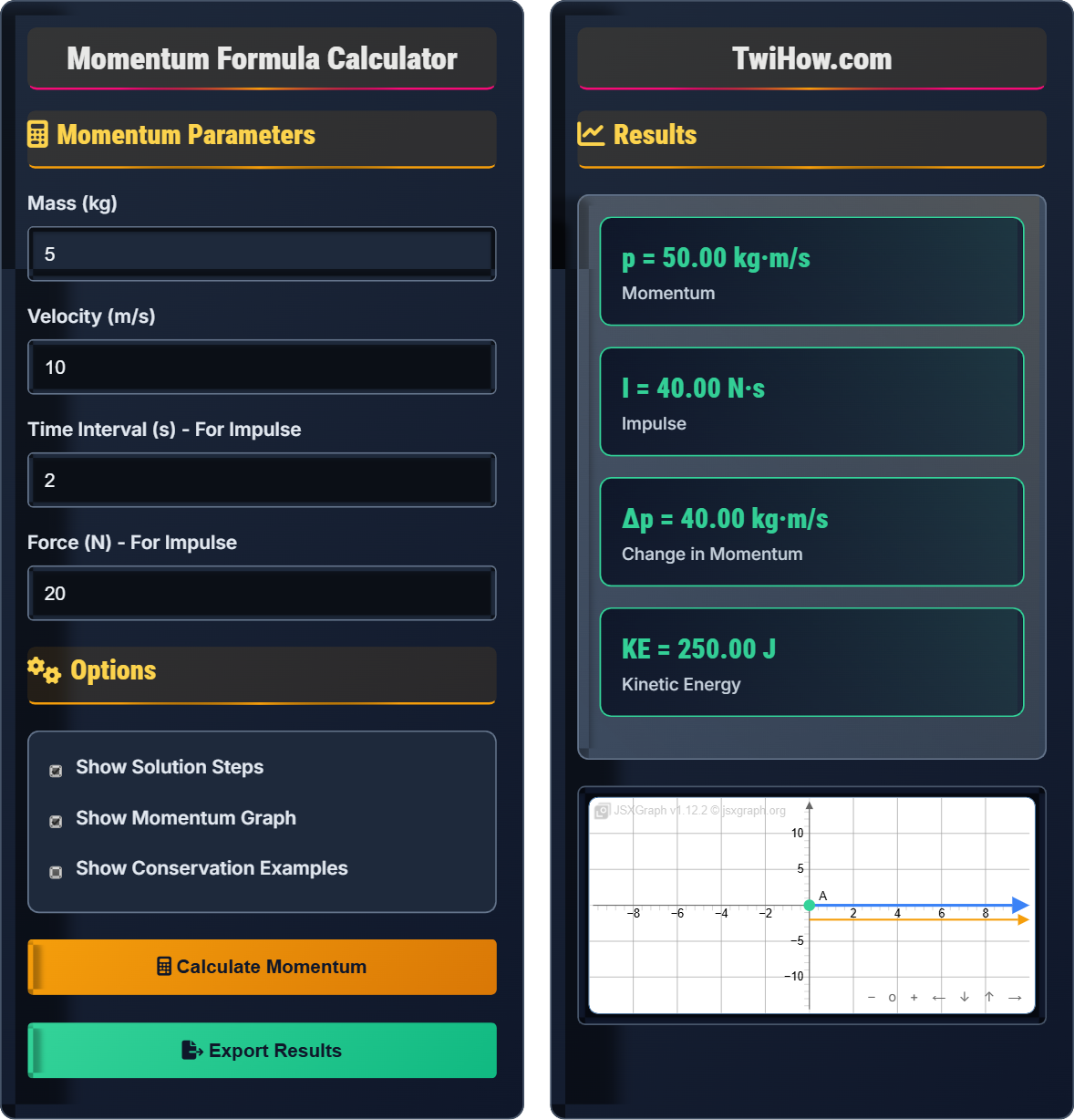
Show the calculator /Simulator\( p = mv \)
Momentum is a fundamental concept in physics that describes the quantity of motion an object has. It is defined as the product of an object's mass (m) and its velocity (v). Momentum is a vector quantity, meaning it has both magnitude and direction. The SI unit of momentum is kilogram meters per second (kg·m/s).
Key properties of momentum:
- Momentum is conserved in isolated systems (conservation of momentum)
- Greater mass or velocity results in greater momentum
- Momentum is directional, following the direction of velocity
- Change in momentum equals impulse (FΔt)
Use this formula whenever analyzing motion, collisions, or forces in physics problems. It's essential for understanding how objects interact and transfer energy during impacts, explosions, and other mechanical events.
Momentum Parameters
Options
Results
| Property | Value | Unit | Description |
|---|
Enter parameters to see solution steps.
Momentum Formula Explained
Momentum is a measurement involving mass in motion, capturing the quantity of motion an object has. It is a vector quantity, meaning it has both magnitude and direction. The momentum formula p = mv defines momentum as the product of an object's mass (m) and its velocity (v). This fundamental concept is central to understanding how objects interact in collisions and other physical phenomena.
The basic momentum formula is:
Where:
- \(p\) = momentum (kg·m/s)
- \(m\) = mass (kg)
- \(v\) = velocity (m/s)
Key characteristics of momentum:
- Vector Quantity: Has both magnitude and direction
- Conserved: Total momentum in an isolated system remains constant
- Dependent: Increases with mass or velocity
- Directional: Follows the direction of velocity vector
- Collisions: Analyzing before and after scenarios
- Rocket Propulsion: Conservation of momentum principle
- Sports: Understanding impact and force
- Engineering: Safety systems and impact analysis
Momentum Fundamentals
p = mv, where p is momentum, m is mass, v is velocity.
I = FΔt = Δp = m(v_f - v_i)
Where I = impulse, F = force, Δt = time interval.
- Momentum is conserved in isolated systems
- Greater mass or velocity increases momentum
- Momentum is a vector quantity
Conservation of Momentum
Total momentum before = Total momentum after in isolated systems.
- Elastic collisions (both momentum and KE conserved)
- Inelastic collisions (momentum conserved, KE not)
- Perfectly inelastic (objects stick together)
- System must be isolated (no external forces)
- Vector directions matter in calculations
- Momentum transfers between objects
- Can be applied to multiple dimensions
Momentum Formula Learning Quiz
A car of mass 1000 kg is traveling at 20 m/s. What is its momentum?
Using the momentum formula p = mv, where m = 1000 kg and v = 20 m/s:
p = 1000 × 20 = 20,000 kg·m/s
The answer is C) 20000 kg·m/s.
Momentum is calculated as the product of mass and velocity. This fundamental relationship shows that momentum increases linearly with both mass and velocity. Understanding this basic calculation is crucial because it forms the foundation for more complex momentum problems, including collisions and conservation scenarios.
Momentum: The product of mass and velocity (p = mv)
Vector Quantity: Has both magnitude and direction
SI Unit: Kilogram meters per second (kg·m/s)
• Momentum = mass × velocity
• Direction of momentum matches velocity direction
• Greater mass or velocity results in greater momentum
• Remember: p = mv (simple multiplication)
• Units: kg·m/s (mass in kg, velocity in m/s)
• Momentum is directional - consider signs for direction
• Forgetting to convert units properly
• Mixing up mass and weight in calculations
• Ignoring the vector nature of momentum
A 5 kg object initially moving at 3 m/s experiences a constant force of 10 N for 2 seconds. Calculate the final velocity of the object and explain how impulse relates to the change in momentum.
Step 1: Calculate impulse using I = FΔt
I = 10 N × 2 s = 20 N·s
Step 2: Calculate initial momentum
p_initial = mv_initial = 5 kg × 3 m/s = 15 kg·m/s
Step 3: Apply impulse-momentum theorem: I = Δp = p_final - p_initial
20 N·s = p_final - 15 kg·m/s
p_final = 20 + 15 = 35 kg·m/s
Step 4: Calculate final velocity
v_final = p_final/m = 35 kg·m/s ÷ 5 kg = 7 m/s
The final velocity is 7 m/s. The impulse (20 N·s) equals the change in momentum (20 kg·m/s).
The impulse-momentum theorem states that impulse equals the change in momentum. This relationship is fundamental in analyzing forces acting over time intervals. When a force acts on an object for a duration, it changes the object's momentum by an amount equal to the impulse. This principle is particularly useful in collision problems and safety engineering.
Impulse: Product of force and time interval (I = FΔt)
Impulse-Momentum Theorem: I = Δp = m(v_f - v_i)
Change in Momentum: Difference between final and initial momentum
• I = FΔt (impulse equals force times time)
• I = Δp (impulse equals change in momentum)
• Impulse is vector quantity in direction of force
• Impulse always equals change in momentum
• Use this theorem for force-time problems
• Remember direction matters for vectors
• Confusing impulse with momentum
• Forgetting that impulse is vector quantity
• Not considering direction in vector calculations
A 2 kg ball moving at 4 m/s collides elastically with a stationary 3 kg ball. Calculate the velocities of both balls after the collision, assuming the collision is perfectly elastic.
Step 1: Define variables
Before collision: m₁ = 2 kg, v₁ = 4 m/s, m₂ = 3 kg, v₂ = 0 m/s
After collision: v₁' = ?, v₂' = ?
Step 2: Apply conservation of momentum
m₁v₁ + m₂v₂ = m₁v₁' + m₂v₂'
2(4) + 3(0) = 2v₁' + 3v₂'
8 = 2v₁' + 3v₂' ... (1)
Step 3: Apply conservation of kinetic energy (elastic collision)
½m₁v₁² + ½m₂v₂² = ½m₁v₁'² + ½m₂v₂'²
½(2)(4)² + ½(3)(0)² = ½(2)v₁'² + ½(3)v₂'²
16 = v₁'² + 1.5v₂'² ... (2)
Step 4: Solve the system of equations
From equation (1): v₁' = (8 - 3v₂')/2
Substituting into equation (2): 16 = ((8-3v₂')/2)² + 1.5v₂'²
After solving: v₂' = 3.2 m/s, v₁' = -0.8 m/s
Therefore, the 2 kg ball moves backward at 0.8 m/s, and the 3 kg ball moves forward at 3.2 m/s.
In elastic collisions, both momentum and kinetic energy are conserved. This creates a system of equations that can be solved simultaneously. The negative sign for the first ball indicates it reverses direction after the collision. This problem demonstrates the power of conservation laws in predicting outcomes of physical interactions.
Elastic Collision: Both momentum and kinetic energy are conserved
Conservation of Momentum: Total momentum remains constant
Conservation of Kinetic Energy: Total KE remains constant
• Momentum conserved in all collisions
• KE conserved only in elastic collisions
• Direction matters in momentum calculations
• Use conservation of momentum first
• For elastic collisions, use KE conservation too
• Signs indicate direction of motion
• Forgetting to account for direction (signs)
• Applying KE conservation to inelastic collisions
• Mixing up before and after values
A rocket of initial mass 1000 kg ejects gas at a rate of 10 kg/s with a velocity of 2000 m/s relative to the rocket. Calculate the thrust produced by the rocket and explain how this relates to conservation of momentum.
Step 1: Calculate thrust using the rocket equation
Thrust = ṁ × v_exhaust
Where ṁ = mass flow rate = 10 kg/s
v_exhaust = exhaust velocity = 2000 m/s
Thrust = 10 kg/s × 2000 m/s = 20,000 N
Step 2: Explain momentum conservation
Initially, the system (rocket + fuel) has zero momentum. As fuel is ejected backward, the rocket gains forward momentum. The momentum lost by the exhaust gases equals the momentum gained by the rocket, satisfying conservation of momentum.
The rocket produces a thrust of 20,000 N.
Rocket propulsion is a perfect example of conservation of momentum. The rocket expels mass in one direction, gaining momentum in the opposite direction. This principle doesn't require an external medium to push against, unlike conventional engines. The thrust generated depends on the rate of mass ejection and the exhaust velocity.
Rocket Thrust: Force generated by ejecting mass (ṁv)
Mass Flow Rate: Rate at which mass is expelled (kg/s)Exhaust Velocity: Velocity of expelled mass relative to rocket
• Thrust = mass flow rate × exhaust velocity
• Momentum conserved in rocket-fuel system
• Works in vacuum due to momentum conservation
• Higher exhaust velocity increases efficiency
• Greater mass flow rate increases thrust
• Applies Newton's third law fundamentally
• Thinking rockets need air to push against
• Forgetting momentum conservation in propulsion
• Confusing thrust with velocity
Which of the following statements about conservation of momentum is correct?
Conservation of momentum states that the total momentum of an isolated system remains constant when no external forces act on the system. This applies to all types of collisions (elastic and inelastic) and various physical processes. The condition is that the system must be isolated from external forces.
The answer is C) Momentum is conserved in isolated systems with no external forces.
Conservation of momentum is one of the fundamental laws of physics. It applies universally to isolated systems, regardless of the type of interaction. The key condition is that no external forces act on the system. This principle is more general than conservation of kinetic energy, which only applies to elastic collisions.
Isolated System: System with no external forces acting on it
External Forces: Forces from outside the system
Fundamental Law: Principle that applies universally
• Applies to all collision types
• Requires isolated system (no external forces)
• More general than energy conservation
• Define your system boundaries carefully
• Check for external forces before applying
• Works for any dimension (1D, 2D, 3D)
• Assuming momentum is always conserved (ignoring external forces)
• Thinking it only applies to specific situations
• Confusing with conservation of energy
FAQ
Q: What is the difference between momentum and kinetic energy?
A: While both momentum and kinetic energy describe aspects of motion, they are fundamentally different quantities. Momentum is defined as p = mv (mass × velocity) and is a vector quantity that has both magnitude and direction. Kinetic energy is defined as KE = ½mv² and is a scalar quantity that only has magnitude.
The key differences are:
- Momentum is linearly dependent on velocity (p ∝ v), while kinetic energy is quadratically dependent (KE ∝ v²)
- Momentum is conserved in all isolated collisions, but kinetic energy is only conserved in elastic collisions
- Momentum has direction, kinetic energy does not
These relationships mean that for the same mass, doubling the velocity doubles the momentum but quadruples the kinetic energy.
Q: How does the impulse-momentum theorem apply in real-world safety systems?
A: The impulse-momentum theorem (I = Δp = FΔt) is fundamental to safety system design. By extending the time interval (Δt) over which a collision occurs, the average force experienced can be significantly reduced. This principle is applied in:
- Car crumple zones that extend collision time
- Airbags that increase the time over which the person's momentum changes
- Padded surfaces that lengthen impact duration
- Seat belts that stretch slightly during impact
Since impulse (change in momentum) is fixed by the situation, increasing the time reduces the force according to F = Δp/Δt, making impacts less dangerous.