Newton's Second Law Calculator
Complete mechanics guide • Step-by-step solutions
Newton's Second Law::
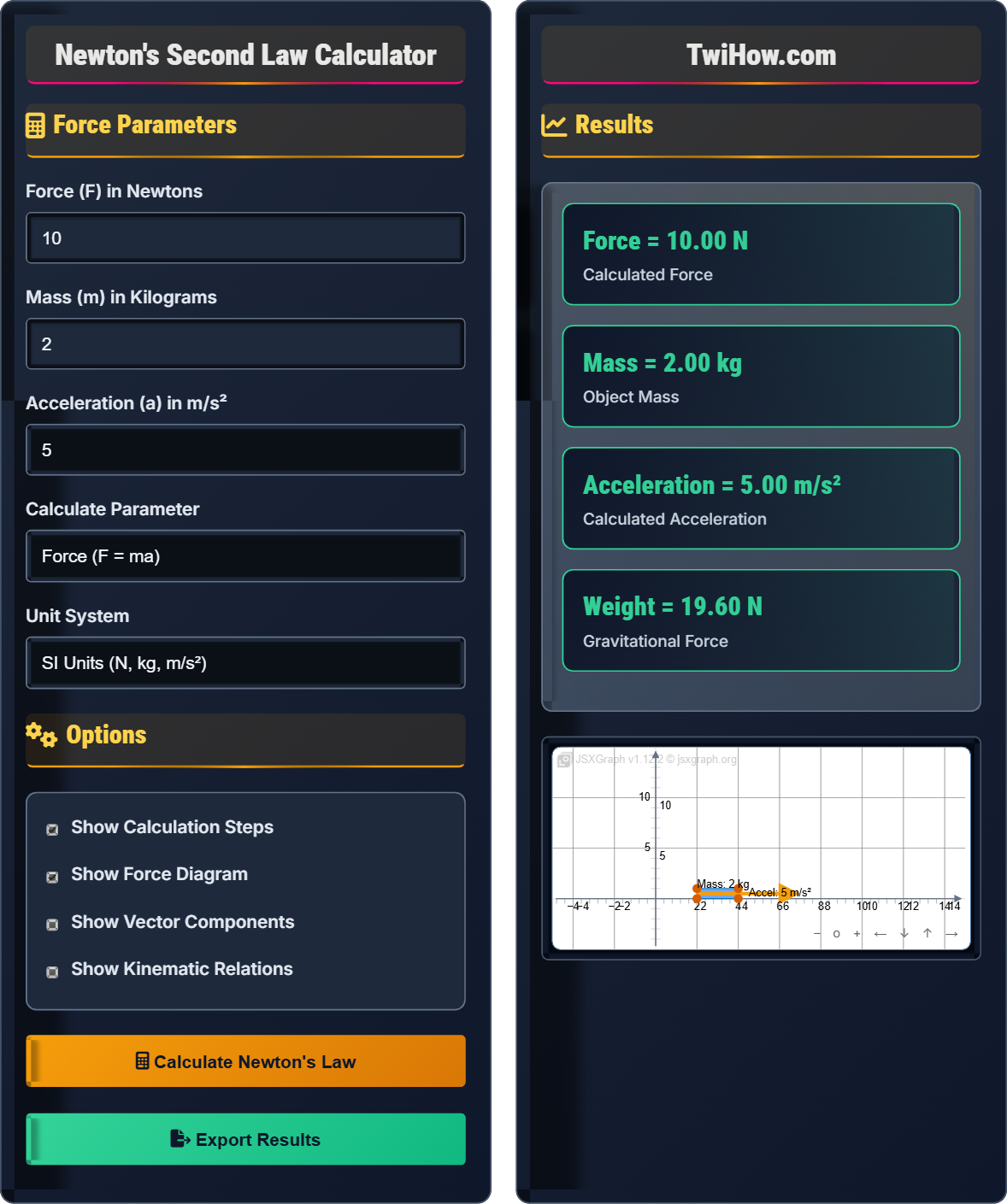
Show the calculator /Simulator\( \vec{F} = m\vec{a} \)
Newton's Second Law states that the acceleration of an object is directly proportional to the net force acting on it and inversely proportional to its mass. The law quantifies the relationship between force, mass, and acceleration, establishing that force equals mass times acceleration. This fundamental principle of classical mechanics describes how objects respond to applied forces and forms the basis for analyzing motion in physics.
Where:
- \(\vec{F}\) = net force vector (Newtons)
- \(m\) = mass of object (kg)
- \(\vec{a}\) = acceleration vector (m/s²)
The law can also be expressed as \(\vec{F} = \frac{d\vec{p}}{dt}\), where \(\vec{p}\) is momentum. This formulation is more general and applies to systems with changing mass. The second law is fundamental to engineering, aerospace, automotive design, and any application involving motion and forces.
Force Parameters
Options
Results
| Parameter | Value | Unit | Symbol |
|---|
Enter parameters to see calculation steps.
Additional physics relations will appear here.
Newton's Second Law Explained
Newton's Second Law of Motion states that the acceleration of an object is directly proportional to the net force acting upon it and inversely proportional to its mass. This fundamental law of physics quantifies the relationship between force, mass, and acceleration, providing the mathematical foundation for classical mechanics. The law is expressed as F = ma, where F is the net force, m is the mass, and a is the acceleration. This law explains how objects respond to applied forces and is essential for understanding motion in the physical world.
The fundamental form of Newton's Second Law is:
Vector form showing direction dependency:
Differential form (more general):
Where:
- \(\vec{F}\) = net force vector (Newtons, N)
- \(m\) = mass of object (kilograms, kg)
- \(\vec{a}\) = acceleration vector (meters per second squared, m/s²)
- \(\vec{p}\) = momentum vector (kg⋅m/s)
- \(\vec{v}\) = velocity vector (m/s)
Newton's Second Law has numerous applications:
- Engineering: Structural design, vehicle dynamics, aerospace
- Sports: Analyzing athletic performance and equipment design
- Transportation: Car safety, braking systems, acceleration
- Space Exploration: Rocket propulsion, orbital mechanics
- Newton's First Law: Law of inertia
- Newton's Third Law: Action-reaction pairs
- Conservation of Momentum: Derived from second law
- Kinematic Equations: Describe motion under constant acceleration
Newton's Laws Fundamentals
Newton's Second Law states that the acceleration of an object is directly proportional to the net force acting on it and inversely proportional to its mass.
\( \vec{F} = m\vec{a} \)
Where F = net force, m = mass, a = acceleration.
- Force and acceleration vectors point in same direction
- Mass is scalar, acceleration is vector
- Applies to net force (sum of all forces)
- Valid in inertial reference frames
Applications
Foundation for dynamics, kinematics, and statics.
- Vehicle crash analysis
- Structural engineering
- Sports biomechanics
- Robotics and automation
- Only valid for constant mass systems
- Requires inertial reference frame
- Breaks down at relativistic speeds
- Quantum mechanics requires different approach
Newton's Second Law Learning Quiz
What force is required to accelerate a 5 kg object at 3 m/s²?
Using Newton's Second Law: F = ma
Given: m = 5 kg, a = 3 m/s²
Substituting values: F = 5 kg × 3 m/s² = 15 kg⋅m/s² = 15 N
The required force is 15 Newtons.
The answer is B) 15 N.
Newton's Second Law directly relates force, mass, and acceleration. The relationship is linear - doubling the mass requires double the force to maintain the same acceleration. The law emphasizes that acceleration is proportional to the net force applied and inversely proportional to the object's mass. This fundamental relationship forms the basis for analyzing all mechanical systems.
Force: Push or pull that changes an object's motion
Mass: Amount of matter in an object
Acceleration: Rate of change of velocity
• F = ma (force equals mass times acceleration)
• Direction of acceleration matches net force
• Units must be consistent (SI: N, kg, m/s²)
• Always use consistent units
• Identify the net force (sum of all forces)
• Remember that acceleration is a vector
• Confusing mass with weight
A 10 kg block is pushed horizontally with a force of 50 N. If the coefficient of kinetic friction between the block and surface is 0.3, what is the acceleration of the block? (Use g = 9.8 m/s²)
Step 1: Identify all forces acting on the block
Applied force: F_app = 50 N (forward)
Friction force: F_friction = μ_k × N
Normal force: N = mg = 10 kg × 9.8 m/s² = 98 N
Friction force: F_friction = 0.3 × 98 N = 29.4 N (opposite to motion)
Step 2: Calculate net force
F_net = F_app - F_friction = 50 N - 29.4 N = 20.6 N
Step 3: Apply Newton's Second Law
F_net = ma
a = F_net / m = 20.6 N / 10 kg = 2.06 m/s²
The block accelerates at 2.06 m/s² in the direction of the applied force.
This problem demonstrates how to handle multiple forces. When applying Newton's Second Law, we must consider the net force (sum of all forces). The friction force opposes motion and must be subtracted from the applied force. This example shows how real-world problems often involve multiple interacting forces, requiring careful free-body diagram analysis.
Net Force: Sum of all forces acting on an object
Friction: Force opposing relative motion
Free Body Diagram: Representation of forces on an object
• Sum all forces to find net force
• Friction opposes motion direction
• Normal force balances perpendicular forces
• Draw free body diagrams
• Assign positive/negative directions
• Consider all contact and field forces
• Forgetting friction force
• Adding forces in wrong direction
• Confusing static and kinetic friction
An elevator with a mass of 800 kg accelerates upward at 2 m/s². What is the tension in the cable supporting the elevator? (Use g = 9.8 m/s²)
Step 1: Identify forces acting on elevator
Weight: W = mg = 800 kg × 9.8 m/s² = 7840 N (downward)
Tension: T = ? (upward)
Step 2: Apply Newton's Second Law (positive upward)
F_net = ma
T - W = ma
T - 7840 N = 800 kg × 2 m/s²
T - 7840 N = 1600 N
T = 1600 N + 7840 N = 9440 N
The tension in the cable is 9440 N.
This elevator problem shows how apparent weight changes with acceleration. When accelerating upward, the tension must exceed the weight to provide the net upward force. The cable must support both the weight and provide additional force for acceleration. This is why you feel heavier in an accelerating elevator.
Tension: Pulling force in strings, cables, or ropes
Apparent Weight: Normal force experienced by object
Weight: Gravitational force on an object
• Tension acts along the cable direction
• Weight always acts downward
• Net force determines acceleration direction
• Choose positive direction consistently
• Weight always mg regardless of motion
• Tension adjusts to provide necessary net force
• Forgetting weight force
• Incorrect sign conventions
• Thinking tension equals weight in accelerated motion
A 5 kg block slides down a frictionless incline at 30° to the horizontal. What is its acceleration? What would the acceleration be if the coefficient of kinetic friction were 0.2?
Without friction:
Step 1: Resolve forces along incline
Weight component along incline: W_parallel = mg sin(θ)
W_parallel = 5 kg × 9.8 m/s² × sin(30°) = 5 × 9.8 × 0.5 = 24.5 N
Step 2: Apply Newton's Second Law
F_net = ma
mg sin(θ) = ma
a = g sin(θ) = 9.8 m/s² × sin(30°) = 9.8 × 0.5 = 4.9 m/s²
With friction (μ = 0.2):
Normal force: N = mg cos(θ) = 5 × 9.8 × cos(30°) = 49 × 0.866 = 42.4 N
Friction force: F_friction = μN = 0.2 × 42.4 N = 8.48 N
Net force: F_net = mg sin(θ) - F_friction = 24.5 - 8.48 = 16.02 N
Acceleration: a = F_net / m = 16.02 N / 5 kg = 3.20 m/s²
Without friction: 4.9 m/s², With friction: 3.20 m/s²
On an inclined plane, we resolve forces into components parallel and perpendicular to the surface. The component of weight parallel to the incline causes acceleration. When friction is present, it opposes motion and reduces the net force, resulting in lower acceleration. The angle of the incline affects both the driving force and the normal force (which determines friction).
Inclined Plane: Sloping surface for raising loads
Resolved Forces: Components of force in specific directions
Angle of Incline: Angle between plane and horizontal
• W_parallel = mg sin(θ)
• W_perpendicular = mg cos(θ)
• Friction opposes motion direction
• Always resolve forces along motion direction
• Use trigonometric functions for incline problems
• Friction reduces acceleration on inclines
• Not resolving forces properly
• Using wrong trigonometric function
• Forgetting that friction opposes motion
Which of the following statements about Newton's Second Law is TRUE?
Let's examine each option:
A) False - Force and acceleration are always in the same direction according to F = ma
B) True - From F = ma, if F is constant, a = F/m, so acceleration is inversely proportional to mass
C) False - Mass is an intrinsic property of matter, independent of forces
D) False - The law applies to all objects with acceleration, not just those at rest
Newton's Second Law states that for a constant net force, acceleration is inversely proportional to mass. This means that if you double the mass while keeping the force constant, the acceleration will be halved. The direction of acceleration is always the same as the direction of the net force.
The answer is B) Acceleration is inversely proportional to mass.
The inverse relationship between acceleration and mass is a fundamental aspect of Newton's Second Law. This relationship explains why it takes more force to accelerate a heavy object than a light one. The law also establishes that force and acceleration are vector quantities that point in the same direction. Understanding these conceptual relationships is as important as performing calculations.
Vector Quantity: Has both magnitude and direction
Scalar Quantity: Has only magnitudeInverse Proportion: As one quantity increases, the other decreases
• F = ma (vector equation)
• Direction of a matches direction of F_net
• Mass is scalar, constant for rigid objects
• Remember force and acceleration are vectors
• Mass is a scalar property
• Always consider net force, not individual forces
• Thinking force and acceleration are opposite
• Confusing mass with weight
• Not recognizing vector nature of the law
FAQ
Q: What's the difference between mass and weight?
A: Mass is the amount of matter in an object and is measured in kilograms (kg). It's an intrinsic property that doesn't change regardless of location. Weight is the force exerted on an object due to gravity and is measured in Newtons (N). Weight = Mass × Gravitational acceleration (W = mg). An object with mass 10 kg has the same mass on Earth and the Moon, but its weight is different because gravitational acceleration differs between locations (9.8 m/s² on Earth vs 1.6 m/s² on Moon).
Q: How is Newton's Second Law used in engineering applications?
A: Newton's Second Law is fundamental to engineering analysis. In structural engineering, it's used to calculate forces on buildings and bridges under various loads. In automotive engineering, it helps determine braking distances, acceleration capabilities, and crash forces. Aerospace engineers use it to calculate rocket thrust requirements and spacecraft trajectories. Mechanical engineers apply it in machine design, vibration analysis, and control systems. The law is essential for any system where forces cause acceleration or motion.