Potential Energy Formula Calculator
Complete mechanics guide • Step-by-step solutions
Potential Energy Formula::
Show the calculator /Simulator\( PE = mgh \) (Gravitational Potential Energy)
\( PE = \frac{1}{2}kx^2 \) (Elastic Potential Energy)
Potential energy is the energy an object possesses due to its position in a force field or its configuration. For gravitational potential energy, it depends on mass (m), gravitational acceleration (g), and height (h) above a reference level. For elastic potential energy, it depends on the spring constant (k) and displacement (x) from equilibrium. Potential energy can be converted to kinetic energy and vice versa.
Where:
- \(PE\) = potential energy (Joules)
- \(m\) = mass of the object (kg)
- \(g\) = gravitational acceleration (9.8 m/s²)
- \(h\) = height above reference level (m)
- \(k\) = spring constant (N/m)
- \(x\) = displacement from equilibrium (m)
Potential energy is fundamental to understanding energy conservation, mechanical systems, and the relationship between force and energy. It's a scalar quantity that represents stored energy available for conversion to other forms.
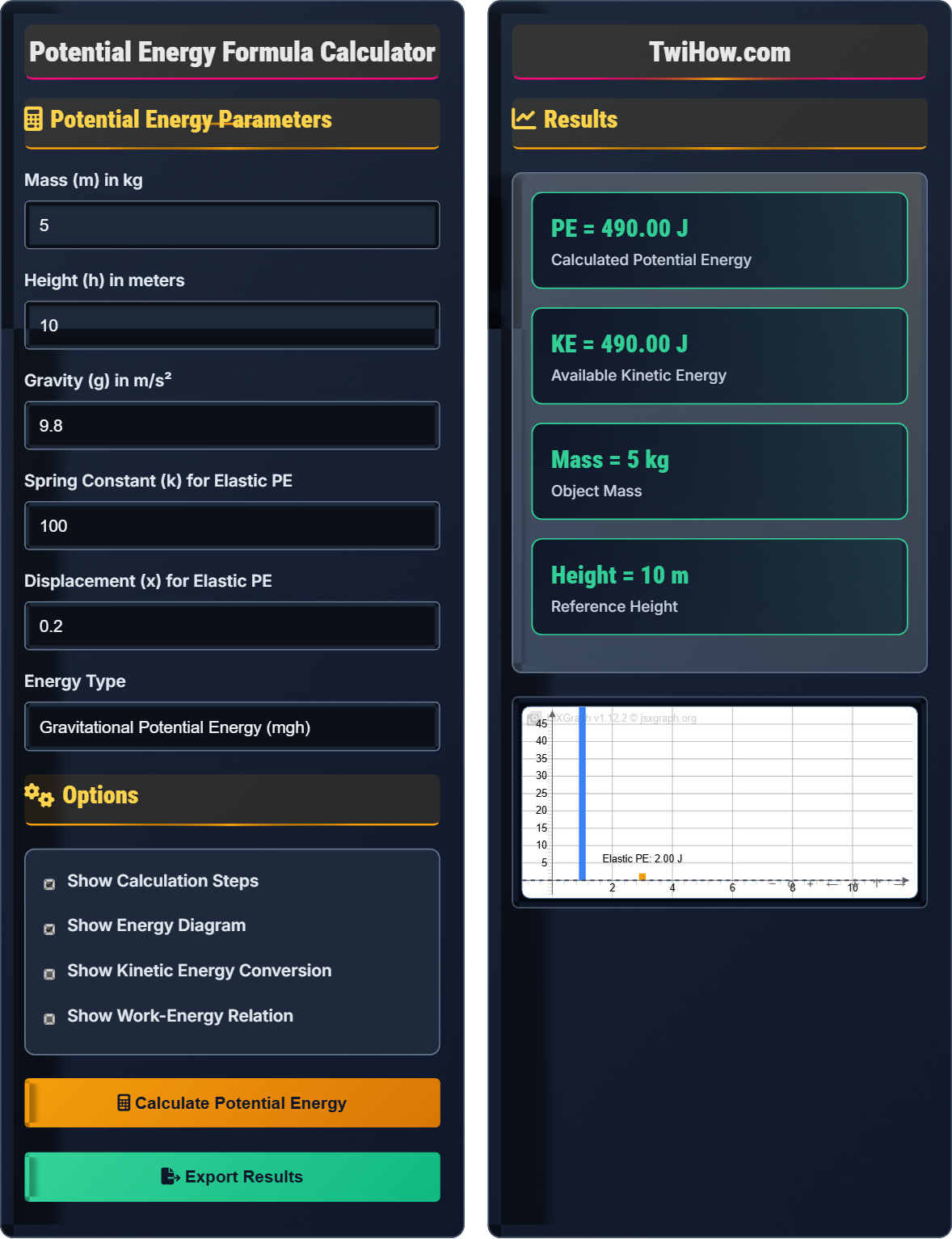
Potential Energy Parameters
Options
Results
| Energy Type | Value | Unit | Formula |
|---|
Enter parameters to see calculation steps.
Additional physics relationships will appear here.
Potential Energy Explained
Potential energy is the energy an object possesses due to its position in a force field or its configuration. It represents stored energy that can be converted to other forms, particularly kinetic energy. The concept is fundamental to understanding energy conservation in physics. Potential energy exists in various forms including gravitational, elastic, electric, and magnetic potential energy. The gravitational potential energy formula (PE = mgh) is the most commonly encountered form in introductory physics.
Gravitational Potential Energy:
Elastic Potential Energy:
Electric Potential Energy:
Where:
- \(PE\) = potential energy (Joules)
- \(m\) = mass (kg)
- \(g\) = gravitational acceleration (m/s²)
- \(h\) = height (m)
- \(k\) = spring constant (N/m) or Coulomb constant
- \(x\) = displacement (m)
- \(q_1, q_2\) = charges (Coulombs)
- \(r\) = distance (m)
Key characteristics of potential energy:
- Scalar Quantity: Has magnitude but no direction
- Reference Dependent: Value depends on chosen reference point
- Conservative Fields: Only exists in conservative force fields
- Energy Storage: Represents stored energy ready for conversion
- Hydroelectric Power: Water stored at elevation
- Spring Mechanisms: Clocks, shock absorbers
- Archery: Stored energy in bent bow
- Roller Coasters: Energy conversion between PE and KE
Potential Energy Fundamentals
Potential energy is the energy possessed by an object due to its position in a force field or its configuration.
\( PE = mgh \)
Where PE = potential energy, m = mass, g = gravity, h = height.
- PE = 0 at reference level
- Depends on reference point choice
- Scalar quantity (no direction)
- Conservative force field requirement
Applications
Foundation for conservation of energy, mechanical systems, and energy conversion.
- Hydropower generation
- Archery and projectile motion
- Spring-loaded mechanisms
- Gravitational slingshot maneuvers
- Reference level affects PE value
- Gravitational field varies with location
- Spring constant depends on material properties
- Energy can be converted to kinetic energy
Potential Energy Learning Quiz
What is the gravitational potential energy of a 2 kg object placed 5 meters above the ground? (g = 9.8 m/s²)
Step 1: Identify parameters
Mass (m) = 2 kg
Height (h) = 5 m
Gravity (g) = 9.8 m/s²
Step 2: Apply gravitational potential energy formula
PE = mgh
PE = 2 kg × 9.8 m/s² × 5 m
PE = 98 kg⋅m²/s² = 98 J
The gravitational potential energy is 98 Joules.
The answer is C) 98 J.
This problem demonstrates the fundamental gravitational potential energy formula. The key insight is that potential energy is directly proportional to mass, gravitational acceleration, and height. The units work out to Joules (kg⋅m²/s²) when using SI units. This formula is valid near Earth's surface where g is approximately constant.
Potential Energy: Energy due to position in force field
Gravitational Field: Force field due to mass
Reference Level: Zero potential energy point
• PE = mgh (near Earth's surface)
• Always specify reference level
• Units must be consistent
• Choose reference level wisely
• Use consistent units (kg, m, s)
• Remember that PE increases with height
• Forgetting to specify reference level
• Using wrong value for gravitational acceleration
• Not maintaining consistent units
A spring with a spring constant of 200 N/m is compressed by 0.3 meters. What is the elastic potential energy stored in the spring? How much work was required to compress it?
Step 1: Identify parameters
Spring constant (k) = 200 N/m
Displacement (x) = 0.3 m
Step 2: Apply elastic potential energy formula
PE_elastic = ½kx²
PE_elastic = ½ × 200 N/m × (0.3 m)²
PE_elastic = ½ × 200 × 0.09
PE_elastic = 9 J
Step 3: Determine work required
By the work-energy theorem, the work done to compress the spring equals the potential energy stored: W = 9 J
The elastic potential energy stored is 9 Joules, and 9 Joules of work was required to compress the spring.
This example shows the elastic potential energy stored in a compressed spring. The energy is proportional to the square of displacement, meaning that doubling the compression quadruples the stored energy. The work-energy theorem states that the work done against the spring force is stored as potential energy in the spring. This principle is used in many mechanical devices.
Spring Constant: Stiffness of the spring (N/m)
Elastic Potential Energy: Energy stored in deformed elastic material
Work-Energy Theorem: Work done equals energy change
• PE_elastic = ½kx²
• Energy stored quadratically with displacement
• Work required equals stored energy
• Remember the ½ factor in elastic PE formula
• Squaring displacement makes PE very sensitive to compression
• Use this for analyzing spring-powered devices
• Forgetting the ½ factor in the formula
• Not squaring the displacement
• Confusing displacement with spring length
A 10 kg ball is held 20 meters above the ground. When released, it falls freely (neglecting air resistance). What is its kinetic energy just before hitting the ground? What is its velocity at that moment?
Step 1: Calculate initial potential energy
PE_initial = mgh = 10 kg × 9.8 m/s² × 20 m = 1960 J
Step 2: Apply conservation of energy
At ground level, all potential energy converts to kinetic energy
KE_final = PE_initial = 1960 J
Step 3: Calculate velocity using KE formula
KE = ½mv²
1960 J = ½ × 10 kg × v²
1960 = 5v²
v² = 392
v = √392 ≈ 19.8 m/s
Just before hitting the ground, the ball has 1960 J of kinetic energy and a velocity of approximately 19.8 m/s.
This problem demonstrates energy conservation in a gravitational field. The potential energy at the top converts entirely to kinetic energy at the bottom (assuming no energy losses). This principle is fundamental to understanding mechanical energy conservation and is used in analyzing falling objects, pendulums, and other mechanical systems.
Energy Conservation: Energy cannot be created or destroyed
Kinetic Energy: Energy due to motion
Free Fall: Motion under gravity alone
• PE + KE = constant (conservation)
• PE converts to KE during fall
• v = √(2gh) for free fall from rest
• Use energy conservation when forces are conservative
• PE at start equals KE at finish (no losses)
• The final velocity is independent of mass
• Not applying energy conservation principle
• Forgetting that velocity depends on height, not mass
• Not considering that PE is relative to reference level
A 2 kg object is attached to a spring (k=150 N/m) and lifted 3 meters above the ground. If the spring is stretched 0.4 meters from its equilibrium position, what is the total potential energy of the system?
Step 1: Calculate gravitational potential energy
PE_grav = mgh = 2 kg × 9.8 m/s² × 3 m = 58.8 J
Step 2: Calculate elastic potential energy
PE_elastic = ½kx² = ½ × 150 N/m × (0.4 m)² = ½ × 150 × 0.16 = 12 J
Step 3: Calculate total potential energy
PE_total = PE_grav + PE_elastic = 58.8 J + 12 J = 70.8 J
The total potential energy of the system is 70.8 Joules.
This problem combines both gravitational and elastic potential energies. Since potential energy is a scalar quantity, we can simply add the contributions from different sources. This is important in systems like suspension bridges, shock absorbers, or any mechanical system with multiple energy storage mechanisms. The total potential energy represents the combined energy storage capacity of the system.
Total Potential Energy: Sum of all potential energy contributions
Superposition Principle: Energies can be added algebraically
Mechanical System: Collection of masses, springs, and constraints
• Add potential energies from different sources
• Scalar quantities can be summed directly
• Each energy type follows its own formula
• Identify all potential energy sources
• Calculate each separately
• Sum to get total potential energy
• Only considering one type of potential energy
• Not recognizing all energy sources
• Forgetting that energies are scalars
Which of the following statements about potential energy is TRUE?
Let's examine each option:
A) False - PE and KE are different quantities that may or may not be equal
B) False - Potential energy is a scalar quantity (has magnitude only)
C) True - The value of potential energy depends on the chosen reference level
D) False - PE exists in gravitational, elastic, electric, magnetic, and other fields
Potential energy is always defined relative to a reference point. For gravitational potential energy, we can choose the ground, sea level, or any other convenient reference. The difference in potential energy between two points is what matters physically, not the absolute value. This is why we often say "change in potential energy" rather than just "potential energy".
The answer is C) Potential energy depends on the reference point chosen.
The reference point dependence of potential energy is a fundamental concept. What matters physically is the change in potential energy between two positions, not the absolute value. This is why we can choose any convenient reference level - the physics remains the same. The reference point is arbitrary, but once chosen, it must be consistent throughout the problem. This principle applies to all forms of potential energy.
Scalar Quantity: Has magnitude but no direction
Reference Point: Zero potential energy location
Conservative Force: Force where work is path-independent
• PE is scalar, not vector
• Reference point affects absolute value
• Only changes in PE are physically meaningful
• Always specify reference level
• Focus on changes in PE
• Remember PE exists in multiple fields
• Forgetting reference point affects PE value
• Confusing PE with KE
• Thinking PE is only gravitational
FAQ
Q: What's the difference between potential and kinetic energy?
A: Potential energy is energy stored due to position or configuration (like height in gravity or stretch in a spring), while kinetic energy is energy due to motion. Potential energy can be converted to kinetic energy and vice versa, as seen when a ball falls (PE decreases, KE increases) or when a pendulum swings. The key difference is that potential energy is "stored" energy waiting to be released, while kinetic energy is "active" energy of motion.
Q: How is potential energy used in engineering applications?
A: Potential energy is fundamental in many engineering applications. In civil engineering, it's used to calculate water pressure in dams and reservoirs. In mechanical engineering, it's essential for spring-loaded mechanisms, shock absorbers, and pendulum clocks. In aerospace, gravitational potential energy calculations are critical for satellite orbits and launch trajectories. Renewable energy systems like hydroelectric plants convert gravitational potential energy to electrical energy. Understanding potential energy helps engineers design efficient systems that minimize energy waste.