Work Formula Calculator
Complete mechanics guide • Step-by-step solutions
Work Formula::
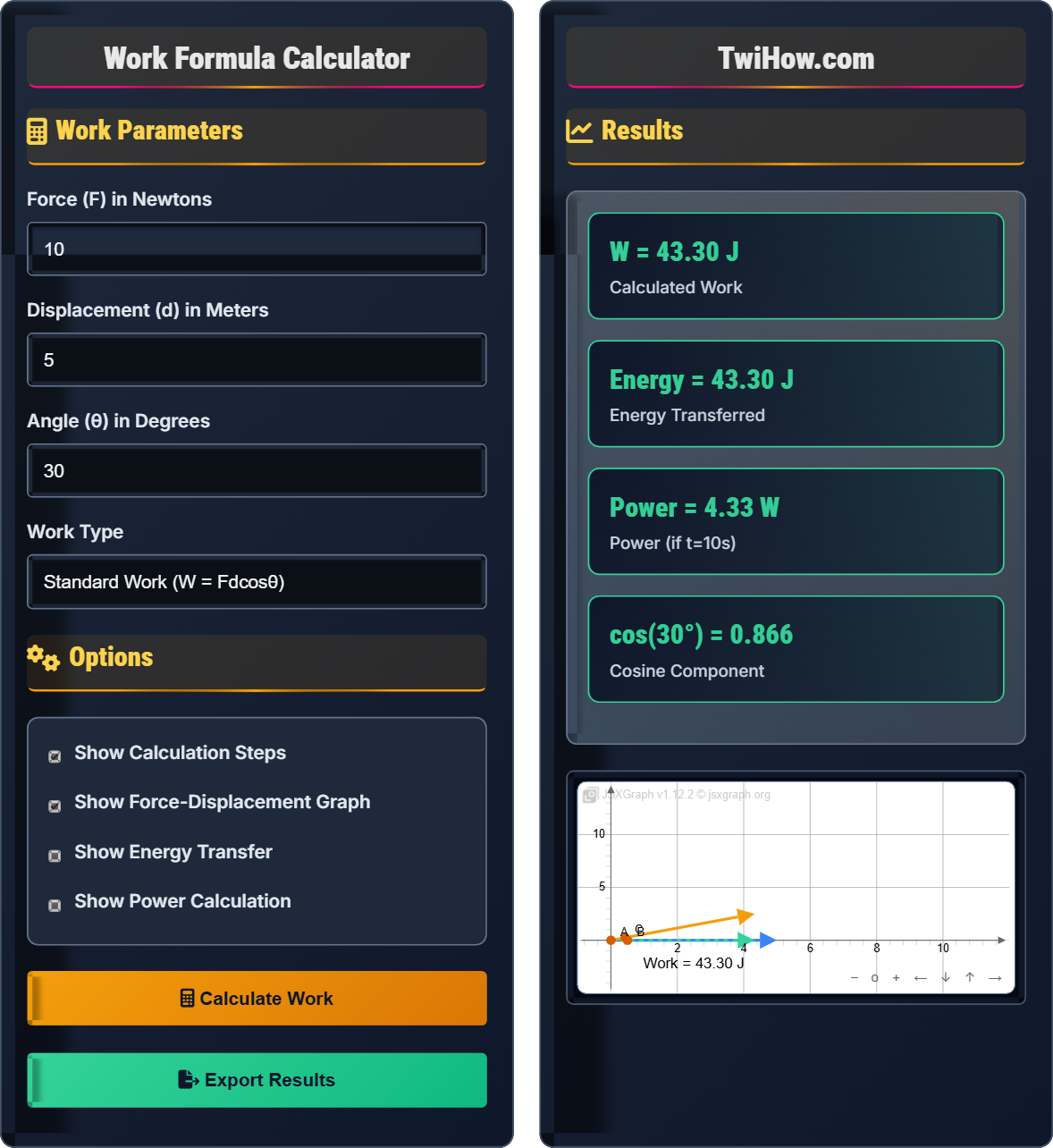
Show the calculator /Simulator\( W = F \cdot d \cdot \cos(\theta) \)
Work is defined as the energy transferred when a force acts on an object causing it to move through a distance. The work formula quantifies this transfer by multiplying the force applied, the displacement of the object, and the cosine of the angle between the force and displacement vectors. Work is measured in Joules (J) and represents the scalar product of force and displacement vectors.
Where:
- \(W\) = work done (Joules)
- \(F\) = magnitude of force applied (Newtons)
- \(d\) = displacement (meters)
- \(\theta\) = angle between force and displacement (degrees)
When the force is applied in the same direction as displacement (θ = 0°), work simplifies to W = Fd. Work is positive when force and displacement are in the same direction, negative when opposite, and zero when perpendicular. The work-energy theorem states that the net work done on an object equals its change in kinetic energy.
Work Parameters
Options
Results
| Parameter | Value | Unit | Symbol |
|---|
Enter parameters to see calculation steps.
Additional physics relationships will appear here.
Work Formula Explained
Work in physics is defined as the transfer of energy that occurs when a force acts on an object causing it to move through a distance. It's a scalar quantity measured in Joules (J) and represents the mechanical energy transferred to or from an object. The work formula incorporates both the magnitude of the force and the displacement, as well as the directional relationship between them. Work is only done when there is displacement in the direction of the applied force.
The fundamental work formula is:
Special cases:
Where:
- \(W\) = work done (Joules)
- \(F\) = magnitude of applied force (Newtons)
- \(d\) = magnitude of displacement (meters)
- \(\theta\) = angle between force and displacement vectors
- \(\cos(\theta)\) = direction component of work
Key characteristics of work:
- Scalar Quantity: Has magnitude but no direction
- Sign Matters: Positive for same direction, negative for opposite
- Zero When Perpendicular: Force perpendicular to displacement does no work
- Path Independent: Only initial and final positions matter
- Mechanical Systems: Lifting, pushing, pulling objects
- Energy Conservation: Work-energy theorem applications
- Thermodynamics: Work done by or on systems
- Engineering: Machine efficiency and power calculations
Work Fundamentals
Work is the transfer of energy that occurs when a force causes displacement in the direction of the force.
\( W = F \cdot d \cdot \cos(\theta) \)
Where W = work, F = force, d = displacement, θ = angle between F and d.
- Work = 0 when θ = 90°
- Work > 0 when 0° ≤ θ < 90°
- Work < 0 when 90° < θ ≤ 180°
- Work = Fd when θ = 0°
Applications
Foundation for kinetic energy, potential energy, and conservation of energy.
- Mechanical engineering design
- Automotive efficiency calculations
- Construction and lifting systems
- Biomechanics and human movement
- Only component of force in direction of motion matters
- Displacement must occur for work to be done
- Static friction can do no work
- Internal forces in systems do no net work
Work Formula Learning Quiz
A 50 N force is applied to push a box 10 m along a horizontal surface. If the force is applied at a 60° angle to the horizontal, how much work is done on the box?
Step 1: Identify known values
Force (F) = 50 N
Displacement (d) = 10 m
Angle (θ) = 60°
Step 2: Apply work formula
W = F × d × cos(θ)
W = 50 × 10 × cos(60°)
W = 500 × 0.5 = 250 J
The work done on the box is 250 Joules.
The answer is A) 250 J.
This problem demonstrates the importance of the angle in work calculations. Only the component of the force in the direction of displacement contributes to work. When the force is applied at an angle, we use the cosine of the angle to find the effective component of the force. In this case, cos(60°) = 0.5, so only half of the applied force contributes to the work done in the direction of motion.
Work: Energy transfer through force and displacement
Force Component: Effective part of force in displacement direction
Scalar Product: Multiplication including direction relationship
• W = Fdcos(θ) (includes direction)
• Only parallel component of force does work
• Work is zero when force perpendicular to motion
• Always consider the angle between force and displacement
• Use cosine to find effective force component
• Remember that work can be negative
• Forgetting to account for the angle
• Using the full force instead of component
• Not considering the direction relationship
A 2 kg book is lifted vertically 1.5 m at constant speed. How much work is done against gravity? What is the work done by gravity?
Step 1: Calculate the weight of the book
Weight (W) = mg = 2 kg × 9.8 m/s² = 19.6 N
Step 2: Determine the force needed to lift the book
Since the book moves at constant speed, the lifting force equals the weight: F = 19.6 N upward
Step 3: Calculate work done by the lifting force
Angle between lifting force and displacement = 0°
W_lift = F × d × cos(0°) = 19.6 N × 1.5 m × 1 = 29.4 J
Step 4: Calculate work done by gravity
Gravity acts downward, displacement is upward, so θ = 180°
W_gravity = F_gravity × d × cos(180°) = 19.6 N × 1.5 m × (-1) = -29.4 J
The work done against gravity is +29.4 J, and the work done by gravity is -29.4 J.
This example illustrates the sign convention in work calculations. When the applied force and displacement are in the same direction, work is positive. When they oppose each other, work is negative. The work done against gravity is stored as gravitational potential energy. The negative work done by gravity indicates that gravity removes energy from the system as the book is lifted.
Gravitational Force: Downward force due to gravity
Gravitational Potential Energy: Energy stored by lifting objects
Constant Speed: Zero acceleration, net force = 0
• Work by gravity is negative when lifting
• Work against gravity is positive
• At constant speed, applied force = weight
• Consider direction of force relative to motion
• Remember that gravity always pulls downward
• Use equilibrium conditions when speed is constant
• Forgetting that gravity opposes upward motion
• Not considering the sign of work done by gravity
• Confusing applied force with net force
A 10 kg box is pushed horizontally with a constant force of 50 N for 8 meters across a surface with a kinetic friction coefficient of 0.2. What is the net work done on the box?
Step 1: Calculate the normal force
On a horizontal surface: N = mg = 10 kg × 9.8 m/s² = 98 N
Step 2: Calculate the frictional force
F_friction = μN = 0.2 × 98 N = 19.6 N
Step 3: Calculate work done by applied force
W_applied = F_applied × d × cos(0°) = 50 N × 8 m × 1 = 400 J
Step 4: Calculate work done by friction
Friction opposes motion: θ = 180°
W_friction = F_friction × d × cos(180°) = 19.6 N × 8 m × (-1) = -156.8 J
Step 5: Calculate net work
W_net = W_applied + W_friction = 400 J + (-156.8 J) = 243.2 J
The net work done on the box is 243.2 Joules.
This problem demonstrates how to calculate net work when multiple forces act on an object. The applied force does positive work, while friction does negative work. The net work represents the total energy transferred to the object. According to the work-energy theorem, this net work equals the change in kinetic energy of the object.
Frictional Force: Resistive force opposing motion
Normal Force: Perpendicular contact force
Net Work: Sum of all work done on object
• Friction always opposes motion direction
• Net work = sum of individual works
• W_net = ΔKE (work-energy theorem)
• Identify all forces doing work
• Calculate work for each force separately
• Sum all works to get net work
• Forgetting to account for friction
• Using wrong angle for friction work
• Not considering direction of friction
A 5 kg object moves in a circular path of radius 3 m at constant speed. How much work does the centripetal force do on the object during one complete revolution?
Step 1: Identify the direction of centripetal force
The centripetal force always points radially inward toward the center of the circle.
Step 2: Identify the direction of displacement
The instantaneous displacement (velocity) is always tangent to the circular path.
Step 3: Determine the angle between force and displacement
The angle between radial force and tangential displacement is always 90°.
Step 4: Calculate work done
W = F × d × cos(90°) = F × d × 0 = 0
Since the angle is always 90°, cos(90°) = 0, so the work done by the centripetal force is zero throughout the motion.
The work done by the centripetal force is 0 Joules.
This example demonstrates a key principle: forces perpendicular to the direction of motion do no work. In circular motion, the centripetal force changes the direction of the velocity but not its magnitude. Since the force is always perpendicular to the displacement, no energy is transferred through work. This is why objects in uniform circular motion maintain constant speed despite experiencing a net force.
Centripetal Force: Radial force maintaining circular motion
Uniform Circular Motion: Constant speed along circular path
Tangential Velocity: Velocity vector tangent to path
• Perpendicular force does no work
• Centripetal force changes direction, not speed
• W = 0 when θ = 90°
• Always consider the angle between force and displacement
• Remember that work requires displacement in force direction
• Circular motion has special work properties
• Assuming any force doing work on moving object
• Not recognizing perpendicular directions
• Forgetting that centripetal force does no work
Which of the following statements about work is TRUE?
Let's examine each option:
A) False - Work can be positive, negative, or zero depending on the angle between force and displacement
B) False - Work is a scalar quantity (magnitude only, no direction)
C) True - Work is negative when the force opposes the displacement (90° < θ ≤ 180°)
D) False - Work is measured in Joules (J), not Newtons (N)
Work is a scalar quantity that can be positive (when force and displacement are in the same direction), negative (when they oppose each other), or zero (when perpendicular). The sign indicates the relationship between the direction of the force and the displacement.
The answer is C) Work can be negative.
The scalar nature of work is important to understand. Unlike force and displacement which are vectors, work has only magnitude. The sign of work indicates the direction relationship between force and displacement but doesn't make work a vector. Negative work means energy is removed from the system, while positive work means energy is added to the system.
Scalar Quantity: Has magnitude only (no direction)
Vector Quantity: Has both magnitude and direction
Negative Work: Energy removed from system
• Work is scalar, not vector
• W > 0 when force and displacement in same direction
• W < 0 when force opposes displacement
• Remember work is scalar
• Focus on angle relationship
• Consider energy transfer direction
• Treating work as vector quantity
• Assuming work is always positive
• Confusing units of work with force
FAQ
Q: What's the difference between work and energy?
A: Work and energy are closely related but distinct concepts. Energy is a property of a system that represents its capacity to do work. It exists in various forms (kinetic, potential, thermal, etc.). Work is a process of transferring energy from one system to another through the application of a force causing displacement. When work is done on an object, its energy changes. The work-energy theorem states that the net work done on an object equals its change in kinetic energy. Both are measured in Joules, but energy is a state property while work is a process quantity.
Q: How is the work formula used in engineering applications?
A: The work formula is fundamental in engineering for calculating energy requirements, efficiency, and system performance. In mechanical engineering, it's used to determine the work needed for lifting, moving, or deforming objects. In thermodynamics, work calculations are essential for analyzing heat engines, compressors, and turbines. Civil engineers use it for construction projects involving cranes and hoisting. Electrical engineers apply work concepts when calculating energy consumption. The formula helps engineers optimize designs by understanding energy transfers and minimizing losses.