Food Deserts and Food Apartheid Impact on Community Health
Complete health guide • Food access
Food Access and Health:
Analyze Health ImpactFood deserts and food apartheid represent critical public health challenges that limit access to nutritious, affordable food in underserved communities. Food deserts refer to geographic areas with limited access to grocery stores, while food apartheid recognizes the systemic racial and economic inequalities that create these conditions. Both phenomena contribute to poor health outcomes and health disparities.
Key characteristics include:
- Geographic Isolation: Limited access to full-service grocery stores
- Economic Barriers: High cost of healthy foods and limited income
- Transportation Challenges: Lack of reliable transportation
- Quality Issues: Predominance of convenience stores and fast food
- Systemic Causes: Historical disinvestment and discriminatory policies
These conditions disproportionately affect low-income and minority communities, creating long-term health disparities and perpetuating cycles of poor nutrition and chronic disease.
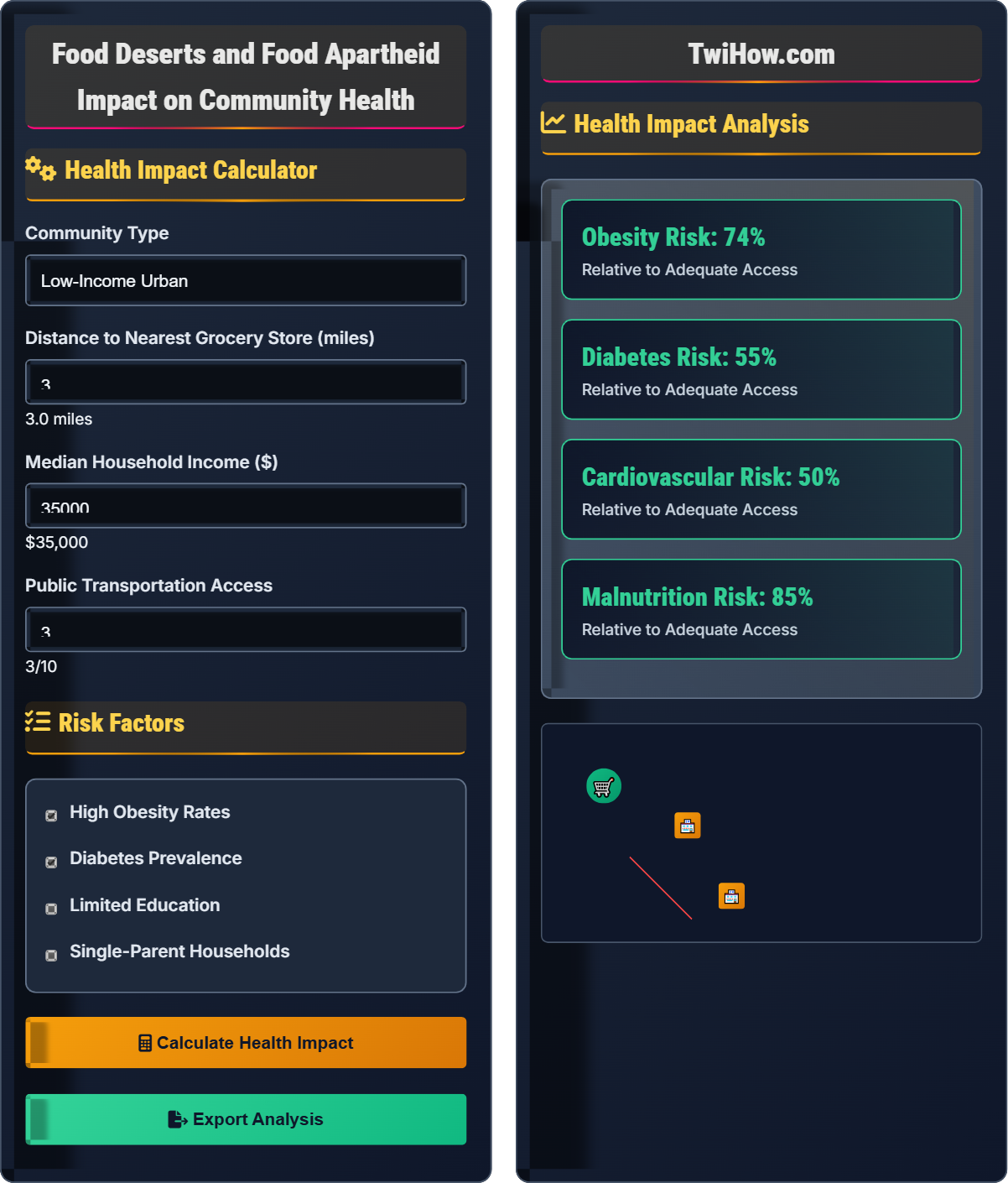
Health Impact Calculator
Risk Factors
Health Impact Analysis
Health Impact Analysis
Communities with limited food access experience higher rates of obesity, diabetes, cardiovascular disease, and other diet-related chronic conditions due to reliance on processed and fast foods.
Insufficient access to fresh fruits, vegetables, and whole grains leads to deficiencies in essential vitamins, minerals, and fiber, contributing to poor health outcomes.
Children in food desert communities face higher rates of childhood obesity, developmental delays, and poor academic performance linked to inadequate nutrition.
Studies show that residents of food deserts have shorter life expectancies due to increased rates of diet-related diseases and limited access to preventive health services.
Food Access Analysis
Distance to grocery stores, transportation limitations, and neighborhood design affect food accessibility, particularly for elderly, disabled, and low-income residents.
High cost of healthy foods, limited income, and lack of bulk purchasing options create financial barriers to nutritious food access.
Prevalence of convenience stores, fast food, and processed foods in underserved areas limits access to fresh, healthy options.
Work schedules, store hours, and limited time for food shopping create additional barriers for working families.
Food Deserts and Food Apartheid Health Impact
Food deserts are geographic areas where residents have limited access to affordable and nutritious food, particularly fresh fruits and vegetables. Food apartheid is a term used by scholars and activists to describe the systemic racism and economic inequalities that create these conditions. Both concepts refer to the same phenomenon but food apartheid acknowledges the intentional policy decisions that created these disparities.
This process shows how geographic and economic factors lead to health disparities through food access limitations.
Food access limitations affect health through multiple pathways:
- Chronic Diseases: Obesity, diabetes, cardiovascular disease, hypertension
- Nutritional Deficiencies: Vitamin, mineral, and fiber inadequacies
- Developmental Issues: Childhood growth and cognitive development problems
- Mental Health: Stress, anxiety, and depression related to food insecurity
- Life Expectancy: Reduced longevity due to preventable health conditions
- Historical Redlining: Discriminatory housing policies that segregated communities
- Economic Disinvestment: Withdrawal of resources from certain neighborhoods
- Zoning Laws: Regulations that favor fast food over grocery stores
- Transportation Planning: Infrastructure that favors suburban development
- Corporate Investment: Retail decisions based on profit margins
Health Impact Mechanisms
Chronic diseases, nutritional deficiencies, developmental issues, mental health impacts, reduced life expectancy.
Health Impact = (Food Access × Nutrition Quality) + (Socioeconomic Factors × Health Outcomes)
Where Impact = health deterioration level, Access = food availability and affordability.
- Food access directly affects nutrition quality
- Social determinants influence health outcomes
- Health disparities are systemic
- Interventions must address root causes
Social Determinants
Historical redlining, economic disinvestment, racial discrimination, zoning laws, transportation access, income inequality.
- Historical policy decisions create conditions
- Economic systems perpetuate inequalities
- Geographic factors concentrate disadvantages
- Access limitations affect health outcomes
- Cycles of disadvantage continue
- Health disparities are not accidental
- Systemic changes are needed
- Community involvement is essential
- Intersectionality matters
Health Impact Analysis
Residents of food deserts have significantly higher rates of obesity, type 2 diabetes, cardiovascular disease, and hypertension. Limited access to fresh fruits, vegetables, and whole grains forces reliance on processed and fast foods that are high in sodium, sugar, and unhealthy fats.
Insufficient intake of essential vitamins, minerals, and fiber leads to deficiencies that affect immune function, bone health, and digestive health. Children are particularly vulnerable to developmental impacts from poor nutrition.
Children in food desert communities face higher rates of childhood obesity, developmental delays, and poor academic performance linked to inadequate nutrition. These effects can have lifelong consequences for health and economic opportunities.
Food insecurity and limited access to healthy options contribute to stress, anxiety, and depression. The constant worry about accessing adequate food creates chronic psychological stress that affects overall health.
Food Access Barriers
Distance to grocery stores, lack of public transportation, and poor walkability prevent residents from accessing healthy food options. Rural areas face different challenges than urban communities, but both experience geographic isolation from healthy food sources.
High cost of healthy foods, limited income, and lack of bulk purchasing options create financial barriers. Fresh produce and healthy options are often more expensive than processed alternatives, making healthy eating financially challenging for low-income families.
Prevalence of convenience stores, corner stores, and fast food establishments in underserved areas limits access to fresh, healthy options. These venues typically offer limited selections of nutritious foods.
Work schedules, store hours, and limited time for food shopping create additional barriers for working families. Single-parent households and individuals with multiple jobs face particular challenges accessing food during store hours.
Systemic Causes
Food Access Comparison
| Factor | Food Desert Areas | Adequate Access Areas |
|---|---|---|
| Distance to Grocery Store | >1 mile (urban), >10 miles (rural) | <1 mile |
| Healthy Food Availability | Limited options | Abundant options |
| Obesity Rates | High (35-45%) | Lower (25-30%) |
| Diabetes Prevalence | High (15-20%) | Lower (8-12%) |
| Heart Disease | Higher rates | Lower rates |
| Life Expectancy | Shorter | Longer |
Historical Development
Intervention Strategies
Community-based interventions can significantly improve food access and health outcomes while addressing systemic causes of food disparities.
Food Access and Health Quiz
What is the primary characteristic of a food desert?
Food deserts are defined as areas with limited access to healthy, affordable food. This includes geographic isolation from grocery stores, economic barriers to purchasing nutritious foods, and limited transportation options. The key is the constraint on access rather than complete absence of food.
The answer is B) Areas with limited access to healthy, affordable food.
Food deserts encompass multiple dimensions of access including geographic, economic, and transportation barriers. The definition recognizes that food access is not just about presence of food but about access to healthy, affordable options that support good nutrition.
Food Desert: Geographic area with limited food access
Food Access: Ability to obtain healthy foods
Healthy Foods: Nutritious, affordable options
• Access includes multiple dimensions
• Geographic and economic factors
• Transportation is key
• Consider all access dimensions
• Think about healthy options
• Evaluate affordability
• Confusing food deserts with food scarcity
• Not considering transportation
• Ignoring economic barriers
Explain the pathways through which food deserts contribute to poor health outcomes in affected communities.
Pathway 1 - Dietary Quality: Limited access to fresh produce forces reliance on processed and fast foods that are high in sodium, sugar, and unhealthy fats, leading to poor nutrition.
Pathway 2 - Chronic Disease: Poor diet increases risk of obesity, diabetes, cardiovascular disease, and hypertension, which are prevalent in food desert communities.
Pathway 3 - Nutritional Deficiencies: Inadequate intake of essential vitamins, minerals, and fiber affects immune function and overall health.
Pathway 4 - Child Development: Poor nutrition in children affects growth, cognitive development, and academic performance.
Pathway 5 - Mental Health: Food insecurity creates chronic stress that affects mental health and overall well-being.
Food deserts affect health through multiple interconnected pathways. The primary mechanism is through dietary quality, which then cascades through various health outcomes. Understanding these pathways helps identify intervention points and the comprehensive nature of the problem.
Dietary Quality: Nutritional value of consumed foods
Chronic Disease: Long-term health conditions
Nutritional Deficiencies: Inadequate nutrient intake
• Multiple pathways exist
• Pathways are interconnected
• Effects are cumulative
• Consider direct and indirect effects
• Think about vulnerable populations
• Evaluate long-term impacts
• Focusing on single pathway
• Not considering vulnerable groups
• Ignoring long-term effects
A community of 10,000 residents lives in a food desert with the nearest grocery store 5 miles away. The community has a median income of $25,000 and limited public transportation. Calculate the likely health impacts if the community lacks access to healthy foods for 10 years, considering that food desert residents have 25% higher obesity rates and 40% higher diabetes rates.
Base Population Analysis:
Assuming 30% obesity rate in normal areas: 10,000 × 30% = 3,000 obese residents
Food Desert Impact:
Increased obesity rate: 30% × 1.25 = 37.5%
Additional obese residents: 10,000 × 37.5% = 3,750 residents
Additional cases: 3,750 - 3,000 = 750 more obese residents
Diabetes Impact:
Assuming 10% base rate: 10,000 × 10% × 1.40 = 1,400 diabetic residents
Additional cases: 1,400 - (10,000 × 10%) = 400 more diabetic residents
Healthcare Costs: Additional burden of treating these conditions over 10 years.
This calculation demonstrates how food access limitations create significant health disparities at the community level. The cumulative effect over time shows how systemic issues create long-term health burdens that compound over years.
Population Health: Health outcomes for entire community
Health Disparities: Unequal health outcomes
Healthcare Costs: Financial burden of treating conditions
• Effects are cumulative over time
• Population-level impacts
• Healthcare costs increase
• Calculate population-level impacts
• Consider cumulative effects
• Think about healthcare costs
• Not calculating population impacts
• Ignoring cumulative effects
• Not considering healthcare costs
You are designing a food access intervention for a community with 5,000 residents in a food desert. Propose a comprehensive strategy that addresses the root causes of food access limitations and promotes long-term health improvements.
Immediate Actions: Establish mobile markets and community gardens to provide immediate access to fresh produce.
Medium-term Solutions: Support local food co-ops and incentivize grocery store development through tax credits and zoning changes.
Long-term Strategies: Advocate for transportation improvements, address zoning disparities, and support economic development.
Community Engagement: Involve residents in planning and implementation to ensure cultural appropriateness and sustainability.
Health Education: Provide nutrition education and cooking classes to maximize health benefits of improved access.
Policy Advocacy: Work to change systemic factors that created the food desert conditions.
Effective food access interventions require multi-level approaches that address immediate needs while working on systemic changes. The most successful strategies combine immediate relief with long-term systemic changes and community engagement.
Multi-level Approach: Addressing multiple factors
Community Engagement: Resident involvement in solutions
Systemic Change: Addressing root causes
• Address root causes
• Engage community
• Plan for sustainability
• Combine immediate and long-term
• Involve community members
• Address systemic factors
• Focusing only on immediate needs
• Not involving community
• Ignoring systemic causes
What is the main difference between "food desert" and "food apartheid" terminology?
Food apartheid is a term that acknowledges the systemic racism and economic inequality that create food access disparities. While "food desert" describes the geographic phenomenon, "food apartheid" recognizes the intentional policy decisions and discriminatory practices that created these conditions.
The answer is C) Food apartheid acknowledges systemic racism and economic inequality.
The terminology reflects different perspectives on the causes of food access disparities. Food apartheid explicitly recognizes the role of systemic racism and discriminatory policies, while food desert is a more neutral geographic descriptor.
Food Desert: Geographic description of limited access
Food Apartheid: Recognition of systemic causes
Systemic Racism: Institutional discrimination
• Terminology reflects perspective
• Systemic causes matter
• Acknowledgment is important
• Consider terminology implications
• Recognize systemic causes
• Acknowledge historical context
• Not understanding terminology differences
• Ignoring systemic factors
• Overlooking historical context
FAQ
Q: What are the most effective interventions for addressing food access issues in our community?
A: The most effective interventions include: 1) Community gardens and farmers markets to provide fresh produce, 2) Mobile markets that bring food directly to neighborhoods, 3) Incentives for grocery stores to locate in underserved areas, 4) Transportation programs to help residents access healthy food, and 5) Policy changes to address zoning and investment patterns. Success requires community engagement and addressing systemic factors.
Q: How can we address the root causes of food access disparities?
A: Addressing root causes requires: 1) Anti-displacement policies to prevent gentrification, 2) Investment in infrastructure and transportation, 3) Zoning reforms to support healthy food access, 4) Economic development in underserved communities, 5) Addressing historical redlining effects, and 6) Ensuring community voices are included in planning decisions. Systemic change is needed for lasting impact.
Social Determinants
Historical redlining and discriminatory policies have concentrated poverty and limited grocery store access in certain communities.
Minority communities are disproportionately affected by food access barriers, reflecting broader systemic inequalities.
Income disparities create different levels of food access and quality, perpetuating health inequities across economic lines.
Zoning laws, agricultural subsidies, and urban planning decisions influence food access patterns and community health outcomes.