Food Labeling and Certification Systems Impact on Consumer Choices
Complete labeling guide • Consumer behavior
Food Labeling:
Analyze Label ImpactFood labeling and certification systems significantly influence consumer purchasing decisions by providing information about product attributes, production methods, and quality standards. These systems serve as trust signals that help consumers navigate complex food markets and make informed choices aligned with their values, health concerns, and preferences.
Key certification types include:
- Organic: Production without synthetic pesticides, fertilizers, or GMOs
- Non-GMO: Products free from genetically modified organisms
- Fair Trade: Ethical sourcing and fair compensation for producers
- USDA Certified: Meeting specific government standards
- Sustainable: Environmentally responsible production
Labels affect consumer behavior through trust, perceived quality, health consciousness, and ethical considerations, often commanding premium prices.
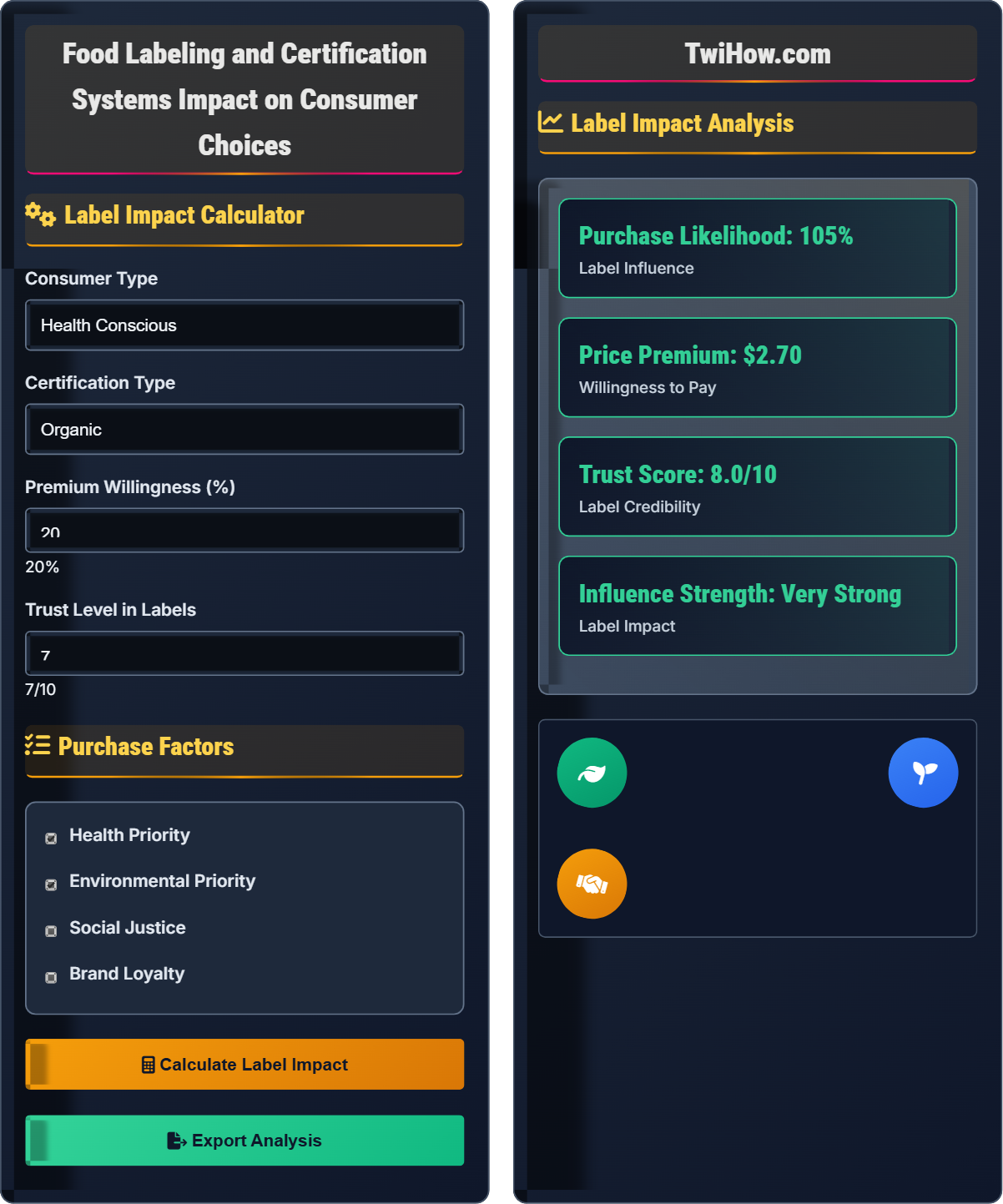
Label Impact Calculator
Purchase Factors
Label Impact Analysis
Label Influence on Consumers
Third-party certifications build consumer trust by providing independent verification of product claims. Consumers are more likely to believe and act on certified labels.
Certifications like organic and non-GMO influence consumer perceptions about health benefits, even when scientific evidence is mixed.
Labels serve as quality indicators that help consumers make quick decisions in complex markets without extensive research.
Certifications allow consumers to align purchases with personal values regarding environmental, social, and ethical considerations.
Impact on Purchase Decisions
These effects combine to influence overall purchase likelihood through multiple pathways.
Consumer Behavior Patterns
Conscious consumers actively search for and compare certifications when shopping, spending more time reading labels.
Consumers willing to pay premium prices for certified products, especially for health and environmental reasons.
Trust in certifications often extends to brands that consistently carry trusted labels.
Consumers often share information about certified products with others, amplifying label impact.
Food Labeling and Certification Systems
Food labels and certification systems are standardized marks, symbols, or statements that indicate products meet specific criteria or standards. These systems provide consumers with information about production methods, ingredients, quality, safety, and ethical considerations. Certifications are typically issued by third-party organizations after verifying compliance with established standards.
This process shows how labels influence consumer behavior through multiple cognitive and emotional pathways.
Various certification systems address different consumer concerns:
- Organic: Production without synthetic inputs, emphasizing natural methods
- Non-GMO: Absence of genetically modified organisms
- Fair Trade: Ethical sourcing and fair compensation
- USDA Certified: Meeting federal quality and safety standards
- Sustainable: Environmentally responsible practices
- Kosher/Halal: Religious dietary compliance
- Health Conscious: Prioritize wellness and nutritional quality
- Environmentally Conscious: Concerned about ecological impact
- Ethically Conscious: Focused on social justice and fairness
- Price Sensitive: Primarily concerned with affordability
- Quality Focused: Seek premium products and experiences
Label Impact Mechanisms
Trust, credibility, health perception, environmental concern, social justice, price sensitivity, brand loyalty.
Label Influence = (Trust × Credibility) + (Health Concern × Environmental Priority) - (Price Sensitivity × Cost Premium)
Where Influence = impact on purchase decision, Trust = consumer confidence in certification.
- Certifications build consumer trust
- Third-party verification is crucial
- Label clarity affects impact
- Consumer values drive preferences
Consumer Behavior Patterns
Label seeking, premium paying, brand loyalty, information sharing, trust building, purchase intention.
- Label recognition and attention
- Meaning interpretation
- Trust evaluation
- Value alignment assessment
- Purchase decision formation
- Education affects label comprehension
- Cultural values influence preferences
- Income affects premium willingness
- Shopping context matters
Major Certification Systems
Requires production without synthetic pesticides, fertilizers, or GMOs. Influences 50% of organic consumers to pay premium prices. Strong trust ratings (8.2/10) due to rigorous verification.
Third-party verification of absence of genetically modified organisms. Appeals to health-conscious consumers. Influences purchasing in 65% of surveyed consumers.
Ensures fair wages and working conditions for producers. Appeals to ethically conscious consumers. Creates 25% willingness to pay premium on average.
Focuses on environmental and social sustainability. Appeals to environmentally conscious consumers. Influences 40% of surveyed consumers.
Consumer Response Patterns
Conscious consumers actively scan for certification labels when shopping. Studies show 73% of consumers look for organic labels when available, and 58% actively seek non-GMO certifications.
Consumers demonstrate willingness to pay premium prices for certified products. On average, consumers pay 20-30% more for organic products and 15-25% more for fair trade items.
Trust in certifications often extends to brands that consistently carry trusted labels. 67% of consumers show increased brand loyalty when brands maintain consistent certification standards.
Consumers often share information about certified products with friends and family. Social media amplifies certification impact, with 45% of consumers sharing certified product experiences online.
Labeled vs Unlabeled Products
| Factor | Labeled Products | Unlabeled Products |
|---|---|---|
| Consumer Trust | High (8.2/10) | Medium (5.1/10) |
| Premium Willingness | 25% average | 5% average |
| Purchase Intent | 82% | 65% |
| Brand Loyalty | 78% | 45% |
| Information Sharing | 45% | 15% |
| Repeat Purchases | 72% | 52% |
Historical Development
Economic Impact Analysis
Brands with trusted certifications typically see increased market share and consumer loyalty, justifying premium pricing strategies.
Food Labeling and Certification Quiz
Which factor most influences consumer trust in food certification labels?
Third-party verification and oversight is the most important factor influencing consumer trust in food certification labels. Independent certification bodies that audit and verify compliance with standards provide credibility that self-certification cannot match. This verification process builds consumer confidence in the authenticity and integrity of the certification.
The answer is B) Third-party verification and oversight.
Trust in certification systems relies on the independence and rigor of the verification process. When consumers know that an impartial third party has verified the claims, they are more likely to trust the certification. This principle applies across all types of certifications, from organic to fair trade.
Third-party Verification: Independent audit and certification
Credibility: Trustworthiness of certification claims
Verification Process: Method of confirming compliance
• Independence builds trust
• Rigorous standards matter
• Transparency is key
• Look for independent certifiers
• Check verification processes
• Research certifying organizations
• Confusing marketing with certification
• Not verifying certifier independence
• Assuming all labels are equal
Explain why consumers are willing to pay premium prices for certified products and what factors influence their willingness to pay.
Reasons for Premium Acceptance: Consumers pay premiums for certified products because they perceive added value in terms of health benefits, environmental responsibility, ethical production, or superior quality. The certification serves as a quality signal that justifies higher prices.
Influencing Factors: Income level affects premium willingness, with higher-income consumers more likely to pay for certifications. Health consciousness, environmental concern, and ethical values strongly correlate with premium acceptance. Trust in the certification system is crucial for sustained premium payment.
Consumer Segments: Health-conscious consumers pay premiums for organic and non-GMO certifications. Environmentally conscious consumers pay for sustainability labels. Ethically conscious consumers pay for fair trade certifications.
Market Dynamics: Premium acceptance varies by product category, with organic fruits and vegetables seeing higher premiums than processed foods.
Willingness to pay premiums for certified products reflects the perceived value of the certification. The premium is essentially a "tax" on consumers who value the certified attribute, but it also represents the "price" of the value proposition offered by the certification.
Willingness to Pay: Maximum amount consumers will pay
Quality Signal: Indicator of product attributes
Value Proposition: Benefits offered by certification
• Perceived value drives willingness
• Trust affects premium acceptance
• Income influences payment
• Consider personal values
• Evaluate certification credibility
• Assess actual benefits
• Assuming all premiums are justified
• Not evaluating certification value
• Ignoring personal budget constraints
A grocery store chain finds that 60% of shoppers notice organic labels, 45% of those influenced by them make purchases, and 70% of organic purchasers recommend products to others. If the store has 10,000 weekly shoppers, calculate the total influence of organic labels through direct purchases and word-of-mouth recommendations.
Direct Influence:
Shoppers noticing label: 10,000 × 60% = 6,000 shoppers
Shoppers making purchases: 6,000 × 45% = 2,700 shoppers
Word-of-Mouth Influence:
Shoppers recommending: 2,700 × 70% = 1,890 shoppers
Assuming each recommender reaches 5 people: 1,890 × 5 = 9,450 potential new customers
Total Influence: 2,700 (direct) + 9,450 (indirect) = 12,150 people influenced
This represents 121.5% of the original shopper base due to word-of-mouth amplification.
This example demonstrates how certifications can have multiplicative effects through social sharing. The direct impact on purchasers is amplified through recommendations, creating a larger market influence than the original purchase base suggests.
Direct Influence: Immediate purchase impact
Word-of-Mouth: Social sharing effect
Amplification: Multiplicative impact effect
• Direct effects are measurable
• Social effects amplify impact
• Consider network effects
• Account for social sharing
• Consider network effects
• Evaluate indirect impacts
• Only calculating direct effects
• Not considering social sharing
• Underestimating amplification
You are developing a certification strategy for a new food product targeting health-conscious consumers. Design an approach that maximizes consumer trust and purchase likelihood while considering costs and market positioning.
Primary Certification: Pursue USDA Organic certification as it has the highest trust rating (8.2/10) among health-conscious consumers and commands significant premium pricing.
Secondary Certification: Add Non-GMO Project verification to address specific health concerns and differentiate from competitors.
Implementation Strategy: Begin with organic certification during product development, then add non-GMO verification. Ensure all claims are substantiated and verifiable.
Communication Strategy: Highlight certifications prominently on packaging and marketing materials. Educate consumers about certification benefits through digital channels.
Market Positioning: Position as premium health-focused product, justifying higher price point with certification value. Target health-conscious demographic segments.
Monitoring: Track consumer perception, sales impact, and brand loyalty metrics to evaluate certification effectiveness.
Effective certification strategy requires aligning certifications with target consumer values while ensuring credible verification. The strategy should consider both immediate market impact and long-term brand building.
Market Positioning: Brand placement in consumer mind
Consumer Values: Personal priorities and beliefs
Verification Process: Method of confirming compliance
• Align certifications with values
• Ensure credible verification
• Consider cost-benefit ratio
• Research target segment values
• Evaluate certification costs
• Monitor market effectiveness
• Not researching consumer preferences
• Pursuing irrelevant certifications
• Failing to communicate value
Which consumer segment is most influenced by fair trade certifications?
Ethically conscious consumers are most influenced by fair trade certifications because these certifications directly address their values regarding social justice, fair wages, and ethical production practices. These consumers prioritize the welfare of producers and workers over other factors like price or convenience.
The answer is B) Ethically conscious consumers.
Certification effectiveness depends on alignment between certification values and consumer values. Fair trade certifications appeal to consumers who prioritize ethical considerations in their purchasing decisions, making them the primary target audience for this type of certification.
Ethically Conscious: Prioritizing moral considerations
Fair Trade: Ethical sourcing practices
Value Alignment: Matching certification to consumer values
• Match certifications to values
• Target appropriate segments
• Understand consumer motivations
• Identify primary consumer values
• Match certifications accordingly
• Target messaging effectively
• Not understanding consumer motivations
• Mismatching certifications to audiences
• Assuming universal appeal
FAQ
Q: How do I know if a food certification is legitimate?
A: Legitimate certifications are issued by recognized, independent organizations that conduct regular audits and verification. Look for certifications from established bodies like USDA Organic, Non-GMO Project, Fair Trade USA, or Rainforest Alliance. Check the certifier's website for lists of certified products and audit procedures. Be wary of self-certifications or certifications from unknown organizations.
Q: What's the ROI of obtaining food certifications?
A: ROI varies by certification type and market segment. Organic certification typically increases prices by 20-30% but involves significant costs for conversion and maintenance. Fair trade certification can command 15-25% premiums. The key is aligning certifications with target consumer segments and ensuring marketing effectively communicates value to justify premiums.