Food Price Responses to Geopolitical and Economic Shocks
Complete shock guide • Food economics
Food Price Shocks:
Analyze Price ResponsesFood prices are highly sensitive to geopolitical and economic shocks, which can cause sudden and significant price volatility. These shocks affect supply and demand dynamics, trade flows, currency values, and market sentiment. Understanding how food prices respond to such shocks is crucial for policymakers, farmers, and consumers.
Key shock types include:
- Geopolitical Shocks: Wars, conflicts, sanctions, trade disputes, political instability
- Economic Shocks: Currency devaluations, inflation, recession, financial crises
- Market Shocks: Supply disruptions, demand surges, speculation
- Policy Shocks: Trade restrictions, export bans, subsidy changes
Responses vary by commodity, geography, and market structure, with some shocks causing immediate price spikes while others have delayed effects.
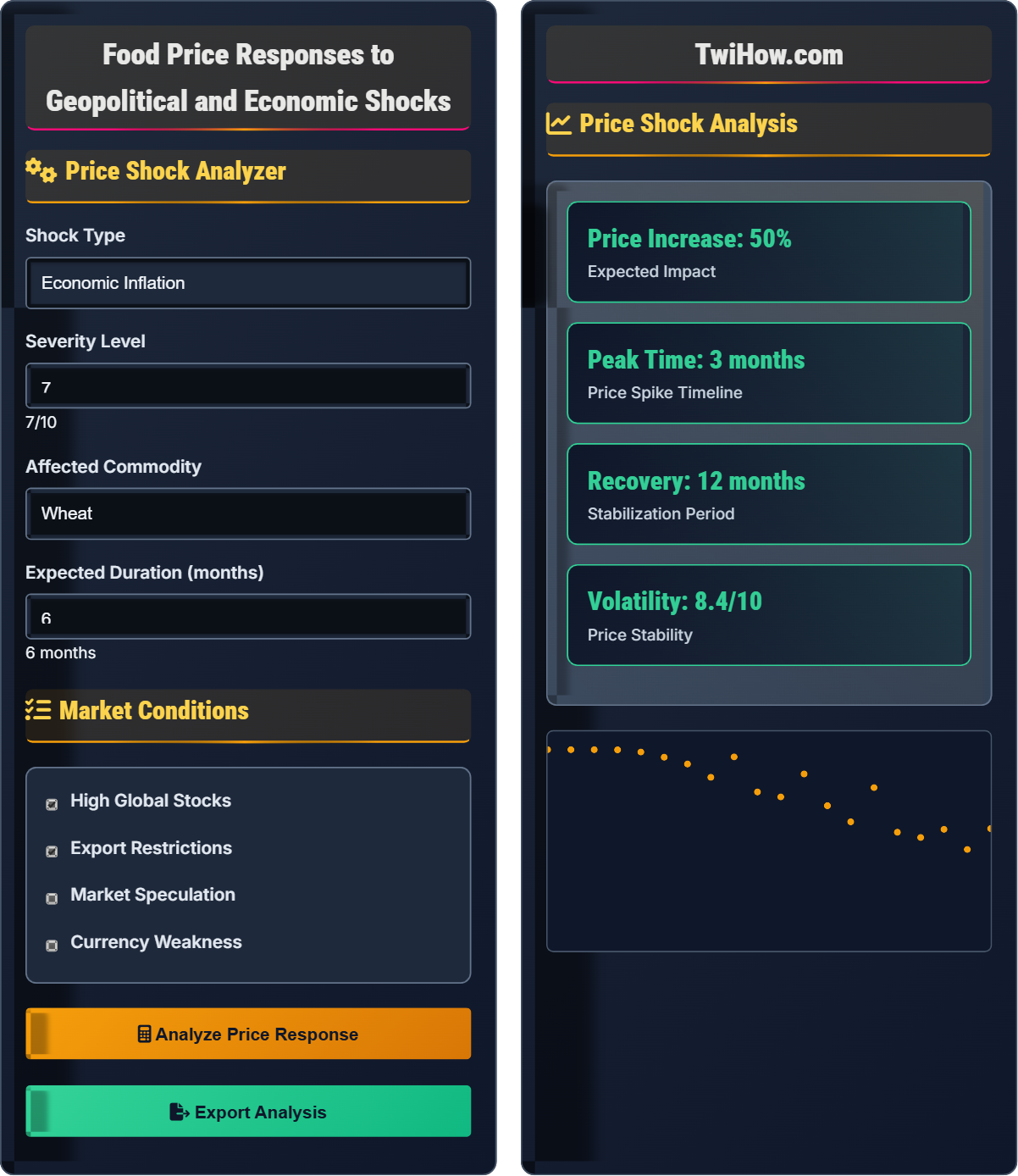
Price Shock Analyzer
Market Conditions
Price Shock Analysis
Price Response Patterns
Prices spike due to supply fears, panic buying, and market uncertainty. Futures markets often experience sharp increases as traders hedge against risk.
Markets adapt as alternative suppliers emerge, inventories are drawn down, and consumers adjust consumption patterns.
Supply chains are restructured, new trade routes established, and market equilibrium begins to reestablish.
Markets return to normal levels, though new baselines may be established depending on permanent supply changes.
Transmission Mechanisms
Direct impact on production capacity, export capabilities, or transportation routes leading to reduced supply.
Hoarding behavior, panic buying, or strategic stockpiling increases short-term demand pressure.
Exchange rate fluctuations affect import/export competitiveness and domestic price levels.
Speculative trading and investor behavior amplify price movements beyond fundamentals.
Impact Pathways
Shocks propagate through markets via multiple pathways, affecting different stakeholders at varying degrees and speeds.
Food Price Shocks Explained
Food price shocks are sudden and significant changes in food prices caused by external events that disrupt normal supply and demand relationships. These shocks can be triggered by geopolitical events, economic crises, natural disasters, or policy changes, leading to volatility in food markets that affects producers, consumers, and food security.
This pathway shows how external events propagate through markets to affect food prices.
Food price shocks can be categorized by their origin and mechanism:
- Supply Shocks: Production disruptions, natural disasters, conflicts
- Demand Shocks: Economic booms, population changes, dietary shifts
- Policy Shocks: Trade restrictions, subsidies, regulations
- Financial Shocks: Currency devaluations, speculation, market crashes
- Speed: Immediate vs. delayed responses
- Magnitude: Size of price change
- Duration: Length of elevated prices
- Scope: Geographic and commodity coverage
- Reversibility: Whether prices return to normal levels
Geopolitical Shock Mechanisms
Wars, sanctions, trade disputes, political instability, currency crises, export bans, supply chain disruptions.
Price Response = (Shock Severity × Market Sensitivity) ÷ (Supply Flexibility + Demand Elasticity)
Where Response = price change magnitude, Severity = shock intensity.
- Food staples are more sensitive to shocks
- Globalized markets respond faster
- Low stocks amplify effects
- Export restrictions worsen impacts
Economic Shock Effects
Inflation, recession, currency devaluation, financial crisis, speculation, oil price changes.
- Currency devaluation increases import costs
- Inflation affects purchasing power
- Financial crises impact investment
- Oil price changes affect transportation
- Interest rates affect speculation
- Monetary policy affects responses
- Trade dependencies matter
- Consumer income levels important
- Government interventions can help
Price Shock Mechanisms
Geopolitical events can directly disrupt food production through destruction of infrastructure, displacement of farmers, or contamination of agricultural areas. Economic sanctions may restrict access to inputs like fertilizers, seeds, or machinery, reducing productive capacity.
Conflicts can block critical shipping routes, ports, or transportation corridors. Economic sanctions may restrict trade flows, forcing countries to find more expensive alternatives or face shortages.
Economic shocks often lead to currency devaluations, making imported food more expensive. Exporting countries may face reduced revenues when their currencies strengthen, affecting production incentives.
Uncertainty from geopolitical events can lead to speculative trading, amplifying price movements. Fear of future shortages may trigger hoarding behavior by governments and private actors.
Historical Examples
Global food prices spiked due to a combination of factors: rising oil prices, biofuel mandates, export restrictions by major exporters, and speculative trading. Rice prices doubled in some markets, triggering social unrest in multiple countries.
The war disrupted exports of wheat, corn, and sunflower oil from Ukraine and Russia, leading to significant price increases. Global wheat prices rose 30% in the first month of the conflict.
The pandemic caused both supply and demand disruptions. Supply chains were disrupted by lockdowns, while demand shifted as restaurants closed and panic buying occurred in retail markets.
While primarily a financial crisis, the economic downturn affected food prices through currency devaluations in developing countries and reduced investment in agriculture, leading to supply constraints.
Shock Response Comparison
| Shock Type | Response Speed | Magnitude | Duration | Reversibility |
|---|---|---|---|---|
| War/Conflict | Immediate | High | Long | Variable |
| Sanctions | Fast | High | Medium | Reversible |
| Currency Crisis | Fast | Medium | Medium | Reversible |
| Export Ban | Immediate | High | Variable | Reversible |
| Financial Crisis | Medium | Medium | Long | Reversible |
Historical Timeline
Mitigation Strategies
Proactive measures to reduce vulnerability to food price shocks typically provide positive returns in terms of food security and economic stability.
Food Price Shocks Quiz
Which type of shock typically has the most immediate impact on food prices?
War or conflict typically has the most immediate impact on food prices because it can instantly disrupt production, transportation, and trade routes. Unlike economic recessions or gradual changes, conflicts create immediate uncertainty and supply disruptions that are quickly reflected in market prices.
The answer is B) War or conflict.
Food markets are highly sensitive to uncertainty and supply disruptions. When geopolitical events occur, they immediately affect expectations about future supply, leading to rapid price adjustments. This is why food prices often spike within hours of major geopolitical announcements.
Food Price Shock: Sudden and significant change in food prices
Supply Disruption: Interruption to normal food supply
Market Sentiment: Trader and consumer confidence
• Geopolitical events have immediate effects
• Markets respond to uncertainty quickly
• Supply disruptions drive prices up
• Consider the immediacy of effects
• Think about supply chain disruptions
• Remember market psychology matters
• Assuming all shocks have immediate effects
• Not considering market psychology
• Underestimating supply disruptions
Explain how currency devaluation affects food prices in importing and exporting countries.
Importing Countries: Currency devaluation makes imported food more expensive, increasing domestic food prices. Citizens need more local currency to buy the same amount of imported food, directly affecting consumer prices.
Exporting Countries: Currency devaluation can make exports cheaper in foreign markets, potentially increasing demand. However, it also increases the cost of importing inputs like fertilizers and machinery, which can raise production costs.
Overall Impact: Import-dependent countries typically see price increases, while exporting countries may experience mixed effects depending on the balance between export competitiveness and input costs.
Currency exchange rates directly affect international food trade. When a country's currency weakens, its purchasing power decreases internationally, making imports more expensive. This relationship is fundamental to understanding how economic shocks transmit through food systems.
Currency Devaluation: Decrease in currency value
Exchange Rate: Value of one currency relative to another
Import Parity Price: Domestic price equivalent to import cost
• Weaker currency increases import costs
• Export competitiveness may improve
• Input costs affect production
• Consider both import and export effects
• Think about input-output relationships
• Remember bidirectional impacts
• Only considering one direction
• Not accounting for input costs
• Assuming all countries are affected equally
A major grain-producing country implements export restrictions due to domestic food security concerns. The country accounts for 15% of global wheat exports. If global wheat stocks are low and the restriction lasts 6 months, estimate the likely impact on global wheat prices and explain the transmission mechanism.
Estimated Impact: With 15% of global supply restricted and low stocks, global wheat prices could increase by 20-35% in the short term, depending on the availability of alternative suppliers.
Transmission Mechanism:
1. Immediate supply shock reduces available wheat on global markets
2. Futures markets respond with price increases based on supply fears
3. Importers seek alternative suppliers, driving up prices for available supply
4. Panic buying and stockpiling amplify the price response
5. Prices begin to stabilize as alternative supplies come online or demand adjusts
Duration: High prices likely persist for 3-6 months until alternative supply arrangements are made.
This example demonstrates how export restrictions can have global impacts even when affecting a relatively small portion of world supply. The key is the combination of the restriction with existing market conditions (low stocks), which amplifies the impact.
Export Restrictions: Limits on food exports
Global Stocks: Available inventory worldwide
Supply Shock: Sudden reduction in available supply
• Market conditions amplify shocks
• Futures markets respond quickly
• Alternative suppliers take time
• Consider existing market conditions
• Think about market expectations
• Account for alternative suppliers
• Not considering market conditions
• Underestimating market reactions
• Forgetting about futures markets
You are advising a government on how to respond to a sudden 40% increase in rice prices due to export restrictions by major suppliers. Design a policy response that balances food security for citizens with market stability.
Immediate Measures:
1. Release strategic rice reserves to temporarily increase supply and calm markets
2. Implement temporary price subsidies for vulnerable populations
3. Negotiate emergency imports from alternative suppliers
Medium-term Measures:
4. Diversify import sources to reduce dependency
5. Support domestic rice production through incentives
6. Expand strategic reserve capacity
Long-term Measures:
7. Develop alternative staple crops to reduce rice dependency
8. Strengthen regional food security cooperation
9. Improve market monitoring and early warning systems
Effective policy responses to food price shocks require a multi-faceted approach that addresses immediate needs while building long-term resilience. The key is balancing short-term relief with market stability to avoid creating further distortions.
Strategic Reserves: Government-held food stocks
Price Subsidies: Government payments to reduce consumer costs
Market Distortions: Government interventions that affect prices
• Balance immediate relief with market stability
• Build long-term resilience
• Target vulnerable populations
• Use multiple policy tools
• Coordinate with international partners
• Monitor market responses
• Only focusing on short-term fixes
• Not considering market reactions
• Ignoring fiscal constraints
How does market psychology amplify food price shocks?
Market psychology amplifies food price shocks by causing prices to rise faster and further than justified by actual supply and demand fundamentals. Fear of shortages leads to panic buying, hoarding, and speculative trading, which creates additional upward pressure on prices beyond the physical supply disruption.
The answer is B) It causes prices to rise faster than justified by fundamentals.
Psychological factors play a crucial role in food price dynamics. When uncertainty increases, both consumers and traders tend to overreact, creating feedback loops that amplify initial shocks. This is why food prices can exhibit volatility that exceeds the underlying physical supply disruption.
Market Psychology: Collective behavior and sentiment
Fear Premium: Extra cost due to uncertainty
Feedback Loop: Self-reinforcing price mechanism
• Psychology amplifies physical shocks
• Fear creates additional demand
• Speculation increases volatility
• Consider behavioral responses
• Account for speculation
• Think about information flows
• Ignoring psychological factors
• Assuming rational market behavior
• Not accounting for speculation
FAQ
Q: What are the most effective policies to protect against food price shocks?
A: The most effective policies include: 1) Strategic grain reserves for emergency releases, 2) Diversified import sources to reduce dependency, 3) Domestic production support through incentives and R&D, 4) Social protection programs for vulnerable populations, 5) Early warning systems for price monitoring, and 6) International cooperation agreements. The most successful approaches combine multiple strategies.
Q: How long do food price shocks typically last?
A: The duration varies significantly by shock type: temporary supply disruptions (2-6 months), export restrictions (3-12 months), conflicts (1-3 years), economic crises (2-5 years). The most persistent effects occur when shocks permanently alter supply capacity or trade relationships. Recovery typically takes 12-24 months after the initial shock ends.