How Food Safety Regulations Protect Consumers and Producers?
Complete food safety guide • Step-by-step explanations
Food Safety Regulations:
Show Compliance CalculatorFood safety regulations establish comprehensive frameworks that protect public health by ensuring safe food production, processing, and distribution. These regulations safeguard consumers from foodborne illness while providing producers with clear standards, legal protections, and market access opportunities.
Key regulatory bodies and their roles:
- US FDA: Oversees most food products except meat and poultry
- USDA FSIS: Regulates meat, poultry, and egg products
- EU EFSA: European Food Safety Authority
- WHO/FAO: International standards and guidelines
- HACCP: Hazard Analysis Critical Control Points system
Regulations balance consumer protection with industry innovation and competitiveness.
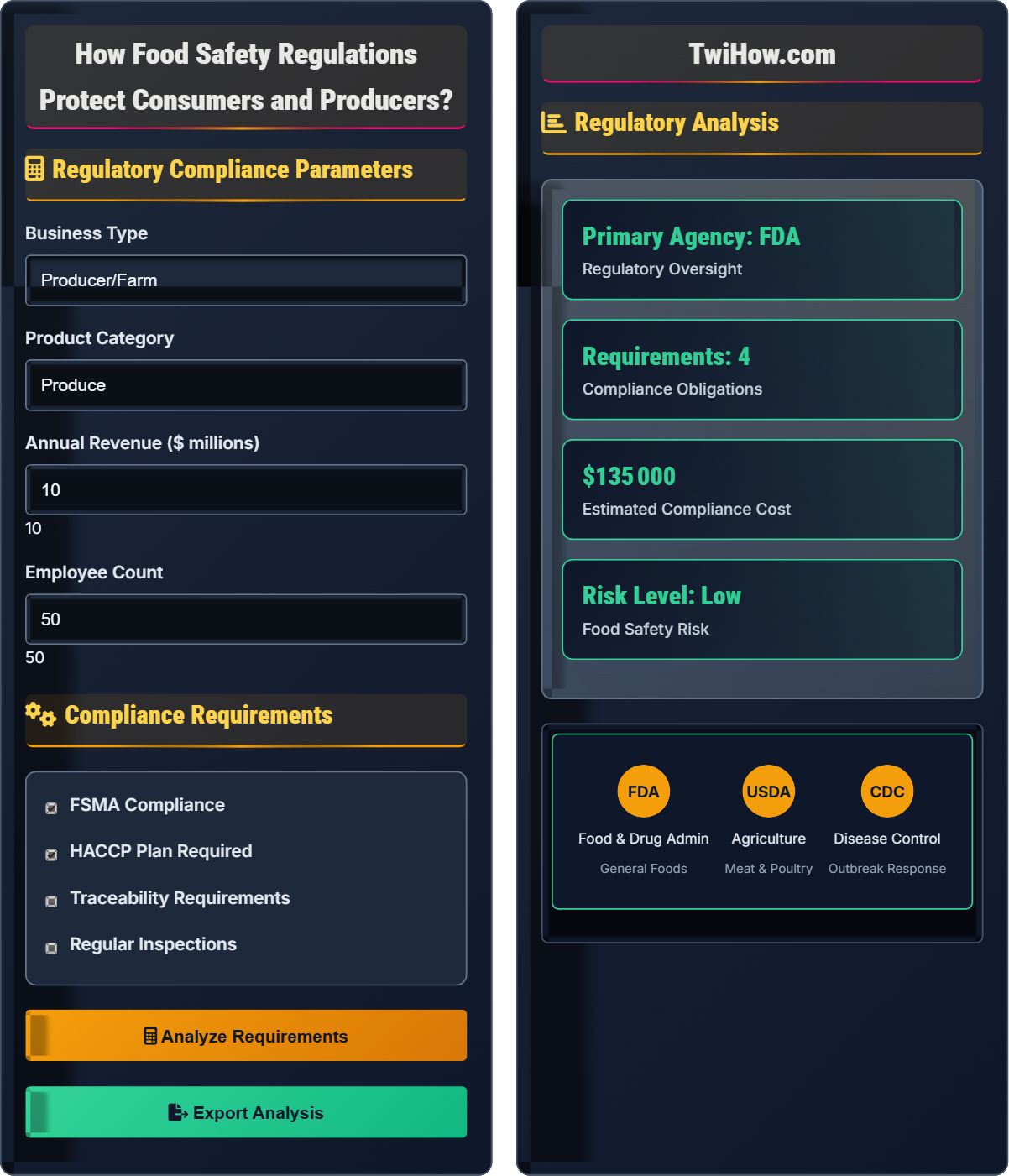
Regulatory Compliance Parameters
Compliance Requirements
Regulatory Analysis
| Requirement | Type | Frequency | Cost |
|---|---|---|---|
| HACCP Plan | Mandatory | Annual Review | $15,000 |
| Sanitation SOPs | Mandatory | Ongoing | $10,000 |
| Supplier Verification | Mandatory | Quarterly | $8,000 |
| Record Keeping | Mandatory | Ongoing | $5,000 |
Food Safety Regulations Explained
Food safety regulations create a multi-layered protection system involving federal agencies, state authorities, and international organizations. The primary goal is to prevent foodborne illness and ensure safe food supply.
Key regulatory components:
- Prevention: Hazard analysis and risk-based controls
- Inspection: Regular monitoring and enforcement
- Response: Rapid action during foodborne illness outbreaks
- Traceability: Ability to track food from farm to fork
- Standards: Scientifically-based safety criteria
Food safety risk is calculated using:
Where:
- Probability: Likelihood of hazard occurrence
- Severity: Potential health consequences
- Exposure: Frequency and magnitude of contact
Food safety incidents have significant economic consequences:
- Recall Costs: Average $10M per incident
- Brand Damage: Long-term reputation impact
- Legal Liability: Lawsuits and settlements
- Lost Sales: Consumer confidence decline
- Regulatory Penalties: Fines and sanctions
The Food Safety Modernization Act (FSMA) shifted focus from responding to contamination to preventing it:
- Preventive Controls: Mandatory hazard analysis for food facilities
- Produce Safety: Standards for growing, harvesting, packing, and holding
- Foreign Supplier Verification: Import safety requirements
- Accredited Third-Party Certification: Voluntary program
- Enhanced Enforcement: Mandatory recall authority
Consumer Protection Mechanisms
Contamination prevention, outbreak response, labeling requirements, inspection authority, recall procedures.
Risk = Probability × Severity × Exposure
Where Probability = likelihood of hazard occurrence, Severity = health consequences, Exposure = frequency of contact.
- Zero tolerance for certain pathogens in ready-to-eat foods
- Mandatory reporting of foodborne illness outbreaks
- Traceback investigations during recalls
- Labeling requirements for allergens
Producer Benefits
Legal liability protection, market access, consumer trust, competitive advantage, standardization.
- Reduced recall risk and associated costs
- Enhanced brand reputation and customer loyalty
- Market access to regulated sectors
- Insurance premium reductions
- Operational efficiency improvements
- Compliance costs vary by business size
- Small businesses may qualify for exemptions
- International harmonization benefits exporters
- Technology adoption can reduce long-term costs
Food Safety Regulations Quiz
Which agency is primarily responsible for regulating meat and poultry products in the United States?
The USDA Food Safety and Inspection Service (FSIS) is responsible for regulating meat, poultry, and processed egg products in the United States. The FDA regulates all other food products. This division of responsibility dates back to the Pure Food and Drug Act of 1906 and subsequent legislation.
The answer is B) USDA FSIS (Food Safety and Inspection Service).
Understanding the jurisdictional divisions between regulatory agencies is crucial for food industry compliance. The USDA FSIS has exclusive authority over meat and poultry products, while the FDA oversees everything else. This division helps prevent regulatory overlap and ensures specialized expertise for different food categories.
FSIS: Food Safety and Inspection Service, part of USDA
Jurisdiction: Legal authority over specific food categories
Exclusive Authority: Sole regulatory responsibility for a domain
• USDA FSIS inspects all meat/poultry sold in interstate commerce
• Products must bear USDA inspection mark
• Federal inspection is mandatory for interstate commerce
• Remember: Meat/Poultry = USDA, Everything Else = FDA
• Look for USDA inspection marks on products
• State regulations may supplement federal requirements
• Confusing FDA and USDA responsibilities
• Assuming all foods are regulated by FDA
• Ignoring dual jurisdiction for mixed products
Explain the seven principles of HACCP (Hazard Analysis Critical Control Points) and describe how implementing these principles protects both consumers and producers.
The Seven HACCP Principles:
1. Conduct Hazard Analysis: Identify and assess potential hazards in the food production process
2. Determine Critical Control Points (CCPs): Identify points where control can prevent, eliminate, or reduce hazards
3. Establish Critical Limits: Set maximum/minimum values for control at CCPs
4. Establish Monitoring Procedures: Create procedures to measure control at CCPs
5. Establish Corrective Actions: Define actions when monitoring shows CCP deviation
6. Establish Verification Procedures: Confirm HACCP system effectiveness
7. Establish Record-Keeping Procedures: Document all HACCP activities
Protection for Consumers: Systematic prevention of foodborne hazards, consistent safety standards, rapid response to deviations
Protection for Producers: Legal compliance defense, reduced liability exposure, market access requirements, operational efficiency improvements
HACCP provides a systematic, science-based approach to food safety that shifts from end-product testing to preventive controls. By identifying critical points in the process and establishing controls, HACCP creates multiple barriers to contamination. This proactive approach is more effective and cost-efficient than relying solely on end-product testing.
HACCP: Hazard Analysis Critical Control Points, systematic preventive approach
Critical Control Point (CCP): Step where control can prevent food safety hazard
Critical Limit: Maximum/minimum value at a CCP to prevent hazards
• HACCP is legally required for juice, seafood, and meat/poultry
• All seven principles must be implemented together
• Documentation is essential for verification
• Use flow diagrams to identify CCPs systematically
• Regular team reviews ensure plan effectiveness
• Training is critical for successful implementation
• Treating HACCP as documentation exercise only
• Failing to validate critical limits scientifically
• Not updating plans when processes change
A medium-sized food processing facility produces $50 million in annual revenue and employs 200 people. Under FSMA regulations, calculate the compliance requirements and estimated costs. Assume preventive controls cost $25,000 annually, HACCP implementation costs $15,000, supplier verification $8,000, and ongoing monitoring $12,000. If non-compliance could result in a recall costing $5 million, what is the ROI of compliance?
Compliance Requirements:
Given the size and revenue, this facility is subject to full FSMA preventive controls requirements.
Annual Compliance Costs:
Preventive controls: $25,000
HACCP implementation: $15,000
Supplier verification: $8,000
Ongoing monitoring: $12,000
Total annual compliance cost: $60,000
ROI Calculation:
Assuming 1% chance of recall without compliance: Expected loss = $5M × 0.01 = $50,000
With compliance, assume 0.1% chance: Expected loss = $5M × 0.001 = $5,000
Risk reduction value: $50,000 - $5,000 = $45,000
Net compliance cost: $60,000 - $45,000 = $15,000
ROI = (Risk reduction - Compliance cost) / Compliance cost = ($45,000 - $60,000) / $60,000 = -25%
However, compliance provides additional benefits (market access, brand protection) making it valuable despite negative direct ROI.
This example illustrates the economic rationale behind food safety regulations. While compliance has upfront costs, it prevents much larger losses from recalls and legal liability. The ROI calculation shows that even with reduced risk, the direct financial benefit may not immediately offset costs, but the risk mitigation is essential for business continuity.
FSMA: Food Safety Modernization Act (2011)
Preventive Controls: Systematic hazard prevention requirements
ROI: Return on Investment
• Facilities over $1M revenue generally must comply
• Small businesses may have modified requirements
• Third-party audits may be required for imports
Under FSMA's Food Traceability Rule, a food manufacturer must maintain records for 17 "Key Data Elements" (KDEs) for high-risk foods. If a product causes an outbreak, regulators can trace the source within 24 hours. Calculate the impact on a hypothetical outbreak scenario: If without traceability the investigation takes 4 weeks and costs $2M, but with proper KDEs it takes 1 day and costs $200,000, what is the cost savings? What additional benefits does traceability provide?
Cost Savings Calculation:
Without traceability: $2,000,000 investigation cost
With traceability: $200,000 investigation cost
Direct cost savings: $2,000,000 - $200,000 = $1,800,000
Time Savings: 28 days vs 1 day = 27-day reduction
Additional Benefits:
1. Reduced consumer exposure: Faster identification stops further illnesses
2. Smaller recall scope: Precise identification limits recall size
3. Less market disruption: Quicker resolution maintains consumer confidence
4. Legal protection: Demonstrates good faith compliance efforts
5. Operational efficiency: Better inventory and supply chain management
These benefits make traceability systems economically valuable despite implementation costs.
Traceability represents a critical component of modern food safety systems. The ability to quickly identify the source of contamination during an outbreak can save lives, reduce economic losses, and maintain consumer confidence. The 24-hour rule under FSMA represents a significant advancement in response capability.
Traceability: Ability to track food through supply chain
KDEs: Key Data Elements required for traceability
Backward Traceability: Tracking from consumer to source
• 17 KDEs required for high-risk foods
• 24-hour traceback capability required
• Records must be maintained for 2 years
• Implement electronic recordkeeping for efficiency
• Train staff on traceability procedures
• Regularly test traceability systems
• Incomplete KDE documentation
• Manual record systems that slow response
• Not testing traceability procedures regularly
What was a significant change introduced by the Food Safety Modernization Act (FSMA) regarding FDA's authority?
Before FSMA, the FDA could only request voluntary recalls from companies. FSMA granted the FDA mandatory recall authority, allowing it to order companies to recall contaminated food products if there is a reasonable probability that the food will cause serious adverse health consequences or death. This represents a significant shift in regulatory power.
The answer is B) Mandatory recall authority for contaminated products.
The mandatory recall authority represents a fundamental shift in FDA's enforcement capabilities. Previously, the FDA had to rely on companies' cooperation for recalls, which sometimes resulted in delays that put consumers at risk. The mandatory authority allows the FDA to act more decisively to protect public health.
Mandatory Recall: Government-ordered product removal from market
Voluntary Recall: Company-initiated product removal
Enforcement Authority: Government power to compel compliance
• Mandatory authority applies to reasonable probability of harm
• Companies still initiate most recalls voluntarily
• FDA can suspend registration for non-compliance
• Respond promptly to FDA requests to avoid mandatory orders
• Maintain robust food safety systems to prevent recalls
• Have recall procedures prepared in advance
• Assuming FDA always requests voluntary recalls
• Not having recall procedures ready
• Delaying response to FDA concerns
FAQ
Q: How do food safety regulations benefit small food businesses that face compliance costs?
A: Food safety regulations provide several benefits for small businesses:
1. Market Access: Compliance enables participation in regulated markets and food service channels that require certifications
2. Insurance Benefits: Many insurers offer lower premiums for businesses with recognized food safety certifications
3. Customer Confidence: Demonstrates commitment to safety, building customer trust and loyalty
4. Legal Protection: Shows good faith effort in case of foodborne illness claims
5. Financial Assistance: Various grants and resources are available to help small businesses comply
Additionally, many regulations include modified requirements or extended compliance timelines for smaller operations.
Q: How do food safety regulations protect me as a consumer?
A: Food safety regulations protect consumers in several ways:
1. Prevention Focus: Requirements for preventive controls and hazard analysis before problems occur
2. Regular Inspections: Government oversight of food facilities to ensure compliance
3. Rapid Response: Systems for quick identification and response to foodborne illness outbreaks
4. Mandatory Reporting: Companies must report certain food safety issues
5. Labeling Requirements: Information about allergens, ingredients, and nutritional content
6. Recall Authority: Government power to remove unsafe products from the market
These protections work together to minimize your risk of foodborne illness and ensure accurate information about food products.