How Food Supply Chains Work and Where Are They Vulnerable?
Complete supply chain guide • Risk analysis
Food Supply Chain Overview:
Analyze Supply Chain RisksFood supply chains are complex networks that move food from farms to consumers, involving multiple stages, actors, and transportation methods. Understanding how these systems work and identifying their vulnerabilities is crucial for food security and economic stability.
Key supply chain stages include:
- Production: Growing, harvesting, and initial processing of food
- Processing: Transforming raw ingredients into consumer-ready products
- Distribution: Transporting goods through warehouses and distribution centers
- Retail: Selling products to consumers through various channels
- Consumption: Final use of food products by consumers
Vulnerabilities in food supply chains can arise from natural disasters, transportation disruptions, labor shortages, cyber attacks, and geopolitical conflicts, potentially leading to food insecurity and economic disruption.
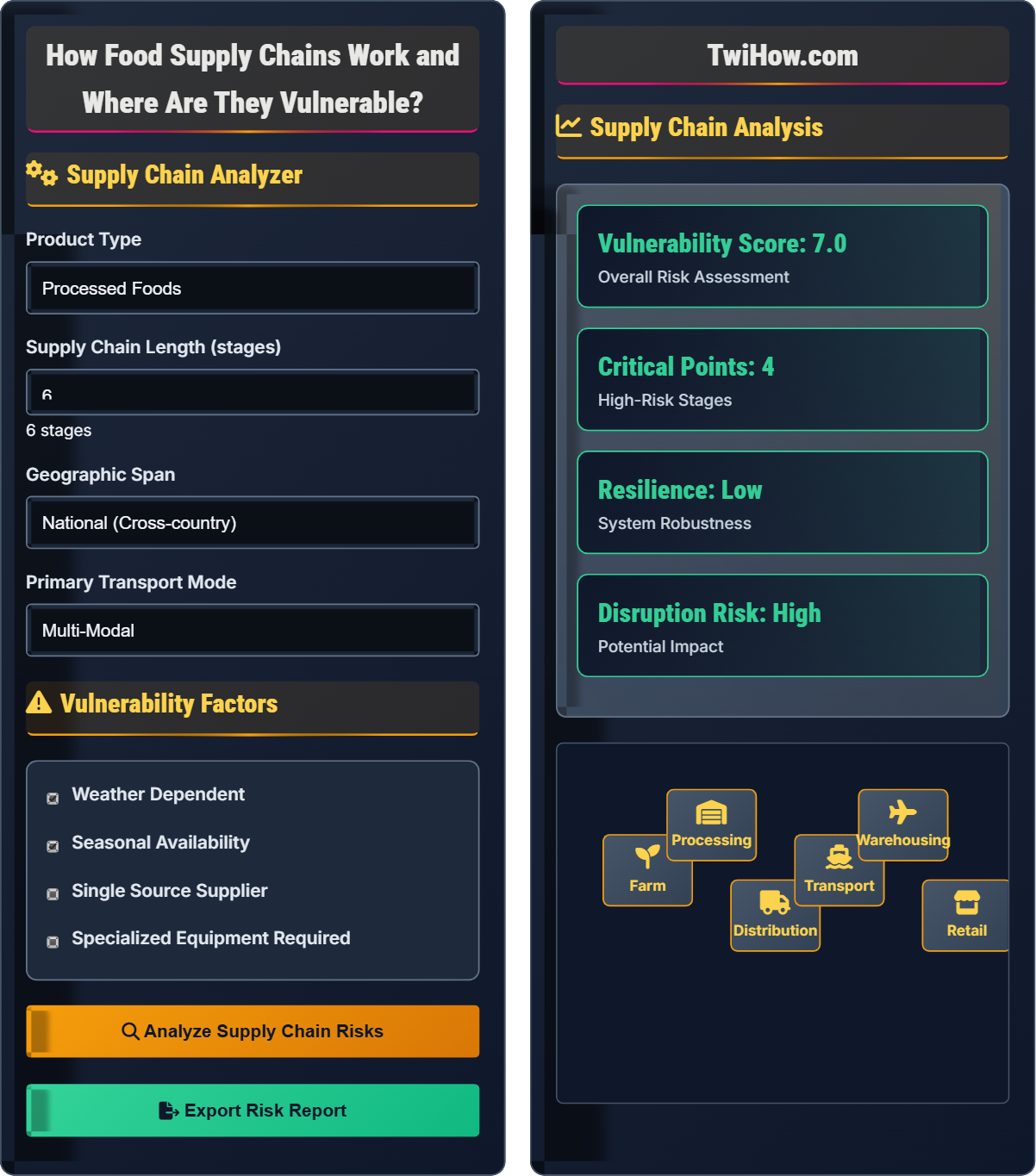
Supply Chain Analyzer
Vulnerability Factors
Supply Chain Analysis
Identified Risk Factors
Long-distance transport increases exposure to fuel price volatility, traffic delays, and infrastructure failures.
Seasonal products and weather-sensitive crops face production uncertainties that cascade through the supply chain.
Reliance on single suppliers or distribution centers creates critical bottlenecks that can halt the entire chain.
Harvesting, processing, and transportation stages require significant labor, making them vulnerable to workforce disruptions.
Resilience Strategies
Develop multiple suppliers and distribution channels to reduce dependency on single sources.
Maintain strategic stockpiles at key points to absorb short-term disruptions.
Implement tracking systems and predictive analytics to anticipate and respond to disruptions.
Reduce geographic span to minimize transportation risks and improve response time.
Food Supply Chain Operations Explained
A food supply chain is the network of interconnected activities and entities that move food from production to consumption. It encompasses all the steps required to get food from farms to consumers, including growing, harvesting, processing, packaging, transporting, storing, and selling food products.
Each stage involves multiple actors and activities, with complex relationships and dependencies that can create vulnerabilities throughout the system.
Key components that make up food supply chains:
- Suppliers: Farmers, producers, and manufacturers
- Processors: Facilities that transform raw materials
- Transporters: Companies that move goods between locations
- Distributors: Entities that manage product flow
- Retailers: Stores and outlets that sell to consumers
- Consumers: End users of food products
- Direct: Short chains connecting producers directly to consumers
- Traditional: Multi-stage chains with intermediaries
- Global: International chains spanning multiple countries
- Vertical: Integrated chains owned by single entities
- Collaborative: Partnerships between multiple organizations
Supply Chain Vulnerabilities
Natural disasters, transportation disruptions, cyber attacks, labor shortages, supplier failures, market fluctuations.
Risk = Probability × Impact × Exposure
Where Risk = potential damage, Probability = likelihood of occurrence, Impact = severity of consequences.
- Longer chains have more potential failure points
- Specialized components create single points of failure
- Geographic concentration increases regional risks
- Dependency on single suppliers creates vulnerability
Resilience Strategies
Diversification, redundancy, flexibility, visibility, agility, sustainability.
- Identify vulnerabilities
- Assess potential impacts
- Develop mitigation strategies
- Implement redundancy
- Monitor and adapt
- Build stakeholder partnerships
- Balance resilience with efficiency
- Consider cost-benefit ratios
- Plan for various scenarios
- Invest in technology and visibility
Food Supply Chain Quiz
Which of the following sequences correctly represents the stages of a typical food supply chain?
The correct sequence starts with production (farming/growing), followed by processing (transforming raw materials), then distribution (moving goods), and finally retail (selling to consumers). This represents the logical flow from farm to table.
The answer is B) Production → Processing → Distribution → Retail.
Understanding the sequential nature of supply chains is fundamental to identifying where vulnerabilities may occur. Each stage builds upon the previous one, meaning disruptions at earlier stages can cascade throughout the entire system. The farm-to-table journey involves multiple handoffs and transformations that each present unique risks.
Production: Growing or manufacturing raw materials
Processing: Transforming raw materials into finished products
Distribution: Moving goods through the supply network
• Supply chains follow a logical sequence
• Each stage adds value to the product
• Disruptions cascade downstream
• Remember the farm-to-table progression
• Consider value addition at each stage
• Think about material flow direction
• Reversing the supply chain sequence
• Confusing distribution with retail
• Forgetting the processing step
Identify and explain the three most critical vulnerabilities in food supply chains and their potential impacts.
1. Transportation Disruption: Food supply chains rely heavily on efficient transportation networks. Disruptions from natural disasters, strikes, fuel shortages, or infrastructure failures can halt the movement of goods, leading to shortages and spoilage. The impact includes food waste, price spikes, and supply shortages.
2. Single Point of Failure: Over-reliance on single suppliers, distribution centers, or transportation routes creates critical bottlenecks. If a key facility fails, the entire chain can be disrupted. The impact includes total supply interruption and inability to quickly switch alternatives.
3. Weather and Climate Dependency: Food production is inherently dependent on weather conditions. Droughts, floods, extreme temperatures, and climate change can affect crop yields and livestock production. The impact includes reduced availability, increased prices, and seasonal disruptions.
Supply chain vulnerabilities often stem from dependencies and interconnections. The most critical vulnerabilities are those that can cause system-wide disruptions rather than localized problems. Understanding these vulnerabilities helps in developing targeted mitigation strategies and building resilient systems.
Single Point of Failure: A part of the system whose failure stops the entire system
Transportation Disruption: Interruption in the movement of goods
Weather Dependency: Reliance on favorable weather conditions
• Identify system-wide impacts
• Consider cascading effects
• Assess probability and severity
• Think about interdependencies
• Consider worst-case scenarios
• Evaluate recovery time
• Focusing only on immediate impacts
• Ignoring secondary effects
• Not considering systemic risks
A major hurricane destroys a key port facility that handles 40% of fresh produce imports for a region. The port is expected to remain closed for 6-8 weeks. Calculate the potential impact on the food supply chain and propose mitigation strategies for retailers and consumers.
Impact Assessment: With 40% of fresh produce imports disrupted, retailers can expect significant shortages, particularly for items that cannot be sourced locally. Prices will likely increase by 20-50% due to reduced supply and increased transportation costs from alternative routes.
Immediate Retailer Actions: Diversify import routes, increase inventory of shelf-stable alternatives, communicate with customers about potential shortages, negotiate with local suppliers for increased capacity.
Consumer Mitigation: Accept temporary substitution of products, consider frozen or canned alternatives, adjust meal planning to accommodate available items, support local producers.
Long-term Strategies: Develop redundant supply routes, invest in local sourcing, build strategic reserves, improve supply chain visibility systems.
Real-world supply chain disruptions demonstrate the interconnected nature of global food systems. The impact of a single point of failure can ripple through multiple sectors and geographies. Effective mitigation requires both immediate response actions and long-term structural changes to build resilience.
Port Facility: Infrastructure for receiving and shipping cargo
Supply Chain Visibility: Real-time tracking of goods and information
Redundancy: Backup systems and alternative pathways
• Plan for critical infrastructure failures
• Build buffer stocks for essential items
• Identify critical infrastructure dependencies
• Develop alternative routing plans
• Establish emergency communication protocols
• Over-relying on single import routes
• Not having contingency plans
• Failing to diversify suppliers
A food company is evaluating whether to source ingredients from a single large supplier in a distant location or multiple smaller suppliers in different regions. Analyze the risks and benefits of each approach and recommend a strategy.
Single Large Supplier (Pros): Lower costs, consistent quality, simplified logistics, stronger negotiating power.
Single Large Supplier (Cons): High risk of supply disruption, dependence on single entity, potential for quality issues, limited flexibility.
Multiple Smaller Suppliers (Pros): Reduced risk of total disruption, geographic diversification, increased flexibility, competitive pricing.
Multiple Smaller Suppliers (Cons): Higher management complexity, potential quality inconsistencies, increased logistics costs.
Recommended Strategy: Hybrid approach using 2-3 suppliers in different geographic regions, with one primary supplier and 1-2 backup suppliers. This balances cost efficiency with risk mitigation.
Supply chain risk management involves balancing cost efficiency with resilience. The optimal strategy often involves diversification without over-complicating operations. The goal is to minimize the probability and impact of disruptions while maintaining operational efficiency.
Supply Chain Risk: Potential for disruptions to affect operations
Diversification: Spreading risk across multiple sources
Hybrid Strategy: Combining different approaches for optimal results
• Balance cost and risk factors
• Diversify without over-complicating
• Maintain quality standards
• Map critical supplier dependencies
• Assess supplier financial stability
• Implement dual sourcing for key inputs
• Choosing suppliers based on cost alone
• Not evaluating supplier risks
• Over-concentrating in single regions
Which of the following is the most effective strategy for building resilience in food supply chains?
Building strategic buffer stocks provides protection against short-term disruptions, while diversifying suppliers reduces dependency on single sources. This combination addresses both supply interruptions and demand fluctuations. The other options would actually increase vulnerability by reducing flexibility and creating single points of failure.
The answer is C) Building strategic buffer stocks and diversifying suppliers.
Supply chain resilience requires multiple complementary strategies. Buffer stocks provide immediate protection against disruptions, while supplier diversification prevents total system failure. These strategies work together to create a robust system that can withstand various types of shocks and continue functioning.
Buffer Stocks: Strategic inventory held to absorb disruptions
Supplier Diversification: Using multiple sources for the same inputs
Supply Chain Resilience: Ability to withstand and recover from disruptions
• Balance cost and resilience
• Diversify critical dependencies
• Maintain strategic reserves
• Identify critical supply points
• Develop alternative sourcing options
• Monitor supplier financial health
• Optimizing for cost only
• Not planning for disruptions
• Over-relying on single suppliers
FAQ
Q: How do disruptions in food supply chains affect me as a consumer?
A: Supply chain disruptions can affect you in several ways: 1) Higher prices due to reduced supply, 2) Product shortages or unavailability of certain items, 3) Reduced variety of available products, 4) Potential quality issues if retailers rush to fill gaps. You might notice empty shelves during severe disruptions, such as during natural disasters or pandemics, and see price increases for essential items like meat, produce, or dairy products.
Q: What can businesses do to protect themselves from food supply chain disruptions?
A: Businesses can take several protective measures: 1) Diversify suppliers to avoid single points of failure, 2) Maintain strategic buffer stocks of critical ingredients, 3) Develop alternative sourcing plans, 4) Invest in supply chain visibility technology to track shipments in real-time, 5) Build relationships with local suppliers as backup options, 6) Develop flexible menus that can accommodate ingredient substitutions, and 7) Create contingency plans for different disruption scenarios.