Urban Food Systems & Demographics
Complete guide • Step-by-step explanations
Urban Food Systems:
Show Adaptation PlannerAs urbanization accelerates globally, food systems must adapt to serve growing metropolitan populations with diverse dietary preferences, cultural backgrounds, and economic capabilities. Urban food systems face unique challenges including limited space, transportation logistics, and changing consumer behaviors.
Key adaptation strategies include vertical farming, urban agriculture, food hubs, local sourcing, and culturally responsive production. These approaches address the intersection of urban density, demographic diversity, and food security.
Demographic changes such as aging populations, multiculturalism, and income inequality require tailored food system responses. Success depends on integrating technology, policy, and community engagement.
Real-world applications span from rooftop gardens to smart city food networks and culturally diverse food markets.
Adaptation Planning Parameters
Adaptation Strategies
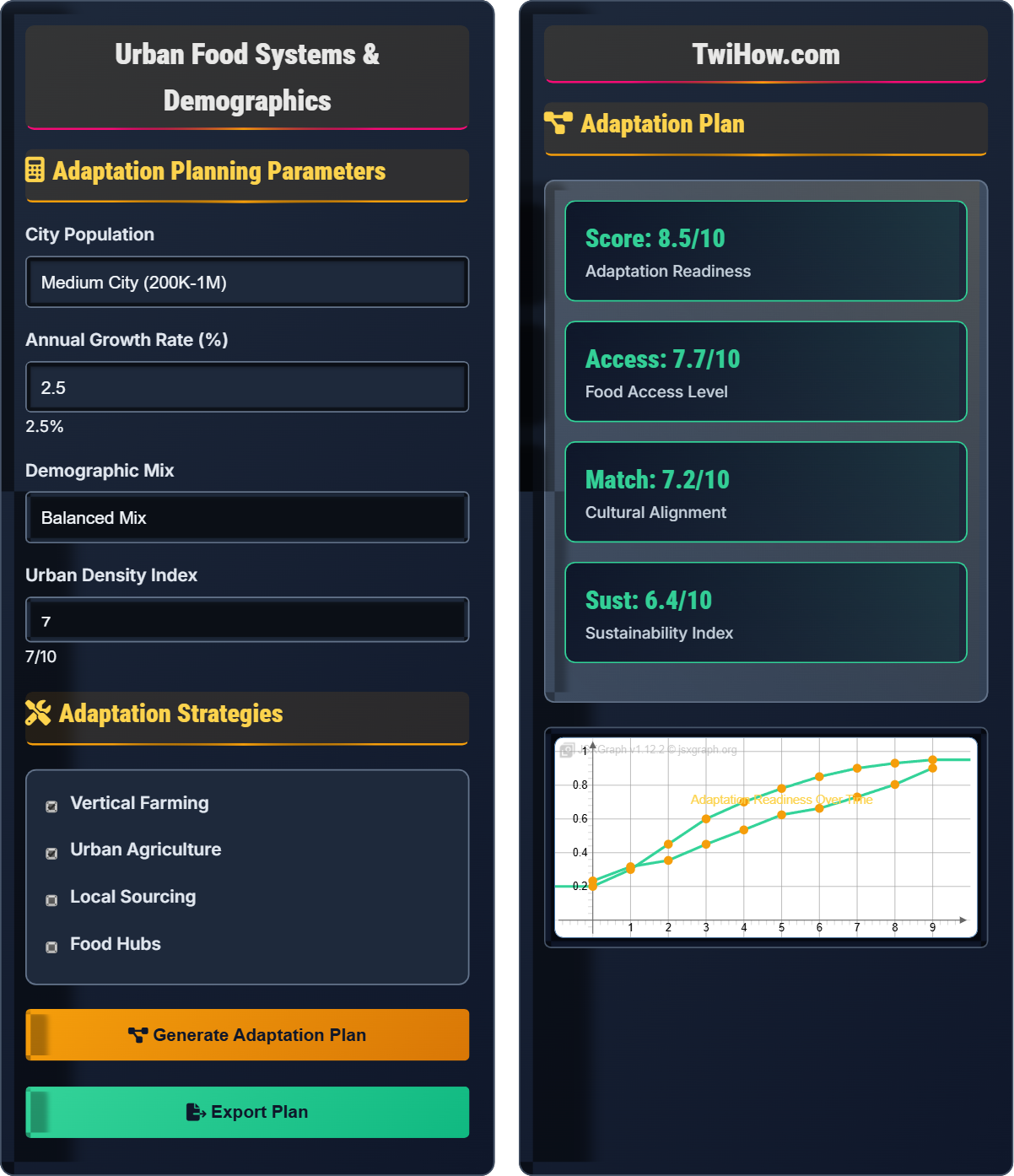
Adaptation Plan
| Strategy | Priority | Implementation | Impact |
|---|---|---|---|
| Vertical Farming | High | Medium | High |
| Urban Agriculture | High | Easy | Medium |
| Local Sourcing | Medium | Medium | High |
| Food Hubs | Medium | Hard | High |
How Food Systems Adapt to Urbanization and Changing Demographics
Urban food systems encompass the complex network of activities, actors, and infrastructure involved in feeding city populations. As urbanization accelerates globally, these systems must evolve to address unique challenges of density, diversity, and resource constraints.
Successful urban food systems employ multiple strategies to address changing demographics:
Multi-story indoor farms that maximize food production in limited urban space using controlled environments, LED lighting, and hydroponic systems.
Community gardens, rooftop farms, and backyard plots that bring food production closer to consumers and strengthen community connections.
Technology-enabled logistics that optimize food delivery, reduce waste, and connect local producers with urban consumers efficiently.
Adaptation Strategies
Vertical farming, urban agriculture, food hubs, local sourcing, smart logistics, community gardens, and culturally responsive production.
Adaptation Index = (Population Density × 0.3) + (Demographic Diversity × 0.25) + (Resource Availability × 0.2) + (Infrastructure Capacity × 0.25)
Where each component is rated on a 0-10 scale.
- Maximize space efficiency
- Embrace cultural diversity
- Integrate technology solutions
- Ensure accessibility for all
Success Stories
Singapore has transformed into a leader in urban agriculture, with vertical farms and rooftop gardens providing 30% of the nation's leafy vegetables. The city-state's "30 by 30" initiative aims to produce 30% of nutritional needs locally by 2030.
Following economic decline, Detroit developed extensive urban agriculture initiatives, converting vacant lots into community gardens and commercial farms that now serve diverse populations and create local jobs.
Milan implemented a comprehensive urban food policy addressing waste reduction, sustainable procurement, and food education, serving as a model for other European cities managing demographic changes.
Urban Adaptation Planner
Urban Food Systems & Demographics Quiz
Which of the following is NOT a primary benefit of urban agriculture?
Increased land speculation is not a primary benefit of urban agriculture. While urban agriculture may increase property values in surrounding areas, speculative investment is generally seen as a potential negative consequence rather than a benefit. The primary benefits include reduced transportation costs, enhanced food security, community engagement, and environmental improvements.
The answer is C) Increased land speculation.
Urban agriculture provides multiple benefits including food security, environmental improvements, and community building. However, it can also lead to unintended consequences like gentrification and land speculation. Understanding both benefits and challenges is crucial for effective urban food planning.
Urban Agriculture: Growing food in urban environments
Food Security: Reliable access to sufficient food
Land Speculation: Investing in land expecting future value increases
• Benefits include local food access
• Community engagement is key
• Unintended consequences exist
• Consider community needs first
• Plan for long-term sustainability
• Address potential displacement
• Ignoring gentrification effects
• Overestimating production capacity
• Not engaging community
Explain how food systems must adapt differently for aging populations versus young urban professionals, and why these adaptations are important.
Aging Population Adaptations:
Nutritional Focus: Emphasis on nutrient-dense foods with vitamins, minerals, and fiber to support health as metabolism slows.
Accessibility: Convenient delivery services, nearby grocery stores, and ergonomic packaging for those with mobility limitations.
Health Integration: Coordination with healthcare systems for therapeutic diets and medication-food interactions.
Young Professional Adaptations:
Convenience: Ready-to-eat meals, meal kits, and quick-service restaurants to accommodate busy schedules.
Technology Integration: Online ordering, delivery apps, and social media marketing.
Flexibility: Varied dining options for different work schedules and social activities.
Importance: Tailored approaches ensure all demographic groups have access to appropriate nutrition, supporting public health and economic productivity.
Different demographic groups have distinct nutritional needs, lifestyle patterns, and food preferences. Successful urban food systems must recognize these differences and provide appropriate options to serve diverse populations effectively.
Nutritional Needs: Specific dietary requirements based on age and health
Food Accessibility: Physical and economic access to food
Demographic Segmentation: Dividing population by characteristics
• Demographics drive food preferences
• Accessibility is crucial
• Health considerations vary by age
• Survey community needs
• Offer diverse options
• Adapt to changing demographics
• One-size-fits-all approach
• Ignoring cultural preferences
• Not planning for demographic shifts
A mid-sized city (population 400,000) expects 35% population growth over the next decade, with increasing cultural diversity (currently 40% non-native residents). The city has limited available farmland and high real estate costs. Calculate the food production gap and propose three strategies to address it, considering both space constraints and cultural preferences.
Current Food Demand: 400,000 residents × 2 lbs/day = 800,000 lbs/day
Future Food Demand: 400,000 × 1.35 = 540,000 residents × 2 lbs/day = 1,080,000 lbs/day
Food Production Gap: 1,080,000 - 800,000 = 280,000 lbs/day
Strategies:
1. Vertical Farming Centers: Multi-story indoor farms in former industrial buildings to maximize production in limited space.
2. Cultural Food Districts: Specialized markets and production areas serving diverse cultural preferences.
3. Smart Distribution Networks: Technology-enabled logistics connecting regional farms with urban consumers.
These strategies address both space constraints and cultural diversity while preparing for population growth.
This example demonstrates how urban planners must consider multiple factors simultaneously: population growth, spatial constraints, cultural diversity, and food security. Effective solutions require integrated approaches that address multiple challenges.
Food Production Gap: Difference between demand and local production
Vertical Farming: Multi-story indoor agricultural systems
Smart Distribution: Technology-optimized food logistics
• Plan for future growth
• Maximize space efficiency
• Respect cultural diversity
• Use underutilized spaces
• Engage diverse communities
• Leverage technology solutions
• Ignoring demographic changes
• Not planning for growth
• Overlooking cultural needs
A city with 30% Hispanic, 25% Asian, 20% African American, and 25% other demographics wants to ensure its food system serves all communities equitably. Propose specific strategies to address cultural food preferences, language barriers, and economic accessibility for diverse populations.
Cultural Food Access:
• Establish ethnic food districts with authentic ingredients and preparation methods
• Partner with cultural organizations to identify specific food needs
• Support immigrant entrepreneurs in food businesses
Language Accommodation:
• Multilingual signage and information materials
• Culturally competent staff in food assistance programs
• Translation services for food education programs
Economic Accessibility:
• Subsidized community-supported agriculture for low-income families
• Mobile markets in underserved neighborhoods
• Culturally appropriate food assistance programs
These strategies ensure equitable access to culturally appropriate foods for all demographic groups.
Cultural responsiveness in food systems goes beyond offering diverse foods—it requires understanding and accommodating the complex interplay of cultural identity, language, and economic factors that influence food access and consumption.
Cultural Responsiveness: Adapting services to cultural needs
Equitable Access: Fair access regardless of background
Food Justice: Fair and sustainable food systems
• Recognize cultural food traditions
• Address language barriers
• Ensure economic equity
• Engage community leaders
• Offer culturally familiar options
• Address systemic barriers
• Assuming universal food preferences
• Not engaging communities
• Overlooking economic barriers
Which technology innovation has the greatest potential to revolutionize urban food systems?
Vertical farming systems have the greatest potential to revolutionize urban food systems because they address the fundamental challenge of limited space in dense urban environments. By enabling year-round production in controlled environments, vertical farms can provide fresh produce close to consumers while using 95% less water and no pesticides.
The answer is B) Vertical farming systems.
While all technologies contribute to urban food innovation, vertical farming addresses the core challenge of space scarcity in urban environments. It combines space efficiency with environmental sustainability and food security benefits.
Vertical Farming: Multi-story indoor agricultural systems
Controlled Environment: Artificially regulated growing conditions
Resource Efficiency: Optimal use of inputs
• Space efficiency is critical in cities
• Sustainability drives adoption
• Scalability matters for impact
• Consider space constraints
• Evaluate resource efficiency
• Assess scalability potential
• Focusing on single solutions
• Not considering space limitations
• Ignoring sustainability factors
FAQ
Q: How can cities balance the need for affordable housing with urban agriculture initiatives?
A: Cities can balance these needs through:
1. Integrated Development: Combining residential buildings with rooftop gardens and vertical farms
2. Zoning Flexibility: Allowing mixed-use developments that include food production spaces
3. Policy Incentives: Tax breaks for developers who incorporate urban agriculture
4. Community Land Trusts: Preserving land for both housing and food production
5. Modular Design: Buildings that can adapt spaces for either purpose as needs change
6. Underutilized Spaces: Converting abandoned lots and brownfields for agriculture
Successful planning integrates both needs rather than treating them as competing priorities.
Q: How can urban food systems ensure equitable access across different income levels?
A: Equitable access requires:
1. Subsidized Programs: SNAP benefits acceptance at farmers markets and community gardens
2. Mobile Markets: Bringing fresh food to underserved neighborhoods
3. Sliding Scale Pricing: Income-based pricing at community food programs
4. Public Infrastructure: Municipal gardens and food distribution centers
5. Education Programs: Teaching budget-friendly nutrition skills
6. Cooperative Models: Community-owned food enterprises
These approaches ensure that all residents, regardless of income, have access to healthy, culturally appropriate food.