Food Equity & Access for Marginalized Communities
Complete guide • Step-by-step explanations
Food Equity & Access:
Show Equity AnalyzerFood equity and access ensure that all individuals, regardless of race, income, geography, or social status, have access to affordable, nutritious, and culturally appropriate food. Addressing disparities in food access requires comprehensive strategies that tackle root causes of food insecurity.
Key challenges include food deserts, transportation barriers, affordability issues, and cultural appropriateness. Solutions involve community-based initiatives, policy interventions, and collaborative partnerships.
Successful approaches include community gardens, mobile markets, food co-ops, nutrition education, and policy reforms that address systemic inequities in food systems.
Real-world applications span from urban farming initiatives to federal food assistance programs and community-led food sovereignty movements.
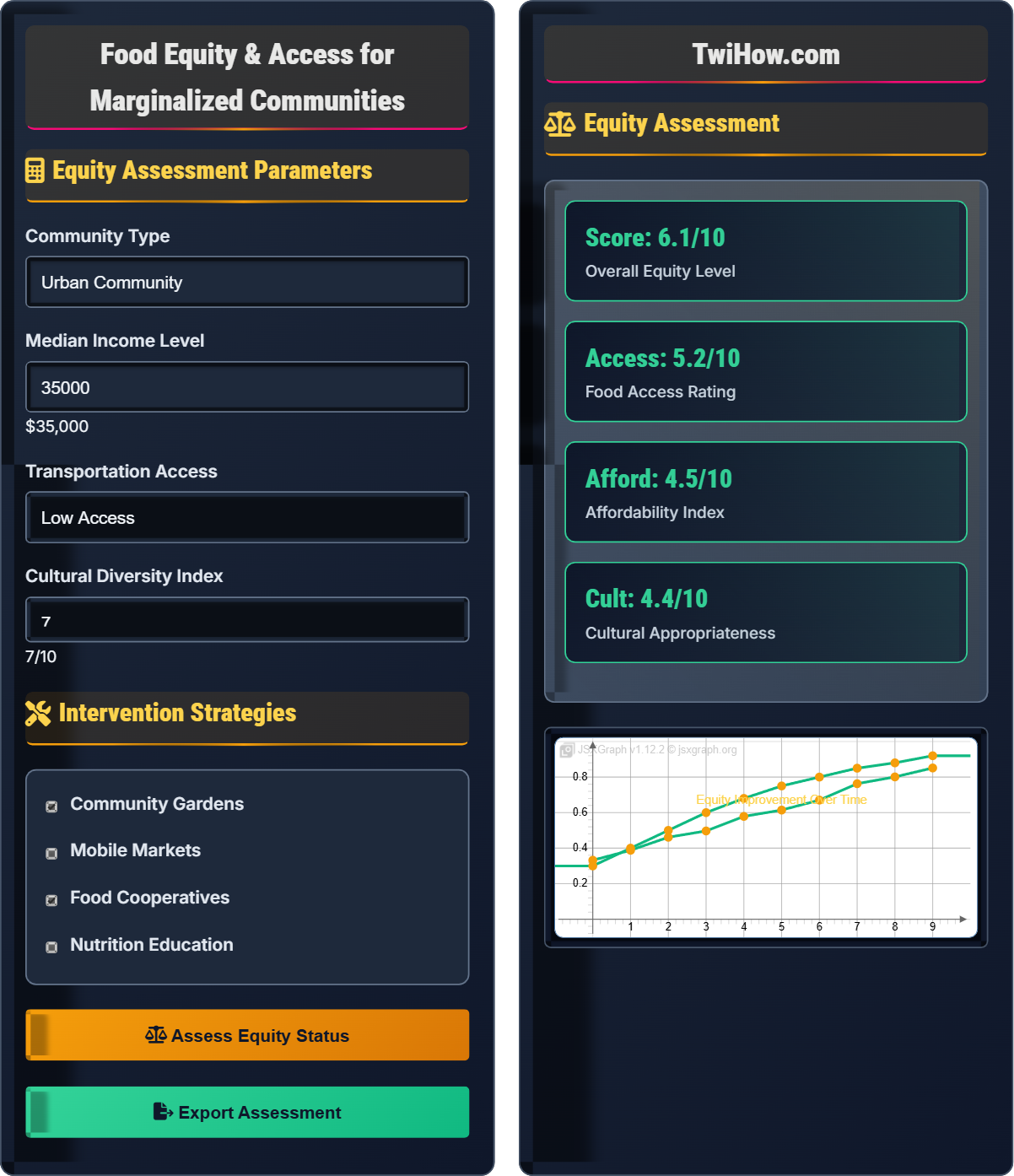
Equity Assessment Parameters
Intervention Strategies
Equity Assessment
| Factor | Score | Status | Recommendations |
|---|---|---|---|
| Physical Access | 6.2 | Needs Improvement | Expand transportation options |
| Economic Access | 7.1 | Good | Maintain current support |
| Cultural Appropriateness | 7.5 | Good | Continue diversity efforts |
| Quality & Nutrition | 6.8 | Needs Improvement | Improve food quality options |
How Food Systems Address Equity and Access for Marginalized Communities
Food equity ensures that all individuals have access to affordable, nutritious, and culturally appropriate food regardless of race, income, geography, or social status. It addresses systemic inequalities that create disparities in food access and nutrition outcomes.
Successful food equity initiatives employ multiple approaches to address systemic barriers:
Provide fresh produce, build community connections, and empower residents to grow their own food. These initiatives address both access and cultural appropriateness while building social capital.
Bring fresh, affordable food directly to underserved areas lacking grocery stores. These initiatives overcome transportation barriers and increase access to nutritious options.
Member-owned food enterprises that prioritize community needs over profit. Co-ops often offer culturally appropriate foods at affordable prices while maintaining democratic governance.
Equity Strategies
Community gardens, mobile markets, food co-ops, nutrition education, food policy councils, and policy advocacy.
Equity Index = (Physical Access × 0.25) + (Economic Access × 0.25) + (Cultural Appropriateness × 0.25) + (Quality & Nutrition × 0.25)
Where each component is rated on a 0-10 scale.
- Community involvement is essential
- Address root causes, not symptoms
- Consider cultural appropriateness
- Ensure sustainability
Success Stories
Detroit has transformed vacant lots into productive urban farms and community gardens, creating food access in previously underserved neighborhoods while building community resilience and economic opportunities.
Mobile markets bring fresh, affordable produce directly to food deserts, overcoming transportation barriers and providing culturally appropriate options for diverse communities.
Community-owned grocery stores operated as cooperatives ensure that food access remains in community hands while providing culturally appropriate and affordable options.
Community Equity Analyzer
Food Equity & Access Quiz
Which of the following is the most accurate definition of a food desert?
A food desert is defined as an area that lacks access to affordable, nutritious food. This includes both urban and rural areas where residents have limited access to supermarkets or grocery stores offering fresh, healthy, and affordable food options. The definition encompasses both availability and affordability barriers.
The answer is B) Areas lacking access to affordable, nutritious food.
Food deserts represent a systemic issue where geographic, economic, and social factors combine to limit access to healthy food. This creates health disparities and perpetuates cycles of poverty and poor nutrition in affected communities.
Food Desert: Geographic area with limited access to affordable, nutritious food
Food Access: Physical and economic access to nutritious food
Food Security: Reliable access to sufficient food for active health
• Geographic and economic barriers matter
• Both urban and rural areas affected
• Quality and affordability both important
• Consider transportation barriers
• Examine affordability factors
• Look at food quality options
• Assuming only rural areas are affected
• Ignoring economic access
• Focusing only on availability
Explain why cultural appropriateness is essential in food equity initiatives and provide specific examples of how to address this need.
Importance of Cultural Appropriateness:
Identity and Connection: Food is deeply connected to cultural identity, traditions, and family bonds. Culturally appropriate food strengthens community connections.
Acceptance and Participation: Programs offering culturally familiar foods have higher participation rates and sustained engagement.
Nutritional Outcomes: Familiar foods are more likely to be consumed, leading to better nutritional outcomes.
Specific Examples:
• Partner with cultural organizations to source appropriate ingredients
• Hire community members as program staff and educators
• Offer cooking classes featuring traditional recipes
• Create multilingual educational materials
• Include culturally significant holidays and celebrations
Cultural appropriateness recognizes that food is not just nutrition but also cultural expression and identity. Effective food equity initiatives must honor and respect the diverse cultural backgrounds of community members.
Cultural Appropriateness: Meeting cultural preferences and dietary practices
Food Identity: Connection between food and cultural heritage
Community Engagement: Active participation in programs
• Respect cultural food practices
• Include community voices
• Honor dietary restrictions
• Consult with cultural leaders
• Source diverse ingredients
• Offer flexible options
• Assuming universal food preferences
• Not involving community members
• Overlooking dietary restrictions
A predominantly Latino community of 15,000 residents has one small grocery store and three fast-food restaurants. The nearest supermarket is 8 miles away. The median household income is $28,000, and 40% of residents lack reliable transportation. The community speaks Spanish primarily. Assess the food equity challenges and propose three targeted interventions.
Challenges Identified:
Geographic Access: Residents live far from full-service grocery stores, creating transportation barriers.
Economic Access: Low income limits purchasing power for healthy foods.
Cultural Appropriateness: Limited access to traditional Latino ingredients and foods.
Language Barriers: Spanish-speaking residents may face communication challenges.
Targeted Interventions:
• Mobile Market Program: Weekly mobile markets offering fresh produce and traditional ingredients with Spanish-speaking staff.
• Community Garden Initiative: Cultivate traditional vegetables and herbs familiar to the community.
• Food Co-op Development: Member-owned cooperative grocery store with culturally appropriate options and bilingual services.
This example demonstrates how multiple barriers intersect to create food inequity. Effective solutions must address geographic, economic, cultural, and linguistic factors simultaneously to create meaningful change.
Food Desert: Area with limited access to healthy food
Transportation Barrier: Distance or lack of transit options
Cultural Food Practices: Traditional dietary patterns
• Address multiple barriers simultaneously
• Include community in planning
• Consider cultural needs
• Map existing resources
• Engage community leaders
• Address transportation
• Not considering cultural needs
• Assuming one-size-fits-all
• Ignoring transportation issues
A city council is considering policies to address food equity in low-income neighborhoods. They are evaluating zoning changes to attract grocery stores, incentives for healthy food retailers, and support for community food initiatives. Evaluate the potential effectiveness of each approach and recommend a comprehensive strategy.
Zoning Changes:
Pros: Can attract large retailers; creates infrastructure for food access
Cons: May not address affordability; potential for gentrification
Healthy Food Retailer Incentives:
Pros: Encourages variety of food options; supports local businesses
Cons: May not be sufficient alone; requires ongoing support
Community Initiative Support:
Pros: Empowers residents; culturally appropriate; builds social capital
Cons: Requires community capacity; may face sustainability challenges
Comprehensive Strategy: Combine all approaches with community input, ensuring policies are implemented together rather than in isolation.
Effective food equity policy requires a multi-faceted approach that addresses different aspects of the problem simultaneously. No single policy intervention can adequately address the complex nature of food inequity.
Food Policy: Government actions affecting food access
Zoning Regulations: Land use planning tools
Community Capacity: Ability to implement initiatives
• Multiple approaches needed
• Community input essential
• Address systemic issues
• Include community voices
• Address affordability
• Plan for sustainability
• Single-policy solutions
• Not engaging communities
• Ignoring economic barriers
Which approach is most likely to create sustainable food equity in marginalized communities?
Community-led initiatives are most likely to create sustainable food equity because they build local capacity, ensure cultural appropriateness, foster ownership and pride, and develop leadership within the community. These initiatives are designed by and for community members, making them more responsive to local needs and more likely to be maintained long-term.
The answer is B) Community-led initiatives.
Sustainable food equity requires empowering communities to take ownership of their food systems. External interventions, while helpful in the short term, often fail to create lasting change without community engagement and leadership.
Community-Led: Initiated and managed by community members
Sustainability: Long-term viability and maintenance
Capacity Building: Developing local skills and resources
• Community ownership essential
• Build local capacity
• Foster leadership
• Support community leadership
• Provide technical assistance
• Ensure resource access
• Top-down approaches
• Not building local capacity
• Assuming one-size-fits-all
FAQ
Q: How can we start addressing food equity in our community with limited resources?
A: Start with these resource-efficient approaches:
1. Community Mapping: Identify existing assets like corner stores, community gardens, and informal food networks
2. Partnerships: Collaborate with faith-based organizations, schools, and local businesses
3. Volunteer Mobilization: Organize community members to coordinate food sharing and mutual aid
4. Advocacy: Push for policy changes that support food access
5. Education: Start nutrition education and cooking classes using community kitchens
6. Seed Funding: Apply for small grants to pilot promising initiatives
Begin with what exists in your community and build from there.
Q: What policy tools are most effective for addressing food equity?
A: Most effective policy tools include:
1. Zoning Reform: Encourage healthy food retailers in underserved areas
2. Healthy Food Financing: Provide loans and grants to healthy food retailers
3. SNAP Enhancement: Increase benefits and expand eligible food purchases
4. Community Development: Support community-based food enterprises
5. Procurement Policies: Require institutions to source locally and healthily
6. Tax Incentives: Reward businesses that serve underserved areas
Combining multiple policy tools creates the strongest impact.