How do Food Systems Address Nutrition and Dietary Diversity?
Complete food security guide • Step-by-step explanations
Nutrition & Dietary Diversity:
Show Nutrition PlannerFood systems play a crucial role in addressing global nutrition challenges and promoting dietary diversity. They encompass the entire pathway from production to consumption, influencing the availability, accessibility, and quality of diverse, nutritious foods. Modern food systems must balance efficiency with nutritional outcomes to combat malnutrition and support healthy diets.
Key approaches to nutrition and dietary diversity:
- Diversified Production: Cultivating a variety of crops and livestock
- Fortification & Biofortification: Enhancing nutritional content
- Value Chain Optimization: Preserving nutrients during processing
- Food Accessibility: Ensuring availability and affordability
- Education & Awareness: Promoting healthy eating habits
Successful food systems integrate multiple strategies to ensure optimal nutrition for all populations.
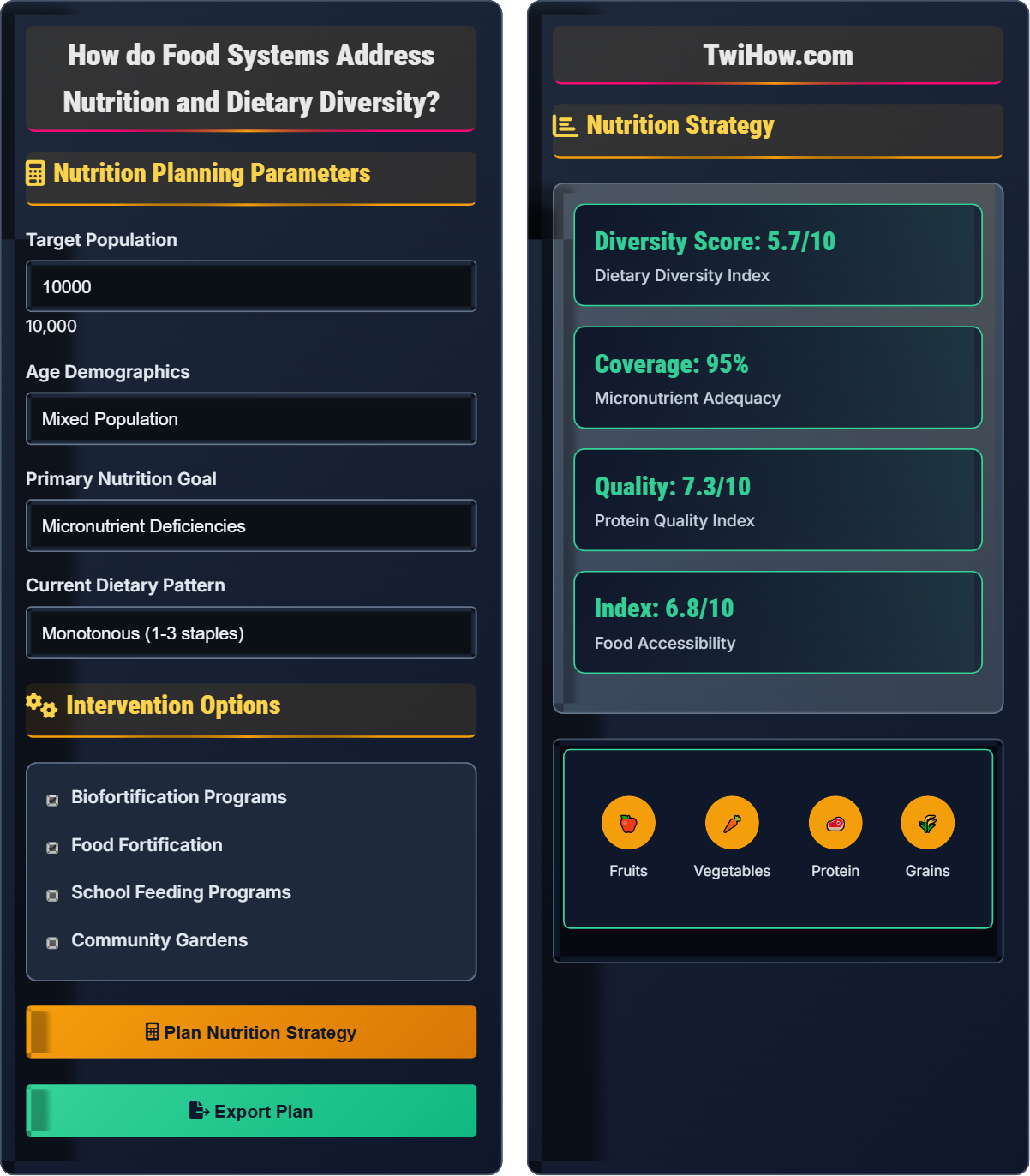
Nutrition Planning Parameters
Intervention Options
Nutrition Strategy
| Strategy | Priority | Impact | Timeline |
|---|---|---|---|
| Biofortification | High | Long-term | 2-3 years |
| Food Fortification | High | Medium-term | 1-2 years |
| Education Programs | Medium | Long-term | 3-5 years |
| Supply Chain | Medium | Medium-term | 1-3 years |
Food Systems and Nutrition
Food systems play a fundamental role in delivering nutrition to populations worldwide. They encompass the entire pathway from production to consumption, directly impacting dietary diversity, nutritional adequacy, and food security. Modern food systems must balance efficiency with nutritional outcomes to address both undernutrition and overnutrition.
Key components of nutrition-focused food systems:
- Diversified Production: Growing a variety of crops and livestock species
- Processing & Fortification: Enhancing nutritional content during processing
- Storage & Preservation: Maintaining nutritional quality during storage
- Distribution & Access: Ensuring nutritious foods reach all populations
- Education & Awareness: Promoting healthy dietary practices
The Dietary Diversity Score (DDS) can be calculated as:
Where standard food groups include cereals, roots/tubers, legumes/nuts, dairy, meat/fish, eggs, dark green leafy vegetables, vitamin A-rich fruits/vegetables, and other fruits/vegetables.
A score of 5 or more indicates adequate dietary diversity for adults.
Food systems significantly impact micronutrient status:
- Vitamin A: Deficiency affects 250 million children globally
- Iron: Affects 1.6 billion people, primarily women and children
- Zinc: Deficiency affects 17% of global population
- Iodine: Deficiency affects 2 billion people worldwide
- Folate: Critical for maternal and child health
Modern food systems increasingly focus on sustainable nutrition:
- Agrobiodiversity: Promoting genetic diversity in crops
- Local Foods: Supporting indigenous and traditional foods
- Climate-Smart: Adapting to climate change while maintaining nutrition
- Value Chains: Optimizing for nutritional quality and food safety
- Technology: Leveraging innovations for nutrition outcomes
Dietary Diversity Strategies
Food groups, nutrient density, seasonal availability, cultural acceptability, accessibility.
DDS = (Number of food groups consumed / 9) × 10
Where 9 represents the standard food groups used in dietary diversity assessments.
- Minimum of 5 food groups for adequate adult nutrition
- Children need 6+ food groups for optimal nutrition
- Seasonal diversity is important for year-round nutrition
- Cultural preferences must be considered in planning
Nutrition Intervention Programs
Biofortification, food fortification, supplementation, education, policy reform.
- Assessment of nutritional needs
- Selection of appropriate interventions
- Stakeholder engagement
- Implementation and monitoring
- Evaluation and scaling
- Interventions should be evidence-based
- Community acceptance is crucial
- Sustainability planning is essential
- Integration with existing systems is preferred
Nutrition and Dietary Diversity Quiz
According to the FAO, what is the minimum number of food groups that should be consumed in a 24-hour period to indicate adequate dietary diversity for adults?
According to the Food and Agriculture Organization (FAO), consuming 5 or more food groups in a 24-hour period indicates adequate dietary diversity for adults. This threshold is used as an indicator of household food security and is associated with better nutritional outcomes.
The answer is C) 5 food groups.
The dietary diversity score is a practical tool for assessing food security and nutrition status. It's based on the principle that consuming foods from different groups provides a broader range of nutrients necessary for health. The 5-group threshold balances practicality with nutritional adequacy.
Dietary Diversity Score (DDS): Number of different food groups consumed
Food Groups: Standardized categories of foods with similar nutritional properties
Food Security: Access to sufficient, safe, nutritious food
• 5+ groups indicate adequate adult diversity
• Children need 6+ groups for optimal nutrition
• Quality matters as much as quantity
• Include foods from different groups daily
• Emphasize seasonal variety
• Consider cultural food preferences
• Assuming quantity equals quality
• Ignoring cultural food preferences
• Not considering seasonal availability
Explain what biofortification is and how it differs from food fortification. Provide specific examples of biofortified crops and their nutritional benefits.
Biofortification: The process of breeding crops to increase their nutritional value, particularly vitamins and minerals, through conventional plant breeding, agronomic practices, or biotechnology. The enhanced nutritional content is inherent in the crop itself.
Food Fortification: The addition of vitamins and minerals to processed foods during manufacturing. The nutrients are added externally to the food product.
Examples of Biofortified Crops:
• Golden Rice: Genetically modified rice enriched with beta-carotene (vitamin A precursor)
• Orange Sweet Potato: Naturally bred variety rich in beta-carotene
• Iron-Biofortified Beans: Bean varieties with higher iron content through selective breeding
• Zinc-Biofortified Wheat: Wheat varieties with enhanced zinc content
• Vitamin A Cassava: Cassava with increased beta-carotene levels
Biofortification offers the advantage of delivering nutrients through staple foods that people already consume, making it sustainable and cost-effective.
Biofortification represents a food systems approach to nutrition, addressing deficiencies by improving the nutritional content of staple foods. Unlike fortification, which requires processing infrastructure, biofortification can benefit populations through existing food systems and traditional consumption patterns.
Biofortification: Breeding crops to increase nutritional content
Food Fortification: Adding nutrients during food processing
Nutritional Enhancement: Improving nutritional value of foods
• Biofortification targets staple crops
• Nutritional content is inherent in the crop
• Requires minimal behavior change
• Focus on widely consumed staple foods
• Engage communities in acceptance
• Monitor nutritional impact
• Confusing biofortification with fortification
• Not considering community acceptance
• Overlooking seed system development
A community of 15,000 people has a high prevalence of iron deficiency anemia (40% of women of reproductive age). The average woman consumes 150g of staple cereal per day, which contains 2mg of iron per 100g. Calculate the current iron intake and determine how much additional iron is needed to meet the recommended daily allowance of 18mg for women of reproductive age. If biofortified cereals contain 6mg of iron per 100g, calculate the potential improvement.
Current Iron Intake:
Daily cereal consumption: 150g
Iron content: 2mg per 100g
Current intake: (150g ÷ 100g) × 2mg = 3mg per day
Additional Iron Needed:
Recommended intake: 18mg per day
Deficit: 18mg - 3mg = 15mg per day
With Biofortified Cereals:
Enhanced iron content: 6mg per 100g
New intake: (150g ÷ 100g) × 6mg = 9mg per day
Remaining deficit: 18mg - 9mg = 9mg per day
Biofortification would provide 6mg more iron per day, reducing the deficit from 15mg to 9mg. This represents a 40% reduction in iron deficiency risk through staple food consumption alone.
This example demonstrates how biofortification can make meaningful improvements to nutritional status through existing food consumption patterns. While it doesn't solve the entire deficiency problem, it significantly reduces the gap and provides a sustainable intervention that doesn't require behavior change.
Iron Deficiency Anemia: Anemia caused by insufficient iron intake
Recommended Daily Allowance (RDA): Amount of nutrient needed to meet requirementsBiofortification Impact: Nutritional improvement through crop enhancement
• Biofortification provides incremental improvements
• Multiple interventions often needed
• Baseline consumption patterns matter
A community garden project aims to improve dietary diversity in a neighborhood where 60% of households consume fewer than 4 food groups daily. The project provides plots for 200 families, with each plot yielding 150kg of vegetables annually. If vegetables contribute to 2 additional food groups and each household currently consumes 1.2 food groups, calculate the potential improvement in dietary diversity scores. Assume 75% of participating households will increase their consumption by 2 food groups.
Baseline Situation:
Households consuming <4 groups: 60%
Average consumption: 1.2 food groups
Project Scope:
Total families served: 200
Expected participation: 75% of 200 = 150 families
Potential Improvement:
Additional food groups per household: 2
New average consumption: 1.2 + 2 = 3.2 food groups
Impact Assessment:
Households reaching adequate diversity (≥5 groups): 0 (since 3.2 < 5)
However, this represents a 167% increase in food group consumption (from 1.2 to 3.2)
Community gardens provide important micronutrients and variety, though additional interventions may be needed to reach optimal diversity scores.
Community gardens are valuable for improving access to fresh vegetables and increasing dietary diversity. While they may not reach the 5+ food group threshold alone, they contribute significantly to nutritional status and can be combined with other interventions for greater impact.
Community Gardens: Shared spaces for growing food collectively
Dietary Diversity: Variety of food groups consumed
Food Access: Physical and economic ability to obtain food
• Multiple interventions often needed
• Community gardens complement other programs
• Participation rates affect outcomes
• Combine with nutrition education
• Include diverse crop varieties
• Ensure water and infrastructure
• Expecting single interventions to solve all problems
• Not considering seasonal limitations
• Overlooking maintenance requirements
Which of the following best describes a comprehensive food systems approach to addressing nutrition and dietary diversity?
A comprehensive food systems approach addresses all aspects of the food system - from production to consumption - to ensure nutritious foods are produced, processed, distributed, and consumed effectively. This includes improving production diversity, preserving nutritional quality during processing, ensuring equitable distribution, and promoting healthy consumption patterns.
The answer is B) Addressing production, processing, distribution, and consumption together.
Food systems thinking recognizes that nutrition outcomes depend on the entire pathway from farm to fork. Interventions at any single point may have limited impact if other parts of the system are not addressed. A holistic approach considers all stages and stakeholders in the food system.
Food Systems Approach: Comprehensive strategy addressing all system components
System Thinking: Understanding interconnections and interdependencies
Multi-sectoral: Involving multiple sectors and stakeholders
• Address all system components
• Consider interconnections
• Engage multiple stakeholders
• Map the entire food system
• Identify leverage points
• Coordinate across sectors
• Focusing on single interventions
• Not considering system-wide impacts
• Ignoring stakeholder perspectives
FAQ
Q: What policy interventions are most effective for improving dietary diversity?
A: Most effective policy interventions include:
1. Agricultural Diversification: Incentives for farmers to grow diverse crops
2. Food Safety Standards: Ensuring diverse foods are safe to consume
3. School Meal Programs: Providing diverse, nutritious meals to children
4. Food Fortification Mandates: Requiring fortification of staple foods
5. Nutrition Education: Public campaigns promoting dietary diversity
6. Market Access: Improving access to diverse foods in underserved areas
Successful programs typically combine multiple policy approaches for greatest impact.
Q: How can smallholder farmers contribute to improved nutrition in their communities?
A: Smallholder farmers can contribute by:
1. Crop Diversification: Growing a variety of crops including vegetables, legumes, and fruits
2. Biofortified Varieties: Adopting nutritionally enhanced crop varieties
3. Agroforestry: Integrating trees and shrubs that provide diverse foods
4. Home Gardens: Establishing diverse home garden systems
5. Livestock Integration: Including small livestock for animal-source foods
6. Seed Systems: Participating in seed exchanges for diverse varieties
Smallholders are crucial for local food security and dietary diversity, particularly in rural areas.