Food Systems Packaging & Waste Management
Complete guide • Step-by-step explanations
Packaging & Waste Management:
Show Waste Management SimulatorFood systems address packaging and waste management challenges through innovative solutions that balance product protection, shelf-life extension, and environmental sustainability. This involves developing eco-friendly packaging materials, implementing circular economy principles, and optimizing waste reduction strategies throughout the supply chain.
Key components of food system waste management:
- Sustainable Packaging: Biodegradable, recyclable, and minimal packaging solutions
- Waste Reduction: Prevention, reuse, and recycling strategies
- Supply Chain Optimization: Reducing losses during transportation and storage
- Consumer Education: Promoting responsible consumption and disposal
- Regulatory Compliance: Meeting environmental standards and regulations
Modern approaches integrate technology, policy, and behavioral change to create closed-loop systems that minimize environmental impact while maintaining food safety and quality.
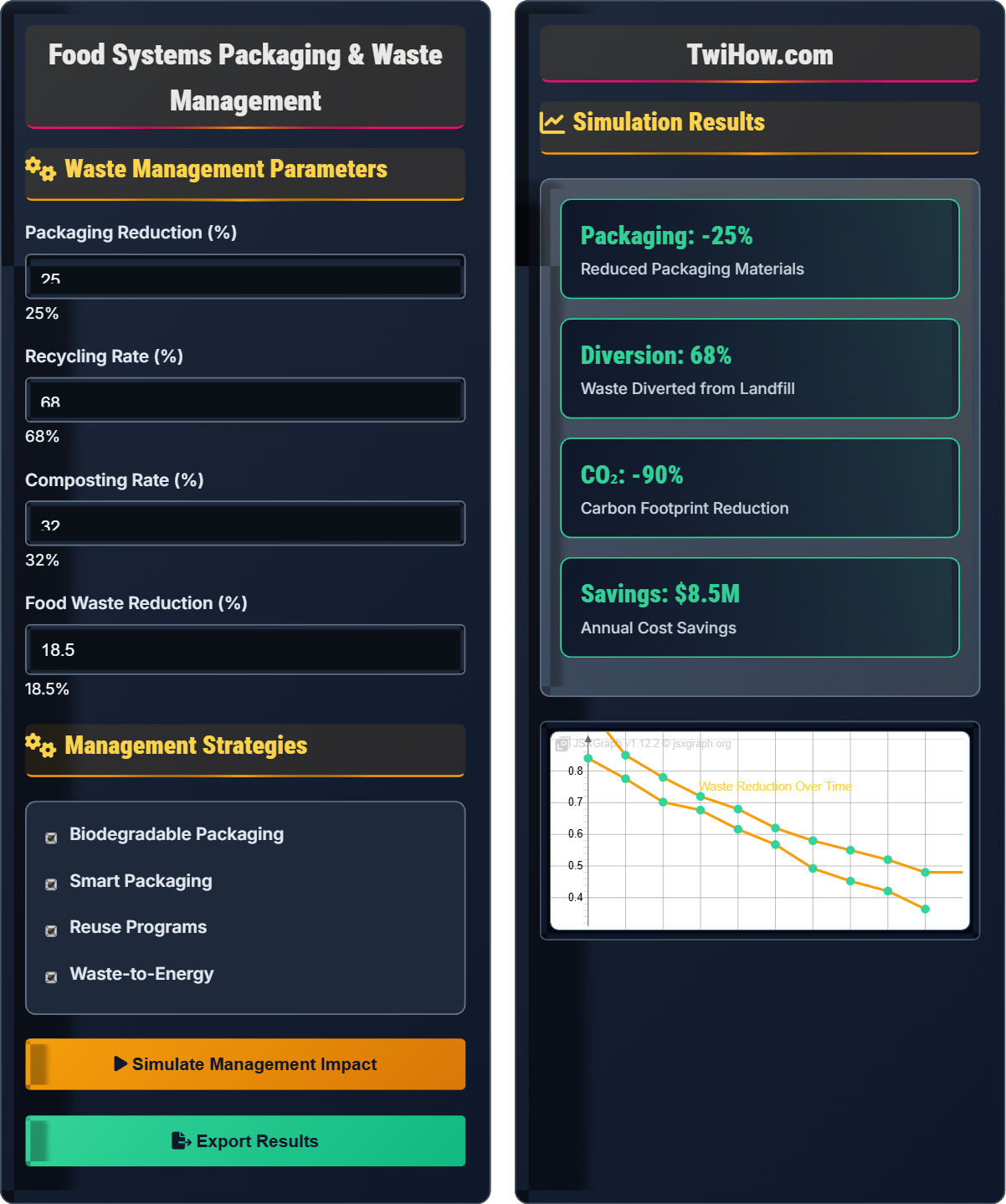
Waste Management Parameters
Management Strategies
Simulation Results
| Strategy | Implementation | Impact (%) | Cost Savings ($) |
|---|---|---|---|
| Biodegradable Packaging | High | 35 | $1.2M |
| Smart Packaging | Medium | 20 | $0.8M |
| Reuse Programs | Medium | 25 | $0.7M |
| Waste-to-Energy | Low | 15 | $0.5M |
Food System Packaging & Waste Management
Food waste management in food systems encompasses strategies, technologies, and practices designed to minimize waste generation, maximize resource recovery, and reduce environmental impact throughout the food supply chain. This includes packaging optimization, waste reduction initiatives, and circular economy approaches that turn waste into valuable resources.
Effective food waste management follows the waste hierarchy principle:
Where:
- Prevention: Reducing waste generation at source
- Minimization: Reducing packaging and portion sizes
- Reuse: Finding alternative uses for waste materials
- Recycling: Converting waste into new materials
- Recovery: Extracting energy or nutrients from waste
- Disposal: Final disposal as last resort
Key areas where food systems address packaging and waste challenges:
- Active Packaging: Materials that extend shelf life through antimicrobial agents
- Intelligent Packaging: Sensors that indicate freshness and safety
- Minimal Packaging: Right-sizing to reduce material use
- Compostable Materials: Packaging that decomposes organically
- Edible Packaging: Consumable films made from natural ingredients
- Returnable Systems: Reusable containers and packaging
- Life Cycle Assessment: Evaluating environmental impact of packaging
- Circular Economy: Designing systems for continuous reuse
- Design for Recycling: Creating easily recyclable packages
- Source Reduction: Minimizing waste at point of generation
- Extended Producer Responsibility: Manufacturers accountable for disposal
Fundamentals of Food Waste Management
Waste hierarchy, circular economy, life cycle assessment, biodegradable materials, smart packaging, extended producer responsibility.
Efficiency = (Original Waste - Reduced Waste) / Original Waste × 100
Where Efficiency = percentage reduction in waste generation.
- Prevention is better than cure
- Materials should be recyclable or compostable
- Systems thinking is essential for comprehensive solutions
Applications
Compostable packaging, smart labels, reusable containers, waste sorting systems, biogas generation, upcycled food products.
- Primary packaging design
- Secondary packaging optimization
- Waste collection systems
- Processing and conversion facilities
- Consumer education programs
- Economic viability for businesses
- Consumer acceptance
- Regulatory compliance
- Infrastructure requirements
Food Waste Management Quiz
According to the waste management hierarchy, which approach should be prioritized in food systems?
The waste hierarchy prioritizes approaches in order of environmental benefit. The correct sequence is: Prevention > Minimization > Reuse > Recycling > Recovery > Disposal. Prevention and reduction at the source is the most environmentally beneficial approach, followed by reuse and recycling. This hierarchy guides sustainable packaging and waste management decisions in food systems.
The answer is C) Prevention and reduction.
The waste hierarchy is a fundamental principle in environmental management that ranks waste management options based on their environmental impact. The pyramid structure visually represents that prevention at the top is most beneficial, while disposal at the bottom is least desirable. In food systems, this means designing packaging that prevents waste, choosing materials that can be reused or recycled, and only using disposal methods as a last resort.
Waste Hierarchy: Ranking of waste management options by environmental preference
Prevention: Avoiding waste generation in the first place
Extended Producer Responsibility: Manufacturers responsible for product lifecycle
• Prevention is more effective than treatment
• Reuse is better than recycling
• Recovery is better than disposal
• Design packaging for multiple uses
• Choose easily recyclable materials
• Minimize packaging where possible
• Focusing only on recycling instead of prevention
• Not considering the full lifecycle
• Ignoring consumer behavior patterns
Explain how smart packaging technologies help reduce food waste and describe three specific examples of smart packaging applications.
Smart Packaging Benefits: Smart packaging incorporates sensors, indicators, and communication technologies to provide real-time information about food quality, safety, and freshness. This helps consumers and retailers make informed decisions, reducing premature disposal of still-safe food items.
Three Examples:
1. Time-Temperature Indicators: Labels that change color based on cumulative exposure to temperature over time, indicating actual shelf life rather than arbitrary dates.
2. Gas Sensors: Devices that detect spoilage gases inside packages, providing accurate freshness indicators.
3. Near Field Communication (NFC) Tags: Electronic tags that provide detailed product information, storage instructions, and real-time quality updates when scanned with smartphones.
Smart packaging transforms passive packaging into active information systems. Traditional "best by" dates often lead to food waste when products are still safe to consume. Smart packaging provides objective data about actual food condition, helping reduce unnecessary disposal. These technologies bridge the information gap between producers and consumers, leading to more informed purchasing and consumption decisions.
Smart Packaging: Packaging with embedded sensing or communication capabilities
Time-Temperature Indicators: Labels showing cumulative thermal history
Active Packaging: Packaging that interacts with contents to extend shelf life
• Technology must be cost-effective for widespread adoption
• Consumer education is crucial for effectiveness
• Data privacy concerns must be addressed
• Start with high-value products
• Focus on clear consumer benefits
• Integrate with existing retail systems
• Overcomplicating technology for consumers
• Not considering cost-benefit ratios
• Ignoring scalability challenges
A food retailer generates 500 tons of waste annually, with disposal costs of $200 per ton. They plan to implement a waste reduction program targeting 30% reduction in waste and 50% increase in recycling rate (currently 40%). Calculate the potential annual savings and environmental benefits assuming recycling costs $50 per ton.
Current Waste: 500 tons
Current Disposal: 60% of 500 tons = 300 tons at $200/ton = $60,000
Current Recycling: 40% of 500 tons = 200 tons at $50/ton = $10,000
Total Current Cost: $70,000
After Reduction: 500 tons × 0.70 = 350 tons total
New Recycling: 50% of 350 tons = 175 tons at $50/ton = $8,750
New Disposal: 50% of 350 tons = 175 tons at $200/ton = $35,000
New Total Cost: $43,750
Annual Savings: $70,000 - $43,750 = $26,250
Environmental Benefits: 150 tons less waste, 175 tons recycled
This problem demonstrates the economic case for waste reduction programs. By reducing waste generation and increasing recycling, companies can achieve significant cost savings while reducing environmental impact. The key insight is that recycling, while having some cost, is much cheaper than disposal and creates additional value through material recovery.
Waste Reduction: Decreasing the amount of waste generated
Recycling Rate: Percentage of waste diverted from disposal
Closed Loop System: Waste materials returned to production cycle
• Waste reduction has compounding economic benefits
• Recycling infrastructure requires upfront investment
• Measurement is crucial for program success
• Start with high-volume waste streams
• Partner with recycling facilities
• Track metrics consistently
• Not accounting for contamination costs
• Underestimating implementation costs
• Failing to measure baseline metrics
A food processing company wants to implement circular economy principles in their packaging system. Propose a closed-loop packaging strategy and explain the potential challenges and benefits of implementation.
Closed-Loop Strategy:
1. Reusable Containers: Implement a returnable container system where customers return packaging for cleaning and reuse
2. Material Recovery: Establish collection centers to gather and process used packaging materials
3. Design for Durability: Create robust packaging designed for multiple uses
4. Take-Back Programs: Partner with retailers to collect used packaging
Benefits: Reduced material costs, lower waste disposal fees, improved brand reputation, reduced environmental impact
Challenges: Customer participation, logistics complexity, initial infrastructure investment, cleaning and sanitization requirements
Circular economy in food packaging moves away from the traditional linear model (make-use-dispose) toward a regenerative system. The goal is to keep materials in use for as long as possible while extracting maximum value. This approach requires rethinking product design, supply chains, and customer relationships to create systems where waste becomes input for new production cycles.
Circular Economy: Economic system based on reuse and regeneration
Linear Economy: Traditional take-make-dispose model
Design for Circularity: Creating products for reuse and recycling
• Systems thinking is essential for circular design
• Stakeholder engagement is crucial for success
• Long-term perspective required for investment decisions
• Start with pilot programs to test feasibility
• Create incentives for customer participation
• Partner with logistics providers
• Underestimating behavioral change requirements
• Not planning for reverse logistics
• Ignoring contamination risks
Which factor is most critical when evaluating biodegradable packaging materials for food systems?
While biodegradability is important, the primary function of food packaging is to protect food safety and quality. Biodegradable materials must maintain barrier properties against moisture, oxygen, and light while preventing contamination. Without adequate barrier properties, food spoilage occurs, negating the environmental benefits of biodegradable packaging. Food safety regulations also require materials that don't compromise food quality.
The answer is B) Barrier properties and food safety.
The primary function of food packaging is preservation and protection, not just environmental friendliness. When evaluating biodegradable materials, the critical consideration is whether they can perform the essential functions of packaging while meeting safety standards. This includes maintaining food quality, preventing contamination, and extending shelf life. Environmental benefits are meaningless if the packaging fails to protect the food product.
Barrier Properties: Ability to prevent transmission of gases, moisture, etc.
Biodegradable: Capable of decomposing naturally in environment
Food Safety: Protection from contamination and spoilage
• Safety and quality come before environmental benefits
• Performance must meet industry standards
• Shelf life considerations are paramount
• Test materials under actual storage conditions
• Consider end-of-life disposal scenarios
• Balance performance with sustainability
• Prioritizing biodegradability over functionality
• Not testing under real-world conditions
• Ignoring regulatory requirements
FAQ
Q: What are the biggest challenges in transitioning to sustainable packaging systems?
A: The main challenges include:
Cost Considerations: Sustainable materials often cost more initially, though they may provide long-term savings through waste reduction
Performance Requirements: Ensuring sustainable materials meet food safety and shelf-life requirements
Supply Chain Complexity: Coordinating with suppliers and customers for new systems
Consumer Acceptance: Educating consumers about proper disposal and benefits
Infrastructure Needs: Establishing collection and processing systems for new materials
Regulatory Compliance: Navigating evolving regulations across different markets
Success requires a phased approach, stakeholder engagement, and careful cost-benefit analysis of different options.
Q: What policies best support sustainable packaging and waste management?
A: Effective policies include:
Extended Producer Responsibility (EPR): Making manufacturers responsible for end-of-life management of their products
Single-Use Plastic Bans: Restricting problematic packaging materials
Tax Incentives: Providing tax breaks for companies using sustainable packaging
Standardization: Creating uniform labeling and disposal systems
Investment in Infrastructure: Supporting recycling and composting facilities
Consumer Education: Funding programs to improve waste sorting and disposal
Successful policy frameworks combine regulatory measures with market incentives to drive sustainable packaging adoption.