Post-Harvest Loss in Food Systems
Complete guide • Step-by-step explanations
Post-Harvest Loss Prevention:
Show Loss Reduction CalculatorPost-harvest loss represents a critical challenge in food security, with approximately 14% of food lost between harvest and retail. These losses occur during storage, transportation, processing, and handling, affecting both economic returns for farmers and food availability for consumers.
Key factors contributing to post-harvest loss include inadequate storage facilities, poor transportation infrastructure, improper handling techniques, and lack of processing capacity. Climate conditions and pest infestation also significantly impact losses.
Effective solutions include improved storage technologies, better handling practices, appropriate processing methods, and enhanced supply chain coordination. These interventions can significantly reduce losses and improve food security.
Real-world applications span from hermetic storage bags to solar dryers, cold storage facilities, and mobile processing units that serve remote farming communities.
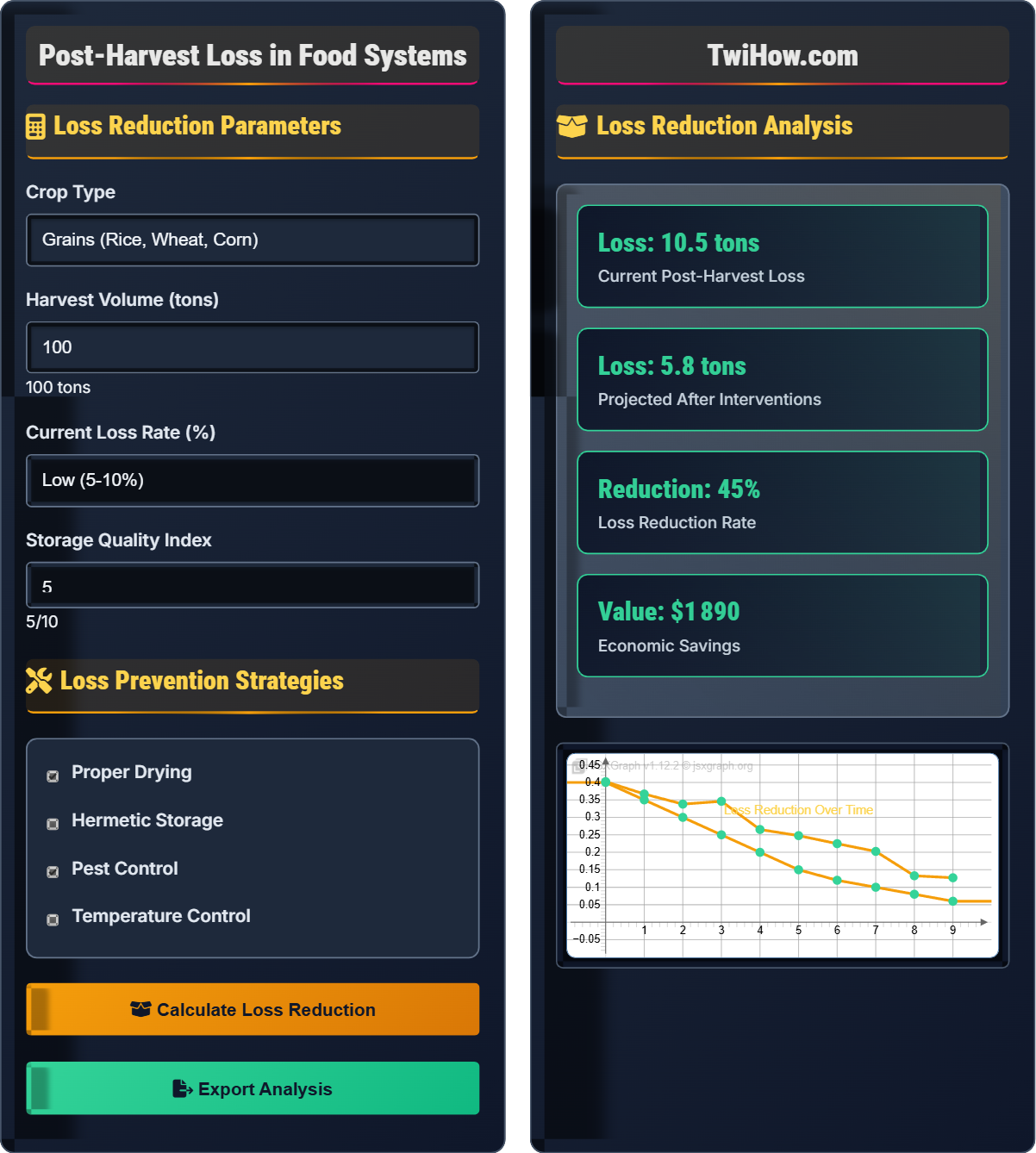
Loss Reduction Parameters
Loss Prevention Strategies
Loss Reduction Analysis
| Phase | Current Loss | Projected Loss | Reduction |
|---|---|---|---|
| Harvest | 2.5% | 1.2% | -1.3% |
| Storage | 12.0% | 4.8% | -7.2% |
| Transport | 3.0% | 1.5% | -1.5% |
| Processing | 2.5% | 0.5% | -2.0% |
Post-Harvest Loss Prevention in Food Systems
Post-harvest loss refers to the deterioration in quality and quantity of agricultural products between harvest and consumption. These losses occur throughout the supply chain and significantly impact food security, farmer incomes, and environmental sustainability.
Effective post-harvest loss prevention involves multiple coordinated approaches:
Hermetic storage, temperature control, humidity management, and pest prevention are critical for preserving grain quality and reducing losses during storage.
Proper packaging, temperature control during transit, and timely delivery reduce losses during transportation from farms to markets.
Proper harvesting techniques, gentle handling, and appropriate processing methods preserve product quality and minimize physical damage.
Loss Prevention Strategies
Hermetic storage, solar drying, cold storage, improved packaging, quality handling, and supply chain optimization.
Loss Reduction = (Current Loss Rate - Projected Loss Rate) / Current Loss Rate × 100
Where Loss Rate = (Lost Quantity / Total Harvested) × 100
- Proper timing is crucial
- Quality preservation starts at harvest
- Technology must be appropriate
- Training is essential
Success Stories
Hermetic storage bags have revolutionized grain storage for smallholder farmers, reducing losses from 20% to less than 2% while eliminating the need for pesticides. These bags preserve grain quality for extended periods.
Solar dryers have enabled farmers to preserve fruits and vegetables, extending shelf life and creating value-added products that command higher prices in markets.
Mobile cold storage units have reduced post-harvest losses for perishable crops by maintaining optimal temperature and humidity conditions during transport and short-term storage.
Loss Reduction Calculator
Post-Harvest Loss Prevention Quiz
Which storage method is most effective for preventing insect infestation in grains?
Hermetic storage is the most effective method for preventing insect infestation. These storage systems create an airtight environment that suffocates insects and prevents their reproduction, while also protecting against moisture and mold.
The answer is B) Hermetic storage.
Hermetic storage works by sealing the container so tightly that oxygen levels drop and carbon dioxide levels rise, creating an environment where insects cannot survive. This method requires no chemicals or pesticides.
Hermetic Storage: Airtight storage that prevents gas exchange
Insect Infestation: Invasion by pests that damage crops
Oxygen Depletion: Process that suffocates insects
• Airtight seals are essential
• Regular monitoring required
• Check seals regularly
• Store in cool, dry places
• Monitor for condensation
• Not checking seal integrity
• Storing in humid conditions
• Ignoring temperature fluctuations
Explain the importance of proper drying in post-harvest loss prevention and describe different drying methods.
Importance of Proper Drying:
Moisture Control: Reducing moisture content prevents mold growth and spoilage.
Insect Prevention: Dry conditions inhibit insect activity and reproduction.
Quality Preservation: Proper drying maintains nutritional value and appearance.
Storage Durability: Dry products can be stored longer without degradation.
Drying Methods:
• Sun Drying: Traditional method using solar energy
• Mechanical Drying: Using heated air systems
• Solar Driers: Enhanced sun drying with improved airflow
• Smoke Drying: Traditional method with preservative properties
Each method has specific applications based on crop type, climate, and resources.
Moisture is the primary factor that enables spoilage organisms to thrive. By removing moisture, we create conditions that are inhospitable to mold, bacteria, and insects, thereby extending the storage life of agricultural products.
Moisture Content: Water present in agricultural products
Spoilage: Deterioration due to microorganisms
Storage Life: Duration products remain usable
• Achieve target moisture levels
• Prevent reabsorption
• Monitor during storage
• Use moisture meters
• Ensure good airflow
• Protect from rain
• Inadequate drying time
• Not checking moisture levels
• Drying too quickly
A farmer harvests 5 tons of maize with a current loss rate of 25%. The maize sells for $300 per ton. Calculate the current economic loss and determine the financial benefit of reducing losses to 8% through improved storage.
Current Situation:
Harvest: 5 tons
Current loss rate: 25%
Current loss: 5 × 0.25 = 1.25 tons
Current economic loss: 1.25 × $300 = $375
After Improvement:
New loss rate: 8%
New loss: 5 × 0.08 = 0.4 tons
New economic loss: 0.4 × $300 = $120
Financial Benefit:
Reduction in loss: $375 - $120 = $255 saved
This represents a 68% reduction in economic loss through improved storage.
This example demonstrates the significant economic impact of post-harvest losses. Even modest improvements in storage can result in substantial financial benefits for farmers, making investments in loss prevention highly worthwhile.
Economic Loss: Monetary value of lost products
Return on Investment: Financial benefit from storage improvements
Cost-Benefit Analysis: Comparing investment to savings
• Calculate potential savings
• Consider investment costs
• Evaluate payback period
• Compare storage costs to savings
• Consider multiple crops
• Factor in time value
• Not calculating economic benefits
• Ignoring multiple seasons
• Not considering opportunity costs
A small farming community in a tropical region wants to reduce post-harvest losses for rice and vegetables. Evaluate three technology options: (1) Hermetic storage bags, (2) Solar dryers, (3) Cold storage units. Recommend the most appropriate solution and justify your choice.
Technology Evaluation:
Hermetic Storage Bags:
Pros: Low cost, effective for grains, no electricity needed, easy to use
Cons: Only suitable for dry products, limited capacity
Solar Dryers:
Pros: Utilizes abundant sunlight, extends shelf life, creates value-added products
Cons: Requires sunny weather, mainly for fruits/vegetables
Cold Storage Units:
Pros: Excellent for perishables, extends shelf life significantly
Cons: High energy requirements, expensive, maintenance needs
Recommendation: Start with hermetic storage bags for rice and solar dryers for vegetables. These technologies are cost-effective, appropriate for the climate, and address the main crops grown.
Technology selection must consider local climate, crop types, economic resources, and technical capacity. Appropriate technology matches the specific needs and constraints of the target community.
Appropriate Technology: Technology suited to local conditions
Technology Transfer: Adoption of new technologies
Local Capacity: Available resources and skills
• Match technology to needs
• Consider local capacity
• Factor in maintenance
• Start with simple solutions
• Train local technicians
• Establish maintenance systems
• Over-engineering solutions
• Not considering maintenance
• Ignoring local preferences
What is the most important factor to consider during harvest and handling to minimize post-harvest losses?
Gentle handling is the most important factor during harvest and handling. Physical damage to crops creates entry points for pathogens, accelerates ripening, and reduces storage life. Even with perfect storage, damaged crops will deteriorate quickly.
The answer is B) Gentle handling.
Physical integrity is fundamental to preservation. Damaged crops deteriorate rapidly regardless of storage conditions. Gentle handling at harvest and throughout the supply chain is the foundation for all other preservation efforts.
Physical Damage: Mechanical injury to crops
Pathogen Entry: Disease organisms entering through wounds
Shelf Life: Duration of usability
• Handle with care
• Use appropriate tools
• Minimize mechanical damage
• Use padded surfaces
• Minimize drops
• Train handlers
• Rough handling during harvest
• Using inappropriate tools
• Not training workers
FAQ
Q: What are the most cost-effective ways to reduce post-harvest losses on a small farm?
A: Cost-effective strategies include:
1. Proper Timing: Harvest at optimal maturity and dry conditions
2. Simple Drying: Use raised drying floors and tarpaulins
3. Hermetic Storage: Metal drums or plastic bags with tight seals
4. Sorting: Remove damaged products before storage
5. Proper Handling: Minimize drops and impacts
6. Storage Hygiene: Clean containers and storage areas
These practices can reduce losses by 30-50% with minimal investment.
Q: How can processing facilities reduce post-harvest losses in their supply chain?
A: Processing facilities can reduce losses by:
1. Supplier Training: Educate farmers on proper harvesting and handling
2. Quality Standards: Implement clear specifications and grading
3. Timely Collection: Reduce time between harvest and processing
4. Transportation: Provide appropriate transport and packaging
5. Feedback Systems: Share loss data with suppliers
6. Technology Transfer: Provide storage and handling equipment
Collaborative approaches with farmers can reduce losses throughout the supply chain.