How Food Systems Address the Challenges of Water Scarcity and Quality
Complete water-food systems guide • Step-by-step explanations
Water-Food Systems Fundamentals:
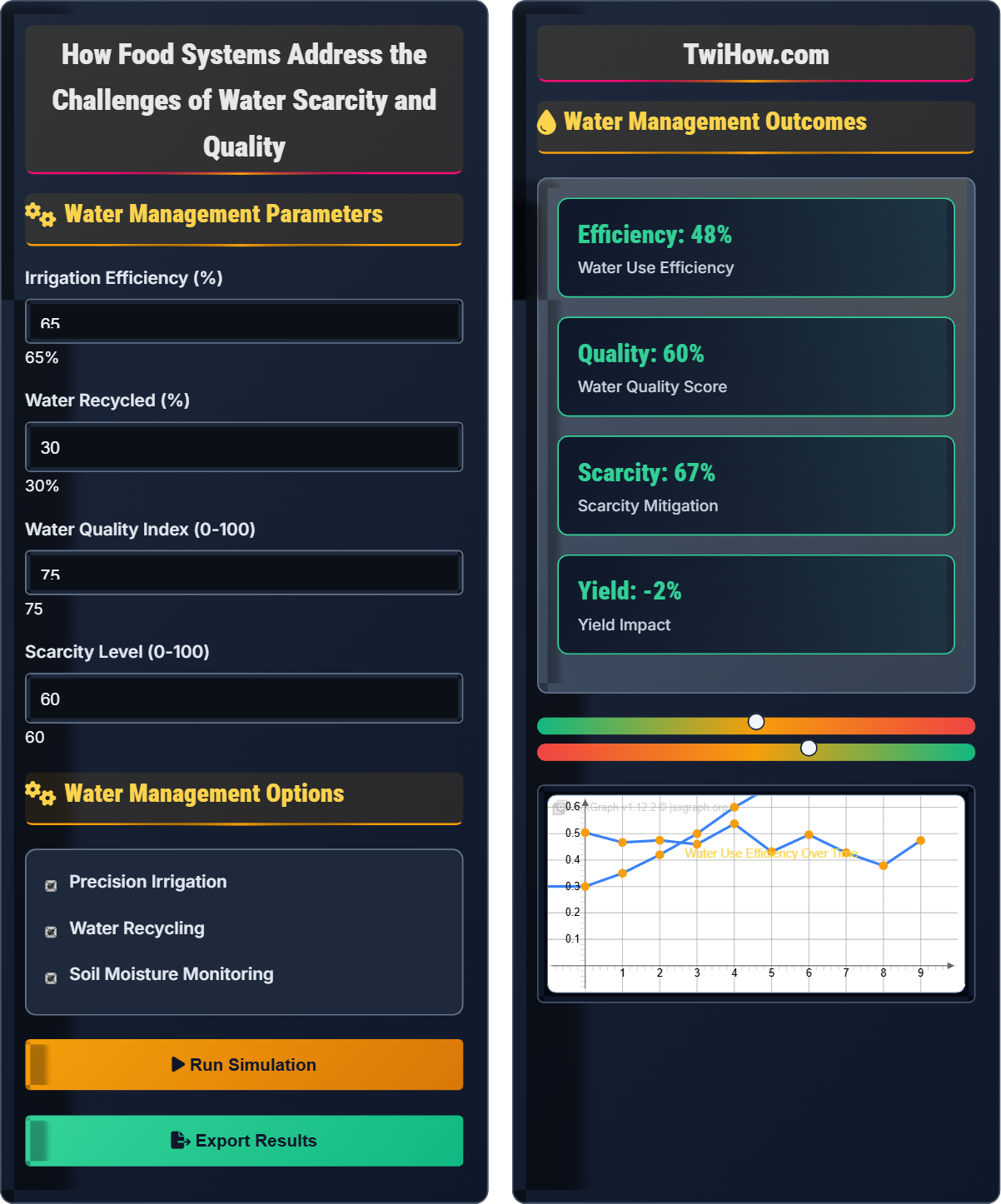
Show Water Management SimulatorFood systems face critical challenges from water scarcity and quality degradation. Agriculture consumes approximately 70% of global freshwater resources, making efficient water management essential for food security and environmental sustainability.
Modern food systems employ diverse strategies to address water challenges, from precision irrigation to water recycling and quality management. These approaches must balance productivity with conservation and environmental protection.
Key water-food system challenges:
- Scarcity: Limited freshwater availability in growing regions
- Quality: Contamination from agricultural runoff and industrial pollution
- Efficiency: Reducing water waste while maintaining yields
- Resilience: Adapting to climate variability and extreme weather
Integrated approaches combine traditional water management with cutting-edge technologies like IoT sensors, precision irrigation, and water recycling systems to optimize both quantity and quality.
Water Management Parameters
Water Management Options
Water Management Outcomes
| Strategy | Effectiveness | Cost | Implementation |
|---|---|---|---|
| Drip Irrigation | 85% | Medium | High |
| Water Recycling | 75% | High | Medium |
| Soil Monitoring | 80% | Low | High |
| Rainwater Harvesting | 60% | Low | Medium |
R=Rain, S=Storage, T=Treatment, I=Irrigation, W=Water, Q=Quality, M=Monitoring, C=Crop, F=Field
Water-Food Systems Management Explained
Water-food systems management encompasses all strategies and technologies used to optimize water use in agriculture while maintaining or improving food production. This includes managing water quantity (availability and scarcity) and water quality (contamination and treatment).
Water efficiency is measured using several important indicators:
Where:
- Water Use Efficiency: Amount of crop produced per unit of water consumed
- Crop Yield: Total harvestable product (kg, tons, etc.)
- Water Consumed: Total water used in production (liters, cubic meters, etc.)
- Goal: Maximize yield while minimizing water consumption
Effective water management in food systems includes:
- Precision Irrigation: Targeted water delivery based on crop needs
- Water Recycling: Reusing and treating agricultural wastewater
- Soil Moisture Monitoring: Optimizing irrigation timing and amount
- Rainwater Harvesting: Collecting and storing precipitation
- Drought-Resistant Crops: Breeding for water efficiency
- Smart Sensors: Real-time monitoring and control
- Filtration Systems: Removing contaminants from irrigation water
- Biological Treatment: Using natural processes to purify water
- Chemical Treatment: Adding substances to neutralize pollutants
- Buffer Zones: Protecting water sources from agricultural runoff
- Testing Protocols: Regular monitoring of water quality
Water-Food Systems Fundamentals
Water efficiency, irrigation technology, water quality, drought management, sustainable agriculture.
Efficiency = Crop Yield / Water Consumed
Where Efficiency = water productivity, Yield = harvest output, Water = total consumption.
- Efficiency increases with precision
- Quality affects crop health
- Technology enables optimization
Applications
Drip irrigation, hydroponics, aquaponics, water recycling, precision agriculture.
- Technology adoption
- Infrastructure development
- Farmer training
- Policy support
- Regional water availability
- Soil characteristics
- Climate conditions
- Economic feasibility
Water-Food Systems Learning Quiz
Which irrigation technology typically provides the highest water use efficiency?
Drip irrigation delivers water directly to plant roots in precise amounts, minimizing evaporation and runoff. It typically achieves 80-95% efficiency compared to 50-60% for flood irrigation. The controlled application reduces water waste and allows for precise nutrient delivery.
The answer is C) Drip Irrigation.
Students should understand that water efficiency depends on matching technology to crop needs and environmental conditions. Drip irrigation is most efficient because it minimizes losses through evaporation, runoff, and deep percolation. However, it requires higher initial investment and maintenance.
Water Use Efficiency: Crop yield per unit of water consumed
Drip Irrigation: System delivering water directly to plant root zones
Evapotranspiration: Combined water loss through evaporation and transpiration
• Precision reduces waste
• Technology selection matters
• Efficiency = yield / water used
• Match technology to crop type
• Consider soil characteristics
• Factor in maintenance costs
• Assuming all irrigation is equal
• Ignoring soil-water interactions
• Overlooking maintenance requirements
Explain how agricultural practices affect water quality and describe the measures food systems can take to protect water resources. What are the economic and environmental trade-offs?
Quality Impacts: Agricultural runoff contains fertilizers, pesticides, and sediments that contaminate water sources. Excess nutrients cause eutrophication, leading to algae blooms and oxygen depletion.
Protective Measures: Buffer strips along waterways, precision fertilizer application, cover crops, integrated pest management, and constructed wetlands for treatment.
Economic Trade-offs: Implementation costs versus long-term benefits, potential yield impacts during transition, market premiums for sustainable products.
Environmental Trade-offs: Reduced productivity initially, but improved long-term soil health and water quality. Balancing immediate needs with ecosystem preservation.
Water quality management in agriculture involves understanding the relationship between farming practices and environmental impacts. Students should recognize that while some protective measures may initially reduce yields or increase costs, they provide long-term benefits through preserved resources and potential market advantages.
Eutrophication: Nutrient enrichment causing excessive plant growth
Buffer Strip: Vegetated area filtering runoff before reaching water bodies
Integrated Pest Management: Comprehensive approach to pest control
• Agriculture affects water quality
• Long-term thinking is essential
• Use precision application
• Implement buffer zones
• Monitor water quality regularly
• Ignoring off-site impacts
• Focusing only on productivity
• Neglecting monitoring
A farmer has 10 hectares of land with access to only 500,000 liters of water per season. Traditional irrigation requires 60,000 liters/hectare but yields 8 tons/hectare. Drip irrigation requires only 35,000 liters/hectare but costs $2,000/hectare to install and increases yield to 9.5 tons/hectare. Calculate which option is better considering water availability and economic returns ($500/ton).
Traditional Irrigation: Water needed = 10 ha × 60,000 L = 600,000 L. This exceeds available water (500,000 L), so it's not feasible.
Drip Irrigation: Water needed = 10 ha × 35,000 L = 350,000 L. This fits within available water. Yield = 10 ha × 9.5 tons = 95 tons. Revenue = 95 × $500 = $47,500. Installation cost = 10 × $2,000 = $20,000. Net return = $47,500 - $20,000 = $27,500.
Analysis: Drip irrigation is the only viable option given water constraints. It also provides better economic returns despite installation costs.
This problem demonstrates how water scarcity can force technology adoption that might otherwise be uneconomical. Students should understand that resource constraints can create compelling business cases for water-efficient technologies, even with higher upfront costs.
Water Availability: Quantity of water accessible for use
Opportunity Cost: Value of next best alternative forgone
Resource Constraint: Limitation imposed by scarce resources
• Resource constraints drive innovation
• Technology adoption has costs
• Economic analysis requires multiple factors
• Always check resource constraints first
• Consider both costs and benefits
• Factor in long-term sustainability
• Ignoring resource constraints
• Calculating only costs
• Forgetting to calculate water needs
A region experiences increasing drought frequency and irregular rainfall patterns. Design a water management strategy that addresses both immediate water scarcity and long-term climate resilience for agricultural systems.
Immediate Actions: Implement efficient irrigation systems, install water storage facilities, adopt drought-resistant crops, establish water-sharing agreements.
Medium-term Strategies: Develop water recycling systems, expand rainwater harvesting, improve soil water retention, diversify crop portfolio.
Long-term Resilience: Invest in climate-smart infrastructure, develop early warning systems, create water banking programs, promote agricultural diversification.
Implementation: Phased approach starting with most impactful measures, stakeholder engagement, financial support for farmers, policy coordination.
Climate adaptation requires multi-faceted approaches addressing immediate needs and long-term resilience. Students should understand the importance of planning horizons and the need for both technical and institutional solutions. Success depends on coordinated efforts across multiple scales.
Climate Adaptation: Adjustments to reduce climate vulnerability
Resilience: Capacity to absorb and recover from disturbances
Water Banking: Storing water rights or physical water for future use
• Plan for multiple time horizons
• Integrate technical and institutional solutions
• Engage all stakeholders
• Start with high-impact measures
• Build adaptive capacity
• Plan for uncertainty
• Focusing only on immediate needs
• Ignoring institutional factors
• Not planning for uncertainty
Which agricultural practice has the most significant positive impact on water quality?
Buffer strips are vegetated areas planted along waterways that filter agricultural runoff, trapping sediments, nutrients, and chemicals before they reach water bodies. They are one of the most effective practices for protecting water quality while maintaining agricultural productivity. The vegetation acts as a natural filtration system.
The answer is B) Installing buffer strips along waterways.
Students should understand that water quality protection often involves managing the interface between agricultural lands and water bodies. Buffer strips represent a simple yet highly effective approach that can be implemented at relatively low cost while providing multiple benefits including wildlife habitat.
Buffer Strip: Vegetated area filtering agricultural runoff
Runoff: Water flowing over land surface carrying pollutants
Non-point Source Pollution: Diffuse pollution from widespread sources
• Prevention is better than treatment
• Natural solutions are often effective
• Multiple benefits are possible
• Use natural filtration systems
• Implement at source
• Consider multiple benefits
• Focusing only on treatment
• Ignoring prevention measures
• Overlooking natural solutions
FAQ
Q: How can I implement water-efficient practices on my farm without breaking the bank?
A: Several cost-effective water management strategies can be implemented gradually:
1. Start Simple: Improve soil health with compost and cover crops to retain moisture
2. Timing Optimization: Irrigate during cooler parts of the day to reduce evaporation
3. Gradual Upgrades: Begin with basic drip irrigation for high-value crops
4. Water Storage: Install rain barrels or small ponds for harvested rainwater
5. Monitoring: Use simple soil moisture tests before irrigating
6. Government Programs: Apply for grants and subsidies for water efficiency improvements
Focus on practices that provide immediate benefits while building toward longer-term investments.
Q: What policies would most effectively promote sustainable water use in agriculture?
A: Effective policies should include:
Economic Incentives: Water pricing that reflects scarcity, subsidies for efficiency improvements, tax credits for conservation practices.
Regulatory Frameworks: Water use permits, quality standards, mandatory efficiency targets for large operations.
Technical Support: Extension services, demonstration projects, research funding for water-efficient technologies.
Market Mechanisms: Water trading systems, certification programs for water-efficient products.
Coordination: Basin-level water management, stakeholder engagement platforms, integrated planning.
Success requires combining carrots (incentives) with sticks (regulations) while providing necessary support.