Food Systems & Vulnerable Populations
Complete guide • Step-by-step explanations
Food Systems & Vulnerable Populations:
Show Vulnerability AnalyzerFood systems must address the unique nutritional and access needs of vulnerable populations including children, elderly, pregnant women, and individuals with disabilities. These groups have specific dietary requirements and face particular barriers to accessing nutritious food.
Key considerations include age-appropriate nutrition, special dietary needs, accessibility accommodations, and targeted support programs. Effective systems require coordinated approaches involving government, community organizations, and private sector.
Strategies include school meal programs, senior nutrition services, special dietary accommodations, and community-based food assistance programs designed to meet specific population needs.
Real-world applications include WIC programs, senior centers, food banks with special diets, and culturally appropriate food services.
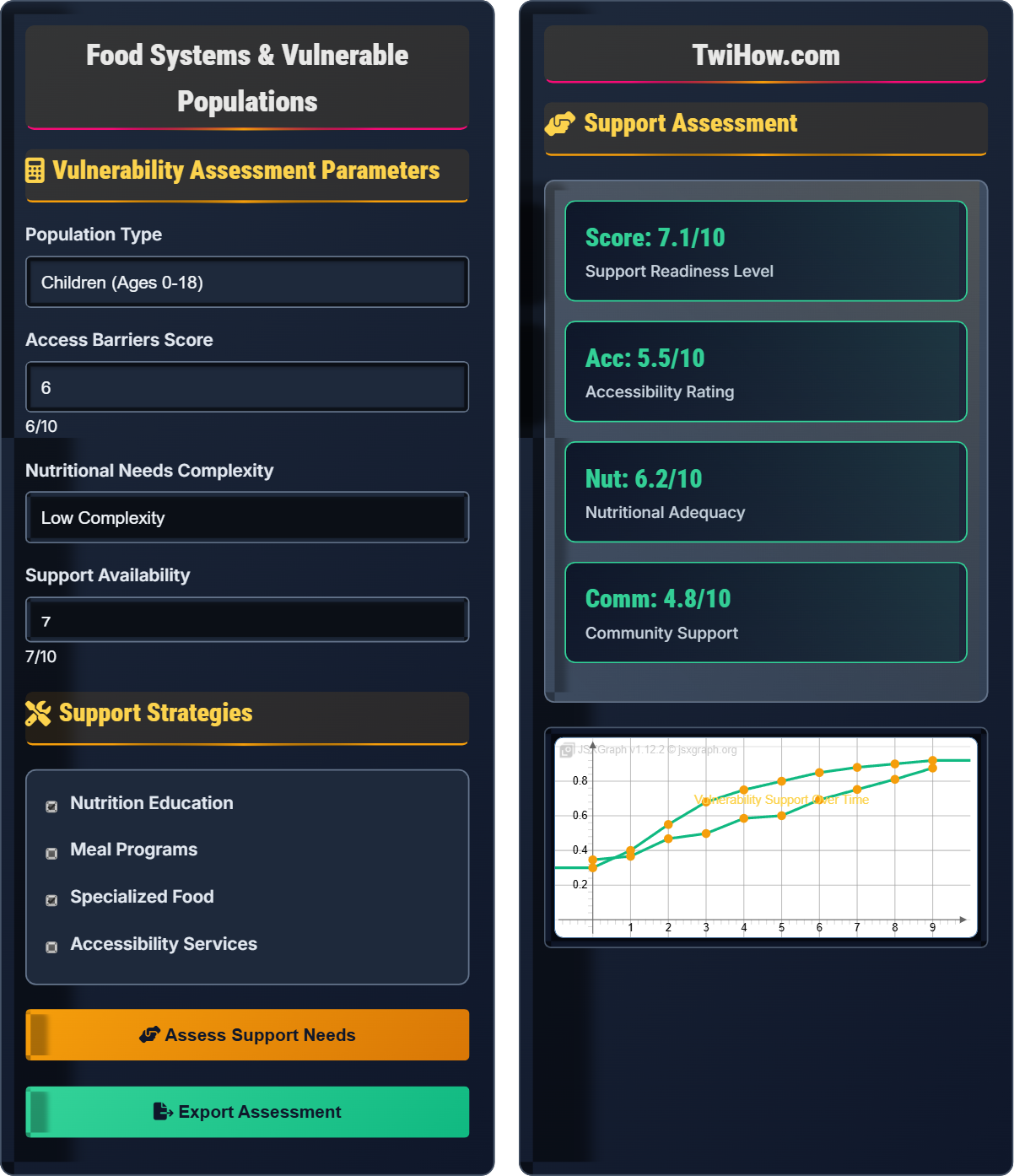
Vulnerability Assessment Parameters
Support Strategies
Support Assessment
| Need Area | Score | Status | Recommendations |
|---|---|---|---|
| Nutrition | 7.5 | Good | Maintain current programs |
| Access | 6.8 | Good | Expand transportation options |
| Education | 7.2 | Good | Continue educational efforts |
| Support | 7.1 | Good | Strengthen community networks |
Food Systems & Vulnerable Populations
Food systems must address the unique nutritional and access needs of vulnerable populations including children, elderly, pregnant women, and individuals with disabilities. These groups have specific dietary requirements and face particular barriers to accessing nutritious food.
Effective food systems employ multiple strategies to support vulnerable populations:
School meal programs, senior nutrition services, and specialized meal delivery for homebound individuals. These programs provide age-appropriate nutrition and address specific dietary needs.
Physical accommodations like wheelchair access, grab bars, and adaptive utensils, as well as sensory accommodations for individuals with vision or hearing impairments.
Age-appropriate and culturally sensitive education programs that teach healthy eating habits, food preparation, and nutrition knowledge to vulnerable populations.
Support Programs
School meal programs, senior nutrition services, WIC programs, food banks, meal delivery services, and community gardens.
Support Index = (Accessibility × 0.3) + (Nutrition × 0.35) + (Education × 0.2) + (Community Support × 0.15)
Where each component is rated on a 0-10 scale.
- Individual needs vary significantly
- Accessibility is crucial
- Cultural sensitivity matters
- Coordination improves outcomes
Success Stories
The NSLP provides nutritious meals to over 30 million children daily, addressing food insecurity while supporting academic performance and healthy development.
Senior centers across the country provide congregate meals and home-delivered meals, addressing both nutritional needs and social isolation among elderly populations.
The WIC program provides supplemental nutrition to pregnant women, new mothers, and young children, improving birth outcomes and childhood nutrition.
Vulnerability Support Analyzer
Food Systems & Vulnerable Populations Quiz
What is the primary nutritional consideration for children in food assistance programs?
The primary nutritional consideration for children is providing growth-supporting nutrients. Children require adequate protein, calcium, iron, vitamins, and minerals to support their physical and cognitive development. While calories are important, the focus is on nutrient-dense foods that support healthy growth.
The answer is B) Growth-supporting nutrients.
Children have different nutritional requirements than adults, with higher needs for protein, calcium, iron, and other nutrients essential for growth and development. Food assistance programs for children must prioritize nutrient density over calorie content alone.
Growth-Supporting Nutrients: Protein, calcium, iron, vitamins
Nutrient Density: Nutrients per calorie
Development: Physical and cognitive growth
• Children need more nutrients per pound
• Focus on nutrient density
• Support cognitive development
• Include dairy and protein
• Focus on fruits and vegetables
• Limit processed foods
• Focusing only on calories
• Not considering development needs
• Ignoring micronutrients
Explain the specific nutritional challenges faced by elderly populations and describe appropriate food system responses.
Specific Nutritional Challenges:
Decreased Appetite: Reduced taste and smell sensitivity, medication side effects, and depression can reduce appetite.
Digestive Issues: Changes in digestion and absorption require softer, more digestible foods.
Chronic Conditions: Diabetes, heart disease, and kidney problems require special dietary considerations.
Physical Limitations: Difficulty chewing, swallowing, or preparing food creates access barriers.
Appropriate Food System Responses:
• Soft Food Options: Cooked vegetables, ground meats, and softer textures
• Smaller, Frequent Meals: Accommodate decreased appetite
• Specialized Diets: Diabetic, low-sodium, and renal-friendly options
• Meal Delivery: Home-delivered meals for mobility-limited individuals
• Senior Centers: Congregate meal programs with social interaction
Elderly populations face unique physiological and social challenges that affect their ability to access and consume nutritious food. Food systems must adapt to these age-related changes while maintaining nutritional adequacy.
Age-Related Changes: Physiological changes with aging
Specialized Diets: Foods for specific health conditions
Congregate Meals: Group meal programs
• Adapt to physical limitations
• Address chronic conditions
• Maintain social aspects
• Enhance flavor safely
• Provide soft textures
• Include social aspects
• Not considering texture needs
• Ignoring chronic conditions
• Overlooking social aspects
A rural community of 10,000 residents has 15% elderly residents, 20% children under 18, and limited public transportation. The nearest grocery store is 12 miles away. Assess the food system vulnerabilities and propose three targeted interventions to address the needs of vulnerable populations.
Identified Vulnerabilities:
Transportation Barriers: 35% of residents (elderly + children) face significant access challenges with grocery store 12 miles away.
Service Gaps: Limited meal programs and nutrition services for vulnerable populations.
Isolation Risk: Elderly residents particularly vulnerable to food insecurity due to mobility limitations.
Targeted Interventions:
• Mobile Food Pantry: Weekly visits to deliver food to elderly and isolated residents.
• School Bus Delivery: After-school hours bus runs to grocery store for families.
• Community Gardens: Senior-led gardening programs with harvest sharing.
These interventions address the specific access and nutritional needs of vulnerable populations in this rural setting.
Rural communities often face unique challenges with food access due to geographic isolation and limited infrastructure. Solutions must be creative and community-centered to address the specific vulnerabilities of different population groups.
Rural Food Access: Geographic and transportation barriers
Mobile Services: Outreach programs that come to communities
Community-Centered: Solutions developed with community input
• Address geographic barriers
• Use existing infrastructure
• Engage community members
• Partner with transportation services
• Leverage school infrastructure
• Create community networks
• Not considering geographic challenges
• Overlooking existing resources
• Not involving community
A city wants to coordinate multiple food assistance programs (school meals, senior services, WIC, food banks) to better serve vulnerable populations. Evaluate three coordination strategies: (1) Centralized database, (2) Referral networks, (3) Integrated service delivery. Recommend the optimal approach and justify your reasoning.
Strategy Evaluation:
Centralized Database:
Pros: Comprehensive client information, reduced duplication, efficient resource allocation
Cons: Privacy concerns, implementation costs, technical complexity
Referral Networks:
Pros: Maintains organizational independence, flexible, lower cost
Cons: Information gaps, potential for missed referrals
Integrated Service Delivery:
Pros: Seamless client experience, comprehensive services, efficient resource use
Cons: Requires organizational restructuring, coordination challenges
Optimal Approach: Combination of referral networks and integrated service points where feasible. Start with referral networks to build coordination, then gradually move toward integrated delivery at key locations.
Coordination between multiple service providers requires balancing efficiency with organizational autonomy. A phased approach allows for gradual improvement while building trust and experience among participating organizations.
Service Coordination: Aligning multiple programs
Referral Networks: Information sharing between services
Integrated Delivery: Combined service provision
• Start with simple coordination
• Build trust gradually
• Maintain flexibility
• Establish clear communication
• Define roles clearly
• Monitor outcomes
• Attempting full integration too quickly
• Not addressing privacy concerns
• Overlooking organizational culture
What is the most important factor when designing food programs for vulnerable populations?
Cultural and religious appropriateness is most important because it ensures that food programs are acceptable and utilized by the populations they serve. Without cultural sensitivity, even nutritionally adequate programs may not be accessed or consumed by vulnerable populations.
The answer is B) Cultural and religious appropriateness.
Cultural appropriateness is fundamental to program success. Even the most nutritionally sound food will not benefit recipients if it conflicts with their cultural, religious, or personal food preferences and practices.
Cultural Appropriateness: Foods that match cultural preferences
Religious Considerations: Dietary laws and restrictions
Program Acceptance: Willingness to participate
• Respect cultural diversity
• Consider religious practices
• Include community input
• Consult with community leaders
• Offer diverse options
• Respect dietary restrictions
• Assuming universal preferences
• Not consulting communities
• Ignoring religious practices
FAQ
Q: How can we improve food access for elderly residents in our community?
A: Improve elderly food access through:
1. Home-Delivered Meals: Programs like Meals on Wheels for homebound seniors
2. Transportation Services: Senior shuttles to grocery stores and farmers markets
3. Senior Centers: Congregate meal programs with social interaction
4. Mobile Markets: Bring fresh food directly to senior housing
5. Pharmacy Partnerships: Coordinate food delivery with medication pickup
6. Volunteer Networks: Neighbor-to-neighbor shopping assistance
Focus on both nutrition and social aspects of meal programs.
Q: What food assistance programs are available for families with young children?
A: Available programs for families with young children:
1. WIC Program: Supplemental nutrition for pregnant women, new mothers, and children under 5
2. School Meal Programs: Free/reduced lunch and breakfast for eligible students
3. Summer Meal Programs: Meals for children during summer break
4. Food Banks: Emergency food assistance for families
5. Head Start Programs: Nutrition services as part of early childhood education
6. Community Gardens: Educational programs with family participation
Contact local social services for eligibility and enrollment information.