Food Systems: Economic Viability & Environmental Stewardship
Complete guide • Step-by-step explanations
Food Systems Balance:
Show Balance CalculatorBalancing economic viability with environmental stewardship in food systems requires innovative approaches that maintain profitability while protecting natural resources. This involves sustainable farming practices, efficient resource use, and long-term planning that considers both financial returns and environmental impacts.
Key strategies include precision agriculture, regenerative farming, circular economy principles, and ecosystem services valuation. These approaches create win-win scenarios for farmers, consumers, and the environment.
Successful implementation requires supportive policies, market incentives, and technological innovation that makes sustainable practices economically attractive.
Real-world applications include carbon credit programs, sustainable certification schemes, and conservation agriculture that maintains productivity while enhancing environmental outcomes.
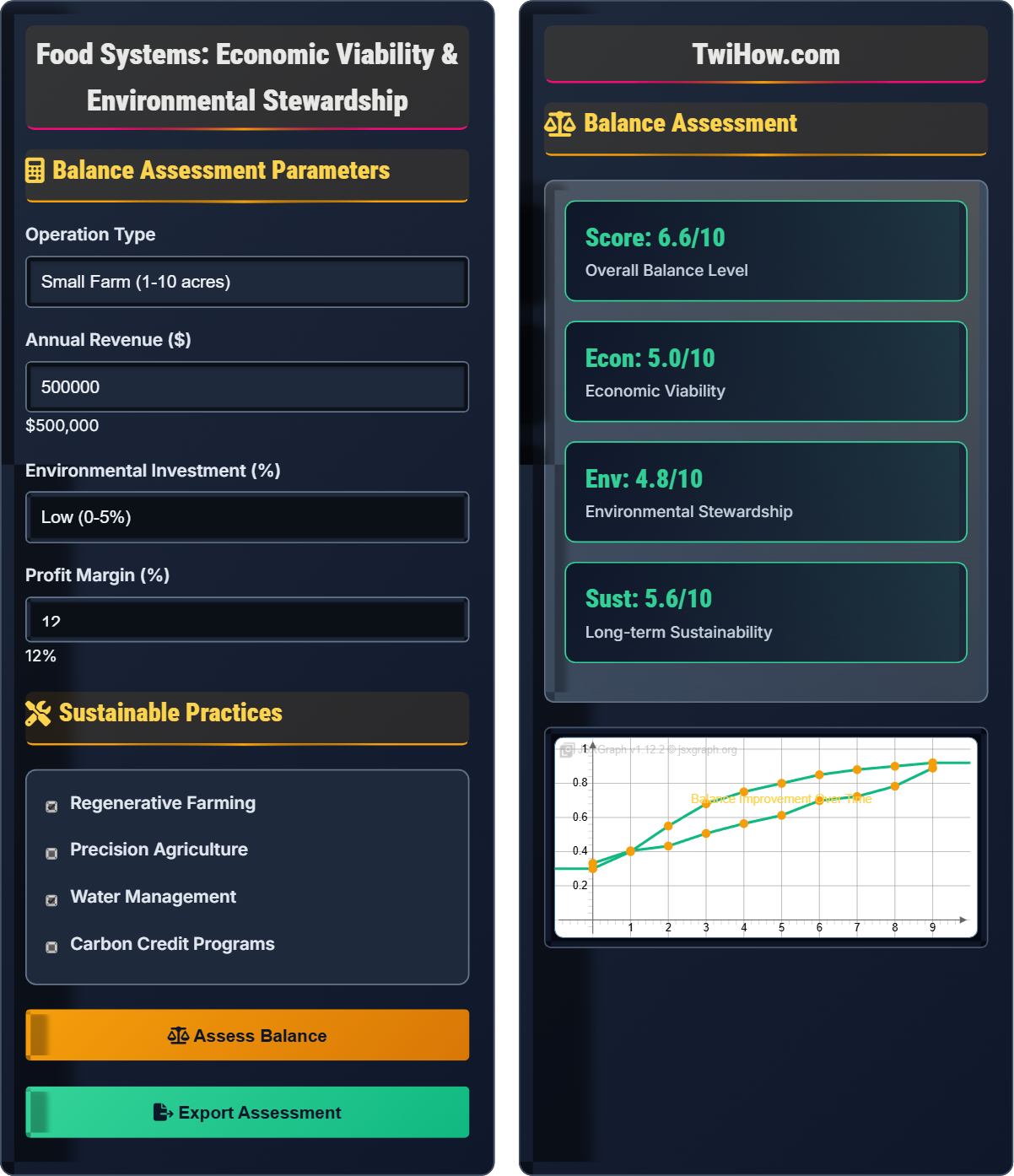
Balance Assessment Parameters
Sustainable Practices
Balance Assessment
| Indicator | Score | Status | Recommendations |
|---|---|---|---|
| Economic Performance | 7.8 | Good | Maintain current strategies |
| Environmental Impact | 7.1 | Good | Expand sustainable practices |
| Resource Efficiency | 7.5 | Good | Continue optimization |
| Profitability | 7.6 | Good | Explore new markets |
Balancing Economic Viability with Environmental Stewardship
Food systems must simultaneously achieve economic profitability and environmental sustainability. This balance requires innovative approaches that maintain financial returns while protecting natural resources and ecosystem services for future generations.
Successful food systems employ multiple strategies to achieve balance:
Practices that restore soil health, increase biodiversity, and sequester carbon while maintaining or improving productivity. This approach creates long-term economic value while enhancing environmental outcomes.
Using technology to optimize input use (fertilizers, water, pesticides) based on specific field conditions. This reduces environmental impact while maintaining economic efficiency through resource optimization.
Creating closed-loop systems where waste from one process becomes input for another. This reduces environmental impact while creating additional revenue streams.
Balancing Strategies
Regenerative agriculture, precision farming, circular economy, ecosystem services, and sustainable intensification.
Balance Index = (Economic Performance × 0.4) + (Environmental Impact × 0.35) + (Resource Efficiency × 0.25)
Where each component is rated on a 0-10 scale.
- Long-term thinking is essential
- Win-win scenarios are possible
- Investment in sustainability pays dividends
- Measurement drives improvement
Success Stories
Some ranches have adopted rotational grazing and cover cropping practices that improve soil health, increase carbon sequestration, and maintain or increase livestock productivity while reducing input costs.
Modern farms use GPS-guided equipment, soil sensors, and data analytics to optimize input application, reducing environmental impact while maintaining yields and reducing costs.
Food processors convert waste streams into valuable products like bioenergy, animal feed, or compost, creating additional revenue streams while reducing waste disposal costs.
Economic-Environmental Balance Calculator
Food Systems Balance Quiz
Which of the following best describes the relationship between regenerative agriculture and economic viability?
Regenerative agriculture improves long-term profitability by enhancing soil health, reducing input costs, increasing resilience to weather extremes, and potentially accessing premium markets. While initial implementation may require investment, the long-term economic benefits often outweigh the costs.
The answer is B) Improves long-term profitability.
Regenerative practices like cover cropping, reduced tillage, and diversified rotations improve soil health, which leads to better yields over time, reduced input costs, and increased resilience. This creates a positive feedback loop that benefits both environmental outcomes and economic returns.
Regenerative Agriculture: Farming practices that restore soil health
Soil Health: Physical, chemical, and biological properties
Input Costs: Expenses for fertilizers, pesticides, fuel
• Long-term thinking pays off
• Soil health is an asset
• Investment in sustainability
• Start with pilot programs
• Measure soil health improvements
• Access premium markets
• Focusing only on short-term costs
• Not measuring soil improvements
• Ignoring long-term benefits
Explain how precision agriculture balances economic and environmental objectives, and provide specific examples of technologies that achieve this balance.
How Precision Agriculture Balances Objectives:
Economic Benefits: Reduces input costs by applying fertilizers, pesticides, and water only where and when needed. Increases yields through optimized growing conditions.
Environmental Benefits: Reduces chemical runoff, conserves water, and minimizes soil degradation by optimizing input application.
Specific Technologies:
• Variable Rate Application: Applies inputs based on soil variability
• Drone Monitoring: Identifies pest or disease problems early
• Soil Sensors: Monitors moisture and nutrient levels
• GPS-Guided Equipment: Reduces overlap and waste
• Data Analytics: Optimizes planting and harvesting timing
Precision agriculture exemplifies how technology can create win-win scenarios. By collecting and analyzing data, farmers can make more informed decisions that improve both economic returns and environmental outcomes simultaneously.
Precision Agriculture: Technology-enabled farming optimization
Variable Rate Application: Adjusting inputs by location
Site-Specific Management: Managing by field location
• Data drives decisions
• Optimization reduces waste
• Technology enables balance
• Start with key technologies
• Focus on high-value inputs
• Track cost savings
• Over-investing in technology
• Not analyzing data properly
• Ignoring maintenance costs
A dairy farm produces 1,000 tons of milk annually and generates 500 tons of manure. Currently, they pay $20/ton to dispose of manure. They can install a biogas digester for $200,000 that converts manure to electricity and fertilizer. The system generates $150,000/year in electricity sales and $50,000/year in fertilizer sales. Calculate the payback period and evaluate the economic-environmental benefits.
Current Situation:
Disposal cost = 500 tons × $20/ton = $10,000/year
After Installation:
Electricity revenue = $150,000/year
Fertilizer revenue = $50,000/year
Net revenue = $150,000 + $50,000 - $10,000 = $190,000/year
Payback Period:
$200,000 ÷ $190,000/year = 1.05 years
Benefits:
Economic: Short payback period with ongoing revenue stream
Environmental: Eliminates waste disposal, reduces emissions, creates renewable energy
This example demonstrates how circular economy principles can create immediate economic benefits while delivering significant environmental improvements. The conversion of waste to valuable products creates multiple revenue streams that offset initial investment costs rapidly.
Circular Economy: System where waste becomes input
Biogas Digester: Converts organic waste to energy
Payback Period: Time to recover investment
• Waste streams have value
• Multiple revenue streams
• Quick payback possible
• Identify waste streams
• Research conversion technologies
• Calculate payback periods
• Not valuing waste streams
• Ignoring conversion technologies
• Not calculating financial returns
A farmer implementing sustainable practices wants to access premium markets but faces challenges with certification costs, consumer education, and distribution channels. Evaluate three strategies to overcome these barriers: (1) Direct marketing, (2) Certification partnerships, (3) Value-added processing. Recommend the optimal approach and justify your reasoning.
Strategy Evaluation:
Direct Marketing:
Pros: Higher margins, direct consumer relationships, storytelling opportunities
Cons: Limited scale, marketing burden, seasonal constraints
Certification Partnerships:
Pros: Shared costs, established credibility, access to premium buyers
Cons: Ongoing fees, compliance requirements, market volatility
Value-Added Processing:
Pros: Higher margins, differentiation, year-round sales
Cons: Capital investment, regulatory compliance, market development
Optimal Approach: Start with direct marketing to build consumer relationships and prove market demand, then pursue certification partnerships for scale, followed by value-added processing for maximum margins.
Market access for sustainable products requires a staged approach that builds consumer trust, demonstrates value, and scales efficiently. The optimal sequence allows farmers to learn market dynamics while minimizing risk.
Direct Marketing: Selling directly to consumers
Certification: Third-party verification of practices
Value-Added Processing: Converting raw products
• Start with direct relationships
• Build credibility gradually
• Scale strategically
• Tell your story
• Focus on quality
• Build relationships
• Scaling too quickly
• Not educating consumers
• Ignoring market research
Which practice provides the best balance of economic and environmental benefits?
Precision input application provides the best balance by applying inputs only where and when needed. This reduces environmental impact (less runoff, less waste) while maintaining economic efficiency (reduced input costs, optimized yields).
The answer is B) Precision input application.
Precision input application exemplifies the balance principle by optimizing rather than maximizing or minimizing. It recognizes that economic and environmental goals can be aligned through intelligent resource management.
Precision Application: Targeted input delivery
Resource Optimization: Efficient resource use
Input Efficiency: Output per unit of input
• Optimization beats maximization
• Data drives efficiency
• Balance is achievable
• Measure before applying
• Use technology tools
• Track efficiency metrics
• Applying inputs uniformly
• Not measuring results
• Ignoring site variation
FAQ
Q: How can I implement sustainable practices while maintaining profitability?
A: Start with practices that have immediate benefits:
1. Soil Testing: Optimize fertilizer application to save money
2. Water Management: Install efficient irrigation systems
3. Integrated Pest Management: Reduce pesticide use
4. Rotational Grazing: Improve pasture health
5. Direct Marketing: Capture premium prices
6. Energy Efficiency: Reduce operational costs
Focus on practices with short payback periods first.
Q: What sustainable practices offer the best return on investment for food processors?
A: Highest ROI practices include:
1. Energy Efficiency: LED lighting, variable speed motors
2. Water Recycling: Closed-loop systems
3. Waste Valorization: Convert byproducts to products
4. Renewable Energy: Solar panels, biogas systems
5. Lean Manufacturing: Reduce waste and inefficiency
6. Packaging Optimization: Reduce material use
These typically pay back within 2-5 years.