Food Systems Balancing Global Trade with Local Self-Reliance
Complete trade-local balance guide • Step-by-step explanations
Trade-Local Balance Fundamentals:
Show Balance SimulatorFood systems face the complex challenge of balancing global trade benefits with local self-reliance needs. Global trade offers access to diverse foods, economic opportunities, and comparative advantages, while local self-reliance provides food security, economic stability, and environmental sustainability.
Effective balance requires strategic planning that leverages international markets for non-local products while maintaining domestic production capacity for essential foods. This approach optimizes both efficiency and resilience while supporting local economies and food security.
Key balancing considerations:
- Security: Ensuring reliable access to essential foods
- Economics: Balancing trade benefits with local economic development
- Environment: Managing transportation impacts and local resource use
- Social: Supporting local communities and cultural food systems
Successful food systems integrate global and local approaches, creating hybrid models that capture the benefits of both while mitigating their respective risks and challenges.
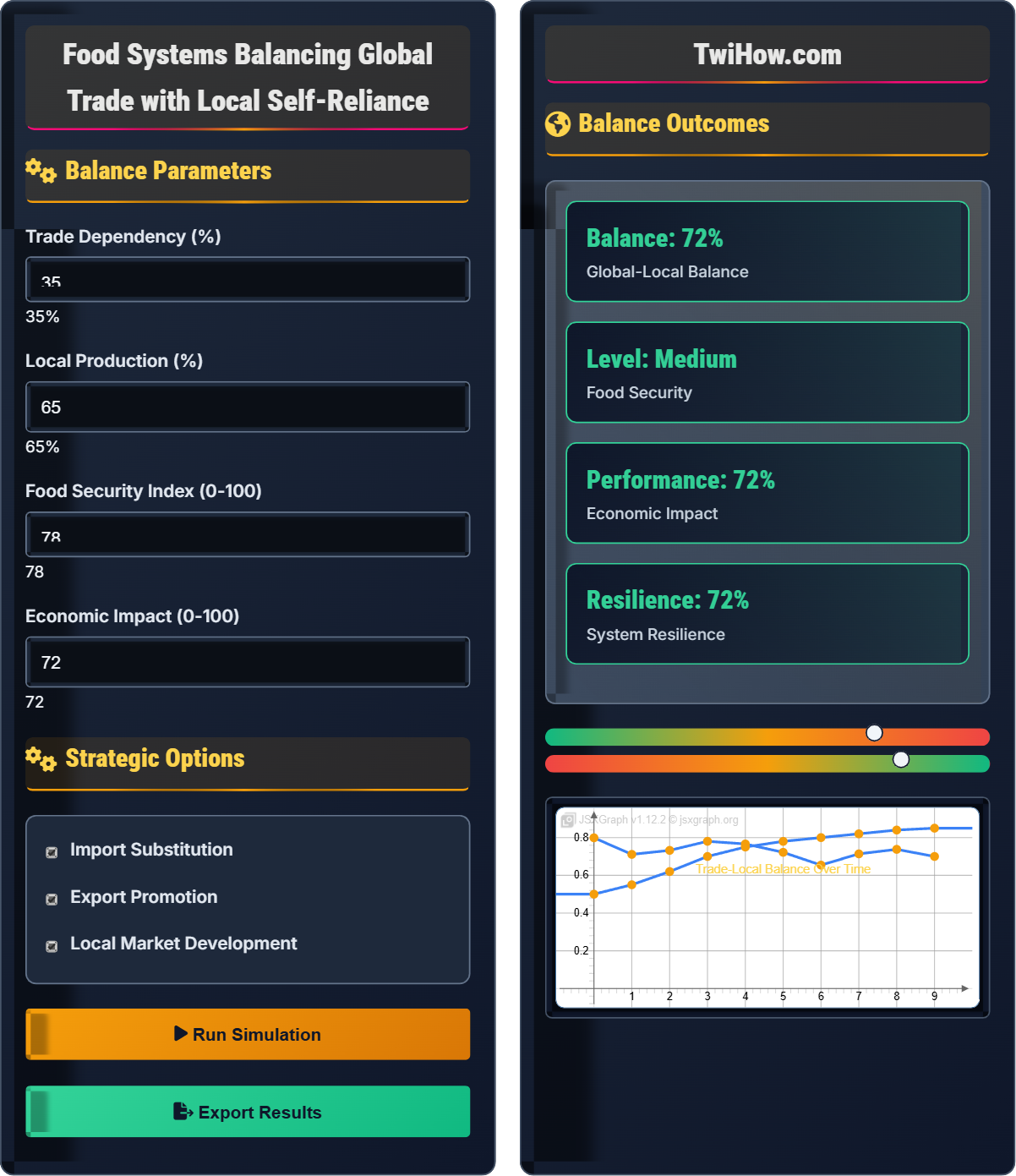
Balance Parameters
Strategic Options
Balance Outcomes
| Component | Score | Target | Recommendation |
|---|---|---|---|
| Local Production | 65% | 60-80% | On target |
| Imports | 35% | 20-40% | Acceptable |
| Exports | 25% | 20-30% | On target |
| Self-sufficiency | 75% | 70-85% | Strong |
G=Global, T=Trade, S=Security, L=Local, P=Production, M=Markets, E=Exports, F=Food, C=Consumption
Trade-Local Balance in Food Systems Explained
Trade-local balance in food systems refers to the optimal mix of global trade participation and local production that maximizes food security, economic benefits, and system resilience. This involves strategically determining which foods to produce domestically versus importing, and which to export versus retaining for domestic consumption.
Balance effectiveness is measured using several important indicators:
Where:
- Local Production: Percentage of food produced domestically
- Food Security: Access, availability, and stability measures
- Economic Performance: Economic benefits and trade balance
- Goal: Optimize all components for sustainable balance
Effective trade-local balance includes:
- Strategic Imports: Importing foods that are difficult to produce locally
- Export Promotion: Leveraging comparative advantages in global markets
- Import Substitution: Replacing imports with domestic production where viable
- Local Market Development: Strengthening domestic food systems
- Emergency Stocks: Maintaining reserves for food security
- Diversification: Multiple suppliers and production sources
- Policy: Tariffs, subsidies, and regulatory frameworks
- Investment: Infrastructure and capacity building
- Market: Price signals and supply chain development
- Technology: Innovation for local production enhancement
- Cooperation: Regional and international partnerships
Trade-Local Balance Fundamentals
Food security, trade balance, import substitution, comparative advantage, food sovereignty, local food systems.
Index = (Local Production + Food Security + Economic Performance) / 3
Where Index = balance effectiveness, Local Production = domestic output, Food Security = access measures, Economic Performance = trade benefits.
- Balance varies by food type
- Security requires strategic reserves
- Efficiency supports both goals
Applications
Import substitution policies, export promotion programs, local food initiatives, strategic reserves, trade agreements.
- Food security assessment
- Comparative advantage analysis
- Policy development
- Stakeholder engagement
- Geographic factors
- Climate conditions
- Economic capacity
- Political stability
Trade-Local Balance Learning Quiz
According to the principle of comparative advantage, which foods should a country prioritize for import?
Comparative advantage suggests that countries should specialize in producing goods they can produce relatively more efficiently and import goods that are relatively expensive to produce domestically. This maximizes overall economic efficiency and allows resources to be allocated to areas of greatest strength.
The answer is A) Foods that are expensive to produce domestically.
Students should understand that comparative advantage is about relative efficiency, not absolute capability. Even if a country could produce all foods, it may be economically beneficial to import those that are expensive to produce locally and focus on producing items where it has a relative advantage. This principle underlies much of international trade theory.
Comparative Advantage: Ability to produce goods at lower opportunity cost
Opportunity Cost: Value of next best alternative forgone
Relative Efficiency: Efficiency compared to other goods or countries
• Focus on relative, not absolute advantage
• Consider opportunity costs
• Efficiency drives specialization
• Identify domestic strengths
• Calculate opportunity costs
• Consider climate and resources
• Confusing absolute and comparative advantage
• Ignoring opportunity costs
• Assuming self-sufficiency is always best
Explain the tension between food security objectives and trade liberalization. How can countries balance these competing priorities?
Tension Sources: Food security emphasizes domestic production and self-reliance, while trade liberalization promotes efficiency through specialization and imports. Security concerns include supply disruptions, price volatility, and dependence on foreign suppliers.
Balance Strategies: Maintain strategic reserves, diversify import sources, develop domestic capacity for essential foods, use tariffs and quotas selectively, and implement early warning systems.
Practical Approach: Import non-essential or difficult-to-produce foods while maintaining domestic production of staples and strategic items.
Policy Tools: Seasonal restrictions, stock management, price stabilization, and emergency protocols.
Outcome: Efficient resource allocation while maintaining security buffers.
This question highlights the fundamental tension in food system policy. Students should understand that both objectives are valid but require different approaches. The key is finding a middle path that captures trade benefits while maintaining security through strategic planning and policy instruments.
Food Security: Reliable access to sufficient, safe, nutritious food
Trade Liberalization: Reducing barriers to international trade
Strategic Reserves: Emergency food stocks for security
• Security and efficiency can coexist
• Strategic planning is essential
• Balance varies by food type
• Classify foods by importance
• Diversify suppliers
• Maintain strategic stocks
• Assuming trade and security are incompatible
• Ignoring strategic food categories
• Not planning for emergencies
A country imports 50% of its rice at $0.80/kg but could produce domestically at $1.20/kg. However, domestic production would create 10,000 jobs and reduce import spending by $200M annually. If the country produces 500,000 tons of rice, calculate the net economic impact of import substitution, including job creation value (estimate $20,000/job annually).
Current Import Cost: 500,000 tons × 50% × 1000 kg/ton × $0.80/kg = $200M
Domestic Production Cost: 500,000 tons × 1000 kg/ton × $1.20/kg = $600M
Cost Difference: $600M - $200M = $400M additional cost
Job Creation Value: 10,000 jobs × $20,000/job = $200M
Import Savings: $200M
Net Economic Impact: -$400M + $200M + $200M = $0
Conclusion: Economically neutral but provides employment and security benefits.
This problem demonstrates that economic analysis must consider both direct costs and broader benefits. Students should understand that pure market efficiency may not capture all relevant factors in food security decisions. The calculation shows that while import substitution may appear costly, the employment and security benefits can offset the efficiency loss.
Import Substitution: Replacing imports with domestic production
Opportunity Cost: Value of foregone alternatives
Externalities: Costs or benefits not reflected in market prices
• Consider all relevant costs and benefits
• Account for employment effects
• Factor in security benefits
• Calculate direct and indirect impacts
• Consider long-term benefits
• Factor in risk reduction
• Focusing only on production costs
• Ignoring employment effects
• Not considering security benefits
A regional bloc wants to enhance food security while maintaining trade benefits. Design a strategy that leverages regional complementarities while ensuring individual country security. Consider different climates, production capacities, and political systems.
Regional Specialization: Each country focuses on foods suited to its climate and resources while maintaining strategic reserves of essentials.
Emergency Mechanisms: Regional food reserves and emergency distribution systems for crisis situations.
Trade Framework: Preferential trade agreements for food security items with guaranteed supply commitments.
Infrastructure: Regional logistics networks for efficient food movement during normal and emergency periods.
Coordination: Information sharing systems, early warning networks, and joint planning mechanisms.
Flexibility: Protocols for switching between trade and security modes based on conditions.
This problem demonstrates that regional approaches can combine trade benefits with security advantages. Students should understand that cooperation can enhance both efficiency and security by leveraging diverse regional capabilities while creating mutual support systems.
Regional Complementarity: Different capabilities across countries
Preferential Trade: Favored trading terms within region
Emergency Protocols: Procedures for crisis situations
• Leverage regional diversity
• Maintain strategic reserves
• Create mutual support systems
• Map regional capabilities
• Design flexible mechanisms
• Build trust through cooperation
• Assuming self-sufficiency for each country
• Ignoring regional synergies
• Not planning for coordination
Which food category should typically have the highest self-sufficiency target?
Staple foods (rice, wheat, maize, potatoes) should have the highest self-sufficiency targets because they form the foundation of food security and nutrition. Disruptions to staple food supplies have the most severe consequences for food security and social stability. Countries typically prioritize domestic production of these essential items.
The answer is B) Staple foods.
Students should understand that food security priorities vary by food type. Staple foods are critical for basic nutrition and social stability, so countries typically aim for high self-sufficiency in these items. Non-essential or specialty foods may be more suitable for trade, while luxury items can often be imported without significant security concerns.
Staple Foods: Basic foods forming diet foundation
Self-Sufficiency: Domestic production meeting domestic demand
Food Security: Reliable access to essential foods
• Prioritize essential foods for self-sufficiency
• Consider social stability implications
• Balance efficiency with security
• Classify foods by importance
• Set tiered self-sufficiency targets
• Consider climate suitability
• Treating all foods equally
• Ignoring social implications
• Not considering climate factors
FAQ
Q: How can local farmers compete with cheap imports while contributing to food security?
A: Local farmers can compete and contribute to security through several strategies:
1. Quality Differentiation: Focus on fresh, organic, or specialty products that imports cannot match
2. Direct Marketing: Sell directly to consumers through farmers' markets and CSAs
3. Value Addition: Process and package products to increase margins
4. Cooperative Organization: Form groups to increase bargaining power
5. Technology Adoption: Improve efficiency and reduce costs
6. Government Support: Advocate for policies supporting local production
Focus on products where local production provides clear advantages.
Q: What policy instruments work best for balancing trade and self-reliance?
A: Effective policy instruments include:
Price Supports: Minimum prices for strategic crops to ensure domestic production.
Import Restrictions: Tariffs and quotas on essential items during critical periods.
Export Controls: Limiting exports of strategic foods during shortages.
Stock Management: Strategic reserves with release mechanisms during price spikes.
Investment Incentives: Subsidies for production of strategic items.
Market Information: Transparent systems for monitoring supply and demand.
Success requires combining multiple instruments with clear triggers and objectives.