How Food Systems Balance Short-Term Needs with Long-Term Sustainability
Complete food systems guide • Step-by-step explanations
Food Systems Fundamentals:
Show Food Systems SimulatorFood systems encompass all activities related to the production, processing, distribution, consumption, and disposal of food. Balancing short-term needs (immediate food security, economic viability) with long-term sustainability (environmental health, resource conservation) is one of the greatest challenges facing humanity today.
Food systems must simultaneously address hunger, malnutrition, economic development, and environmental protection. This requires innovative approaches that optimize trade-offs while maintaining resilience against shocks and stresses.
Key balancing factors:
- Production Efficiency: Maximizing yields while minimizing resource use
- Environmental Impact: Reducing carbon footprint and biodiversity loss
- Social Equity: Ensuring fair access to nutritious food
- Economic Viability: Supporting farmers and rural communities
Modern food systems use integrated approaches combining traditional knowledge with technological innovations to achieve sustainable balance. This includes precision agriculture, circular economy principles, and regenerative farming practices.
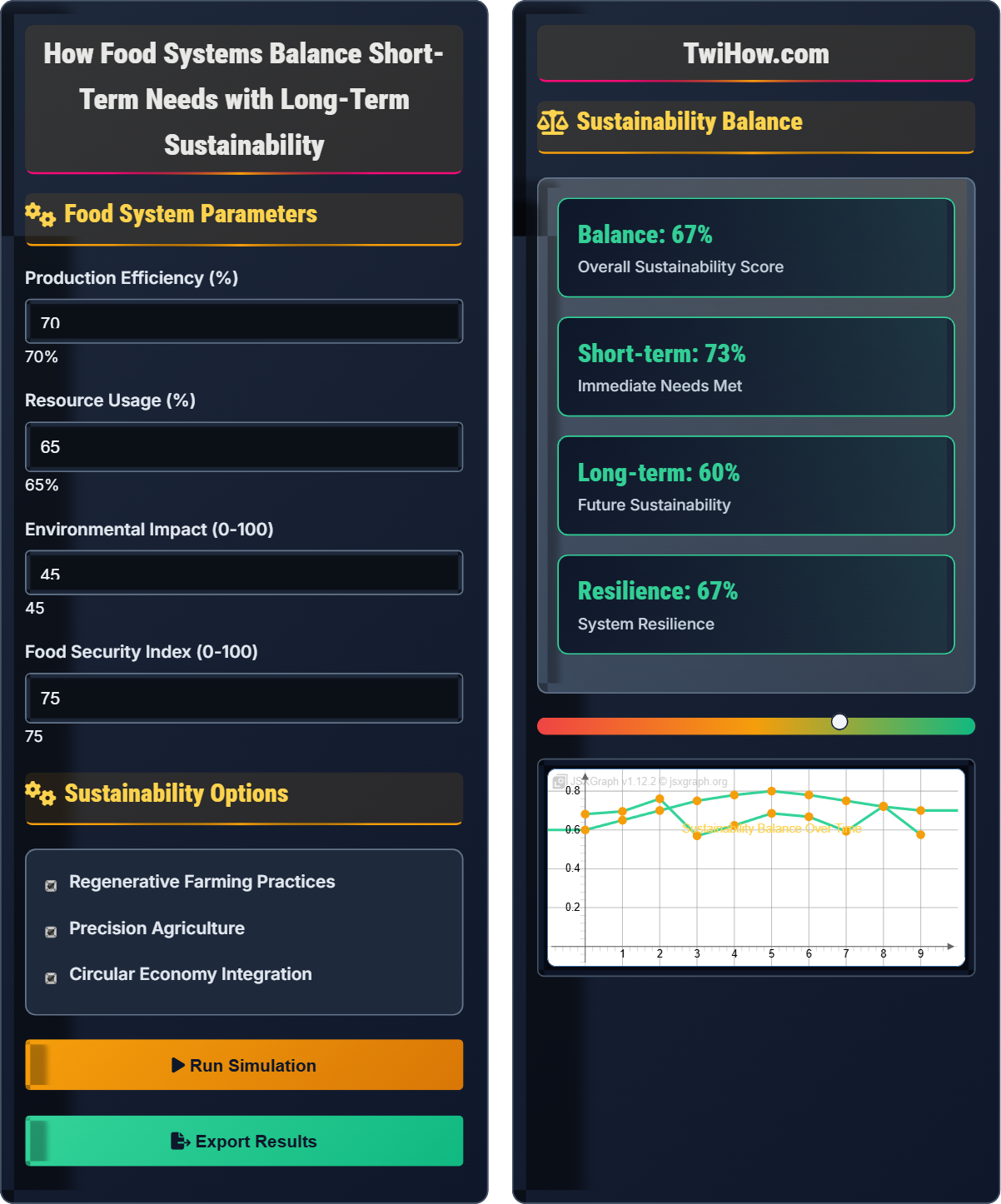
Food System Parameters
Sustainability Options
Sustainability Balance
| Component | Score | Status | Recommendation |
|---|---|---|---|
| Production | 75% | Good | Maintain efficiency |
| Environment | 55% | Fair | Reduce impact |
| Access | 80% | Excellent | Continue efforts |
| Resilience | 70% | Good | Build capacity |
P=Production, F=Processing, D=Distribution, S=Sustainability, R=Resources, E=Environment, T=Technology, C=Consumption, W=Waste
Food Systems Balance Explained
Food systems balance refers to the delicate equilibrium between meeting immediate food security needs while preserving resources and ecosystems for future generations. It involves optimizing trade-offs between production efficiency, environmental sustainability, social equity, and economic viability.
Food systems consist of interconnected components that must work together:
Where:
- Production: Growing and harvesting food
- Processing: Transforming raw ingredients
- Distribution: Transporting and marketing
- Consumption: Nutritious and sustainable eating
- Waste Management: Circular resource use
Effective food systems balancing strategies include:
- Regenerative Agriculture: Soil health, biodiversity conservation
- Precision Farming: Efficient resource use
- Circular Economy: Waste reduction, resource recovery
- Diversified Production: Risk reduction
- Local Food Systems: Reduced transportation
- Technology Integration: Smart farming solutions
- Sustainability Indicators: Environmental, social, economic metrics
- Lifecycle Assessment: Full environmental impact analysis
- Resilience Metrics: System adaptability measures
- Food Security Indices: Access, availability, utilization
- Carbon Footprint: Climate impact measurement
Food Systems Fundamentals
Food security, sustainability, resilience, circular economy, regenerative agriculture.
Balance = (Short-term Benefits + Long-term Sustainability) / 2
Where Balance = system performance, Benefits = immediate gains, Sustainability = future viability.
- Trade-offs require careful evaluation
- Stakeholder engagement is essential
- Systems thinking is critical
Applications
Regenerative farming, precision agriculture, local food networks, sustainable supply chains.
- Integrated farming systems
- Technology adoption
- Policy support
- Consumer education
- Climate adaptation
- Resource conservation
- Equity and justice
- Knowledge sharing
Food Systems Learning Quiz
Which of the following is NOT a component of a comprehensive food system?
While transportation infrastructure is important, it's not typically considered a direct component of food systems. Food systems traditionally include production, processing, distribution, consumption, and waste management. Transportation is a supporting element but not a core component.
The answer is D) Transportation Infrastructure.
Understanding the core components of food systems helps in identifying where interventions can be made to improve sustainability. The five main components form a continuous cycle from farm to fork to waste management. Each component has its own sustainability challenges and opportunities.
Production: Growing and harvesting food
Processing: Transforming raw ingredients into consumable products
Distribution: Moving food from producers to consumers
• Food systems are interconnected cycles
• Each component affects others
• Think of food systems as a continuous loop
• Consider impacts across all components
• Focus on systemic solutions
• Treating components in isolation
• Ignoring waste management
• Focusing only on production
Explain the trade-offs between short-term food security and long-term sustainability in food systems. Why is this balance critical?
Short-term Food Security: Focuses on immediate needs like food availability, affordability, and accessibility. This often requires intensive farming practices, high-yield crops, and efficient distribution systems.
Long-term Sustainability: Emphasizes preserving natural resources, maintaining ecosystem health, and ensuring future food production capacity. This requires conservation practices, biodiversity protection, and reduced environmental impact.
Trade-offs: Intensive farming increases yields but depletes soil and water resources. Chemical inputs boost production but harm ecosystems. Monocultures provide food security but reduce resilience.
Critical Balance: Without sustainable practices, current food systems cannot meet future needs. But without addressing immediate hunger, we face humanitarian crises. The balance ensures both present and future food security.
The tension between immediate and future needs is fundamental to food systems thinking. Students should understand that both perspectives are valid and necessary. Effective food systems find ways to meet current needs without compromising future capacity, often through innovative practices that serve both purposes.
Food Security: Physical, social, and economic access to sufficient safe and nutritious food
Sustainability: Meeting present needs without compromising future generations' ability to meet their needs
Trade-off: Sacrificing one goal to achieve another
• Both short and long-term needs matter
• Trade-offs require careful evaluation
• Innovation can reduce conflicts
• Look for win-win solutions
• Consider systems-level interventions
• Engage all stakeholders
• Prioritizing only one timeframe
• Ignoring interconnectedness
• Underestimating innovation potential
A small farming community faces drought conditions that threaten crop yields. They have two options: (1) Use groundwater reserves to maintain current production levels, or (2) Reduce irrigation and accept lower yields to preserve water for future seasons. Analyze both options considering food security, environmental sustainability, and long-term community resilience.
Option 1 (Groundwater Use): Maintains short-term food security, preserves income, but risks aquifer depletion. May cause long-term water scarcity, affecting future production and community survival.
Option 2 (Water Conservation): Protects long-term water resources, maintains ecological sustainability, but reduces immediate food availability and farmer income.
Analysis: Option 1 provides immediate relief but creates future vulnerabilities. Option 2 sacrifices short-term benefits for long-term sustainability. A balanced approach might include partial irrigation, drought-resistant crops, water-efficient technologies, and alternative income sources.
Recommendation: Hybrid strategy combining immediate support for farmers (subsidies, insurance) with sustainable practices (drip irrigation, drought-resistant varieties) and diversification (alternative livelihoods).
Real-world food systems decisions rarely offer perfect solutions. This example illustrates the complexity of balancing immediate needs with long-term sustainability. Students should learn to evaluate multiple dimensions of impact and consider innovative approaches that reduce trade-offs through technology, policy, and community action.
Resilience: Ability to withstand and recover from shocks
Drought-Resistant Crops: Varieties adapted to low-water conditions
Aquifer: Underground layer of water-bearing rock
• Consider multiple timeframes
• Evaluate environmental impact
• Assess community vulnerability
• Look for adaptive strategies
• Consider community capacity
• Plan for climate variability
• Choosing only short-term solutions
• Ignoring community needs
• Failing to plan for alternatives
A farmer wants to transition from conventional to regenerative agriculture practices. Explain how this transition addresses both short-term and long-term food system goals. What challenges might they face and how can these be overcome?
Short-term Benefits: Improved soil health increases yield stability, reduces input costs, and can command premium prices for sustainably-grown products. Carbon sequestration may qualify for carbon credit programs.
Long-term Benefits: Builds soil fertility, increases biodiversity, enhances water retention, reduces erosion, and creates more resilient farming systems that can withstand climate variability.
Challenges: Transition period may see temporary yield reductions, requires new skills and knowledge, higher initial investment in equipment, market access for regenerative products.
Solutions: Technical assistance programs, financial incentives, gradual transition approach, diversified income streams, consumer education campaigns.
Regenerative agriculture exemplifies how sustainable practices can serve both immediate and future needs. Students should understand that transitions take time and require support systems. The key is demonstrating that sustainable practices can be economically viable while providing environmental benefits.
Regenerative Agriculture: Farming practices that restore ecosystem health
Carbon Sequestration: Capturing atmospheric carbon in soil
Soil Health: Physical, chemical, and biological properties supporting plant growth
• Transitions require planning
• Support systems are essential
• Economic viability is crucial
• Start with pilot projects
• Build knowledge networks
• Seek financial incentives
• Rushing transitions without planning
• Ignoring economic realities
• Lacking technical support
Which of the following best represents a food system that balances short-term needs with long-term sustainability?
Diverse crops provide multiple benefits: increased yield stability (short-term), enhanced biodiversity (long-term), reduced pest pressure, improved soil health, and greater resilience to climate variability. Integrated pest management reduces chemical inputs while maintaining productivity. This approach meets current food needs while building future capacity.
The answer is B) Diverse crops with integrated pest management.
Biodiversity in agriculture exemplifies balanced approaches. Diverse systems provide immediate benefits (yield stability, variety) while building long-term resilience (pest resistance, soil health, genetic diversity). Students should recognize that sustainable practices often enhance both short and long-term outcomes.
Monoculture: Growing single crop species over large areas
Integrated Pest Management: Combining biological, cultural, and mechanical controls
Biodiversity: Variety of species in agricultural systems
• Diversity increases resilience
• Integrated approaches work best
• Balance multiple objectives
• Promote agroecological practices
• Support farmer knowledge exchange
• Develop markets for diverse products
• Focusing on single solutions
• Ignoring system complexity
• Undervaluing traditional knowledge
FAQ
Q: How can I balance producing enough food for my family while protecting the land for my children?
A: Sustainable farming practices can help you achieve both goals:
1. Soil Conservation: Use cover crops, crop rotation, and reduced tillage to maintain soil health while maintaining yields
2. Water Management: Implement efficient irrigation systems and rainwater harvesting
3. Diversification: Grow multiple crops to spread risk and improve soil fertility
4. Integrated Approaches: Combine traditional knowledge with modern techniques
These practices often increase long-term productivity while reducing input costs, benefiting both your family now and in the future.
Q: What policies can help balance food security with environmental sustainability?
A: Effective policies should address multiple dimensions:
Supportive Measures: Subsidies for sustainable practices, research funding, extension services, and market access for sustainable products.
Regulatory Frameworks: Environmental standards, sustainable agriculture guidelines, and food safety regulations.
Market Mechanisms: Carbon pricing, payment for ecosystem services, and certification programs.
Coordination: Multi-stakeholder platforms, integrated planning, and cross-sector collaboration.
Policies must balance incentives for immediate food production with long-term environmental stewardship through targeted support and smart regulation.