Food Systems & Cultural Traditions
Complete guide • Step-by-step explanations
Food Systems & Cultural Traditions:
Show Tradition Impact CalculatorFood systems profoundly impact cultural traditions and culinary heritage by influencing what foods are available, how they are prepared, and how they are shared within communities. These impacts can either preserve or erode traditional food practices, affecting cultural identity and social cohesion.
Modern food systems can support cultural preservation through local food initiatives, traditional recipe documentation, and cultural food festivals. However, they can also threaten heritage through homogenization, loss of traditional knowledge, and replacement of traditional foods.
Successful cultural preservation requires balancing modernization with tradition, supporting local food systems, and documenting traditional practices before they disappear.
Real-world applications include community gardens, cultural food museums, traditional cooking schools, and heritage seed preservation programs.
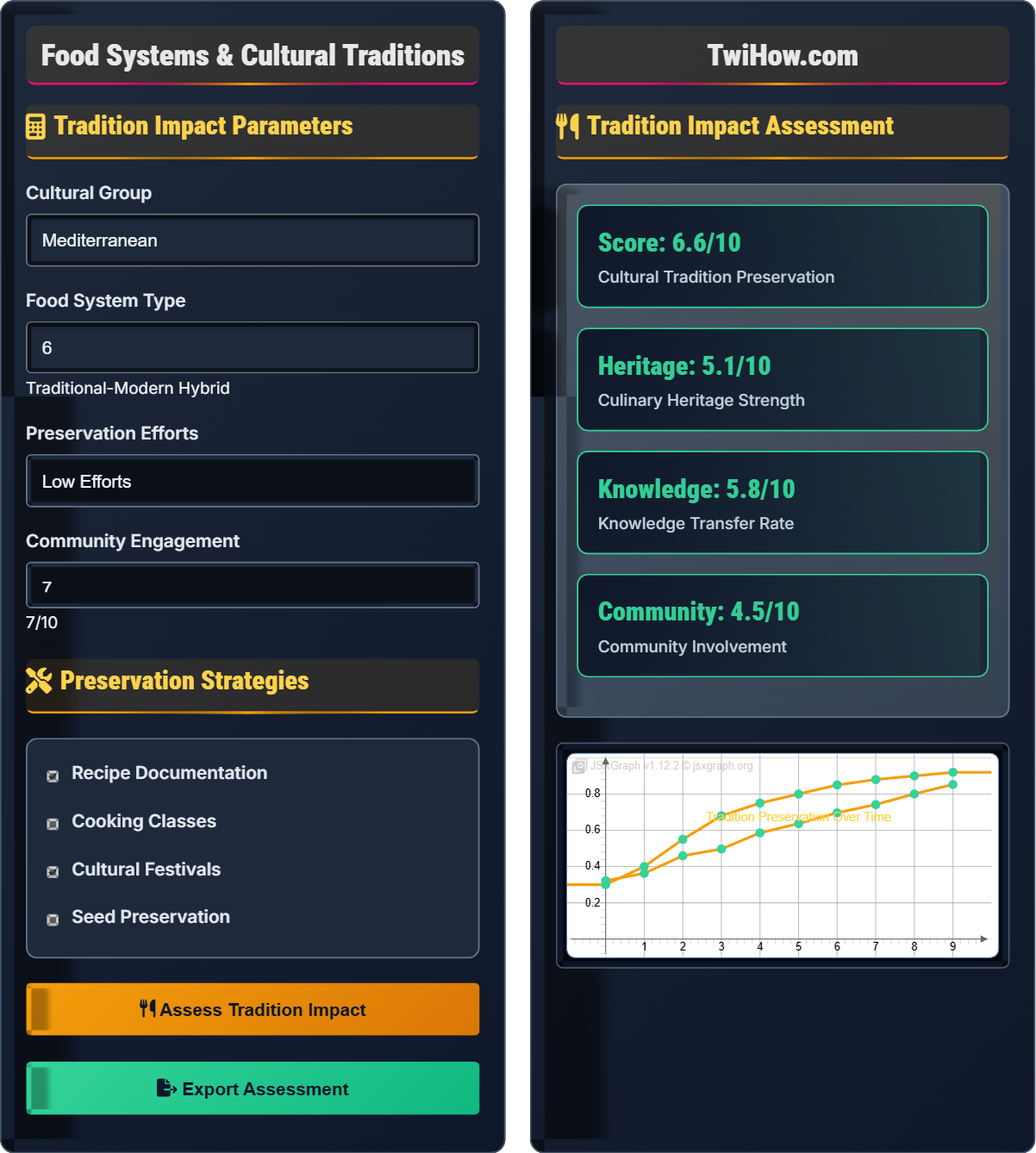
Tradition Impact Parameters
Preservation Strategies
Tradition Impact Assessment
| Factor | Score | Status | Recommendations |
|---|---|---|---|
| Recipe Knowledge | 7.5 | Good | Document remaining recipes |
| Ingredient Access | 6.8 | Good | Support local food sources |
| Preparation Skills | 7.2 | Good | Offer cooking classes |
| Community Sharing | 6.5 | Good | Organize food festivals |
Food Systems & Cultural Traditions
Food systems significantly impact cultural traditions and culinary heritage by influencing food availability, preparation methods, and sharing practices. These impacts can either preserve or erode traditional food practices, affecting cultural identity and social cohesion.
Food systems interact with cultural traditions through multiple pathways:
Traditional recipes passed down through generations embody cultural wisdom about ingredients, preparation methods, and timing. These recipes often have deep cultural significance and connect people to their heritage.
Traditional ingredients, including heirloom varieties and indigenous crops, carry cultural meaning and connect communities to their ancestral lands and practices.
Food-related social practices, such as communal cooking, holiday meals, and food sharing, strengthen community bonds and transmit cultural values.
Preservation Strategies
Recipe documentation, cooking education, cultural festivals, seed preservation, community gardens, and traditional food markets.
Heritage Index = (Recipe Knowledge × 0.3) + (Ingredient Preservation × 0.25) + (Skill Transmission × 0.25) + (Community Practice × 0.2)
Where each component is rated on a 0-10 scale.
- Documentation preserves knowledge
- Education transfers skills
- Community involvement sustains practices
- Policy support ensures longevity
Success Stories
The Slow Food movement promotes local food traditions, traditional cooking methods, and sustainable food practices. It connects communities with their culinary heritage while supporting local food systems.
Many communities have created digital archives of traditional recipes, preserving culinary knowledge for future generations and making it accessible to diaspora communities.
UNESCO has recognized several culinary traditions as Intangible Cultural Heritage, helping to preserve and promote traditional food practices and knowledge.
Tradition Impact Calculator
Food Systems & Cultural Traditions Quiz
Which factor is most critical for preserving traditional food practices?
Knowledge transmission is most critical for preserving traditional food practices. Without passing down recipes, techniques, and cultural significance to younger generations, traditional food practices will inevitably disappear regardless of economic profitability, ingredient availability, or government support.
The answer is B) Knowledge transmission.
Cultural traditions are living practices that depend on continuous transmission from one generation to the next. While other factors are important, the fundamental requirement is that knowledge and skills are actively taught and learned.
Knowledge Transmission: Passing cultural information to next generation
Cultural Continuity: Unbroken chain of practice over time
Intergenerational Learning: Teaching between age groups
• Knowledge must be actively transmitted
• Practice keeps traditions alive
• Cultural meaning is essential
• Involve elders in teaching
• Create formal learning programs
• Document practices
• Assuming knowledge will be retained
• Not prioritizing teaching
• Focusing only on ingredients
Explain how globalization affects traditional food systems and cultural practices, and describe strategies to maintain cultural identity.
Globalization Effects:
Homogenization: Standardized food products and preparation methods replace local traditions.
Market Pressure: Mass-produced foods often undercut traditional local products economically.
Ingredient Access: Traditional ingredients may become harder to obtain as markets globalize.
Cultural Identity: Younger generations may prefer global food trends over local traditions.
Maintenance Strategies:
• Documentation: Record traditional recipes, techniques, and cultural significance
• Education: Create programs that teach traditional cooking to youth
• Preservation: Maintain seed banks and traditional varieties
• Integration: Find ways to incorporate traditional elements into modern life
• Advocacy: Support policies that protect traditional food systems
Globalization creates both opportunities and challenges for traditional food systems. While it can threaten local practices, it also provides platforms for sharing and celebrating cultural diversity. The key is to engage strategically with globalization rather than resist it entirely.
Globalization: Integration of world markets and cultures
Homogenization: Process of becoming uniformCultural Identity: Sense of belonging to cultural group
• Balance preservation with adaptation
• Engage younger generations
• Document before it's lost
• Use digital tools for documentation
• Connect with diaspora communities
• Celebrate cultural diversity
• Not documenting practices
• Assuming traditions will continue
• Not involving youth
A community of 15,000 people has 20% elderly residents who know traditional recipes, but only 5% of young people (ages 15-30) can prepare traditional dishes. The community has lost access to 40% of traditional ingredients due to commercial farming replacing heritage varieties. Assess the cultural food heritage situation and propose three preservation strategies.
Assessment:
Knowledge Gap: Critical - only 5% of young people know traditional recipes while 20% of elderly residents do. This creates an urgent transmission problem.
Ingredient Loss: Severe - 40% of traditional ingredients unavailable threatens recipe authenticity.
Overall Risk: High - without intervention, traditional food culture will likely disappear within one generation.
Preservation Strategies:
• Intergenerational Cooking Classes: Pair elderly residents with young people for hands-on learning.
• Heritage Seed Restoration: Work with local farmers to reintroduce traditional varieties.
• Digital Recipe Archive: Create multimedia documentation of traditional recipes and their cultural significance.
These strategies address the critical knowledge gap while working to restore ingredient access.
This example demonstrates the urgency of knowledge transmission when there's a significant age gap in traditional food knowledge. The solution requires both immediate action to transfer knowledge and longer-term strategies to restore ingredient access.
Knowledge Gap: Difference in knowledge between generations
Heritage Varieties: Traditional crop cultivars
Intergenerational Learning: Teaching across age groups
• Address knowledge gaps urgently
• Restore ingredient access
• Document cultural significance
• Start with most knowledgeable elders
• Focus on easiest recipes first
• Connect with other communities
• Not prioritizing knowledge transfer
• Assuming ingredients will return
• Focusing only on recipes
A local government wants to support traditional food culture while promoting economic development. Evaluate three policy approaches: (1) Tourism promotion, (2) Agricultural subsidies for heritage crops, (3) Cultural education funding. Recommend the best approach and justify your reasoning.
Approach Evaluation:
Tourism Promotion:
Pros: Economic benefits, visibility, employment opportunities
Cons: Risk of commercialization, authenticity concerns, seasonal employment
Agricultural Subsidies:
Pros: Supports ingredient access, preserves varieties, helps farmers
Cons: Requires ongoing funding, may not address knowledge gaps
Cultural Education Funding:
Pros: Addresses knowledge transmission, builds community, long-term impact
Cons: Slower results, requires community engagement
Optimal Approach: Combination of all three approaches. Cultural education addresses the root issue of knowledge transmission, agricultural subsidies ensure ingredient access, and tourism provides economic incentives.
Cultural preservation requires addressing multiple dimensions simultaneously. No single policy approach can address all aspects of cultural food heritage preservation. A comprehensive strategy that combines economic, educational, and agricultural policies is most effective.
Cultural Preservation: Maintaining traditional practices
Policy Integration: Coordinated policy approaches
Heritage Crops: Traditional plant varieties
• Address multiple dimensions
• Include economic incentives
• Focus on knowledge transmission
• Engage community in planning
• Support local entrepreneurs
• Document success stories
• Single-policy approaches
• Not involving communities
• Ignoring economic needs
How do diaspora communities contribute to preserving traditional food cultures?
Diaspora communities often maintain traditional food practices in new environments as a way of preserving cultural identity and connecting with their heritage. They frequently establish ethnic restaurants, specialty food stores, and cultural events that keep traditions alive and share them with host communities.
The answer is B) They maintain practices in new environments.
Diaspora communities often become repositories of traditional practices, sometimes preserving customs that are changing in the original homeland. Food becomes a powerful tool for maintaining cultural identity in new environments.
Diaspora: People living outside their homeland
Cultural Identity: Sense of cultural belonging
Heritage Preservation: Maintaining ancestral practices
• Food connects diaspora to homeland
• Communities preserve practices
• Cultural identity remains important
• Support ethnic food businesses
• Document diaspora practices
• Connect communities globally
• Assuming diaspora abandons culture
• Not recognizing preservation efforts
• Ignoring diaspora contributions
FAQ
Q: How can I pass down traditional recipes and cooking techniques to younger generations?
A: To pass down traditional knowledge:
1. Document Everything: Write down recipes, techniques, and cultural stories
2. Hands-On Teaching: Cook together with younger family members
3. Storytelling: Share the history and significance of dishes
4. Digital Documentation: Record videos of cooking processes
5. Community Events: Participate in cultural food festivals
6. School Programs: Volunteer to teach traditional cooking
Make the learning process enjoyable and meaningful for young people.
Q: Why is it important to preserve traditional food practices in modern times?
A: Preserving traditional food practices is important because:
1. Cultural Identity: Food connects us to our heritage and ancestors
2. Knowledge Systems: Traditional practices contain valuable wisdom about nutrition and sustainability
3. Biodiversity: Traditional foods often involve diverse, heritage ingredients
4. Community: Food practices bring people together and strengthen bonds
5. Health: Many traditional foods are nutritious and sustainable
6. Resilience: Diverse food systems are more resilient to shocks
Traditional knowledge offers solutions to modern challenges.