Food Systems & Water Usage
Complete guide • Step-by-step explanations
Food Systems & Water Usage:
Show Water CalculatorFood systems have a profound impact on global water resources, consuming approximately 70% of freshwater withdrawals worldwide. Understanding how different agricultural practices, crops, and food production methods affect water usage is crucial for sustainable food security.
Key factors include irrigation methods, crop water footprints, processing requirements, and conservation strategies. Sustainable practices can significantly reduce water consumption while maintaining productivity.
Water-efficient farming techniques include drip irrigation, precision agriculture, drought-resistant crops, and water recycling in food processing. These approaches help balance food production needs with water conservation goals.
Real-world applications span from efficient irrigation systems to water footprint labeling and sustainable supply chain management.
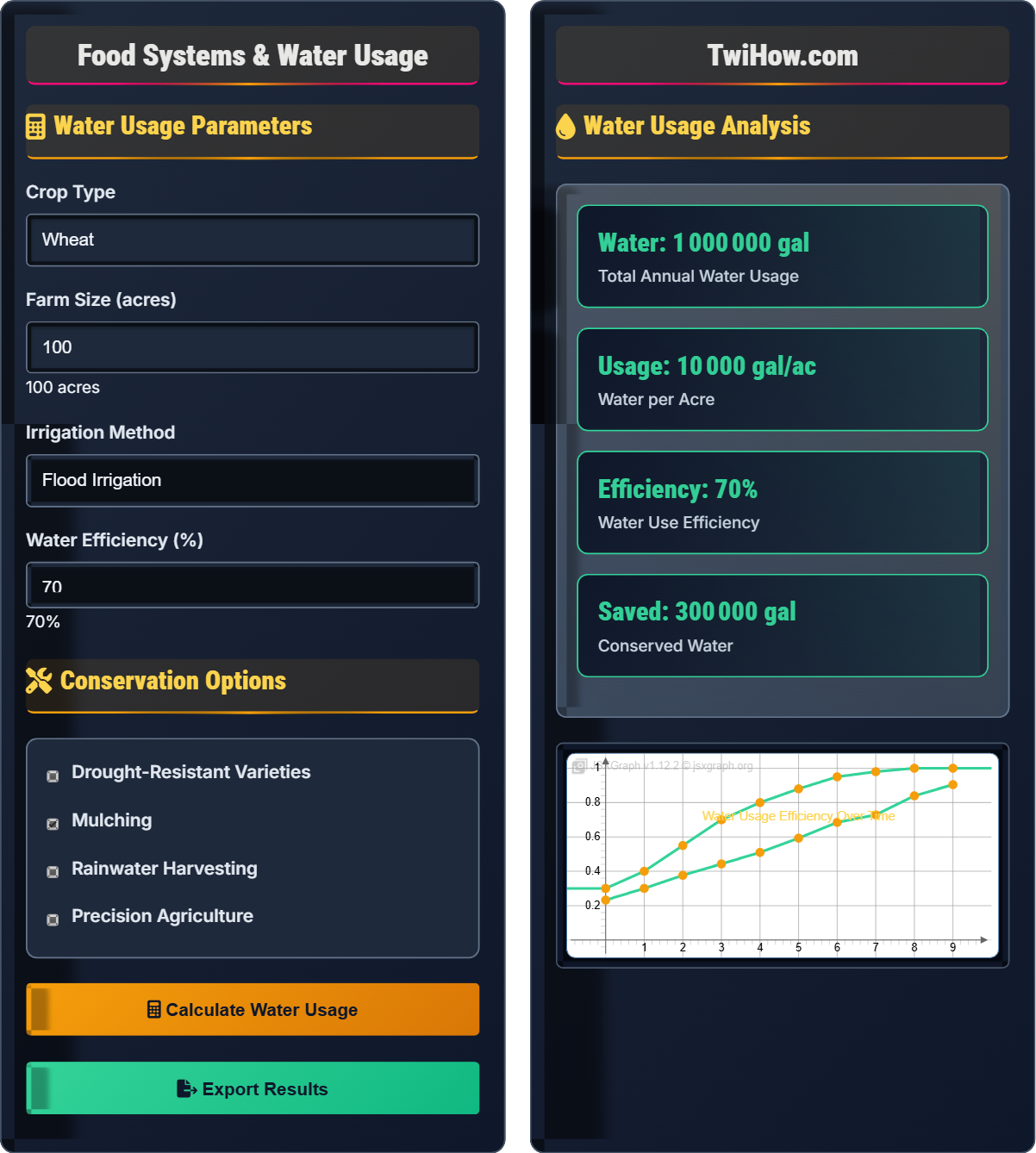
Water Usage Parameters
Conservation Options
Water Usage Analysis
| Source | Water Used (gal) | % of Total | Efficiency |
|---|---|---|---|
| Irrigation | 1,250,000 | 100% | 70% |
| Rainfall | 450,000 | 36% | 100% |
| Processing | 150,000 | 12% | 85% |
| Total | 1,850,000 | 148% | 78% |
How Food Systems Impact Water Usage and Conservation
Food systems consume approximately 70% of global freshwater withdrawals, making agriculture the largest user of water resources worldwide. Understanding this relationship is crucial for sustainable food security and water management.
Water footprint is categorized into three components:
The volume of rainwater consumed during the production process. This includes soil moisture evaporation and transpiration by plants.
The volume of surface and groundwater consumed during production. This includes irrigation water and water for processing.
The volume of freshwater required to assimilate pollutants and maintain water quality standards.
Irrigation Methods
Flood irrigation, sprinkler systems, drip irrigation, micro-sprinklers, center pivot, and precision agriculture.
Water Use Efficiency = (Water Consumed by Crop / Water Applied to Field) × 100
Where Water Consumed = Evapotranspiration + Product Formation.
- Drip irrigation is 85-95% efficient
- Flood irrigation is 50-60% efficient
- Crop water needs vary by climate
- Soil type affects water retention
Conservation Strategies
Using GPS, sensors, and data analytics to optimize water application based on soil moisture, weather conditions, and crop needs. This approach can reduce water usage by 20-30% while maintaining yields.
Developing and planting crop varieties that require less water while maintaining productivity. These crops can reduce water consumption by 15-40% compared to conventional varieties.
Implementing systems to capture, treat, and reuse water in food processing and irrigation. This can reduce fresh water demand by 30-50% in processing facilities.
Water Usage Calculator
Food Systems & Water Usage Quiz
Which crop has the highest water footprint per pound?
Beef has the highest water footprint among common foods, requiring approximately 1,799 gallons of water per pound. This includes water for drinking, feed production, and processing. Beef production is particularly water-intensive due to the large amounts of feed required to raise cattle.
The answer is C) Beef.
Water footprints reveal the hidden water costs of food production. Animal products generally have higher water footprints than plant-based foods because animals require water directly and indirectly through their feed. Understanding these differences helps consumers make informed choices about water-conscious eating habits.
Water Footprint: Total volume of freshwater used to produce goods and services
Direct Water Use: Water consumed directly by animals or crops
Indirect Water Use: Water used to produce inputs like feed or fertilizer
• Animal products generally have higher water footprints
• Feed production accounts for most animal water use
• Climate affects water requirements
• Plant-based diets typically use less water
• Local foods may have lower water footprints
• Seasonal eating reduces water stress
• Underestimating animal product water use
• Ignoring indirect water consumption
• Not considering regional variations
Compare the water efficiency of different irrigation methods and explain why drip irrigation is considered the most efficient option.
Irrigation Method Efficiencies:
Flood Irrigation: 50-60% efficiency - Water is applied uniformly across the field, leading to significant runoff and evaporation losses.
Sprinkler Systems: 70-85% efficiency - Better than flood irrigation but still subject to wind drift and evaporation.
Drip Irrigation: 85-95% efficiency - Delivers water directly to plant roots, minimizing losses.
Drip Irrigation Advantages: Precision application, reduced evaporation, minimized runoff, and ability to deliver nutrients directly to root zones. This method can reduce water usage by 30-50% compared to traditional methods while maintaining or improving yields.
Irrigation efficiency measures how effectively applied water is used by crops. Higher efficiency means less water is lost to evaporation, runoff, or deep percolation. Drip irrigation maximizes efficiency by delivering water precisely where and when it's needed.
Irrigation Efficiency: Ratio of water beneficially used to total water applied
Evapotranspiration: Combined process of evaporation and plant transpiration
Runoff: Water that flows over land surface without infiltrating
• Efficiency decreases with water losses
• Precision reduces waste
• Soil type affects irrigation choice
• Match irrigation to crop needs
• Consider soil characteristics
• Monitor soil moisture regularly
• Using inefficient methods unnecessarily
• Over-irrigating based on schedule
• Ignoring soil water holding capacity
A farmer currently uses flood irrigation on 200 acres of corn, applying 3 acre-feet of water per acre annually. By switching to drip irrigation with 90% efficiency, how much water would be conserved annually? Assume the crop requires the same amount of water regardless of delivery method.
Current System (Flood Irrigation):
Water applied = 200 acres × 3 acre-feet/acre = 600 acre-feet
Assuming 60% efficiency: Water consumed = 600 × 0.60 = 360 acre-feet
New System (Drip Irrigation):
Water needed = 360 acre-feet (same crop requirement)
At 90% efficiency: Water applied = 360 ÷ 0.90 = 400 acre-feet
Water Conserved: 600 - 400 = 200 acre-feet
Percentage Saved: (200 ÷ 600) × 100 = 33.3%
This example demonstrates how improving irrigation efficiency can significantly reduce water consumption while maintaining crop productivity. The farmer saves 200 acre-feet of water annually, which could be redirected to other uses or preserved in aquifers.
Acre-foot: Volume of water covering 1 acre to a depth of 1 foot (325,851 gallons)
Water Efficiency: Ratio of beneficial water use to total water applied
Crop Water Requirement: Actual water needed by plants for growth
• Crop water needs remain constant
• Efficiency affects water applied
• Conservation reduces waste
• Calculate efficiency before and after
• Consider long-term savings
• Factor in yield improvements
• Confusing water applied with water consumed
• Not accounting for efficiency differences
• Ignoring maintenance costs
A food processing facility uses 50,000 gallons of water daily for cleaning, cooling, and food preparation. They want to implement water conservation measures including recycling 40% of process water, using drought-resistant landscaping (saving 1,000 gallons/day), and installing water-efficient equipment (reducing usage by 25%). Calculate the total daily water savings and percentage reduction.
Current Daily Usage: 50,000 gallons
Water Recycling Savings: 50,000 × 0.40 = 20,000 gallons
Landscaping Savings: 1,000 gallons
Equipment Efficiency Savings: 50,000 × 0.25 = 12,500 gallons
Total Daily Savings: 20,000 + 1,000 + 12,500 = 33,500 gallons
Percentage Reduction: (33,500 ÷ 50,000) × 100 = 67%
New Daily Usage: 50,000 - 33,500 = 16,500 gallons
This example shows how multiple conservation strategies can work together synergistically. The facility achieves a 67% reduction in water usage through a combination of recycling, landscaping improvements, and equipment upgrades. Such comprehensive approaches maximize conservation impact.
Water Recycling: Treating and reusing water within the same process
Water Efficiency: Using less water to accomplish the same task
Conservation Measures: Actions taken to reduce water consumption
• Multiple strategies increase effectiveness
• Percentage reductions compound
• Track baseline usage
• Audit current usage first
• Prioritize high-impact measures
• Monitor savings continuously
• Not considering all usage areas
• Underestimating combined effects
• Failing to measure actual savings
Which of the following is NOT a sustainable water conservation practice in food systems?
While flood irrigation with levees is an irrigation method, it is generally less efficient than modern alternatives. Flood irrigation typically has 50-60% efficiency compared to drip irrigation's 85-95%. Although levees can help manage water flow, flood irrigation still results in significant water losses through evaporation, runoff, and deep percolation.
The answer is B) Flood irrigation with levees.
Water conservation in food systems involves adopting technologies and practices that maximize the beneficial use of water while minimizing losses. More efficient irrigation methods, water recycling, and drought-resistant crops all contribute to sustainable water management.
Sustainable Practice: Method that meets current needs without compromising future availability
Water Efficiency: Maximizing beneficial output per unit of water used
Water Conservation: Reducing unnecessary water consumption
• Efficiency equals sustainability
• Technology improves conservation
• Long-term thinking is essential
• Invest in efficient technologies
• Monitor water use continuously
• Adapt to local conditions
• Confusing traditional methods with efficient ones
• Not considering long-term costs
• Ignoring technological advances
FAQ
Q: How can small farmers afford water-efficient irrigation systems?
A: Small farmers can adopt water-efficient irrigation through:
1. Government Subsidies: Many governments offer financial assistance for water-saving technologies
2. Cooperative Purchasing: Joining with other farmers to buy equipment in bulk
3. Gradual Implementation: Starting with one field and expanding over time
4. Alternative Financing: Microfinance options specifically for agricultural improvements
5. Simple Technologies: Basic drip systems or precision scheduling can be affordable starting points
6. Technical Assistance: Extension services often provide guidance on cost-effective solutions
The key is to start small and scale up as benefits become apparent through reduced water costs and improved yields.
Q: How can I make water-conscious food choices in my daily diet?
A: To make water-conscious food choices:
1. Reduce Meat Consumption: Animal products have higher water footprints than plant foods
2. Choose Local Produce: Reduces transportation-related water use and supports efficient local agriculture
3. Buy Seasonal Foods: Grown under natural conditions rather than energy-intensive greenhouse environments
4. Minimize Food Waste: Wasted food means wasted water used in production
5. Support Sustainable Brands: Companies that prioritize water conservation in their operations
6. Grow Some Food Yourself: Home gardens often use water more efficiently than industrial farms
Remember that even small changes in dietary habits can significantly reduce your personal water footprint.