Food Systems Supporting Biodiversity Conservation and Ecosystem Services
Complete biodiversity guide • Step-by-step explanations
Biodiversity Conservation Fundamentals:
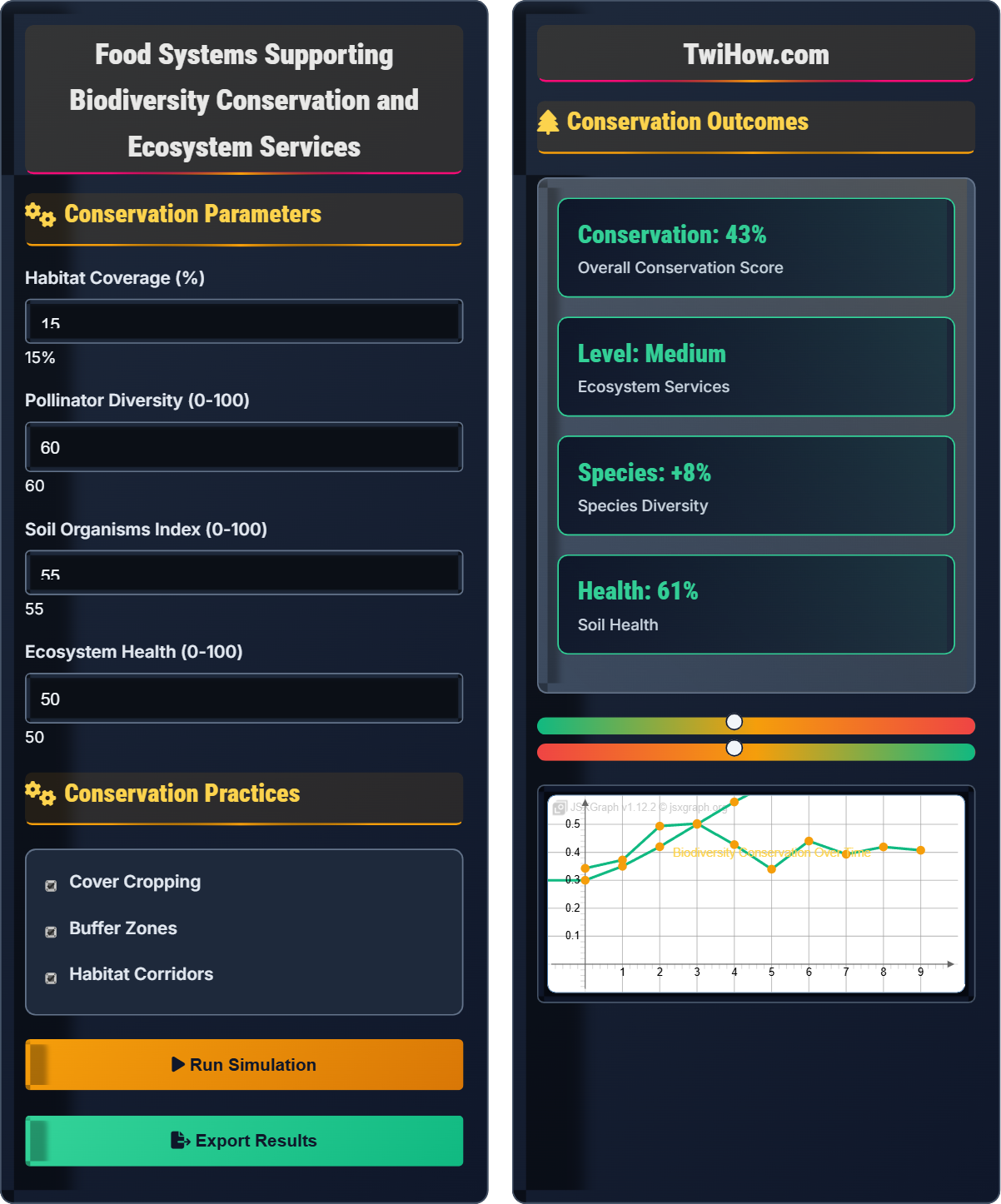
Show Biodiversity Conservation SimulatorFood systems play a critical role in supporting biodiversity conservation and ecosystem services. Agricultural landscapes cover approximately 40% of Earth's land surface, making them crucial for both food production and biodiversity preservation. Sustainable food systems integrate conservation practices that enhance biodiversity while maintaining productivity.
Modern food systems must balance production needs with ecosystem preservation, supporting pollinators, soil organisms, beneficial insects, and wildlife habitats. This requires innovative approaches that enhance ecosystem services like pollination, pest control, water purification, and carbon sequestration.
Key conservation approaches:
- Habitat Creation: Maintaining natural areas within agricultural landscapes
- Agroecology: Mimicking natural ecosystems in farming systems
- Species Protection: Conserving crop wild relatives and pollinators
- Soil Health: Supporting beneficial soil organisms
Successful food systems integrate biodiversity conservation as a core component, creating landscapes that support both agricultural productivity and ecological integrity.
Conservation Parameters
Conservation Practices
Conservation Outcomes
| Service | Current | Target | Improvement |
|---|---|---|---|
| Pollination | 60% | 80% | +20% |
| Pest Control | 45% | 70% | +25% |
| Water Purification | 50% | 75% | +25% |
| Carbon Sequestration | 40% | 65% | +25% |
P=Pollinators, S=Soil, W=Water, B=Biodiversity, H=Habitat, E=Ecosystem, C=Conservation, F=Food, A=Agriculture
Food Systems and Biodiversity Conservation Explained
Biodiversity conservation in food systems involves managing agricultural landscapes to maintain and enhance biological diversity while sustaining food production. This includes protecting habitat corridors, supporting beneficial organisms, and implementing farming practices that enhance ecosystem health and resilience.
Biodiversity conservation is measured using several important indicators:
Where:
- Habitat Quality: Condition of natural areas and corridors
- Species Diversity: Richness and abundance of organisms
- Ecosystem Health: Functional integrity and resilience
- Goal: Optimize all components for conservation
Effective biodiversity conservation includes:
- Agroforestry: Integrating trees into farming systems
- Buffer Strips: Protecting waterways and creating habitat
- Wildlife Corridors: Connecting fragmented habitats
- Pollinator Habitats: Supporting beneficial insects
- Soil Conservation: Protecting soil organisms
- Integrated Pest Management: Reducing pesticide impacts
- Agroecological: Mimicking natural ecosystem processes
- Restoration: Rehabilitating degraded areas
- Preservation: Protecting critical habitats
- Integration: Combining conservation with production
- Community: Engaging local stakeholders
Biodiversity Conservation Fundamentals
Biodiversity conservation, ecosystem services, agroecology, habitat corridors, pollinator conservation, soil health, sustainable agriculture.
Index = (Habitat Quality + Species Diversity + Ecosystem Health) / 3
Where Index = conservation effectiveness, Habitat Quality = condition of natural areas, Species Diversity = organism richness, Ecosystem Health = functional integrity.
- Diversity enhances resilience
- Conservation supports production
- Integration is most effective
Applications
Agroforestry systems, pollinator gardens, buffer strips, wildlife corridors, integrated pest management, soil conservation.
- Practice adoption
- Training programs
- Financial incentives
- Policy support
- Landscape scale
- Species requirements
- Production constraints
- Cost-benefit ratios
Biodiversity Conservation Learning Quiz
Which practice is most effective for supporting pollinator populations in agricultural landscapes?
Wildflower strips provide nectar, pollen, and nesting sites for pollinators throughout the growing season. These strips create habitat corridors that connect fragmented natural areas and support diverse pollinator communities. They also provide shelter from agricultural activities and pesticide drift.
The answer is C) Wildflower strips.
Students should understand that pollinators require both food sources (nectar and pollen) and nesting sites. Wildflower strips address both needs by providing diverse flowering plants and undisturbed areas. This practice demonstrates how conservation can be integrated into agricultural landscapes without sacrificing productivity.
Wildflower Strips: Areas planted with diverse flowering plants
Pollinator Habitat: Areas providing food and nesting resources
Habitat Corridor: Connected areas allowing species movement
• Diverse plants support diverse pollinators
• Continuous blooming is essential
• Protection from pesticides is crucial
• Plant native species
• Ensure continuous bloom
• Minimize pesticide use nearby
• Using only ornamental flowers
• Not considering bloom timing
• Placing near pesticide areas
Explain how biodiversity in food systems provides ecosystem services that benefit agricultural production. Give specific examples of these services.
Pollination Services: Diverse pollinator communities ensure crop reproduction and yield stability.
Pest Control: Beneficial insects and birds control pest populations naturally.
Soil Fertility: Soil organisms decompose organic matter and cycle nutrients.
Water Regulation: Vegetation and soil structure manage water infiltration and retention.
Climate Regulation: Vegetation provides microclimate moderation and carbon sequestration.
Genetic Resources: Wild relatives provide genes for crop improvement.
These services reduce production costs and enhance system resilience.
Students should understand that biodiversity provides tangible benefits to agriculture. Rather than being a constraint, biodiversity enhances agricultural productivity by providing essential services. This demonstrates the economic value of conservation practices and how environmental and production goals can align.
Ecosystem Services: Benefits provided by natural systems
Natural Pest Control: Biological control of pests
Nutrient Cycling: Movement of nutrients through ecosystems
• Biodiversity provides economic benefits
• Services reduce input costs
• Conservation enhances resilience
• Quantify service benefits
• Consider long-term impacts
• Plan for multiple services
• Viewing biodiversity as cost
• Ignoring service benefits
• Not considering economic value
A farmer establishes 500m of buffer strips along waterways, using 2 hectares of land. The buffer strips cost $500/hectare to establish and $100/hectare annually for maintenance. The strips provide $800/hectare in ecosystem services (water filtration, flood control, wildlife habitat). Calculate the net benefit over 10 years and determine if the investment is worthwhile.
Establishment Cost: 2 ha × $500/ha = $1,000
Annual Maintenance: 2 ha × $100/ha = $200
Annual Ecosystem Services: 2 ha × $800/ha = $1,600
Annual Net Benefit: $1,600 - $200 = $1,400
Total 10-Year Benefit: $1,400 × 10 = $14,000
Total 10-Year Costs: $1,000 + ($200 × 10) = $3,000
Net 10-Year Benefit: $14,000 - $3,000 = $11,000
Conclusion: The investment is highly worthwhile with $11,000 net benefit.
This problem demonstrates that conservation investments can provide significant economic returns. Students should understand that ecosystem services have quantifiable economic value that often exceeds implementation costs. The key insight is that conservation can be economically rational for farmers.
Buffer Strip: Vegetated area protecting waterways
Ecosystem Service Value: Economic worth of natural services
Cost-Benefit Analysis: Economic evaluation of investments
• Consider long-term benefits
• Quantify ecosystem services
• Include maintenance costs
• Calculate NPV for long-term projects
• Consider multiple service benefits
• Factor in environmental regulations
• Not considering service benefits
• Forgetting maintenance costs
• Not calculating net returns
Design an agroforestry system for a 10-hectare farm that maximizes both agricultural production and biodiversity conservation. Consider tree placement, species selection, and management practices.
Tree Placement: Plant windbreaks around field edges, alley cropping rows every 30-50m, and scattered trees for wildlife habitat.
Species Selection: Native fruit trees (food), nitrogen-fixing trees (fertilizer), and flowering species (pollinators).
Management: Prune trees to minimize shading, harvest fruits/nuts for income, and maintain understory diversity.
Benefits: Wind protection, soil conservation, pollinator habitat, timber production, and additional income.
Implementation: Phase installation over 2-3 years, provide initial irrigation, and monitor crop yields.
Monitoring: Track biodiversity, soil health, and economic returns.
This problem demonstrates how conservation and production can be integrated. Students should understand that agroforestry requires careful planning to balance tree and crop needs. The key is selecting appropriate species and managing interactions to maximize benefits while minimizing competition.
Agroforestry: Integration of trees and agriculture
Alley Cropping: Crops grown between tree rows
Windbreak: Trees protecting crops from wind
• Balance tree and crop needs
• Select appropriate species
• Manage interactions carefully
• Consider local climate
• Plan for long-term growth
• Diversify tree species
• Planting too densely
• Not considering shading
• Ignoring species compatibility
Which practice most directly supports soil biodiversity and ecosystem services?
Cover cropping provides continuous living roots and organic matter that feed soil organisms, creating habitat and food for beneficial bacteria, fungi, earthworms, and other soil biota. This practice enhances soil structure, nutrient cycling, and biological activity while protecting soil from erosion.
The answer is B) Cover cropping.
Students should understand that soil biodiversity is fundamental to soil health. Cover crops provide the organic matter and root exudates that feed soil organisms. This practice demonstrates how conservation can improve agricultural productivity by enhancing soil ecosystem services.
Cover Cropping: Growing protective plants between main crops
Soil Biodiversity: Diversity of organisms in soil
Root Exudates: Compounds released by plant roots
• Living roots feed soil organisms
• Organic matter is essential
• Protection from disturbance is crucial
• Maintain living roots year-round
• Diversify cover crop species
• Minimize soil disturbance
• Focusing only on chemical inputs
• Ignoring soil biology
• Over-tilling soils
FAQ
Q: Will implementing biodiversity conservation practices reduce my crop yields?
A: Many conservation practices actually enhance yields over time:
1. Soil Health: Cover crops and reduced tillage improve soil fertility
2. Pollination: Wild pollinators increase fruit set and yields
3. Pest Control: Beneficial insects reduce crop damage
4. Water Retention: Better soil structure reduces drought stress
5. Nutrient Cycling: Soil organisms improve nutrient availability
Some practices may have initial yield impacts, but long-term benefits typically exceed short-term costs.
Q: What incentives would best encourage farmers to adopt conservation practices?
A: Effective incentives include:
Financial: Payment for ecosystem services, cost-share programs, and tax credits for conservation.
Technical: Extension services, demonstration farms, and training programs.
Market: Premium prices for sustainably produced products and certification programs.
Regulatory: Compliance pathways that reward proactive conservation.
Information: Tools for quantifying ecosystem service benefits.
Success requires combining multiple incentive types with adequate support services.