Food Systems Supporting Rural Livelihoods and Community Development
Complete rural development guide • Step-by-step explanations
Rural Livelihoods Fundamentals:
Show Rural Development SimulatorFood systems play a central role in rural livelihoods and community development by providing employment, income, and economic opportunities. They connect rural producers to markets, create value-added activities, and support local economies while preserving cultural heritage and environmental resources.
Rural food systems encompass production, processing, distribution, and consumption activities that generate income and employment for rural populations. These systems create multiplier effects that benefit entire communities through job creation, infrastructure development, and social capital building.
Key rural development considerations:
- Employment: Creating diverse income opportunities beyond farming
- Value Addition: Processing and marketing agricultural products locally
- Market Access: Connecting producers to profitable markets
- Infrastructure: Developing roads, storage, and communication systems
Successful rural food systems integrate traditional practices with modern technologies, creating sustainable economic opportunities that keep young people in rural areas while improving quality of life for all residents.
Rural Development Parameters
Development Strategies
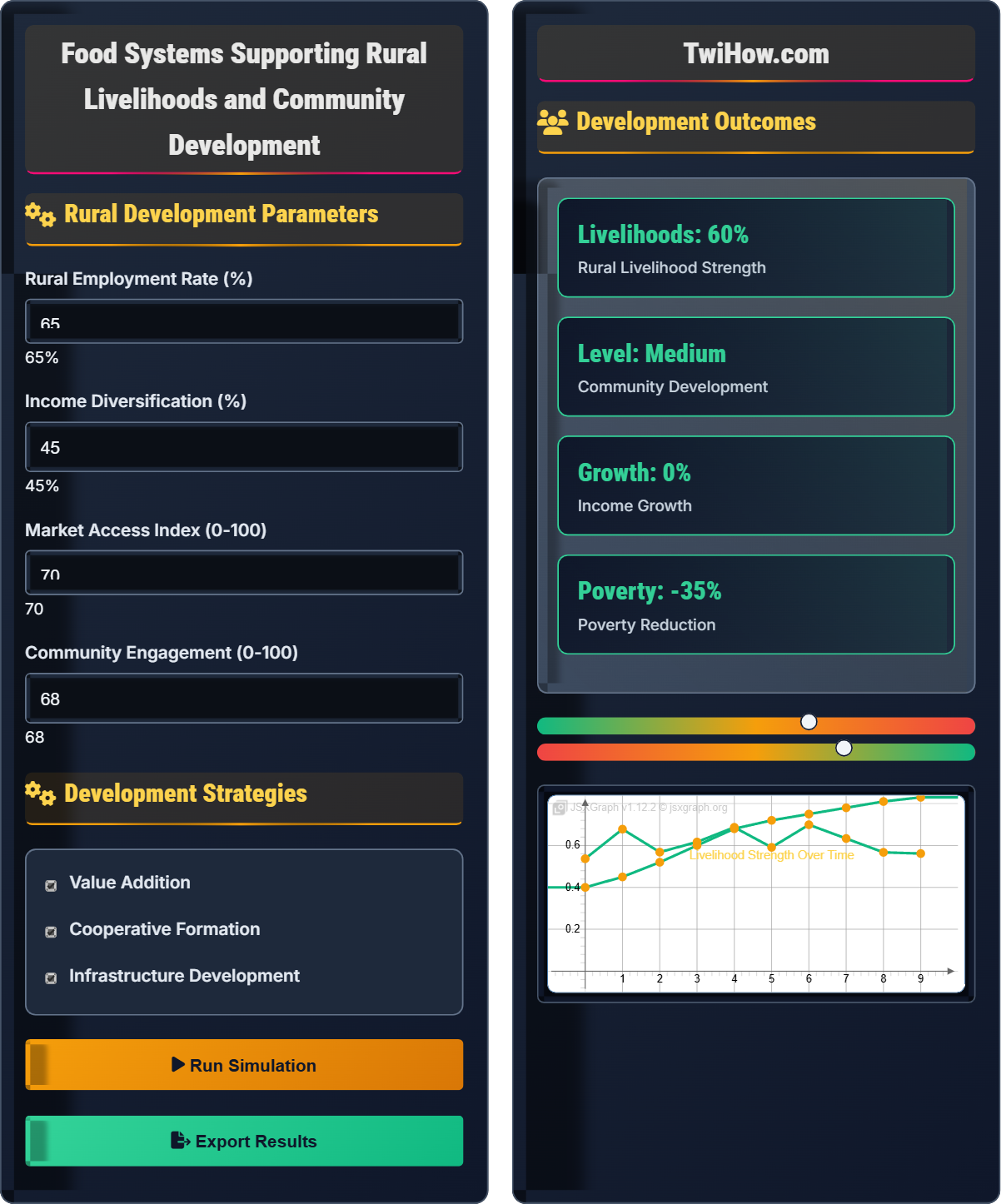
Development Outcomes
| Activity | Contribution | Employment | Income |
|---|---|---|---|
| Primary Production | 40% | Medium | $1,200 |
| Processing | 25% | High | $2,800 |
| Marketing | 20% | High | $3,500 |
| Services | 15% | Low | $1,800 |
F=Farmers, P=Production, M=Markets, V=Value, C=Cooperatives, E=Employment, I=Infrastructure, R=Rural, D=Development
Rural Livelihoods Through Food Systems Explained
Rural livelihood development through food systems encompasses all activities that create sustainable income opportunities and improve quality of life for rural populations. This includes agricultural production, value-added processing, marketing, and related services that generate employment and economic growth.
Rural development effectiveness is measured using several important indicators:
Where:
- Employment: Percentage of population engaged in productive activities
- Income: Average household income levels
- Diversification: Range of income sources available
- Goal: Maximize all components for sustainable livelihoods
Effective rural development through food systems includes:
- Value Addition: Processing and packaging agricultural products
- Market Access: Connecting producers to profitable markets
- Cooperative Formation: Collective organization for better bargaining
- Skills Development: Training in modern farming and processing
- Infrastructure: Roads, storage, and communication systems
- Financial Services: Credit and insurance for rural entrepreneurs
- Individual: Farmer-level improvements
- Group: Cooperative and association-based approaches
- Community: Local-level development initiatives
- Regional: Area-wide development programs
- National: Policy and institutional support
Rural Livelihoods Fundamentals
Rural livelihoods, value addition, cooperative development, income diversification, sustainable agriculture.
Index = (Employment + Income + Diversification) / 3
Where Index = livelihood strength, Employment = job creation, Income = earning capacity, Diversification = multiple income sources.
- Diversification reduces risk
- Collective action increases power
- Infrastructure enables growth
Applications
Farmer cooperatives, value-added processing, agritourism, rural enterprises, microfinance.
- Skills training
- Market development
- Financial support
- Policy reform
- Cultural sensitivity
- Gender inclusion
- Environmental sustainability
- Economic viability
Rural Development Learning Quiz
Which approach provides the greatest stability for rural livelihoods?
Income diversification spreads risk across multiple sources, providing stability when one source fails. Rural households with diverse income streams are more resilient to economic shocks, seasonal variations, and climate-related challenges. This approach maintains rural populations while improving livelihood security.
The answer is B) Income diversification.
Students should understand that diversification is a fundamental principle of risk management. Just as investors diversify portfolios, rural households diversify income sources. This strategy maintains rural communities while providing economic security. The key insight is that stability comes from having multiple income options.
Income Diversification: Multiple sources of household income
Livelihood Security: Stable access to income and resources
Risk Management: Strategies to reduce vulnerability
• Diversification reduces vulnerability
• Multiple income sources provide stability
• Rural development requires variety
• Match activities to local resources
• Consider seasonal patterns
• Build on existing skills
• Assuming single activity efficiency
• Ignoring market factors
• Overlooking management complexity
Explain how farmer cooperatives contribute to rural livelihoods and community development. What are the key benefits and challenges?
Benefits: Increased bargaining power, shared costs and risks, access to credit, bulk purchasing of inputs, collective marketing, knowledge sharing, and improved negotiation positions.
Community Development: Strengthened social cohesion, leadership development, democratic participation, and collective decision-making.
Challenges: Leadership conflicts, free-rider problems, unequal participation, limited management skills, and potential for corruption.
Success Factors: Strong leadership, clear governance, transparent operations, member commitment, and supportive policies.
Impact: Studies show cooperatives can increase farmer incomes by 20-40% while strengthening rural communities.
Cooperatives demonstrate the power of collective action in rural development. Students should understand that individual farmers have limited market power, but together they can achieve better prices, access services, and reduce costs. The key is creating effective governance structures that serve all members.
Cooperative: Member-owned organization serving mutual interests
Bargaining Power: Ability to negotiate favorable termsCollective Action: Joint efforts for common benefit
• Collective power exceeds individual
• Governance is crucial for success
• Member participation drives outcomes
• Start with committed members
• Establish clear rules
• Invest in leadership training
• Poor governance structures
• Limited member engagement
• Inadequate training
A farmer sells 1000 kg of tomatoes for $2/kg directly to consumers. They can instead process into sauce (800kg yield) and sell for $4/kg. Processing costs $0.50/kg plus $500 fixed costs. Calculate which option maximizes income and determine the break-even point for processing.
Direct Sales: 1000 kg × $2/kg = $2,000
Processed Sales: 800 kg × $4/kg = $3,200
Processing Costs: Variable = 1000 kg × $0.50/kg = $500; Fixed = $500; Total = $1,000
Net Income from Processing: $3,200 - $1,000 = $2,200
Comparison: Processing yields $2,200 vs $2,000 direct sales = $200 additional profit.
Break-even Calculation: Let X = break-even quantity. Revenue = Costs; 4(0.8X) = 2X + 0.5X + 500; 3.2X = 2.5X + 500; 0.7X = 500; X = 714 kg.
This problem demonstrates the economic rationale for value addition. Students should understand that processing can increase income but requires careful cost-benefit analysis. The break-even calculation shows the minimum volume needed to justify processing. This is a fundamental concept in rural enterprise development.
Value Addition: Increasing product value through processing
Break-even Point: Volume where revenues equal costs
Yield: Output quantity from processing input
• Calculate all costs including fixed
• Consider yield losses in processing
• Compare net incomes
• Include opportunity costs
• Consider market demand
• Factor in quality improvements
• Forgetting fixed costs
• Ignoring yield losses
• Not comparing net incomes
A rural community wants to establish a food processing facility to add value to local agricultural products. Design a comprehensive development plan considering financing, operations, market access, and community participation.
Feasibility Assessment: Analyze local production volumes, market demand, competition, and processing requirements.
Financing Strategy: Combine member contributions, government grants, microfinance, and potentially private investment. Develop phased investment plan.
Operations Plan: Define products, processing methods, quality standards, and management structure. Establish procurement and sales systems.
Market Access: Identify buyers, develop branding, establish distribution channels, and create marketing strategies.
Community Participation: Ensure broad membership, democratic governance, skill development, and benefit sharing.
Rural enterprise development requires comprehensive planning across multiple dimensions. Students should understand that success depends on market demand, financial sustainability, operational efficiency, and community buy-in. The key is creating a viable business that serves community needs.
Rural Enterprise: Business venture in rural area
Value Chain: Series of activities adding value to products
Community Participation: Involvement of local residents
• Market demand drives success
• Financial sustainability is essential
• Community ownership matters
• Start small and grow
• Build on local strengths
• Engage all stakeholders
• Underestimating operational costs
• Ignoring market research
• Poor governance structures
Which factor contributes most to sustainable rural community development?
Local resource utilization builds sustainable development by leveraging existing assets, creating local employment, and keeping economic benefits within the community. This approach develops local capacity, reduces dependency on external inputs, and creates multiplier effects that benefit the entire community.
The answer is B) Local resource utilization.
Students should understand that sustainable development builds on local strengths rather than importing solutions. This approach creates ownership, reduces external dependencies, and develops local capacity. The key is identifying and maximizing the potential of existing resources and capabilities.
Local Resource Utilization: Using indigenous assets and capabilities
Sustainable Development: Meeting present needs without compromising future
Multiplier Effect: Economic impact spreading through community
• Build on existing strengths
• Develop local capacity
• Create ownership and commitment
• Inventory local resources
• Engage community in planning
• Develop value chains
• Ignoring local capabilities
• Creating external dependencies
• Not involving community
FAQ
Q: How can I add value to my agricultural products without major investment?
A: Several low-cost value addition strategies can increase your income:
1. Simple Processing: Drying, cleaning, grading, and packaging products
2. Direct Marketing: Selling directly to consumers at farmers' markets
3. Product Bundling: Combining complementary products
4. Quality Enhancement: Improving appearance and freshness
5. Seasonal Preservation: Canning, pickling, or freezing seasonal surpluses
6. Cooperative Processing: Pooling resources with other farmers
Focus on activities that match your skills and market demand while building toward larger investments.
Q: What steps should our community take to develop a food processing facility?
A: Successful community food processing development requires:
Initial Assessment: Evaluate local production capacity, market opportunities, and community interest.
Business Planning: Define products, operations, financial requirements, and governance structure.
Stakeholder Engagement: Ensure broad community participation and commitment.
Financial Arrangements: Secure funding through member contributions, grants, loans, and partnerships.
Legal Structure: Establish cooperative or similar organization with clear governance.
Implementation: Start with simple operations and expand based on success.
Success depends on community ownership and market demand.