How do Local Food Systems Compare to Global Supply Chains in Sustainability?
Complete food systems guide • Step-by-step explanations
Local vs Global Systems:
Show Sustainability CalculatorThe sustainability comparison between local food systems and global supply chains involves multiple dimensions including environmental impact, economic viability, social benefits, and food security. While local systems offer shorter supply chains and community benefits, global systems provide variety, year-round availability, and economies of scale. The optimal approach often involves strategic combinations of both.
Key sustainability factors:
- Environmental Impact: Carbon footprint, resource efficiency, biodiversity
- Economic Sustainability: Local economic development vs. price competitiveness
- Social Benefits: Community connections, food sovereignty, cultural preservation
- Food Security: Reliability, diversity, resilience to disruptions
- Resource Efficiency: Optimal growing conditions vs. local production
Modern food systems increasingly recognize the value of hybrid approaches that leverage the strengths of both local and global systems.
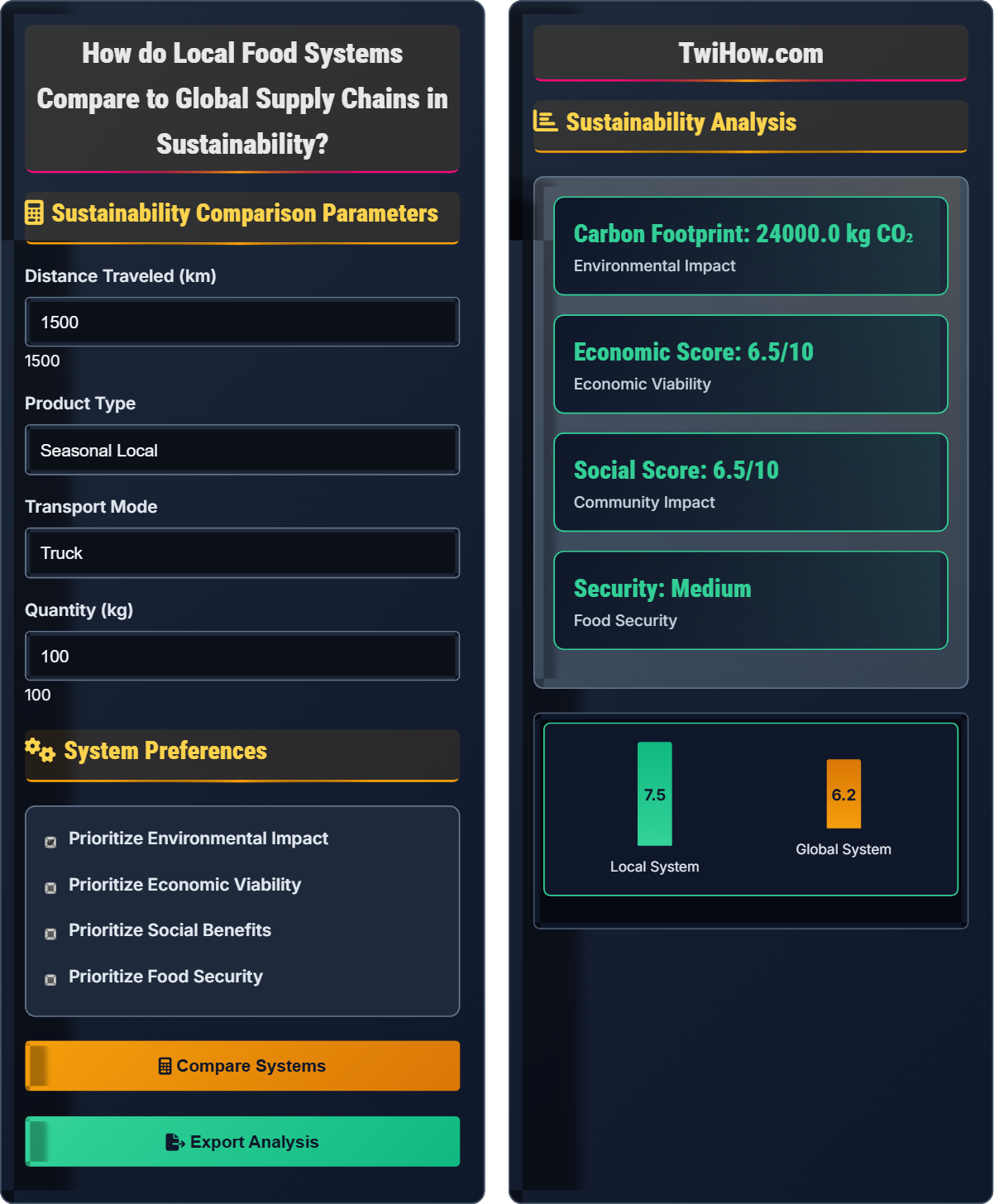
Sustainability Comparison Parameters
System Preferences
Sustainability Analysis
| Factor | Local System | Global System | Comparison |
|---|---|---|---|
| Transport Emissions | Low | High | Local wins |
| Production Efficiency | Medium | High | Global wins |
| Resource Use | Medium | Low | Global wins |
| Seasonality | Optimal | Forced | Local wins |
Local vs Global Food Systems Sustainability
Local and global food systems represent different approaches to food production, distribution, and consumption, each with distinct sustainability profiles. Local food systems emphasize proximity, seasonality, and community connections, while global systems prioritize variety, availability, and economies of scale.
Key characteristics:
- Local Systems: Short supply chains, seasonal production, community focus
- Global Systems: Long supply chains, year-round availability, market efficiency
- Hybrid Approaches: Combining strengths of both systems
- Context Dependency: Optimal choice varies by situation
- Multi-Dimensional: Environmental, economic, social considerations
Overall sustainability can be measured as:
Where each component is normalized on a 0-10 scale. This formula provides a holistic view of system performance across multiple sustainability dimensions.
Where:
- Environmental Impact: Carbon footprint, resource efficiency, biodiversity
- Economic Viability: Cost-effectiveness, local economic development
- Social Benefits: Community connections, food sovereignty
Both systems have distinct economic implications:
- Local Systems: Higher prices, local economic multiplier effect, reduced transportation costs
- Global Systems: Lower prices, market competition, supply chain efficiency
- Price Volatility: Local systems may be more stable, global systems more volatile
- Employment: Local systems create more local jobs, global systems create global jobs
- Investment: Different infrastructure requirements
Modern food systems increasingly adopt hybrid strategies:
- Seasonal Local: Emphasize local production during growing seasons
- Specialty Imports: Import only specialty items not available locally
- Regional Networks: Connect local systems within regions
- Smart Logistics: Optimize global transport routes
- Technology Integration: Use data to optimize both systems
Environmental Impacts
Carbon footprint, food miles, resource efficiency, biodiversity, water usage, soil health, energy consumption.
Carbon Footprint = (Transport Emissions × Distance) + Production Emissions
Resource Efficiency = (Output Quantity / Resource Input) × 100%
- Transportation accounts for 10-15% of total food system emissions
- Production accounts for 80-85% of total emissions
- Local systems are superior for perishable goods
- Global systems may be more efficient for certain products
Economic Considerations
Price competitiveness, local economic development, market access, supply chain efficiency, cost stability.
- Cost per unit analysis
- Economic multiplier effects
- Price volatility assessment
- Market accessibility
- Competitive positioning
- Local systems often have higher prices but stronger local economic impact
- Global systems offer lower prices through economies of scale
- Local economic multiplier is typically 2-3x for local purchases
- Global systems provide more consistent pricing
Local vs Global Food Systems Quiz
Which statement best describes the environmental impact comparison between local and global food systems?
Production emissions typically account for 80-85% of total food system emissions, while transport emissions account for only 10-15%. This means that growing conditions and production methods often have a greater environmental impact than distance traveled. For example, growing tomatoes in heated greenhouses in cold climates may have a higher carbon footprint than importing them from warmer regions.
The answer is C) Production emissions often exceed transport emissions significantly.
The "food miles" concept, while important, is often overemphasized in environmental discussions. The reality is that production methods, energy sources, and growing conditions have a much larger impact on carbon footprints than transportation distances. This challenges simple assumptions about local vs. global systems.
Food Miles: Distance food travels from production to consumption
Carbon Footprint: Total greenhouse gas emissions from product lifecycle
Embodied Energy: Total energy consumed in production and distribution
• Production emissions dominate transport emissions
• Growing conditions matter more than distance
• Energy sources affect environmental impact significantly
• Consider production method over distance
• Evaluate energy sources used
• Look at entire lifecycle impacts
• Assuming shorter distance always means lower emissions
• Ignoring production method differences
• Not considering seasonality effects
Compare the economic impacts of local vs global food systems, including price competitiveness, local economic development, and supply chain efficiency. Explain how the local economic multiplier effect works.
Economic Impacts Comparison:
Local Systems:
• Higher prices due to smaller scale and less automation
• Strong local economic multiplier effect (2-3x)
• More local employment opportunities
• Less efficient supply chains but shorter routes
Global Systems:
• Lower prices through economies of scale
• More efficient logistics and distribution
• Lower local economic impact
• More global employment but less local
Local Economic Multiplier Effect: When money is spent locally, it circulates through the local economy multiple times. For example, a dollar spent at a local farm may go to the farmer, who then spends it at a local store, which then pays local employees, who spend it at other local businesses. Studies show local spending creates 2-3 times more local economic activity than equivalent spending on imported goods.
The economic comparison between local and global systems involves trade-offs between price competitiveness and local economic development. While global systems often offer lower prices, local systems create stronger local economic networks through the multiplier effect, supporting community resilience and economic stability.
Economic Multiplier: Ratio of total local economic impact to initial spending
Economies of Scale: Cost advantages from large-scale production
Local Economic Development: Strengthening local economic networks
• Local spending creates more local economic activity
• Global systems achieve lower prices through scale
• Trade-offs exist between cost and local impact
• Consider total economic impact, not just price
• Evaluate local employment effects
• Assess community economic resilience
• Focusing only on price comparisons
• Ignoring local economic multiplier
• Not considering long-term economic impacts
A region grows tomatoes locally during summer (5 months) but imports them during winter (7 months). Local tomatoes cost $3/kg and have a carbon footprint of 0.8 kg CO₂/kg. Imported tomatoes cost $2/kg and have a carbon footprint of 1.2 kg CO₂/kg. Calculate the annual average cost and carbon footprint per kg of tomatoes. Then calculate how these figures would change if the region imported tomatoes year-round at $2.20/kg with a carbon footprint of 1.1 kg CO₂/kg.
Seasonal Approach (5 months local, 7 months imported):
Local tomatoes: 5 months × 30 days = 150 days
Imported tomatoes: 7 months × 30 days = 210 days
Total days = 360 days
Annual average cost = [(150 × $3) + (210 × $2)] ÷ 360 = ($450 + $420) ÷ 360 = $2.42/kg
Annual average carbon footprint = [(150 × 0.8) + (210 × 1.2)] ÷ 360 = (120 + 252) ÷ 360 = 1.03 kg CO₂/kg
Year-Round Import Approach:
Annual average cost = $2.20/kg (constant)
Annual average carbon footprint = 1.1 kg CO₂/kg (constant)
Comparison: The seasonal approach results in a slightly higher cost ($2.42 vs $2.20) but significantly lower carbon footprint (1.03 vs 1.1 kg CO₂/kg), demonstrating the environmental benefits of seasonal local production.
This example demonstrates that seasonal local production can offer environmental benefits even when it costs slightly more. The key insight is that optimal sustainability often involves strategic combinations of local and global systems based on seasonality and comparative advantages.
Seasonal Production: Aligning production with natural growing seasons
Comparative Advantage: Producing goods where conditions are most favorableHybrid Systems: Combining local and global approaches strategically
• Seasonal production aligns with natural growing conditions
• Comparative advantage affects sustainability outcomes
• Hybrid approaches often optimize multiple goals
A community relies on local food production for 60% of its needs and imports 40% from global supply chains. During a pandemic, local production increases by 20% due to reduced labor costs and increased demand, while global imports decrease by 40% due to supply disruptions. Calculate the new food security composition and analyze the resilience implications. Assume original local production was 1,200 tons and imports were 800 tons.
Original Situation:
Local production: 1,200 tons (60% of total)
Global imports: 800 tons (40% of total)
Total food supply: 2,000 tons
During Pandemic:
Local production increase: 1,200 tons × 1.20 = 1,440 tons
Global import decrease: 800 tons × 0.60 = 480 tons
New total food supply: 1,440 + 480 = 1,920 tons
New Composition:
Local: 1,440 ÷ 1,920 = 75% of total
Global: 480 ÷ 1,920 = 25% of total
Resilience Analysis: The community became more resilient during the crisis because local production could partially compensate for disrupted imports. The local share increased from 60% to 75%, demonstrating that mixed systems provide better resilience than pure local or global approaches.
This example illustrates how diversified food systems provide better resilience during disruptions. Communities with balanced local and global sourcing can adapt more effectively to supply chain shocks, maintaining food security through complementary systems.
Food Security: Reliable access to sufficient, affordable, nutritious food
Resilience: Ability to withstand and recover from disruptions
Supply Chain Shock: Unexpected disruption to normal supply patterns
• Diversified systems provide better resilience
• Local production can adapt during global disruptions
• Balanced approaches optimize security
• Build redundancy into food systems
• Develop local capacity for emergencies
• Maintain diverse supply sources
• Over-relying on single system approaches
• Not planning for supply chain disruptions
• Ignoring resilience benefits of diversification
Which social benefit is most strongly associated with local food systems compared to global supply chains?
Local food systems create direct connections between consumers and producers through farmers' markets, community-supported agriculture (CSA), and farm visits. This builds social capital, trust, and community cohesion. Global systems, while offering variety and standardized safety, create more anonymous transactions between distant parties.
The answer is B) Consumer-producer relationships and community connections.
Social sustainability is often overlooked in food system comparisons. Local systems create opportunities for direct human interaction, community building, and shared values around food. These relationships contribute to social capital and community resilience that global systems cannot replicate.
Social Capital: Networks of relationships that facilitate collective action
Community Connections: Relationships between community members
Trust Building: Development of confidence in relationships
• Local systems foster direct relationships
• Community connections strengthen social fabric
• Social benefits complement environmental and economic factors
• Participate in local food systems to experience benefits
• Support community food initiatives
• Value social connections in food choices
• Focusing only on environmental and economic factors
• Undervaluing social sustainability
• Not considering community impact
FAQ
Q: Should I always buy local food to be more sustainable?
A: Not necessarily. Sustainability depends on multiple factors:
Buy Local When: Perishable items, seasonal produce, supporting local economy, shorter transport distances
Consider Imports When: Non-seasonal items, products unsuitable for local climate, specialty items, when production emissions are lower elsewhere
Best Approach: A balanced strategy focusing on local seasonal produce while selectively importing items that cannot be produced locally or where global production is more efficient environmentally.
The key is understanding that sustainability involves environmental, economic, and social considerations, not just distance traveled.
Q: How can local farmers compete with global food systems economically?
A: Local farmers can compete through:
Value Differentiation: Emphasize freshness, quality, taste, and story behind products
Direct Marketing: Sell directly to consumers through farmers' markets, CSAs, and online platforms
Community Engagement: Build relationships and loyalty through farm visits and events
Specialty Products: Focus on unique, heritage, or organic varieties
Cooperative Marketing: Join forces with other local producers
Niche Markets: Target consumers willing to pay premium for local, sustainable products
While price competition is challenging, local farmers can succeed by emphasizing unique value propositions that global systems cannot provide.