Trade Policies and Tariffs Impact on Food Availability and Prices
Complete trade guide • Food economics
Trade Policy Impact:
Analyze Trade ImpactTrade policies and tariffs significantly influence food availability and prices by affecting the flow of agricultural products across borders. These policies can either facilitate or restrict international food trade, impacting both importing and exporting countries. Understanding these effects is crucial for policymakers, businesses, and consumers.
Key trade policy mechanisms include:
- Tariffs: Taxes on imported goods that increase consumer prices
- Import Quotas: Limits on quantities of goods that can be imported
- Export Restrictions: Limits on goods leaving a country
- Subsidies: Government support that affects international competitiveness
- Trade Agreements: Multilateral or bilateral deals that reduce barriers
These policies can have immediate effects on food prices and long-term impacts on food security and agricultural development.
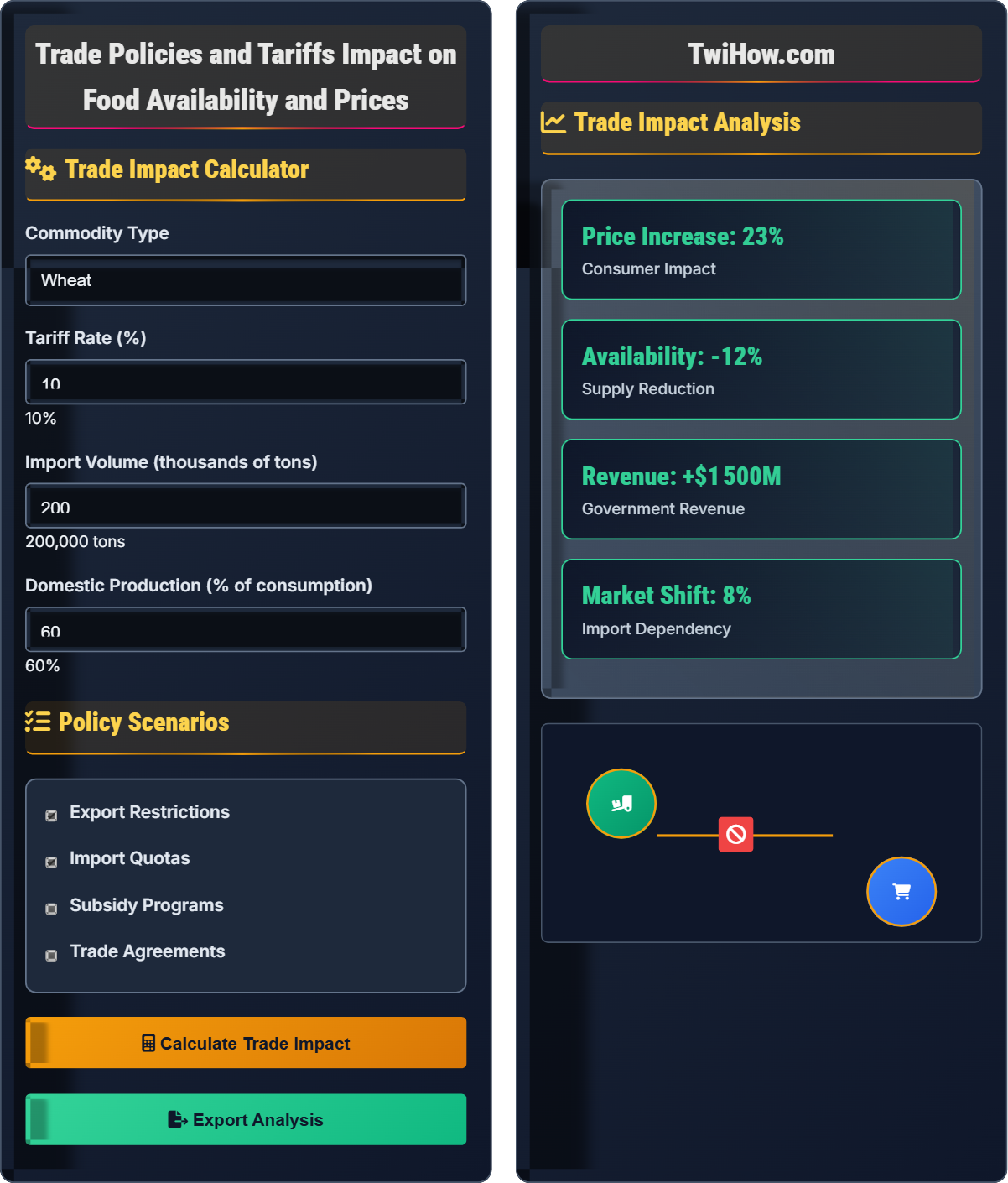
Trade Impact Calculator
Policy Scenarios
Trade Impact Analysis
Tariff Impact Analysis
Tariffs directly increase the cost of imported goods by adding taxes to the base price. This leads to higher consumer prices and reduced purchasing power for consumers who rely on imported products.
Tariffs make imported goods less competitive compared to domestic alternatives, potentially benefiting local producers but increasing costs for consumers.
Tariffs generate revenue for governments, which can be used for various public purposes including agricultural support programs.
Tariffs can disrupt established supply chains and force consumers to seek alternative suppliers, potentially affecting food security.
Trade Policy Effects
Quantity restrictions can create artificial scarcity, leading to higher prices and potential shortages when demand exceeds quota limits.
Export bans or restrictions can reduce global supply, affecting international prices and potentially harming importing countries.
Government support can make domestic products artificially cheap, distorting international markets and affecting competitor countries.
Free trade agreements can reduce barriers and increase availability while potentially affecting domestic producers.
Availability Impact Analysis
Trade barriers can reduce the available supply of certain products, particularly when countries rely heavily on imports for specific commodities.
Barriers force importers to seek alternative suppliers, which can lead to market diversification but also supply chain disruptions.
Trade restrictions can affect seasonal food availability, particularly for perishable goods that have specific growing seasons.
Reduced import competition may affect the quality and variety of available products in the domestic market.
Trade Policies and Food Markets
Trade policies are government measures that regulate international commerce, including tariffs (taxes on imports), quotas (limits on import quantities), subsidies (government support), and trade agreements. These policies affect food availability and prices by influencing the flow of agricultural products across borders, affecting both supply and demand dynamics in global markets.
This process shows how trade policies flow through markets to affect consumers and producers.
Different trade policies have varying effects on food markets:
- Tariffs: Increase consumer prices, generate government revenue
- Import Quotas: Create artificial scarcity, benefit domestic producers
- Export Restrictions: Reduce global supply, affect international prices
- Subsidies: Distort competition, affect global prices
- Trade Agreements: Reduce barriers, increase availability
- Supply and Demand: Trade policies shift supply curves and affect equilibrium prices
- Comparative Advantage: Countries specialize in products they produce efficiently
- Consumer Surplus: Trade barriers reduce consumer benefits
- Producer Surplus: Domestic producers may benefit from protection
- Deadweight Loss: Trade barriers create economic inefficiencies
Tariff Impact Mechanisms
Price effects, availability changes, revenue generation, market distortions, competitive shifts, supply chain disruptions.
Consumer Price = (Import Price × (1 + Tariff Rate)) + Transaction Costs
Where Consumer Price = final price paid by consumers, Import Price = international market price.
- Tariffs always increase consumer prices
- Higher tariffs create larger effects
- Import-dependent countries see bigger impacts
- Perishable goods are more sensitive to trade disruptions
Policy Considerations
Food security, domestic producer support, government revenue, international relations, trade balances, consumer welfare.
- Identify policy objectives
- Assess market structure
- Estimate economic impacts
- Consider distributional effects
- Plan for unintended consequences
- Trade-offs between objectives
- Impact on vulnerable populations
- International retaliation risks
- Long-term vs. short-term effects
Tariff Impact Analysis
Tariffs directly increase the cost of imported goods by adding taxes to the base price. For example, a 10% tariff on wheat worth $200 per ton would increase the consumer price to $220 per ton. This effect is immediate and proportional to the tariff rate.
Tariffs make imported goods less competitive compared to domestic alternatives. This can benefit local producers by reducing competition, but consumers face higher prices and potentially reduced quality or variety.
Tariffs generate revenue for governments, which can be used for various public purposes including agricultural support programs, infrastructure development, or social programs.
Tariffs can create market distortions by artificially supporting inefficient domestic producers and reducing the benefits of international trade specialization.
Trade Policy Effects
Quantity restrictions can create artificial scarcity, leading to higher prices and potential shortages when demand exceeds quota limits. Quotas may benefit domestic producers but can harm consumers and importers.
Export bans or restrictions can reduce global supply, affecting international prices and potentially harming importing countries. These measures may be implemented during domestic shortages but can have global consequences.
Government support can make domestic products artificially cheap, distorting international markets and affecting competitor countries. Subsidies can lead to overproduction and dumping in international markets.
Free trade agreements can reduce barriers and increase availability while potentially affecting domestic producers. These agreements often create winners and losers in different sectors.
Food Availability Effects
Trade barriers can reduce the available supply of certain products, particularly when countries rely heavily on imports for specific commodities. This can lead to shortages and higher prices.
Barriers force importers to seek alternative suppliers, which can lead to market diversification but also supply chain disruptions and potentially higher costs.
Trade restrictions can affect seasonal food availability, particularly for perishable goods that have specific growing seasons. This can limit year-round access to certain products.
Reduced import competition may affect the quality and variety of available products in the domestic market, potentially limiting consumer choices.
Trade Policy Comparison
| Policy Type | Tariffs | Free Trade |
|---|---|---|
| Consumer Prices | Higher | Lower |
| Domestic Production | Protected | Competition |
| Government Revenue | Generated | None |
| Consumer Choice | Limited | Expanded |
| International Relations | Potential Tension | Improved |
| Economic Efficiency | Reduced | Improved |
Historical Trade Policy Timeline
Economic Impact Analysis
Trade policies create complex economic effects that redistribute benefits and costs across different groups in society.
Trade Policy and Food Impact Quiz
What is the direct effect of imposing a 20% tariff on imported wheat?
A 20% tariff directly increases the cost of imported wheat by 20%. This additional cost is typically passed on to consumers, resulting in higher prices. Tariffs are taxes on imports that increase the final consumer price, though the exact percentage may vary depending on market conditions and elasticity.
The answer is B) Consumer prices increase by 20%.
Tariffs are taxes added to the base price of imported goods. When a government imposes a tariff, importers must pay this additional tax, which increases their costs. To maintain profitability, importers typically pass these costs to consumers through higher prices.
Tariff: Tax on imported goods
Consumer Price: Final price paid by consumers
Import Duty: Tax on goods entering a country
• Tariffs increase consumer prices
• Price increases depend on market elasticity
• Consider who pays the tax
• Think about market power
• Remember supply and demand
• Assuming tariffs benefit consumers
• Not considering market dynamics
• Forgetting about tax incidence
Explain how trade wars affect food availability and prices in both participating and third-party countries.
Direct Effects: Participating countries impose tariffs on each other's agricultural products, increasing prices for consumers and reducing availability of certain goods.
Indirect Effects: Countries may redirect trade to alternative partners, affecting global supply and demand patterns.
Third-Party Effects: Neutral countries may benefit from redirected trade but also face global price volatility and supply chain disruptions.
Long-term Effects: Trade wars can lead to permanent changes in global supply chains, affecting food security and agricultural development patterns.
Trade wars create complex ripple effects throughout the global food system. The interconnected nature of international trade means that policies affecting one country can have far-reaching consequences for food availability and prices worldwide.
Trade War: Reciprocal trade restrictions
Ripple Effect: Secondary impacts of trade policies
Supply Chain: Network of food production and distribution
• Global markets are interconnected
• Policies have spillover effects
• Supply chains are complex
• Consider global market linkages
• Think about supply chain effects
• Evaluate both direct and indirect impacts
• Only considering direct effects
• Not evaluating spillover impacts
• Ignoring supply chain complexity
A country imports 500,000 tons of rice annually at $400 per ton. If the government imposes a 25% tariff on rice imports, calculate the new consumer price, government revenue from tariffs, and the total additional cost to consumers.
New Consumer Price: $400 × (1 + 0.25) = $500 per ton
Government Revenue: 500,000 tons × ($500 - $400) = $50 million
Total Additional Cost to Consumers: 500,000 tons × $100 = $50 million
Impact: Consumers pay 25% more for rice, government collects $50 million in revenue, but overall economic welfare decreases due to reduced efficiency.
This calculation demonstrates the direct transfer of wealth from consumers to the government through tariffs. While the government gains revenue, consumers bear the cost through higher prices, illustrating the redistributive nature of trade policies.
Government Revenue: Money collected from tariffs
Consumer Burden: Additional cost paid by consumersPrice Transfer: Wealth redistribution effect
• Tariff revenue = volume × tariff amount
• Consumer cost = volume × price increase
• Total welfare decreases due to deadweight loss
• Calculate both revenue and cost
• Consider welfare effects
• Think about market efficiency
• Only calculating government revenue
• Not considering consumer burden
• Ignoring efficiency losses
You are designing a trade policy to protect domestic rice farmers while minimizing harm to consumers. The country imports 30% of its rice consumption and domestic production is insufficient to meet demand. Propose a balanced approach that considers both farmer and consumer interests.
Gradual Implementation: Phase in tariffs gradually over 3-5 years to allow market adjustment and consumer adaptation.
Targeted Support: Provide direct subsidies to farmers rather than trade barriers to avoid consumer harm.
Investment in Production: Invest in agricultural research and infrastructure to increase domestic production capacity.
Temporary Measures: Implement tariffs as temporary measures while building long-term domestic capacity.
Consumer Compensation: Use tariff revenue to provide food assistance to low-income consumers.
Trade Diversification: Develop relationships with multiple suppliers to reduce dependency on any single source.
Effective trade policy requires balancing multiple objectives. The key is finding solutions that support domestic producers without unduly harming consumers. This often involves combining multiple policy tools and considering both short-term and long-term effects.
Policy Balance: Balancing competing interests
Gradual Implementation: Phased policy changes
Targeted Support: Direct assistance to producers
• Balance competing interests
• Consider long-term effects
• Use multiple policy tools
• Combine different approaches
• Consider transition periods
• Use revenue for compensation
• Focusing on single objectives
• Not considering consumer effects
• Ignoring long-term consequences
What is the most likely effect of a major rice-exporting country imposing export restrictions during a domestic shortage?
Export restrictions reduce the global supply of rice, creating scarcity in international markets. This leads to higher global rice prices as importing countries compete for limited supplies. The policy may benefit the domestic market by increasing local availability but harms global food security.
The answer is B) Global rice prices increase.
Export restrictions affect global supply-demand balance. When major exporters limit exports, the reduced global supply drives up international prices. This demonstrates how national policies can have significant international consequences, particularly for food security.
Export Restrictions: Limits on goods leaving a country
Global Supply: Total international availability
Price Elasticity: Responsiveness of prices to supply changes
• Reduced supply increases prices
• Major exporters have global influence
• National policies affect international markets
• Consider supply-demand relationships
• Think about market size
• Evaluate global impact
• Not considering global market effects
• Assuming national policies are isolated
• Ignoring supply-demand dynamics
FAQ
Q: What are the most effective trade policies for ensuring food security?
A: The most effective policies include: 1) Maintaining diverse import sources to reduce dependency, 2) Strategic food reserves for emergency situations, 3) Investment in domestic production capacity, 4) Transparent and predictable trade policies, 5) International cooperation agreements, and 6) Flexible response mechanisms for crisis situations. The key is balancing domestic production with international trade to ensure both availability and affordability.
Q: How do trade policies affect the food I buy at the grocery store?
A: Trade policies affect your grocery bills through: 1) Direct price increases from tariffs on imported goods, 2) Reduced availability of certain products when import restrictions are imposed, 3) Changes in quality and variety as supply chains adjust, 4) Seasonal availability disruptions when trade flows are altered, and 5) Indirect effects through global price volatility. The impact varies by product type and the country's trade relationships.