Vertical Farms and Controlled Environment Agriculture
Complete CEA guide • Indoor farming
Controlled Environment Agriculture:
Calculate Farm EfficiencyVertical farms and controlled environment agriculture (CEA) represent innovative approaches to food production that use technology to optimize growing conditions year-round. These systems grow crops in enclosed environments with precisely controlled temperature, humidity, lighting, and nutrient delivery, enabling efficient food production in urban areas and regions with challenging climates.
Key components include:
- Hydroponic/Aeroponic Systems: Soilless growing methods using nutrient solutions
- LED Lighting: Programmable lights that provide optimal spectrum for plant growth
- Climate Control: Systems that regulate temperature, humidity, and air circulation
- Automation: Sensors and robotics for monitoring and maintenance
- Space Optimization: Multi-level growing systems that maximize production per square foot
These technologies offer potential solutions to food security challenges while reducing environmental impacts.
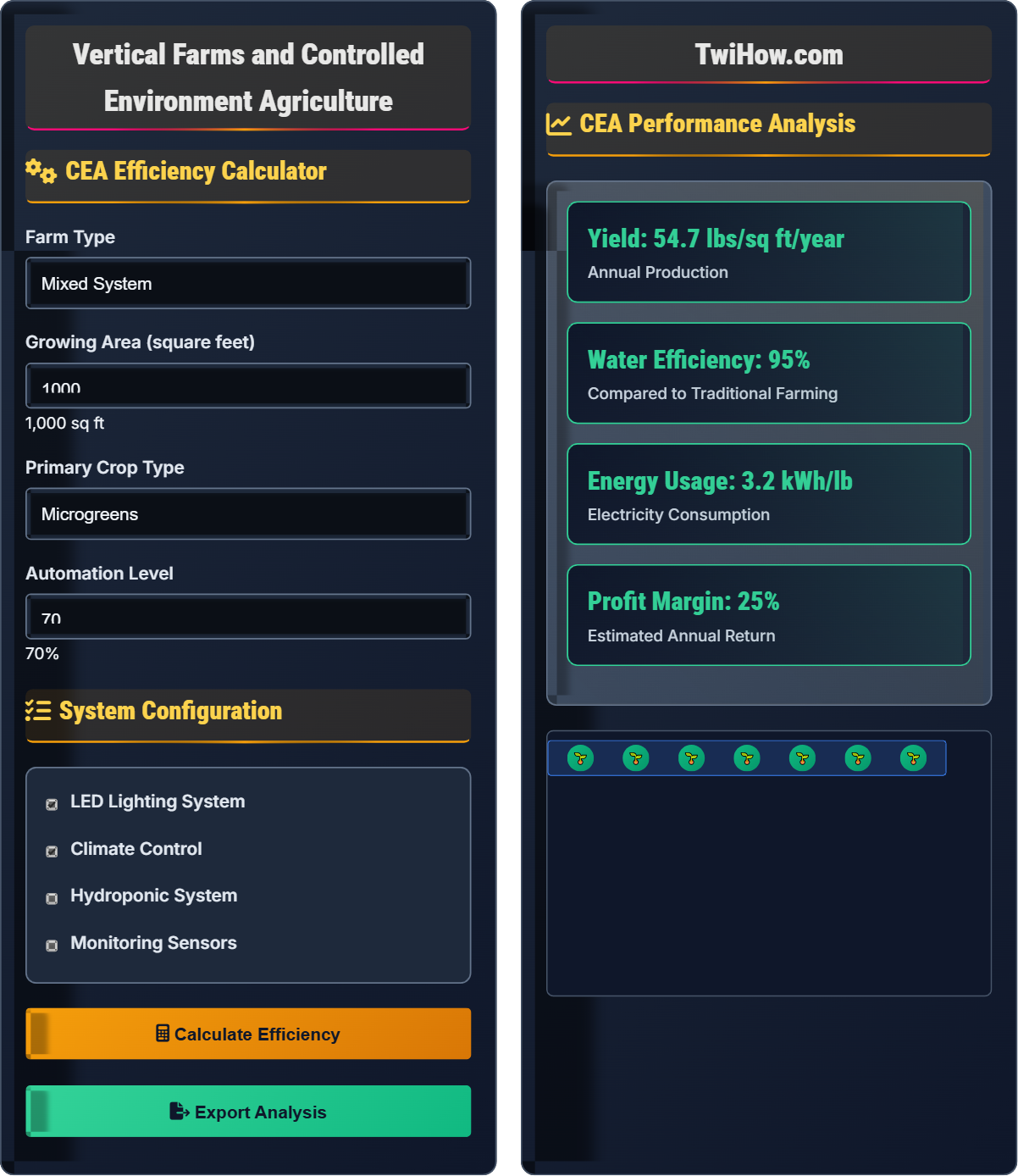
CEA Efficiency Calculator
System Configuration
CEA Performance Analysis
Controlled Environment Components
Programmable LED lights provide optimal light spectrum for photosynthesis. Energy-efficient compared to traditional grow lights, with customizable photoperiods and intensity levels.
Regulates temperature, humidity, and air circulation to create optimal growing conditions. Includes HVAC systems, dehumidifiers, and air filtration.
Automated systems that deliver precise nutrient solutions to plants through hydroponic or aeroponic methods, ensuring optimal nutrition.
Sensors and controllers that monitor pH, EC, temperature, and humidity. Automated systems adjust conditions based on plant needs and growth stages.
Growth Process Flow
Each stage is precisely controlled for optimal growth, with environmental conditions adjusted based on plant development phases.
Efficiency Metrics
Controlled Environment Agriculture Explained
Controlled Environment Agriculture (CEA) is the practice of growing crops in enclosed environments where environmental conditions are artificially controlled. This includes temperature, humidity, light, carbon dioxide levels, and nutrient delivery, allowing for year-round production independent of external weather conditions.
These components work together to create optimal growing conditions for maximum plant productivity.
Different cultivation techniques used in CEA:
- Hydroponics: Plants grown in nutrient-rich water solutions
- Aeroponics: Roots suspended in air and misted with nutrients
- Hydroponics: Plants grown in inert growing media
- Aeroponics: Roots suspended in air and misted with nutrients
- Vertical Stacking: Multi-level growing systems that maximize space
- LED Lighting: Programmable lights with adjustable spectrums
- Climate Control: HVAC systems for temperature and humidity
- Automation: Sensors and robotics for monitoring
- Data Analytics: AI-driven optimization systems
- Water Recycling: Closed-loop irrigation systems
CEA System Components
LED lighting, climate control, nutrient delivery, monitoring systems, automation, growing medium, water management.
Optimal Yield = (Light Intensity × Nutrient Concentration × Climate Control) ÷ (Energy Cost + Maintenance)
Where Yield = production output, Light = photon flux density.
- All components must work in harmony
- Environmental conditions must be precisely controlled
- Energy efficiency is crucial for viability
- Automation reduces labor costs significantly
Benefits and Challenges
Year-round production, water efficiency, pest control, space optimization vs. high capital costs, energy consumption, technical expertise.
- Quantify resource efficiency gains
- Calculate yield improvements
- Assess environmental impacts
- Estimate economic returns
- Consider scalability factors
- Location affects energy costs
- Technology rapidly evolving
- Skilled labor requirements
- Market access crucial
CEA System Components
LED grow lights provide customizable light spectrums optimized for different growth stages. Modern systems use 60-80% less energy than traditional grow lights while delivering superior light quality for photosynthesis.
HVAC systems maintain optimal temperature and humidity levels. Advanced systems include air circulation, dehumidification, and CO2 enrichment for enhanced photosynthesis.
Automated hydroponic or aeroponic systems deliver precise nutrient solutions to plants. These systems recycle water and nutrients, achieving 90-95% water efficiency compared to traditional farming.
Sensors monitor pH, electrical conductivity, temperature, and humidity. Automated systems adjust conditions in real-time, reducing labor requirements and optimizing plant growth.
CEA vs Traditional Agriculture
| Factor | CEA | Traditional |
|---|---|---|
| Water Usage | 95% less | 100% baseline |
| Land Use | 90% less per lb | 100% baseline |
| Yield per sq ft | 10-15x higher | 1x baseline |
| Growing Seasons | 365 days/year | 1-2 seasons |
| Pesticide Use | 0% (typically) | Variable |
| Energy Use | Higher | Solar powered |
Development Timeline
Cost-Benefit Analysis
Most successful CEA operations focus on high-value crops like leafy greens, herbs, and microgreens to achieve positive returns.
CEA and Vertical Farming Quiz
Which growing method is most commonly used in commercial vertical farms?
Hydroponics is the most commonly used growing method in commercial vertical farms. It involves growing plants in nutrient-rich water solutions without soil. This method is favored because it's reliable, scalable, and allows for precise control of nutrient delivery. While aeroponics and aquaponics are also used, hydroponics offers the best balance of efficiency, cost-effectiveness, and reliability for commercial operations.
The answer is B) Hydroponics.
Hydroponics is the dominant method in commercial CEA because it provides consistent results and is easier to scale than other methods. The growing medium is typically rockwool, perlite, or coconut coir, which provides structural support while allowing roots to access nutrient solutions. This method enables precise control over plant nutrition and rapid growth.
Hydroponics: Growing plants in water-based nutrient solutions
Aeroponics: Growing plants with roots suspended in air and misted with nutrients
Hydroponics: Growing plants in nutrient solutions
• Water efficiency is crucial in CEA
• Nutrient control affects plant quality
• Growing method affects scalability
• Hydroponics offers the best reliability
• Consider automation for scalability
• Monitor pH and EC levels constantly
• Assuming all soilless methods are equally viable
• Not considering scalability requirements
• Overlooking maintenance needs
Explain how LED lighting systems in vertical farms contribute to energy efficiency and plant growth optimization.
Energy Efficiency: LED grow lights consume 60-80% less electricity than traditional high-pressure sodium (HPS) or metal halide lamps. They produce less heat, reducing cooling requirements and associated energy costs.
Spectral Control: LEDs can be tuned to emit specific wavelengths of light that plants need most for photosynthesis. Blue light (400-500nm) promotes vegetative growth, while red light (600-700nm) encourages flowering and fruiting.
Photoperiod Control: LED systems can be programmed to provide optimal day/night cycles for specific crops, accelerating growth and improving yields.
Longevity: LED fixtures last 50,000+ hours, reducing replacement costs and maintenance.
This combination of energy efficiency and growth optimization makes LEDs essential for economically viable vertical farming operations.
Plants use specific wavelengths of light for photosynthesis, primarily in the blue and red spectrums. Traditional grow lights emit light across the entire spectrum, wasting energy on wavelengths plants don't use efficiently. LEDs can be engineered to emit only the wavelengths plants need, dramatically improving energy efficiency while optimizing growth.
Photoperiod: The duration of light exposure for plants
Spectral Tuning: Adjusting light wavelengths for specific purposes
Photon Flux Density: Amount of light photons reaching plants
• Match light spectrum to growth stage
• Control photoperiod for growth optimization
• Monitor light intensity regularly
• Use full-spectrum LEDs for versatility
• Adjust intensity based on plant height
• Implement dimming for energy savings
• Using inappropriate light spectrum for crops
• Not adjusting for plant growth stages
• Over-lighting plants causing stress
You are designing a vertical farm to produce leafy greens in a 10,000 sq ft facility. The farm will have 10 growing levels, each 8 feet apart. Calculate the total growing area, estimated annual yield, and break-even time given that leafy greens yield 20 lbs/sq ft/year and sell for $4/lb, with operating costs of $15/sq ft/year and initial investment of $750,000.
Total Growing Area: 10,000 sq ft floor space × 10 levels = 100,000 sq ft of growing area
Annual Yield: 100,000 sq ft × 20 lbs/sq ft = 2,000,000 lbs per year
Annual Revenue: 2,000,000 lbs × $4/lb = $8,000,000
Annual Operating Costs: 100,000 sq ft × $15/sq ft = $1,500,000
Annual Profit: $8,000,000 - $1,500,000 = $6,500,000
Break-even Time: $750,000 ÷ $6,500,000 = 0.115 years ≈ 1.4 months
This simplified calculation shows the potential profitability of well-designed vertical farms, though actual operations have additional costs and considerations.
This example demonstrates the space efficiency of vertical farming. By stacking growing levels, a 10,000 sq ft facility effectively provides 100,000 sq ft of growing space. The key advantage is the ability to produce significantly more food per unit of ground area compared to traditional farming.
Space Efficiency: Production per unit of area
Yield per Square Foot: Amount produced in given area
Break-even Analysis: Time to recover investment
• Calculate total growing area including all levels
• Consider all operating expenses
• Account for equipment depreciation
• Factor in equipment maintenance costs
• Consider market demand for products
• Plan for operational downtime
• Not accounting for all operational costs
• Overestimating yield potential
• Ignoring market competition
You are managing a vertical farm where lettuce is growing in a controlled environment. The optimal growing conditions are 65°F, 70% humidity, and 12 hours of light daily. If the temperature rises to 75°F and humidity drops to 50%, what immediate actions should you take and what long-term strategies should you implement?
Immediate Actions:
1. Activate cooling systems to reduce temperature back to 65°F
2. Increase humidity through misting or humidification systems
3. Check and adjust ventilation to ensure proper air circulation
4. Monitor plant stress indicators for any signs of heat or water stress
Long-term Strategies:
1. Install redundant climate control systems for reliability
2. Implement predictive climate control using AI to anticipate changes
3. Upgrade insulation and sealing to maintain stable conditions
4. Install backup power systems to prevent climate control failures
5. Establish monitoring protocols with alerts for deviations
Climate control is critical in CEA because plants are grown in an artificial environment without natural buffers. Even small deviations from optimal conditions can significantly impact growth, quality, and yield. The controlled environment must be monitored constantly and adjusted immediately when conditions deviate.
Optimal Growing Conditions: Environmental parameters for maximum growth
Climate Control: Systems that regulate temperature and humidity
Plant Stress Indicators: Signs of environmental distress
• Monitor continuously
• Respond immediately to deviations
• Have backup systems ready
• Set up automated alerts
• Maintain detailed logs
• Train staff on emergency procedures
• Not responding quickly enough to deviations
• Failing to have backup systems
• Ignoring early warning signs
What is the primary environmental advantage of vertical farming compared to traditional agriculture?
While vertical farming has multiple environmental advantages, reduced water usage is the most significant. CEA systems typically use 90-95% less water than traditional farming through closed-loop irrigation systems that recirculate water and nutrients. This dramatic reduction in water consumption is crucial in water-scarce regions and represents the largest environmental benefit of vertical farming.
The answer is B) Reduced water usage.
Water scarcity is becoming a critical global issue, making water efficiency a crucial factor in sustainable agriculture. While vertical farming does consume more energy than traditional farming, the water savings are so significant that it represents the primary environmental advantage. The closed-loop systems in CEA prevent water loss through evaporation, runoff, and deep percolation that occurs in traditional agriculture.
Water Efficiency: Amount of crop produced per unit of water
Closed-loop System: Recycling system that minimizes waste
Water Scarcity: Insufficient freshwater availability
• Water efficiency is a key sustainability metric
• Closed-loop systems maximize resource use
• Consider regional water availability
• Monitor water quality continuously
• Recycle nutrient solutions
• Implement water-saving technologies
• Overlooking water savings benefits
• Not considering regional water stress
• Focusing only on energy costs
FAQ
Q: Is vertical farming economically viable compared to traditional farming?
A: Vertical farming can be economically viable, particularly for high-value crops like leafy greens, herbs, and microgreens. While initial capital costs are high ($50-100 per square foot), the high yields (10-15x traditional farming) and year-round production can justify the investment. Most successful operations focus on premium markets in urban areas where transportation and freshness premiums apply.
Q: What are the main challenges facing the vertical farming industry?
A: The main challenges include high energy costs (especially for lighting), significant upfront capital requirements, technical complexity requiring skilled operators, and competition with traditional agriculture for commodity crops. However, the industry is rapidly evolving with improved technologies, energy-efficient LEDs, and automation reducing operational costs.